

TL;DR:
- Walkie talkie games encourage social skills, physical activity, and independence for children of various ages. Proper planning, including safety and device preparation, enhances outdoor play and keeps children engaged. These activities foster teamwork and creativity while transforming open spaces into exciting adventure zones.
Getting kids off screens and into the garden is a battle most parents know well. Walkie talkie games for kids solve that problem in a way few other activities can. They combine real communication, physical movement, and imaginative play in one simple device. Walkie talkies encourage social skills, teamwork, and physical activity when woven thoughtfully into children’s routines. Better still, they give your child a taste of independence without handing over a smartphone. The eight games in this article work across ages, group sizes, and spaces, from a compact back garden to a sprawling park.
Table of Contents
- Key takeaways
- Choosing the best walkie talkie games for kids
- 1. Capture the flag (walkie talkie edition)
- 2. Walkie talkie hide and seek
- 3. Walkie talkie treasure hunt
- 4. Relay race with radio handoffs
- 5. Mission impossible role play
- 6. Hot and cold location game
- 7. Coded message relay
- 8. Nighttime garden patrol
- Comparing the games at a glance
- Matching the right game to your child and setting
- My honest take on outdoor tech play
- Explore more with Thezoofamily
- FAQ
Key takeaways
| Point | Details |
|---|---|
| Games suit multiple ages | Choose games based on your child’s communication ability and physical confidence, not just their age. |
| Safety rules come first | Set channel rules and location boundaries before play begins to keep every session secure. |
| Battery prep prevents disruptions | Charge devices fully before heading out; most kids’ models offer 3 to 5 hours of active use. |
| Teamwork is the real reward | Every game on this list builds listening, cooperation, and verbal expression alongside physical activity. |
| Variation keeps interest alive | Small rule tweaks and new locations are enough to make familiar games feel fresh each time. |
Choosing the best walkie talkie games for kids
Before you pick a game, it helps to think about what makes a walkie talkie activity actually work for your group. The games that land best share a few common traits.
Age appropriateness matters more than you think. A game that requires players to give precise map coordinates works brilliantly for a ten-year-old but will frustrate a six-year-old in under three minutes. Younger children need simple, one-step instructions over the radio. Older children can handle multi-stage missions and coded messages.
Consider the device itself. Kids’ walkie talkies typically offer 3 to 5 hours of active use and communicate across 100 to 400 metres depending on the environment. That range shapes which games are possible. A hide-and-seek game in a large park is very different from one in a small back garden. Family Radio Service devices are suited to short-range outdoor play in areas where phone signal is unreliable, which makes them a sound choice for camping trips and woodland adventures.
Here is what to weigh up before choosing your game:
- Teamwork focus. The best games give each child a clear role so nobody stands idle.
- Physical activity level. Mix running-heavy games with calmer ones to suit different energy levels and mixed-age groups.
- Safety ground rules. Setting clear rules about not sharing locations with strangers and knowing what to do if an unknown voice appears on the channel is something to do before play starts, not during.
- Battery and channel prep. Understanding device operation beforehand reduces interruptions mid-game and keeps everyone safe.
Pro Tip: Assign each team a dedicated channel before the game begins. It prevents crosstalk and adds an authentic, mission-style atmosphere children love.
1. Capture the flag (walkie talkie edition)
This classic outdoor game becomes something else entirely when every team member carries a radio. Divide children into two teams, each guarding a flag at opposite ends of your play area. Players use their devices to pass real-time intelligence: “They’re coming from the left side, two of them!” The instant communication without apps or notifications is exactly what fast-moving team games need.
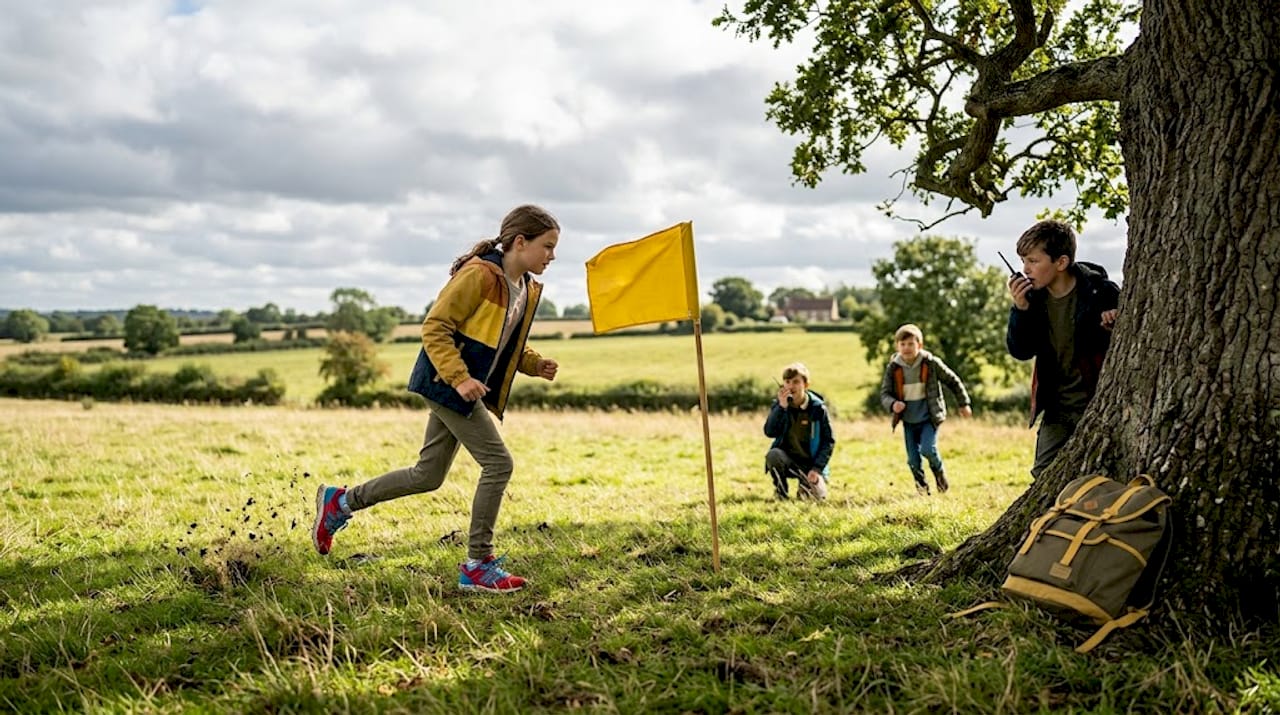
Strategy deepens quickly. Children start assigning roles spontaneously: a scout, a defender, a runner. That kind of organic leadership is genuinely hard to manufacture in structured activities.
2. Walkie talkie hide and seek
Standard hide and seek gets a clever twist. The seeker keeps the walkie talkie, and the hiders must respond with a one-word clue every 60 seconds. Clues can describe what they can see, a sound nearby, or a colour in their surroundings. The seeker has to piece the clues together like a puzzle.
This version works brilliantly for mixed ages because younger children can participate as hiders without needing to run fast. It sharpens listening skills and verbal clarity in a very natural way.
3. Walkie talkie treasure hunt
A walkie talkie treasure hunt is the most versatile game on this list. One player acts as “mission control” and guides the searchers using directional clues delivered over the radio. The searchers cannot see the clues written down. They rely entirely on what they hear.
Pro Tip: Write a simple script of ten clues for mission control before the game. It keeps the pace up and prevents long silences that lose younger children’s attention.
You can scale the difficulty by adjusting how specific the clues are, making this suitable for children aged five right up to twelve. For larger groups, split searchers into two competing teams on separate channels.
4. Relay race with radio handoffs
Set up a short running course and divide children into relay teams. The twist is that no runner starts until the previous runner has radioed in a code word to confirm they have completed their leg. The next runner must acknowledge the code before setting off.
This game is brilliant for teaching fast, reliable communication in active play. Children quickly learn to speak clearly and listen carefully because the race depends on it. It also works as a fun exercise for kids that naturally integrates communication skills without feeling like a lesson.
5. Mission impossible role play
Give every child a character: a spy, a field agent, a tech expert back at base. Build a simple story together, then let it play out in real time. The base operator uses the walkie talkie to feed information, warn about “dangers,” and guide the field agents through challenges you set up in the garden or park.
Some walkie talkie models include voice-changing effects that amplify the drama considerably. Video transmission features in some devices can add another layer of fun for older children. This is one of the richest creative games with walkie talkies available because children co-author the story as they play.
6. Hot and cold location game
One child hides an object somewhere in the play area and then guides the others to it using only “warmer” and “colder” over the radio. The catch is that the hider cannot look out of a window or follow the searchers. They must rely on a rough mental map of the space.
This game works in any environment and needs zero preparation. It is particularly good for younger children because the rules are simple and the feedback is immediate. It also builds spatial awareness in a genuinely playful way.
7. Coded message relay
Create a simple substitution code together before the game, where each number represents a letter. One team transmits a short coded message over the radio, and the other team has a set time to decode it. Then they send one back.
This walkie talkie communication game develops patience, concentration, and teamwork in equal measure. It works best for children aged eight and over and pairs well with a physical challenge: if you decode the message correctly, you earn a clue to a hidden prize.
8. Nighttime garden patrol
This one is for older children and requires a torch. Split the group into two teams: patrollers who walk a set route around the garden, and base operators who stay in one spot. Patrollers radio in updates, report what they observe, and take instructions from base.
The low-light environment heightens every sense and makes communication feel genuinely important. Walkie talkies are more durable than smartphones for this kind of rough outdoor play because there is no fragile screen to worry about in the dark.
Comparing the games at a glance
| Game | Best age | Group size | Activity level | Key skill |
|---|---|---|---|---|
| Capture the flag | 7 and up | 6 to 12 | High | Teamwork, strategy |
| Walkie talkie hide and seek | 5 and up | 3 to 8 | Low to medium | Listening, verbal clarity |
| Treasure hunt | 5 to 12 | 2 to 10 | Medium | Communication, problem solving |
| Relay race with radio | 6 and up | 4 to 12 | High | Speed, coordination |
| Mission impossible role play | 7 and up | 3 to 6 | Medium | Imagination, cooperation |
| Hot and cold location | 4 and up | 2 to 6 | Low | Spatial awareness |
| Coded message relay | 8 and up | 4 to 8 | Low | Concentration, patience |
| Nighttime garden patrol | 9 and up | 4 to 8 | Medium | Observation, communication |
Matching the right game to your child and setting
The comparison table above gives you a starting point. But choosing the right activity also depends on factors that no table can fully capture.
Think about where you are playing. A large open park suits high-activity games like capture the flag and relay races. A back garden is better for hide and seek, hot and cold, or role-play missions. Woodland works brilliantly for treasure hunts where natural landmarks become part of the clues.
Consider the group dynamic too. Mixed ages work best with games where roles vary in difficulty, like the treasure hunt or the mission role play. Peer groups of similar ages can handle more competitive formats. Walkie talkies enable safe outdoor play without the distractions of smartphones, which means even a small group playing in the garden benefits from having a device each.
A few practical considerations worth keeping in mind:
- Younger children (under 7): Keep instructions to one step at a time. Use the hot and cold game or simple hide and seek before moving to anything with coded messages.
- Adverse weather: Most outdoor activities work in light rain, but you should check your device’s water resistance rating beforehand. Keep spare batteries in a dry bag.
- Sustaining repeat play: Change one rule each time you play a familiar game. A new code, a different hiding area, or a time challenge is enough to reset children’s enthusiasm completely.
Understanding how walkie talkies work before you hand them over also helps children use them confidently from the first session.
My honest take on outdoor tech play
I’ve watched walkie talkie games change the dynamic in a garden full of children in a way that genuinely surprised me. What I expected was noise and confusion. What I found was focus. Children who usually talk over each other suddenly start listening, because the device forces one voice at a time.
What I’ve learned is that the gadget itself matters far less than the structure around it. A game with clear roles and a simple objective produces richer play than an expensive device handed to a child with no direction. The coded message relay and the mission role play generate the most sustained concentration I’ve seen in outdoor games. They also produce conversations afterwards. Children want to debrief, plan the next mission, improve their code.
The challenge I hear from parents most often is: “They played it once and then lost interest.” My experience is that this always comes down to repetition without variation. Change one element. Move the location. Add a time limit. Let the children design the next mission themselves. That last one is the most effective thing you can do. When children build the game, they own it, and ownership creates genuine enthusiasm that no rule set can manufacture.
If I had to give one piece of advice, it would be this: play alongside your children the first time. Not to supervise. To model what good walkie talkie communication sounds like. Children copy what they see, and hearing an adult use the device clearly and calmly sets a standard they then try to meet.
— ALAIN
Explore more with Thezoofamily
At Thezoofamily, outdoor play is at the heart of everything we build. Our kids’ walkie talkies are designed with durability, simplicity, and imagination in mind, because we believe the best tech for children gets out of the way and lets the play happen. Whether you are setting up your first treasure hunt or building elaborate garden missions, you will find gear and inspiration on the Thezoofamily website to support every adventure. Explore our walkie talkie range, browse our outdoor play guides, and discover how a single device can turn any open space into an adventure your children will want to repeat again and again.
FAQ
What are the best walkie talkie games for kids?
Capture the flag, treasure hunts, and mission role-play are among the top games for walkie talkies because they combine physical activity with real-time communication and teamwork.
At what age can children start using walkie talkies for games?
Children as young as four can join simple games like hot and cold. More complex communication games suit children aged seven and above, once they can follow multi-step instructions confidently.
How do I keep walkie talkie play safe for children?
Set ground rules before each session: assign a dedicated channel, define the play boundaries, and teach children not to share personal information with anyone who joins the channel unexpectedly.
How long do walkie talkie batteries last during play?
Most kids’ devices offer 3 to 5 hours of active use per charge. Fully charge devices the night before any outdoor activity to avoid interruptions mid-game.
Can walkie talkie games be played indoors?
Yes. Coded message relay and hot and cold adapt well to indoor spaces. Larger rooms or multi-floor homes work especially well for hide and seek variations where players radio in clues from different areas of the house.