

TL;DR:
- Teaching children proper walkie talkie etiquette improves outdoor safety and communication skills.
- Using simple phrases like “Over” and “Come in” helps kids communicate clearly during adventures.
- Pre-setup and reinforcement through role-play foster confident and respectful radio use.
Picture this: your children are racing through a forest trail, walkie talkies in hand, buzzing with excitement. Then two of them speak at once, nobody can hear anything, and what started as an adventure quickly turns into frustrated shouting across the trees. Sound familiar? Good walkie talkie etiquette, meaning the agreed rules and phrases that keep communication clear and respectful, can transform that chaos into something genuinely magical. This guide gives parents practical, simple tools to teach children how to communicate well outdoors, boosting safety, confidence, and the sheer joy of exploratory play together.
Table of Contents
- Why walkie talkie etiquette matters for young explorers
- Essential phrases and rules: what every child should know
- Setting up for success: preparing your walkie talkie session
- Troubleshooting and encouraging good habits
- A new era of playful communication: our thoughts
- Discover more resources for family adventure
- Frequently asked questions
Key Takeaways
| Point | Details |
|---|---|
| Keep phrases simple | Children communicate best with short, clear words and phrases. |
| Practice before play | Preparing and role playing helps children internalise good etiquette. |
| Emphasise safety and respect | Using the right language helps prevent confusion and keeps play safe. |
| Encourage, don’t enforce | Positive reinforcement inspires ongoing use of proper walkie talkie habits. |
Why walkie talkie etiquette matters for young explorers
Walkie talkies are not just toys. For children exploring parks, forests, or beaches, they are a genuine lifeline and a brilliant tool for building social skills. But without some basic ground rules, they quickly become a source of confusion rather than connection. That is where etiquette comes in.
Good etiquette teaches children to listen before they speak, to be concise, and to respect others on the channel. These are not just radio habits. They are life skills. When a child learns to wait for the other person to finish before pressing the transmit button, they are practising patience. When they learn to say their message clearly and briefly, they are building communication confidence. Understanding why walkie talkies matter for children goes well beyond the gadget itself.
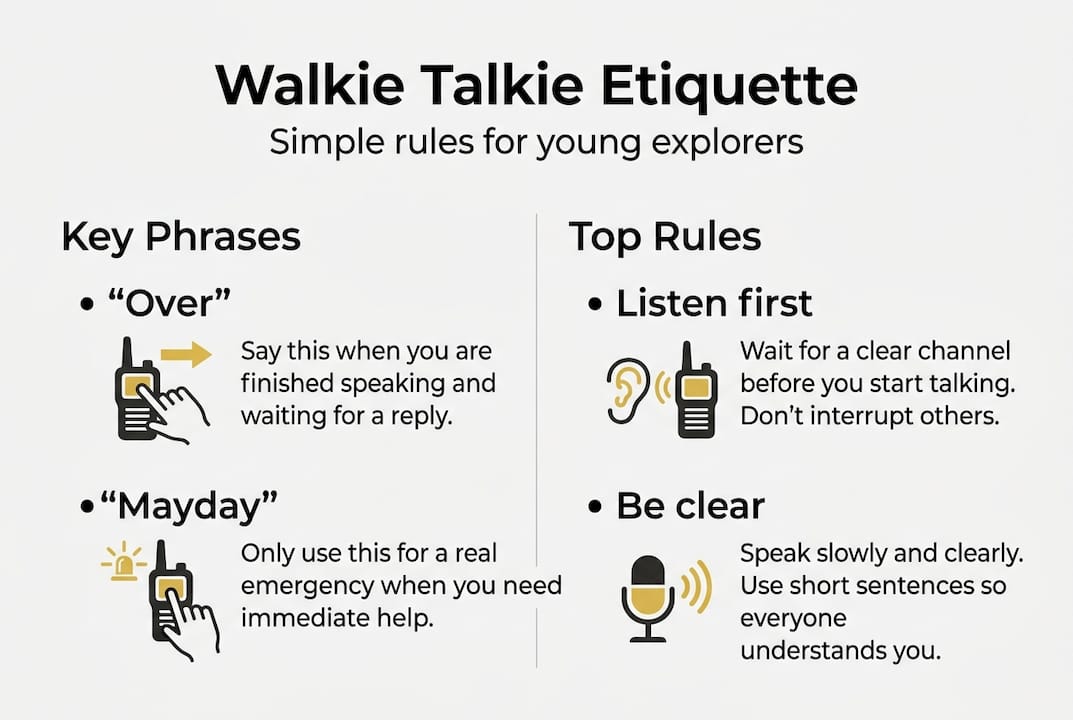
Safety is another enormous reason etiquette matters. In an outdoor environment, a garbled or missed message can mean a child wanders too far, misses a meeting point, or fails to signal a genuine problem. Clear communication keeps families connected and children safe.
One of the most important things to understand is that children do not need the full professional radio code used by emergency services or military personnel. Simplified phrases work far better. As walkie talkie lingo guides explain, short words like ‘Over’, ‘Roger’, and ‘Come in’ are perfectly suited to young users because they are easy to remember and hard to confuse.
“The best walkie talkie etiquette for children is the kind that feels like part of the game, not a set of rules imposed from above.”
Here is a quick look at the core benefits of teaching etiquette early:
- Teamwork: Children learn to coordinate and rely on each other.
- Social development: Turn-taking and active listening become natural habits.
- Emergency readiness: Children know what to say and when if something goes wrong.
- Confidence: Clear communication builds self-assurance in outdoor settings.
- Respect: Children learn that the channel is shared and everyone deserves to be heard.
Understanding how walkie talkies work also helps children appreciate why these rules exist in the first place, making them far more likely to follow them willingly.
Essential phrases and rules: what every child should know
Once children understand why etiquette matters, the next step is giving them the actual language to use. The good news is that the core vocabulary is tiny. A handful of simple words covers almost every situation a child will encounter during outdoor play.
Here is a comparison of professional radio lingo versus the simplified versions that work brilliantly for children:
| Professional term | Child-friendly version | What it means |
|---|---|---|
| Over | Over | I’ve finished speaking, your turn |
| Roger / Wilco | Got it | Message received and understood |
| Come in | Are you there? | Calling someone to respond |
| Mayday | Mayday | Emergency only |
| Affirmative | Yes | Agreement |
| Negative | No | Disagreement |
As walkie talkie lingo resources confirm, keeping phrases like ‘Over’, ‘Roger’, ‘Come in’, and ‘Mayday’ in their original form actually works well for children because they sound exciting and feel special. The key is keeping the messages around those words short and clear.
Here are the golden etiquette rules every child should learn before heading outdoors:
- Wait for the click. Always listen for the other person to say ‘Over’ before you press the button and speak.
- Use names. Start every message with who you are calling and who you are. For example: “Lily, this is Tom, Over.”
- Keep it short. One idea per message. Long transmissions get confusing and boring.
- No unnecessary chatter. The channel is shared. Save it for useful messages.
- ‘Mayday’ is serious. Teach children that this word is only for real emergencies, never for jokes.
Building on understanding walkie talkie basics will help children see these rules as logical rather than arbitrary, which makes a real difference to how willingly they follow them.
Pro Tip: Run a short role-play session at home before your outdoor adventure. Pretend to be explorers, give each child a character name, and practise the phrases together. Children who rehearse in a safe, playful setting remember the rules far better when they are actually out in the field.
Setting up for success: preparing your walkie talkie session
Even the best-intentioned etiquette falls apart if the equipment is not set up properly. A few minutes of preparation before heading outside can save a lot of frustration later.
Here is a simple checklist to run through before every outdoor session:
- Batteries: Check all devices are fully charged or have fresh batteries.
- Channel: Set every walkie talkie to the same channel before leaving the house.
- Volume: Test the volume so everyone can hear clearly without it being painfully loud.
- Range: Remind children of the maximum distance they should travel from each other.
- Names: Confirm each child’s call name for the session.
Getting these basics right means the etiquette you have taught actually has a chance to shine. When equipment fails, children blame the rules rather than the technology, so reliable kit matters.
Here is a comparison of common mistakes versus best practices to share with your children:
| Common mistake | Best practice |
|---|---|
| Speaking before the other person finishes | Wait for ‘Over’ before transmitting |
| Shouting into the device | Speak calmly at a normal volume |
| Using vague language | Be specific: names, locations, actions |
| Saying ‘yes’ or ‘no’ without context | Use ‘affirmative’ or ‘negative’ for clarity |
| Leaving the channel open | Release the button immediately after speaking |
A well-prepared session also means children feel more confident. When they know the channel is correct and the batteries are good, they focus on the adventure rather than the technology. For more inspiration on inspiring outdoor play with walkie talkies, there are plenty of creative ideas to make each session feel fresh.
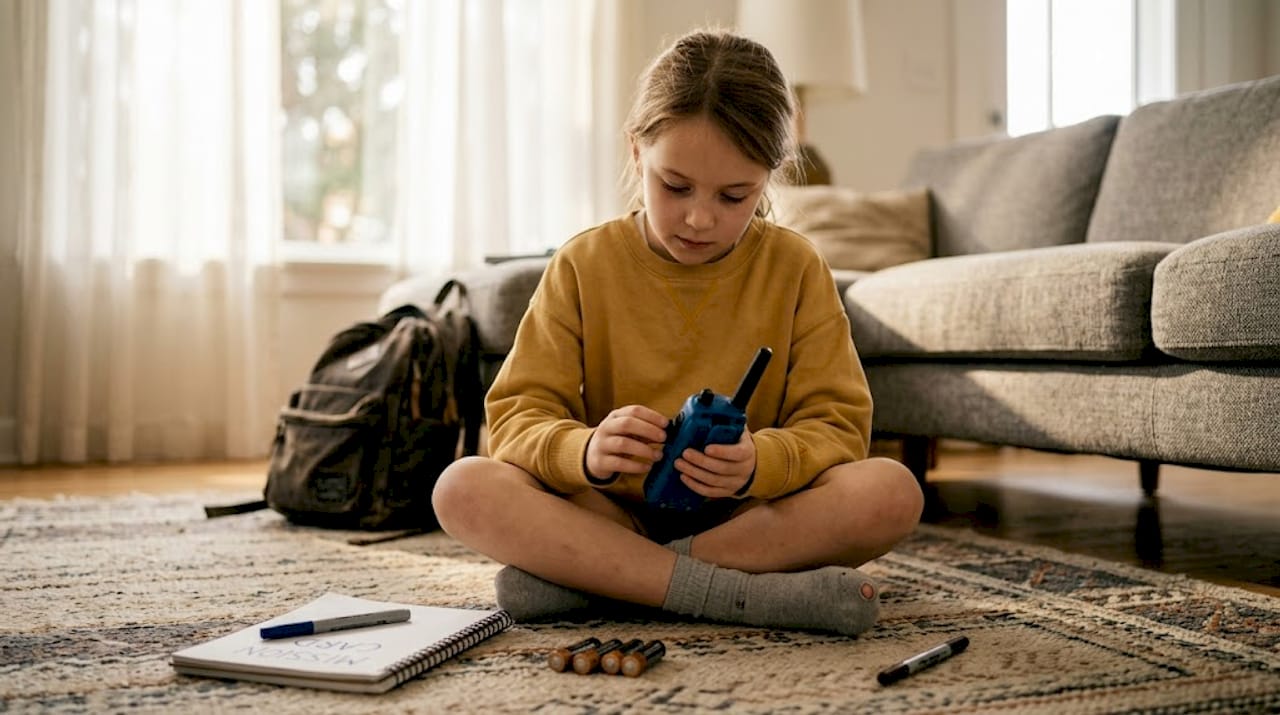
Pro Tip: Create a laminated “mission card” for each child with their call name, the channel number, and the five golden etiquette rules. Clip it to their backpack. It becomes part of the adventure kit and doubles as a handy reminder without feeling like a lecture.
Troubleshooting and encouraging good habits
Even with the best preparation, things will go wrong. Static crackles, messages get missed, and children will occasionally talk over each other. Knowing how to handle these moments calmly is part of building lasting good habits.
Here are the most common problems and how to address them step by step:
- Static or poor signal: Move to higher ground or away from dense trees. Remind children that keeping messages short reduces the chance of losing a transmission mid-sentence.
- Missed messages: Establish a rule that if you do not hear ‘Over’, you ask the sender to repeat. Use a simple phrase like: “Say again, Over.”
- Overlapping speech: Remind children of the ‘wait for Over’ rule. If two people speak at once, both should stop, count to three silently, and the person who called first should try again.
- Forgotten phrases: Do not correct children sharply. Instead, model the correct phrase yourself and invite them to try again.
- Misuse of ‘Mayday’:: Address this immediately but calmly. Explain once more why the word is reserved for real danger, then move on without dwelling on it.
Positive reinforcement is far more effective than correction. Here are some ideas to keep motivation high:
- Praise specific behaviour: “I loved how you waited for ‘Over’ before you spoke. That was brilliant.”
- Group games: Set up a nature scavenger hunt that requires walkie talkie communication to complete.
- Explorer awards: Give out small stickers or badges for excellent etiquette at the end of a session.
- Family debrief: Spend five minutes after each adventure talking about what worked well on the radio.
Safety reminder: Walkie talkies operate on shared channels. Remind children never to share personal information like their surname or home address over the radio, and to use ‘Mayday’ only in a genuine emergency.
A new era of playful communication: our thoughts
Here is something most etiquette guides get wrong: they treat radio rules as a discipline exercise rather than a creative one. We have seen children thrive when etiquette is woven into the story of the adventure, not bolted on as a set of regulations.
The truth is, children do not resist structure. They resist joyless structure. When a child understands that saying ‘Over’ is what real explorers do, they say it with pride. When they realise that clear communication means the mission succeeds, they invest in it. Understanding walkie talkies and child growth shows how much these small habits contribute to bigger developmental gains.
Our view at The Zoofamily is that parents should model rather than enforce. Pick up a walkie talkie yourself, use the phrases, make mistakes, laugh about them, and try again. Children learn communication by watching the people they trust most. The goal is not perfect radio procedure. It is a child who feels confident, connected, and genuinely excited to explore the world around them.
Discover more resources for family adventure
If this guide has sparked ideas for your next outdoor session, there is plenty more waiting for you at The Zoofamily. We have built a growing library of practical advice, creative play ideas, and honest product guides designed specifically for families who love exploring together.
From understanding walkie talkie basics for children to finding the right kit for different ages and terrains, everything we create is rooted in one belief: that children who connect with nature and with each other grow into remarkable people. Every camera we sell plants a tree, because the world our children explore today deserves to be there for their children too. Come and join the adventure.
Frequently asked questions
What is the most important walkie talkie phrase for kids to know?
‘Over’ signals that a child has finished speaking and the channel is open for the next person to respond. It is the single phrase that prevents most communication confusion during outdoor play.
How can parents reinforce walkie talkie etiquette?
Role play and praise are the most effective tools. Turning etiquette into part of a game or mission makes children far more likely to remember and repeat good habits naturally.
What should children do in a walkie talkie emergency?
Teach children that ‘Mayday’ is for emergencies only, never for jokes or testing. Explain clearly what counts as a real emergency so they feel prepared rather than anxious.
Is professional radio code necessary for young children?
No. Simplified lingo for kids is far more effective than professional ten-codes or military terminology. A small set of memorable words works better than a complex system children cannot retain under pressure.