

Every parent faces questions about how city living shapes their child’s experiences with nature. In European cities, creating space for outdoor play is about more than keeping children active, it supports physical, social, emotional, and cognitive growth in ways no indoor activity can match. This article explores how diverse urban environments enable child-directed outdoor play and why reimagining city spaces can help nurture your child’s bond with the natural world.
Table of Contents
- Defining Outdoor Play In City Environments
- Types Of Urban Outdoor Play Experiences
- Benefits For Child Development And Nature Bonding
- Common Barriers And Creative Solutions
- Safety, Accessibility, And Environmental Impact
Key Takeaways
| Point | Details |
|---|---|
| Importance of Outdoor Play | Outdoor play in urban areas significantly supports children’s physical, cognitive, and social development through diverse, child-directed experiences. |
| Variety of Play Types | Urban environments facilitate various play types, including physical, creative, and exploratory play, each fostering essential developmental skills. |
| Environmental Connections | Consistent outdoor play cultivates a strong bond with nature, enhancing children’s environmental awareness and understanding of ecological systems. |
| Addressing Challenges | Collaboration between urban planners and communities is vital to overcoming barriers to outdoor play by creating accessible, safe, and engaging environments. |
Defining Outdoor Play in City Environments
Outdoor play in urban environments represents a complex and dynamic interaction between children and their built surroundings. Urban environments fundamentally shape childhood experiences through accessible spaces that enable physical, cognitive, and social development. Children’s engagement with city landscapes transforms seemingly limited spaces into rich playgrounds of exploration and discovery.
At its core, outdoor play in city settings involves unstructured, child-directed activities occurring in diverse urban environments. These might include neighbourhood parks, community gardens, pedestrian walkways, or small green spaces nestled between buildings. The key distinguishing factor is the child’s agency - their ability to initiate, direct, and spontaneously interact with their immediate outdoor environment. Outdoor play serves as a natural developmental need that transcends geographical limitations, adapting to the unique characteristics of urban landscapes.
City environments present both challenges and opportunities for outdoor play. Key features that support meaningful play experiences include proximity to safe spaces, traffic protection, green elements, and inclusive design that welcomes children of different ages and abilities. Urban planners and parents can collaborate to create micro-environments that encourage exploration, sensory engagement, and natural interactions. These spaces need not be expansive but should offer opportunities for climbing, jumping, observing natural elements, and social interaction.
Urban Play Strategy Select city play areas with varied terrain, natural elements, and minimal traffic exposure to maximise your child’s outdoor learning potential.
Types of Urban Outdoor Play Experiences
Urban environments offer a remarkable diversity of outdoor play experiences that go far beyond traditional playground settings. Exploratory play emerges through varied environmental features, transforming city spaces into dynamic learning landscapes. Children might engage with gardening areas, interact with moveable equipment, or discover imaginative play opportunities in unexpected urban corners.

The typology of urban outdoor play experiences can be broadly categorised into several distinct domains. Physical play involves active movements like climbing structures, riding tricycles, and using sports equipment. Creative play emerges through loose parts, improvised play spaces, and unstructured interactions with urban environments. Urban play spaces accommodate multiple activity types, ranging from structured sports activities to spontaneous exploratory moments that encourage sensory engagement and social interaction.
Age and neighbourhood characteristics significantly influence play experiences. Younger children might prefer sensory exploration and imaginative play, while older children gravitate towards more structured physical activities. Sidewalks, community gardens, small green spaces, and residential courtyards become crucial play environments that support different developmental needs. The key is recognising that urban play is not confined to traditional playgrounds but encompasses a rich, adaptive landscape of potential experiences.
Here is a summary of urban outdoor play types and their primary benefits:
| Play Type | Typical Locations | Key Developmental Benefits |
|---|---|---|
| Physical Play | Parks, pavements, courts | Builds motor skills, fitness |
| Creative Play | Gardens, empty lots | Enhances imagination, flexibility |
| Social Play | Courtyards, walkways | Fosters cooperation, communication |
| Exploratory Play | Green pockets, alleys | Develops curiosity, problem-solving |
Urban Play Insight Map out three different play zones in your neighbourhood that offer varied terrain and play opportunities to maximise your child’s outdoor exploration.
Benefits for Child Development and Nature Bonding
Outdoor play contributes profoundly to children’s holistic development, extending far beyond simple physical activity. Urban environments provide crucial spaces where children can engage with nature, fostering critical cognitive, social, and emotional growth. These experiences help children develop problem-solving skills, creativity, and an intrinsic understanding of natural systems through direct, unmediated interactions with their surrounding environment.
The cognitive benefits of outdoor play are particularly remarkable. Children who regularly interact with natural spaces demonstrate enhanced spatial awareness, improved attention spans, and more sophisticated social skills. Physical activities like climbing, exploring, and navigating urban green spaces stimulate neural pathways, supporting brain development and motor skill refinement. Urban recreation areas significantly impact children’s mental well-being, especially for children from diverse socioeconomic backgrounds, creating equalising opportunities for developmental experiences.
Nature bonding emerges as a crucial outcome of consistent outdoor play. By exploring parks, community gardens, and urban green spaces, children develop a deep, intuitive connection with the natural world. This connection transcends mere recreational activity, cultivating environmental awareness, empathy towards living systems, and a foundational understanding of ecological interdependence. Such experiences lay the groundwork for future sustainable attitudes and behaviours, transforming urban play spaces into powerful developmental ecosystems.
Urban Nature Connection Create a weekly nature journaling routine where your child documents and sketches their outdoor discoveries, fostering a deeper personal connection with urban natural environments.
Common Barriers and Creative Solutions
Urban play environments face multiple complex barriers that restrict children’s outdoor experiences. Primary challenges include parental safety concerns, limited accessible play spaces, and significant socio-economic disparities. Traffic dangers and perceived urban risks often create psychological barriers that prevent parents from allowing children spontaneous outdoor exploration, effectively shrinking the potential for natural play experiences.
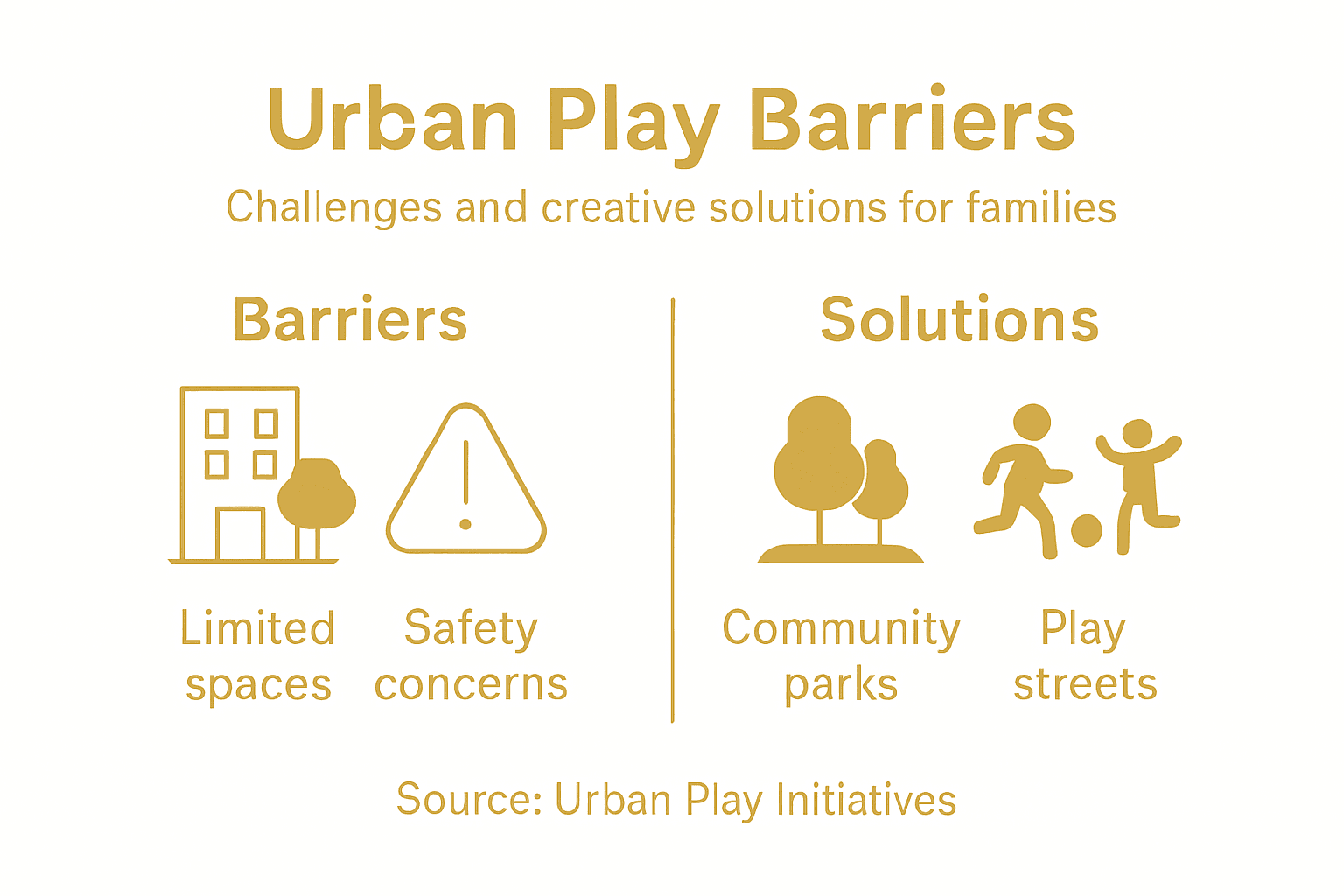
Shrinking urban spaces and increased screen time compound the challenges of outdoor play. Modern urban landscapes are increasingly dominated by built infrastructure, reducing natural play areas. Digital entertainment competes intensely with outdoor activities, creating sedentary alternatives that diminish children’s physical engagement with their environment. These trends necessitate innovative approaches to redesigning urban spaces that prioritise children’s developmental needs and encourage active, exploratory play.
Below is a comparison of common urban play barriers and creative solutions:
| Barrier | Description | Creative Solution |
|---|---|---|
| Limited space | Few accessible play areas in cities | Repurpose underused sites for play |
| Parental safety concerns | Fears regarding traffic and strangers | Design safer crossings, promote oversight |
| Socio-economic disparities | Unequal play opportunities | Community-driven space transformation |
| Screen-driven inactivity | Technology reducing outdoor time | Organise neighbourhood outdoor events |
Creative solutions involve multi-stakeholder strategies that transform urban environments. Community-led initiatives can redesign neglected spaces into engaging play zones, incorporating flexible spatial designs that accommodate diverse play styles. Urban planners can integrate child-friendly features like natural climbing elements, sensory exploration zones, and safe pedestrian areas. Parental education programmes can also help shift perceptions about outdoor play, emphasising its critical role in child development and challenging overly protective approaches to urban childhood experiences.
Urban Play Strategy Identify three underutilised urban spaces near your home that could be transformed into creative play environments with minimal intervention.
Safety, Accessibility, and Environmental Impact
Urban play space design requires nuanced safety considerations that balance children’s exploratory needs with protective measures. Safety encompasses physical infrastructure, supervision strategies, and environmental design that enables children to engage meaningfully with their surroundings. Adult oversight, including parental and grandparental involvement, plays a critical role in creating supportive play environments that foster independence while maintaining appropriate protection.
Evidence-based urban design interventions are fundamental to creating accessible and sustainable play spaces. These strategies include implementing traffic calming measures, establishing clear sightlines, developing accessible pathways, and integrating natural elements that support ecological preservation. The goal is to create environments that are simultaneously safe, inclusive, and environmentally sensitive, allowing children to explore and interact with urban landscapes without unnecessary risks.
Environmental sustainability emerges as a crucial consideration in urban play space design. This involves selecting safe, ecologically responsible materials for play equipment, preserving natural habitats, and creating spaces that educate children about environmental stewardship. By integrating native plant species, minimising artificial surfaces, and designing spaces that allow children to interact with natural systems, urban planners can transform play areas into educational ecological zones that support both child development and environmental awareness.
Urban Safety Insight Conduct a monthly family audit of your local play spaces, noting potential safety improvements and environmental enhancement opportunities.
Inspire Your Child’s Urban Outdoor Adventures with The Zoofamily
Outdoor play in urban areas comes with unique challenges such as limited safe spaces and the need to foster nature connections amidst city life. This article highlights how crucial it is to nurture creativity, exploration, and environmental awareness in children despite these barriers. You want your child to experience joyful physical play, engaging social moments, and inspiring exploratory encounters that weave their connection with nature into everyday city living.
At The Zoofamily, we understand these needs deeply. Our specially designed kids’ cameras, walkie-talkies, and binoculars with animal references stimulate children’s curiosity and invite them to explore their urban surroundings more meaningfully. For every camera sold we plant a tree so your child’s playtime also supports restoring natural beauty for future generations. Experience how simple tools can transform underused city spaces into exciting outdoor learning zones.
Discover how you can empower your child’s adventurous spirit today. Visit The Zoofamily to find inspiration and gear that turns everyday outdoor play into memorable nature bonding moments. Make this the moment to reconnect your family with the outdoors and help craft a greener tomorrow.
Frequently Asked Questions
What is outdoor play in urban environments?
Outdoor play in urban environments refers to unstructured, child-directed activities that occur in various city spaces such as parks, community gardens, and pedestrian walkways. It allows children to explore and engage with their surroundings, promoting physical, cognitive, and social development.
How does outdoor play benefit child development?
Outdoor play significantly contributes to children’s holistic development by enhancing motor skills, creativity, problem-solving abilities, and social skills. Engaging with natural environments also fosters deeper connections with nature, promoting environmental awareness and empathy towards living systems.
What are some barriers to outdoor play in urban areas?
Barriers to outdoor play in urban areas include limited accessible play spaces, parental safety concerns, socio-economic disparities, and increasing screen time that competes with outdoor activities. These challenges can restrict children’s opportunities for spontaneous play and exploration.
How can urban planners create better play environments for children?
Urban planners can improve play environments by designing spaces that incorporate natural elements, ensure safety through traffic-calming measures, and promote accessibility. Engaging local communities in space redesign initiatives can also help transform underutilised areas into inviting play zones.