

TL;DR:
- Nature photography with children captures genuine curiosity, creating a meaningful family archive that fosters creativity and environmental connection.
- Preparing ethically and practically, families should choose appropriate equipment, teach wildlife respect, and involve children in location planning for enriching outdoor experiences.
- Organizing photos monthly through consistent routines and creating tangible projects develop lasting memories and eco-values, nurturing responsible guardians of nature.
Nature photography with children produces something wonderful: genuine curiosity captured in pixels. But most families return from a woodland walk or coastal reserve to find hundreds of blurry, unlabelled images buried across three different devices, and the memory fades before anyone prints a single shot. With a repeatable system, those scattered moments become a living archive that builds creativity, strengthens family bonds, and deepens your children’s connection to the natural world.
Table of Contents
- Preparing for ethical nature photo adventures
- Location scouting and planning: reducing chaos, boosting outcomes
- Organising, sorting, and backing up nature photos
- Creative outputs and conservation: albums, prints and eco-learning
- Why sustainable photo routines improve family memory and eco-values
- Connect your nature photo journey with The Zoofamily
- Frequently asked questions
Key Takeaways
| Point | Details |
|---|---|
| Ethical photography first | Always prioritise animal welfare and habitat care when taking nature photos. |
| Plan sessions for success | Scouting and contingency planning reduce stress and improve outcomes. |
| Use a monthly routine | Regular sorting, naming, and backing up keeps memories safe and accessible. |
| Involve kids creatively | Children learn best when they help plan, shoot, and organise their nature photos. |
| Create meaningful outputs | Turn organised photos into albums, prints, or conservation projects for lasting impact. |
Preparing for ethical nature photo adventures
Now that you understand the core challenge, let’s start by preparing for nature photography in a way that is safe, ethical, and sets up your children for success.
Good preparation is the difference between a chaotic scramble and a genuinely enriching outing. Before you leave the house, run through a simple equipment checklist: a child-friendly camera with a wrist strap, at least one spare battery, two memory cards (always carry a backup), a waterproof bag for gear, snacks to keep energy steady, and a small field guide to local species. Alongside the kit, the ethical guidance you share before departure matters just as much as the equipment itself.
Ethical wildlife photography requires minimising disturbance and following laws and habitat-safety principles, which means teaching children these values at home before they ever point a lens at a living creature. This is one of the most powerful lessons nature photography can offer: the idea that getting the shot is never more important than the welfare of the subject. You can find further inspiration on ecological photography for children to help frame these conversations in language that resonates with younger minds.
Equipment comparison: which camera suits a child best?
| Camera type | Pros for children | Cons | Best age range |
|---|---|---|---|
| Compact kids’ camera | Durable, simple controls, lightweight | Limited zoom range | 4 to 9 years |
| Smartphone | Always available, easy sharing | Fragile, distracting apps | 10 years and above |
| Mirrorless (entry-level) | Excellent image quality, interchangeable lenses | Heavy, expensive, complex | 12 years and above |
For most families, a dedicated kids’ compact camera wins on durability and focus. Smartphones are convenient but tend to pull attention away from the natural world rather than towards it.
Ethical dos and don’ts for young nature photographers:
- Do keep at least 10 metres from nesting birds and resting mammals
- Do stay on marked paths to avoid damaging root systems and ground-nesting habitats
- Do follow local conservation rules and respect site-specific restrictions
- Don’t use flash photography near nocturnal animals or bats
- Don’t move rocks, logs, or debris to reveal hidden creatures
- Don’t make loud noises to startle animals into action for a better shot
Explore more on teaching photography ethics with practical frameworks for different age groups. The natural world offers what researchers describe as nature’s classroom inspiration, and that environment works best when children learn to observe quietly rather than disrupt.
Pro Tip: Encourage children to use telephoto or zoom settings on their camera rather than walking closer to wildlife. This builds patience, improves shot composition, and protects the animals from unnecessary stress.
Important note on seasonal safety: During breeding season (typically March to July in northern Europe), many species are at their most vulnerable. Approach to any nest, burrow, or den site should be avoided entirely, regardless of the photographic opportunity. Check local wildlife trust guidance before visiting nature reserves during spring and early summer.
Location scouting and planning: reducing chaos, boosting outcomes
With your ethical foundations and equipment ready, the next step is to choose locations and plan your adventure for the best possible results.
Location scouting and planning can significantly reduce chaotic shoots and improve outcomes, and this principle applies to family outings just as much as professional assignments. The scouting process works best in three phases: digital research at home, a brief physical walkthrough before the main visit, and contingency planning for weather or access issues.
Before heading out, check these essentials:
- Opening times and any booking requirements for nature reserves or protected areas
- Whether photography is permitted (some sites restrict tripods or commercial use)
- Seasonal wildlife events (e.g., red deer rutting in autumn, migratory birds in spring)
- Footpath accessibility for younger children or pushchairs
- Parking, toilets, and shelter options in case of sudden weather changes
- Any local restrictions on drone use or off-path exploration
Involving children in the planning process is genuinely transformative. Rather than simply taking them somewhere, you create a sense of ownership and anticipation that makes the actual outing far richer. Studies on learning through exploration consistently show that children retain knowledge and develop stronger values when they are active participants in the process, not passive recipients.
How to involve children in location planning (step by step):
- Sit together and look at a map or nature reserve website, letting your child point out interesting features
- Ask them which animals or plants they most want to photograph and research where those species live
- Create a simple “mission list” of three to five things to find and photograph
- Discuss what to do if the weather turns or the wildlife is elusive (flexibility builds resilience)
- Review photos from previous visits together before setting out, spotting what worked and what to try differently
This five-step process, repeated before each outing, builds nature photography creativity in a structured, repeatable way. Families who plan this way report far greater satisfaction with their images and, more importantly, with the experience itself. You can also find educational animal photo tips that pair beautifully with pre-visit preparation.
Understanding animal behaviour eco-awareness adds another layer of depth, helping children predict where to look and how to interpret what they observe rather than simply hoping something appears in front of the lens.
Organising, sorting, and backing up nature photos
Once you return from the outdoor adventure, it’s time to bring all those photos into a well-organised digital system. Here’s how to make it easy and reliable.
The post-outing routine is where most families fall apart. Images pile up on phones and memory cards, duplicates multiply, and within a month nobody can remember which woodland that particular fox photo came from. A structured outdoor photography workflow includes importing files with metadata, flagging keepers, batch editing favourites, and using a consistent folder system. Establishing this rhythm from the very first outing saves an enormous amount of frustration later.

Folder structure comparison for families:
| Organisation method | Best for | Example folder name |
|---|---|---|
| By event | Memorable outings with a clear theme | 2026-04_Bluebell-Wood-Walk |
| By date | High-frequency photographers | 2026/April/12-April |
| By location | Families visiting the same sites repeatedly | Sherwood-Forest/Spring-2026 |
| By species | Children with a specific nature focus | Birds/Robin/2026 |
A family photo system works best when it combines folder structure with a monthly sorting routine: move files to the correct folder, rename key images, delete obvious rejects, and run a backup. Consistency matters far more than perfection.
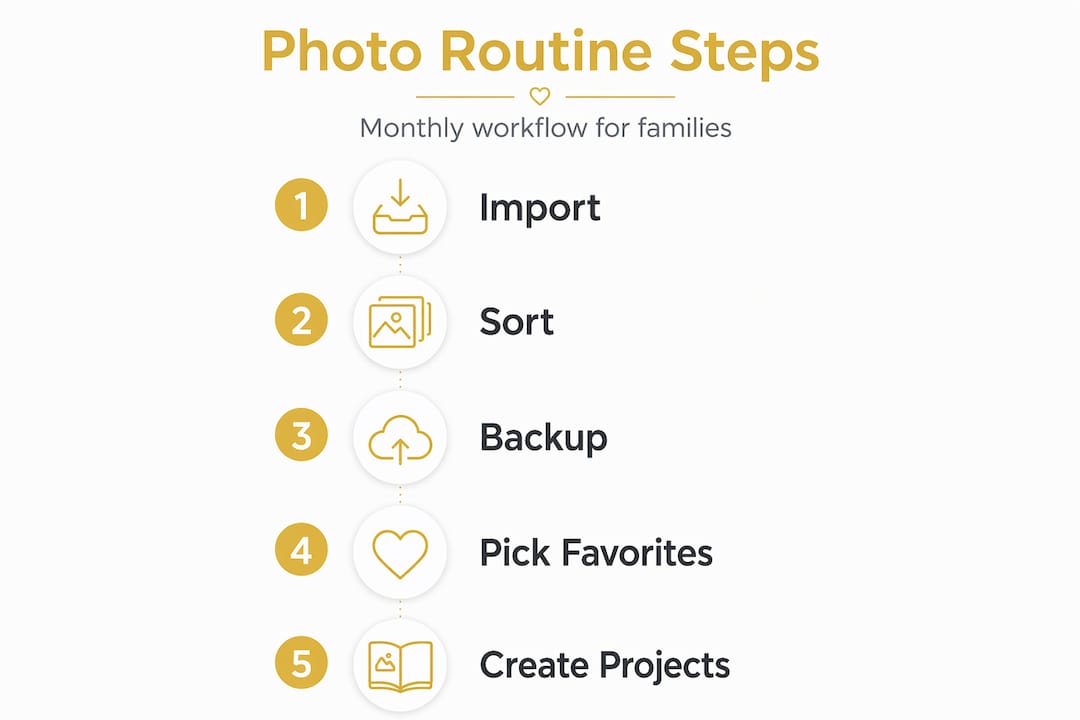
Monthly digital photo routine (step by step):
- Import all photos from cameras and memory cards to a single folder labelled “Inbox”
- Rename the folder with the date and location immediately
- Scroll through quickly and flag obvious keepers (sharp focus, good composition, interesting subject)
- Delete blurry images and near-identical duplicates without hesitation
- Move flagged keepers into the correct event or location folder
- Apply basic edits (brightness, crop) to your top five to ten images
- Back up the entire photo library to both a cloud service and an external hard drive
Pro Tip: Never rely on a single backup. Cloud storage protects against hardware failure; a local drive protects against losing internet access or a subscription lapsing. Both together give your family’s nature archive genuine long-term security.
You can find further outdoor photography tips that align with this workflow, including how to make editing sessions a fun, shared activity rather than a chore. A well-maintained family album workflow ensures that your images are always ready for the creative projects described in the next section.
Creative outputs and conservation: albums, prints and eco-learning
With your photos sorted, let’s explore how to turn them into creative projects that promote conservation and inspire your children to care for the natural world.
Organised photos are only half the story. The real value emerges when those images become something tangible: a printed book your child can hold, a poster on their bedroom wall, or a digital slideshow shared with grandparents. These outputs make the experience feel permanent and meaningful, reinforcing the conservation values woven through every outing.
Creative outputs to consider:
- Annual photo book: A printed collection of the year’s best nature images, organised by season
- Species posters: A printed A3 poster featuring your child’s best photographs of a single species
- Digital slideshow: A simple presentation shared with family, narrated by your child
- Nature journal inserts: Printed wallet-sized photos glued into a nature journal alongside sketches and notes
- Conservation timeline: A year-by-year visual record of how local habitats change over time
Conservation note: When designing creative projects with your children, frame each image in terms of the story behind it. Which species is this? Where does it live? Is its habitat under threat? Connecting a photograph to a conservation reality transforms a fun creative activity into genuine environmental education. This is the kind of learning that stays with children into adulthood.
The most effective approach, as confirmed by a repeatable photo cadence used by experienced outdoor photographers, is to produce creative outputs on a regular cycle rather than waiting for a “perfect” collection. A monthly mini-project (a species spotlight, a seasonal collage) and an annual photo book together create a rhythm that keeps children engaged and motivated throughout the year.
Practical planning for organising photos for albums starts the moment you sort your monthly images: star the shots with the most visual impact, note the species or location in the file name, and set aside ten to fifteen images each month as candidates for the annual book. By December, you’ll have a curated shortlist rather than 3,000 images to sift through in a panic.
Creative nature photography with children flourishes when there is always a project on the horizon. Anticipation drives effort, and effort builds skill.
Why sustainable photo routines improve family memory and eco-values
Here is something most photography guides miss entirely: the routine itself is the point, not the individual images.
Families who sort photos once a year, in a stressed January session, rarely build meaningful archives. Families who spend twenty minutes together at the end of each month do. The difference is not about discipline or organisation skills. It is about treating your nature photo practice the same way you treat any other valued habit, like cooking together or reading before bed. Repetition builds identity, and identity shapes values.
There is also a subtle parenting opportunity hiding inside the monthly routine. When your child sits beside you flagging their favourite fox photograph, they are simultaneously learning to make aesthetic judgements, to value patience (because the best shots come from waiting), and to care about accuracy (because you name the species together as you work). These are not trivial skills.
The counterintuitive insight from ethical photography guidance is that the conflict between “getting the shot” and respecting wildlife welfare is actually one of the most valuable teaching moments you will encounter. When a child wants to run towards a deer to get closer, and you calmly explain why you’re staying still and using zoom instead, you are teaching self-regulation, empathy, and ecological thinking in a single sentence. That lesson lands because the motivation (getting the great photo) is genuinely theirs.
We believe at The Zoofamily that this is how environmental values are truly formed: not through lectures, but through shared practice and gentle, consistent example. Parents who model ethical behaviour in the field, and who make the monthly sorting routine feel like a celebration rather than a chore, are building something far more lasting than a photo library.
Pro Tip: Involve your child in choosing the “photo of the month” during your sorting session. Frame it as an award, display it somewhere visible, and ask them to write or dictate one sentence about the moment it captures. This tiny ritual builds pride, vocabulary, and conservation awareness all at once.
Connect your nature photo journey with The Zoofamily
If you’re keen to keep nurturing your family’s nature photo journey, The Zoofamily offers ongoing support, guidance, and inspiration designed specifically for environmentally conscious families across Europe.
Our blog is packed with practical resources that take your family from first outing to finished album, all grounded in the belief that children who photograph nature become adults who protect it. From detailed guidance on ethical family photography to creative projects that bring your sorted images to life, we cover every stage of the journey. Explore ideas for inspiring creativity with kids outdoors, and discover the cameras, binoculars, and walkie-talkies we’ve designed to make every nature adventure richer, more ethical, and genuinely memorable.
Frequently asked questions
What is the best folder structure for organising nature photos with children?
The best folder structure is one used consistently every month, whether organised by event, date, or location. As family photo organisation research shows, consistency matters far more than the specific system you choose.
How can parents teach photo ethics to their children?
Parents should model ethical behaviour in the field, such as keeping distance from wildlife and following habitat rules. Wildlife photography ethics guidance makes clear that welfare always comes before the photograph, and children absorb this value best by watching adults practise it calmly.
Why is a repeatable monthly routine important for nature photo organisation?
A monthly routine prevents digital clutter from building up, ensures memories are backed up reliably, and keeps the archive accessible. A repeatable outdoor cadence transforms photo management from an occasional panic into a comfortable, enjoyable habit.
What creative projects can families make with organised nature photos?
Families can create digital albums, printed photo books, species posters, nature journal inserts, and conservation-themed timelines. These annual creative outputs give children a tangible reason to care about the quality and organisation of their photographs throughout the year.