

The best outdoor team-building games for young people give the group one shared goal, a few clear rules and a job for every child. Capture the flag, a photo scavenger hunt, a blindfolded guide game, a co-designed obstacle course and a rope challenge all do this, and they need very little kit. Below you get the rules, the right ages and group sizes, and the safety steps. We also show where simple tools such as walkie-talkies, cameras and binoculars turn an ordinary game into a team task.
TL;DR
- Choose games where children need each other to win: shared goals, rotating roles and a short chat afterwards.
- Capture the flag suits groups of about 10 to 30 and ages 8 and up. Photo hunts and walkie-talkie games work for smaller groups and younger children.
- Under age 10, drop or soften the competition, and let every child opt for an easier version.
- Mark boundaries, agree a stop signal, count heads before and after each game and keep a first-aid kit with the group.
- A camera, binoculars or a pair of walkie-talkies gives each child a role, which is the quickest way to include shy players.
Table of Contents
- Why outdoor team games are worth organising
- How to pick a game by age and group size
- Game 1: Capture the flag
- Game 2: Photo scavenger hunt
- Game 3: The walkie-talkie guide game
- Game 4: Build-it-together obstacle course
- Game 5: Over the line (rope challenge)
- Game 6: Balloon football and other relay games
- Game 7: Giant story circle and human knot
- Game 8: Team art in nature
- Adapting games for different ages and abilities
- Safety checklist for the adult in charge
- Our approach to team games
- Kit for your next outdoor game day
- FAQ
- Sources
Why outdoor team games are worth organising
The evidence for shared outdoor challenges is encouraging. A 2025 systematic review in PLOS One looked at adventure education for children aged 6 to 18. It found improvements in leadership, self-efficacy, peer support, relationship skills and independence. The structure of these activities makes players rely on one another, which builds respect and trust.
A peer-reviewed study of the UK’s Ten Tors Challenge followed 226 young people aged 13 to 19. Wellbeing rose after the team event. The gain was linked to how bonded they felt afterwards and how satisfied they were with their performance.
You do not need an expedition for this. The same ingredients appear in a garden game: a shared aim, some interdependence and a feeling of having done it together. If you want more background on building the habit at home, our guide on how to encourage teamwork in kids is a good next read.
How to pick a game by age and group size
Start with who is playing. The table below summarises a comparison of outdoor team activities by age, group size and how much adult facilitation each needs.
| Activity | Ages | Group size | Adult input |
|---|---|---|---|
| Cooperative sports | 8 to 17 | 10 to 30 | Medium |
| Scavenger hunt | 8 to 15 | 4 to 40 | Low to medium |
| Trust walk | 8 to 14 | Any | Low |
| Team art project | 8 to 17 | Any | Low |
| Survival challenge | 11 to 17 | 4 to 12 | Medium to high |
| Rope course | 10 to 17 | 6 to 20 | High |
For a birthday, a school-holiday meet-up or a family gathering, the low-input options are usually the best fit. They need a parent as a referee, not a trained instructor.
Three questions help you decide quickly:
- How old is the youngest player? Under 10, choose cooperative games over races.
- How many children are there? Fewer than six, try a hunt or a communication game. Ten or more, try a flag game.
- What space do you have? A garden suits obstacle courses and hunts. A park or field suits flag games.
Game 1: Capture the flag
This is the classic for a reason. Players have to plan together, split into attackers and defenders, and communicate quickly.
The Scouts’ guide to capture the flag sets it up like this:
- Mark the boundaries with cones or natural features such as trees and paths.
- Make a jail of about 2 m by 2 m on each side, and mark each team’s base.
- Give each team a bright object as its flag. A scarf, frisbee or soft toy all work.
- Players start on their own side. A player tagged on the other side goes to that side’s jail and is freed when a teammate tags them.
- A freed player puts their hands on their head, walks back and touches the base with their foot before rejoining.
- A team wins by taking the other flag safely back to its base, or by jailing every opponent.
One rule keeps the game fair: nobody may stand directly in front of their own flag. The German youth sports body Sportjugend NRW describes the game as lasting 30 to 60 minutes, which is a useful guide for planning an afternoon.
Where it goes wrong: one or two confident children dominate, and the rest hang about at the back. Give each team a captain who changes every round, and ask the quieter children to be the scouts who report what the other side is doing. That job is where a pair of walkie-talkies earns its place. Our Zoo Walkie Talkie is designed for children aged 3 and up and costs €54.95.
Younger variant: for mixed ages, try the flag-belt version described by a youth sports retailer’s games guide. Every player ties a flag loosely around their waist and the other team tries to pull it off with a light tug. Nobody goes to jail and nobody sits out for long.
Game 2: Photo scavenger hunt
A scavenger hunt is one of the easiest team games to adapt. Instead of collecting objects, teams take pictures of them. Nothing gets picked or damaged, and the evidence is a photo you can look at together afterwards.
How to run it:
- Write a list of 10 to 15 things to find. Mix easy ones (something yellow, a bird, a leaf with a jagged edge) with team ones (everyone touching the same tree).
- Make teams of two to four. Give each team one camera so they must agree on every picture.
- Set a time limit of 30 to 45 minutes and a clear area.
- Meet back and let each team show its best three photos. Award points for creativity as well as for completing the list.
Roles that make it a team game: one child is the photographer, one the navigator who reads the list, one the spotter with binoculars, and one the timekeeper. Rotate the roles halfway. This follows the advice that good team activities include role rotation and meaningful responsibility.
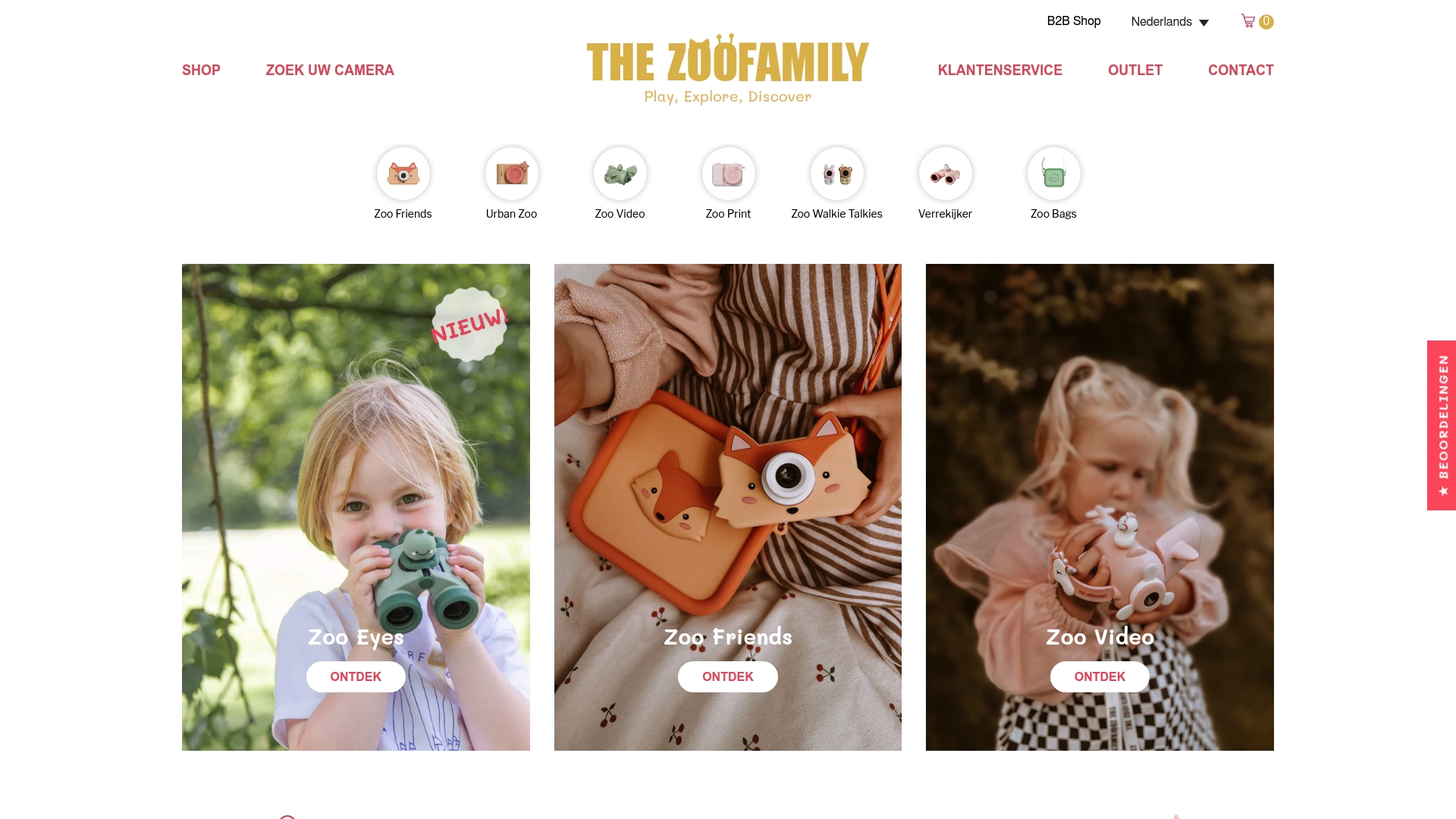
Our Zoo Friends digital cameras cost €69.95 and are made for children aged 3 and up. The animal designs link naturally to a nature theme, so a hunt for animal tracks, bugs and birds fits well. For a hunt where the photos come out straight away, Zoo Print is our instant print camera at €109.95. Printed pictures can go straight onto a team poster at the end. Our zoo eyes binoculars cost €39.95 and give the spotter a proper job.
Game 3: The walkie-talkie guide game
Communication is the skill most children find hardest in a group. This game isolates it.
The idea comes from the blindfolded “minefield” challenge described in a Purdue Extension guide. One partner crosses a roped area scattered with soft, unbreakable items. They use only spoken directions from a partner who cannot touch them. The roles swap in round two.
A walkie-talkie version for younger children:
- Mark out a course in the garden with cones, cushions and skipping ropes.
- One child, the explorer, wears a blindfold, or simply closes their eyes. Another, the guide, stands at the finish with a walkie-talkie. The explorer carries the other.
- The guide gives directions: forward, left, step over. The explorer must reach the finish without touching the obstacles.
- Swap roles. Then try a team version where three guides take turns, one sentence each.
Where it goes wrong: children shout all at once, or give vague instructions such as “over there”. Before the first round, ask the group to agree what makes a good instruction. Give distances (“three steps”) and use left and right from the explorer’s point of view.
The Wisconsin 4-H team-builders packet warns adults to watch for risky behaviour with blindfolds. Keep the ground flat and clear, stay close, and let any child who dislikes the blindfold keep their eyes open and wear a cap pulled low instead.
If you want a pair for the game, Zoo Walkie Talkies are on our shop.
Game 4: Build-it-together obstacle course
Obstacle courses work well because the children can build them as well as run them. Colorado State University Extension says there are no fixed designs or rules. Its basic steps are:
- Design the course with the children, on paper or by talking it through.
- Choose three to five obstacles and a couple of activities.
- Check safety.
- Agree the guidelines together, such as timed or untimed and which sections may be skipped.
- Set it up, try it, then adjust.
The same guide suggests using everyday items: garden furniture, rope, cardboard boxes, brooms, a tent or a sprinkler. Activities can be as simple as carrying a bucket, jumping over a broom handle or doing jumping jacks for 15 to 30 seconds.
Make it a team course: instead of timing each child alone, time the whole team. The clock stops when everyone has finished. Faster runners then have a reason to coach slower ones. Another option is a relay where teams decide who is best at each task, such as running, skipping or spinning. Teenagers like the planning part as much as the running.
For more garden ideas, see our pages on outdoor play activities and natural playground ideas.
Game 5: Over the line (rope challenge)
This is a good option for ages 10 to 16 with eight to 20 players. The setup, as described by Ultimate Camp Resource, needs a 3 to 5 metre rope and two sturdy anchor points at least 3 metres apart. The group must get everyone over the rope without anyone winning individually.
Key points from that guide:
- Hang the rope at shoulder height. Lower is safer.
- Give the group three to five minutes to plan.
- Nobody is lifted without at least two people supporting them.
- If someone touches the rope, that person tries again while the group stays together.
- For inclusion, lower the rope to knee height for stepping over.
Because there are no individual winners, the game suits groups where some children are less sporty.
Game 6: Balloon football and other relay games
When you need something quick and funny for any number of players, try balloon football. A teen games blog describes the setup: mark two goal lines and line up two teams opposite each other. Put a balloon in the middle. Teams try to push the balloon over the other side’s goal line by throwing or rolling tennis balls at it.
The balloon moves slowly and unpredictably, so every child has a chance. It is also a gentle introduction for children who dislike fast contact games.
Game 7: Giant story circle and human knot
Not every team game has to be energetic. A large-group games guide lists the human knot for groups of 8 to 12, plus a story circle where each child adds a sentence. These work well as a calm reset between two active games, and they help the group talk to each other.
Game 8: Team art in nature
Give each team a patch of ground and 15 minutes to make a picture or a sculpture from leaves, sticks and stones. Teams then tour each other’s work. It is a low-input activity that suits mixed ages, and it needs only a few ground rules: nothing living is picked, and everything is returned to the ground at the end. The teamwork comparison table above rates team art projects as suitable for ages 8 to 17 and any group size. For more ideas, see our nature play ideas.

If you want to link the games to learning, there is more on teaching children outdoors too.
Adapting games for different ages and abilities
Under 10: Purdue Extension says competition is generally not appropriate for children under ten. Choose non-competitive games or remove the scoring. In a flag game, count the whole group’s total captures rather than naming a winning team.
Challenge by choice: let each child take part at the level that feels right. Young Explorers Club recommends this framing so anxious children stay involved and nobody is embarrassed for choosing a gentler version. It also notes that a 10-year-old needs different support from a 15-year-old.

Start easy: Ultimate Camp Resource advises introducing the easiest activities first and moving to harder ones. Too hard too early leads to frustration. A story helps too. Instead of balancing on a log, the group is secret agents escaping across a beam.
Quiet roles: the large-group guide above suggests seated roles such as scorekeeper, timekeeper or storyteller for children who need a break. Rotate often so nobody feels sidelined.
Debrief: end each game with two questions: what worked, and what would we change? The Wisconsin 4-H packet calls this closing discussion critical, because it is where children process what they learned.
Safety checklist for the adult in charge
Before you start, walk the area with the children and note the hazards. The Scouts’ guidance lists roads, dips, steps, rocks and rivers, and recommends enough adult helpers. In public places, pair children up so nobody is left alone.
- Boundaries: mark them clearly with cones, and keep play away from roads, water and steep banks.
- Stop signal: agree one and practise it. Prairie South School Division’s guidelines in Canada suggest a double whistle or the word “freeze”.
- Surface and kit: level ground without obstacles, jewellery removed, a stocked first-aid kit and water breaks.
- Tagging: use light touch tags, not tackles.
- Head count: count children before and after every game and every move.
- Blindfolds: stay close and never force a child to wear one.
If a child has a medical condition, check with their parent or carer before the activity and keep contact details with you.
Our approach to team games
We design our products so that children go outside and look closely at nature. A camera, a pair of binoculars or a walkie-talkie each give a child a clear job in a group: the photographer, the spotter, the messenger.
That is why we think the best team games are the ones where nobody is left on the sideline. Give each child a role, rotate it, and let the group decide how to solve the task together.
The animal designs are there to spark interest in nature, and for every camera we sell we plant one tree. A garden hunt or a walk in the park is a small way to start, and the games above need nothing more.
ALAIN
Kit for your next outdoor game day
If you are choosing gifts or kit for children aged 3 and up, these are the pieces that fit the games above:
- Zoo Friends digital camera, €69.95, for the photo hunt.
- Zoo Print instant print camera, €109.95, for photos you can pin up at once.
- Zoo Walkie Talkie, €54.95, for the guide game and capture the flag scouts.
- Zoo eyes binoculars, €39.95, for the spotter.
All are available on thezoofamily.com.
FAQ
What is the easiest team-building game for a mixed-age group?
A photo scavenger hunt or a team art project. Both work for any group size, need little adult input and let children join at their own level. Give each team a mix of ages and rotate the roles.
How long should an outdoor team game last?
Capture the flag can fill 30 to 60 minutes, according to the German youth sports body Sportjugend NRW. For younger children, short rounds of 5 to 15 minutes work better. Finish before energy drops and keep time for a quick chat.
Should team games be competitive?
For children under ten, Purdue Extension advises that competition is generally not appropriate. Use cooperative goals or score the whole group together. Teenagers often enjoy friendly competition, as long as every child has a real role and can opt for an easier version.
How many adults do I need?
The Scouts recommend enough adult helpers for the group and area. Many youth organisations require at least two screened adults. For a family or birthday group, ask another parent to help so one adult can referee and another can watch the edges.
Sources
- Investigating the impact of adventure education (PLOS One review, 2025)
- Interdependence, bonding and support in the Ten Tors Challenge
- Outdoor team building activities for kids
- Capture the flag, Scouts UK
- Capture the flag, Sportjugend Nordrhein-Westfalen
- The best outside games for youth
- Icebreakers, team challenges and other group games, Purdue Extension
- It’s in the Bag: team builders for any group, Wisconsin 4-H
- Outdoor fun with obstacle courses, Colorado State University Extension
- Over the Line rope challenge
- Cooperative games for all ages
- Best outdoor games for teenagers
- Large group games for kids
- Physical Activity Safety Guidelines, Prairie South School Division
- Outdoor education for children