

TL;DR:
- Allowing children to engage in positive risk-taking, such as climbing and exploring, promotes their confidence and resilience. Thoughtful supervision and gradual challenge build developmentally valuable skills while minimizing safety concerns. Parental confidence in permitting adventurous play directly influences children’s growth and ability to handle challenges.
There is a quiet tension many parents carry: the wish to keep children safe, and the nagging feeling that perhaps too much protection is holding them back. The truth, supported by a growing body of research, is that shielding children from every scrape and stumble can actually limit their development in significant ways. Positive risk-taking in nature, from climbing trees to balancing on wet logs, gives children something no padded playground ever can. This guide unpacks what positive risk-taking really means, why it matters more than most parents realise, and how you can support it with confidence.
Table of Contents
- What is positive risk-taking and why does it matter?
- The six faces of adventurous play
- How positive risk-taking builds stronger, more resilient children
- Balancing safety and freedom: practical strategies for parents
- Overcoming common concerns: injury, anxiety, and parental fears
- A real-world approach: what we’ve learnt about risk, nature, and growth
- Explore more ways to raise confident, resilient children
- Frequently asked questions
Key Takeaways
| Point | Details |
|---|---|
| Nature-based risk benefits | Positive risk-taking outdoors boosts children’s confidence, resilience, and well-being. |
| Six forms of risky play | Practical, supervised engagement across all six types develops real-world skills. |
| Balance safety and growth | Dynamic strategies help mums support adventurous play while managing genuine safety. |
| Manage fears, not just risks | Minor bumps are normal—overprotection can actually increase anxiety and hinder confidence. |
| Model confidence | Children learn to assess risks for themselves when mums display calm encouragement and curiosity. |
What is positive risk-taking and why does it matter?
With this dilemma in mind, let’s dig deeper into what positive risk-taking truly means and why experts now say it’s more important than ever.
Positive risk-taking, often called “risky play,” is adventurous play that involves a genuine element of challenge or uncertainty without crossing into genuine danger. It’s the difference between a child climbing a tall oak tree and a child running into traffic. One builds skills and confidence; the other presents a hazard with no developmental return. The distinction is crucial, and once parents understand it, the anxiety around adventurous play tends to ease considerably.
Researcher Ellen Sandseter identified six types of risky play: play at heights, play at high speed, play with dangerous tools, play near dangerous elements (such as water or fire), rough-and-tumble play, and exploring alone or away from adult supervision. Each category represents something children are naturally drawn to, and each offers a unique developmental reward.
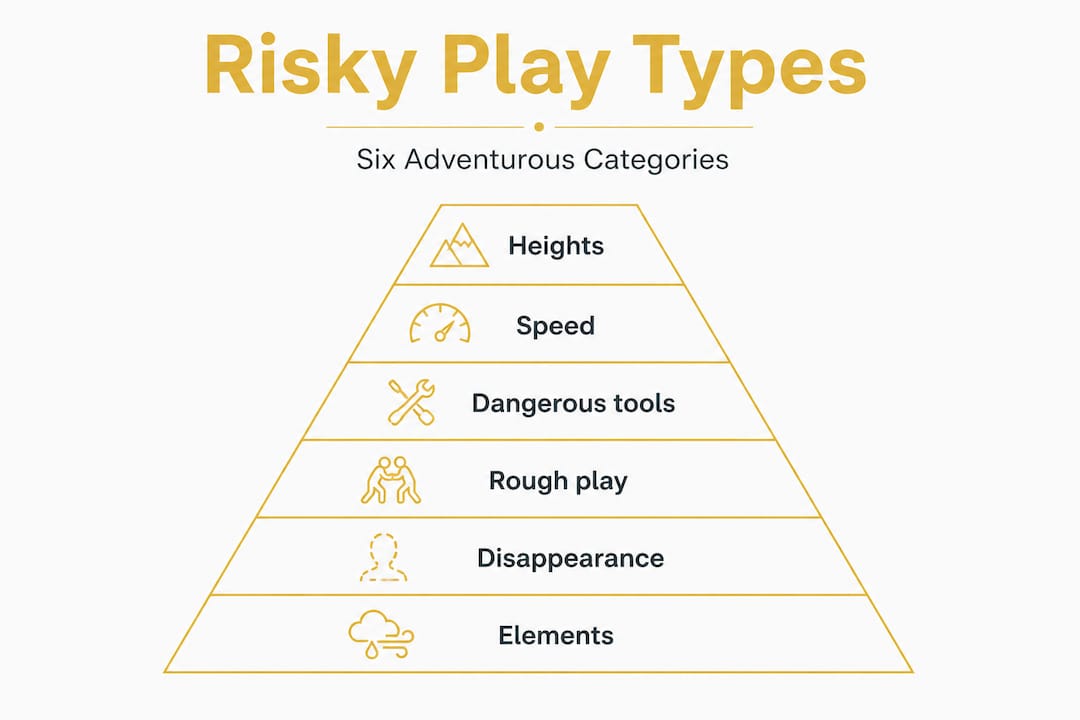
The science behind this is compelling. Research involving 622 teenagers found a 23% increase in well-being and a 36% increase in resilience following adventure trips in nature, with benefits strongest when exposure was progressive and repeated. These are not minor improvements. They reflect meaningful, measurable changes in how children see themselves and handle challenges.
You can read more about how nature-based sensory play supports early development, and for a broader view, explore the evidence on healthy risk-taking in kids and its connection to lifelong growth.
Common misconceptions about risky play:
- It always leads to serious injury (it doesn’t; most outcomes are minor)
- Only physically bold children benefit (cautious children gain just as much, especially over time)
- Adults must remain passive (thoughtful, calm supervision is encouraged)
- It’s the same as recklessness (risky play is purposeful and developmentally valuable)
The six faces of adventurous play
Now that we know why positive risk-taking matters, let’s break down the different forms it takes and how you can recognise and support them in nature-based play.
Understanding Sandseter’s six categories in practical terms makes it far easier to identify and encourage them. Here’s how each one shows up outdoors and what it offers your child:
| Category | Outdoor example | Key benefit |
|---|---|---|
| Play at heights | Climbing trees, scrambling boulders | Spatial awareness, confidence |
| High speed | Running downhill, sledging, cycling | Body control, thrill regulation |
| Dangerous tools | Using sticks, gardening tools, fire (supervised) | Focus, fine motor skills |
| Dangerous elements | Pond dipping, paddling in streams | Risk assessment, environmental curiosity |
| Rough-and-tumble | Wrestling, tumbling in leaves | Social limits, strength, empathy |
| Exploring alone | Walking ahead on a trail, den building | Independence, problem-solving |
To bring these categories into your family’s outdoor time, try this gradual approach:
- Start with observation. Let your child lead and notice which types of play they naturally gravitate towards. Don’t redirect immediately.
- Set the environment, not the rules. Choose places with natural features: trees, slopes, water, and open ground. Nature itself creates the right conditions.
- Assess readiness calmly. Consider your child’s balance, coordination, and how they’ve handled past challenges. Dynamic risk assessment means reviewing the situation in real time, evaluating the child’s state, preparing the setting, and supervising without hovering.
- Step back physically. Create distance between yourself and your child during play. Proximity often communicates doubt.
- Reflect together afterwards. Ask open questions: “What was the trickiest bit?” or “How did you figure that out?” This builds metacognition and emotional intelligence.
- Increase challenge gradually. Each time your child masters a level, introduce a slightly bigger version of the same challenge.
Pro Tip: Instead of instructing during play, narrate what you observe. Saying “You’re working out how to balance on that log” gives children language for their experience without interrupting their process.
For families new to this style of supervised adventurous exploration, starting with just one or two categories makes the transition far less daunting.
How positive risk-taking builds stronger, more resilient children
Understanding how to encourage adventurous play is vital, but why should you prioritise it for your child’s development? The science is clear.
Risky play in nature develops confidence, resilience, decision-making, physical strength, coordination, and the ability to assess personal limits. These are not vague promises; they are consistent findings across multiple disciplines including developmental psychology, education research, and paediatric health.
“Parental engagement with risk was associated with an additional 0.68 hours per week of adventurous play (nearly 40 minutes) and higher parental risk tolerance linked to better child emotion regulation and fewer behavioural problem symptoms.” — Cambridge Research Repository, study of 1,166 preschoolers
What that means in plain terms: when parents are comfortable with risk, children play more adventurously, regulate emotions better, and show fewer behavioural problems. The parent’s mindset directly shapes the child’s development.
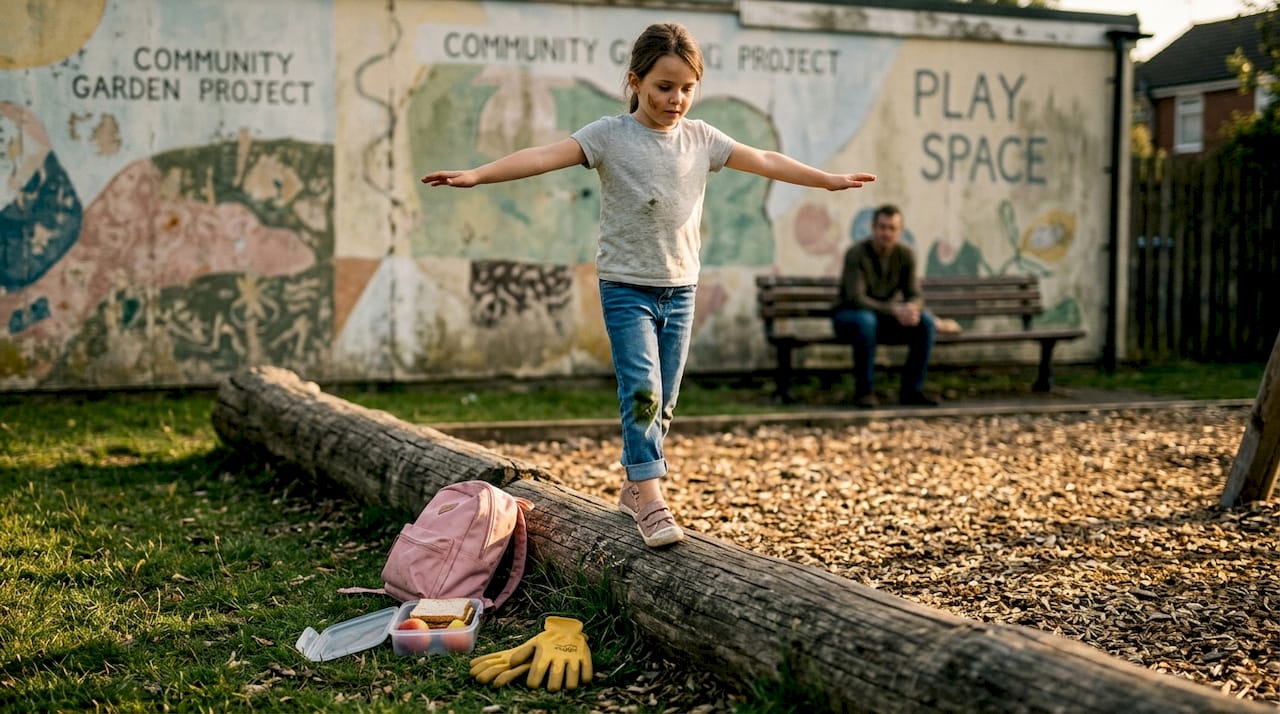
There is also an “anti-phobia” effect worth knowing about. Children who regularly encounter manageable challenges in nature become less fearful over time. They build an internal library of “I survived that” experiences that makes new situations feel less threatening. This is why children who grow up playing freely outdoors tend to show lower rates of anxiety in adolescence.
Developmental benefits backed by research:
- Emotional regulation: Navigating fear and excitement in play teaches children to manage strong feelings without shutting down
- Physical competence: Climbing, jumping, and rough play develop gross motor skills and body confidence
- Social skills: Rough-and-tumble and group exploration build negotiation, empathy, and communication
- Cognitive flexibility: Unstructured, risky play demands creative thinking and fast decision-making
- Independence: Solo exploration builds self-trust and problem-solving capacity
Pairing adventurous physical play with imaginative outdoor play creates a particularly rich developmental environment. Nature storytelling, creature hunts, and den-building can turn a single woodland afternoon into a full developmental workout.
Balancing safety and freedom: practical strategies for parents
With clear benefits in mind, the challenge for most parents is knowing how to manage both their own anxieties and keep their child genuinely safe during adventurous play.
Two frameworks are especially useful here. The REPS model asks parents to Review the environment, Evaluate the child’s readiness, Prepare the setting, and Supervise calmly. The TRiPS scale (Tolerance for Risk in Play Scale) helps parents identify their personal comfort level with different types of risk, making it easier to spot when anxiety rather than genuine danger is driving the urge to intervene.
Here’s a practical approach to dynamic risk assessment in real-life situations:
- Pause before reacting. When you feel the urge to call out “be careful,” take three seconds first. Ask yourself: is this a genuine hazard, or is it discomfort?
- Distinguish visible from hidden risks. A child balancing on a log represents visible, manageable risk. A broken bottle hidden in long grass is a hidden hazard worth addressing.
- Consider the full picture. Dynamic assessment accounts for weather, group dynamics, the child’s mood and energy level, and their past experience. What is appropriate on a warm, dry day may differ on a slippery one.
- Share supervision. In group settings, coordinating with other adults prevents over-intervention from multiple sources.
- Use the ‘good enough’ principle. A setting does not need to be perfectly safe; it needs to be good enough for the child’s current capability.
Pro Tip: Narrate your risk assessment out loud in a calm voice. Saying “The rocks look slippery today, let’s see how you do with your first step” models thoughtful evaluation instead of anxiety.
Readiness cues to look for:
- Steady balance and confident body language
- Previous successful navigation of similar challenges
- Clear focus and engagement (not distraction or fatigue)
- Willingness to slow down when uncertain rather than charging ahead
Research consistently shows that overprotection creates a risk deficit, increasing anxiety in children rather than reducing it. Authoritative parenting, which combines genuine warmth with appropriate structure and trust, consistently outperforms both permissive and overly strict approaches in supporting healthy risk-taking.
Exploring engaging outdoor activities as a starting point gives families low-pressure ways to practise this balance before tackling more adventurous terrain.
Overcoming common concerns: injury, anxiety, and parental fears
Despite all these proven benefits, many parents still hesitate, so let’s address the fears that hold us back.
The most common concern is injury. It is understandable; no parent wants to see their child hurt. But the evidence offers important reassurance: injuries from risky play are mostly minor, such as scrapes, bruises, and the occasional small cut, and the developmental benefits far outweigh the rare chance of something more serious.
“Interventions that boost parental confidence are the key factor in enabling children to play with appropriate freedom, without the excessive protection that creates long-term risk deficits.” — Cambridge Repository
Common fears and what research says:
- “My child will get seriously hurt.” Serious injuries in positive risk play are genuinely rare. Minor ones are common, expected, and part of learning.
- “I’ll be judged by other parents.” Studies show most parents actually value outdoor freedom; social pressure to overprotect is often overestimated.
- “My child is too cautious for this.” Cautious children benefit enormously from gradual exposure, often surpassing more impulsive children in their eventual confidence.
- “I don’t know enough to keep them safe.” REPS and TRiPS tools exist precisely for this; knowledge replaces anxiety with competence.
The concept of a “risk deficit” deserves more attention. When children never encounter manageable challenges, they don’t learn that they can cope. Instead, they develop a low tolerance for discomfort and a heightened fear response. The very strategy meant to protect them actually makes them more vulnerable in the long term.
Building your own confidence as a parent is a legitimate part of this process. Resources on lifelong growth through risk-taking can help you reframe your relationship with adventure and challenge as something positive to model, not manage away.
A real-world approach: what we’ve learnt about risk, nature, and growth
All this research is valuable, but nothing beats perspective gained from lived experience and reflective parenting.
Here at The Zoofamily, we’ve spent considerable time observing how children interact with nature when given genuine freedom, and the single most consistent finding is this: children rise to meet the environment, not our expectations. A forest doesn’t grade performance or praise outcomes. It simply responds. That honesty is what makes it such a powerful teacher.
One thing we’ve come to believe strongly is that controlled playground risk and real nature risk are not the same thing. A plastic climbing frame has been engineered for a specific challenge level. A tree has not. The tree changes with the season, the weather, and the child’s growing body. That variability is precisely where development happens. It cannot be replicated on rubber matting.
We’ve also noticed that children are acutely sensitive to adult energy. When a parent watches with visible tension, children unconsciously shrink their play. When a parent sits nearby absorbed in something else, children expand. This isn’t about neglect; it’s about trust communicated through body language and presence.
The bumps and setbacks matter too. A child who falls from a low branch, dusts themselves off, and tries again is practising something profound: the belief that failure is survivable. That belief becomes the foundation of every ambitious thing they attempt later in life. Exploring the full range of benefits of sensory play in nature alongside physical risk creates a particularly well-rounded outdoor experience, engaging the whole child rather than just their bravery.
The uncomfortable truth is that raising resilient children sometimes requires parents to sit with their own discomfort first. That’s not easy. But it is deeply worth it.
Explore more ways to raise confident, resilient children
If you’re ready to put these lessons into practice, here’s where to find further guidance and community support.
At The Zoofamily, we believe the best way to raise nature-loving, resilient children is to give them the tools and the freedom to explore. Our resources bring together the best thinking on nature-based parenting, creative outdoor play, and positive risk-taking in one place. Whether you’re just starting out or looking for fresh ideas for your next family adventure, we have practical guides to support every step.
From step-by-step guided nature explorations to activity inspiration for all ages and abilities, our blog is designed to help families go further, more confidently, and with greater joy. Because every tree your child climbs is a little more of the world they’re learning to trust, including themselves.
Frequently asked questions
What is dynamic risk assessment in children’s play?
Dynamic risk assessment means judging the child’s readiness, the environment, and the situation in real time, then adjusting your supervision and support accordingly rather than applying fixed rules.
Are injuries from positive risk-taking common or dangerous?
Most injuries are minor, such as scrapes or bruises; serious harm is rare, and the long-term developmental benefits of learning to manage risk significantly outweigh the small chance of anything more serious.
How can I help a cautious child embrace positive risk?
Start with very small challenges in familiar settings, increase the difficulty gradually, and praise effort over outcome; cautious children need incremental exposure to build genuine confidence rather than just compliance.
Does parental anxiety impact children’s willingness to take risks?
Yes, children pick up on adult tension quickly; boosting parental confidence is one of the most effective ways to increase children’s adventurous play and emotional resilience.
Recommended
- Parenting Through Nature Play – Raising Eco-Conscious Kids – The Zoofamily
- Foster your child’s bond with nature: play, learn, thrive – The Zoofamily
- How to nurture healthy risk-taking in kids for lifelong growth – The Zoofamily
- Activités sportives enfants : bienfaits, âges et astuces
- Anger Management Activities for Kids | Masteringanger.com®