

Did you know that children who engage in creative play show higher self-esteem and resilience as they grow? Creativity shapes much more than artistic ability, influencing how kids solve problems, communicate, and adapt to new challenges. By fostering imaginative thinking early on, parents and caregivers can set the stage for stronger cognitive, emotional, and social development that lasts a lifetime.
Key Takeaways
| Point | Details |
|---|---|
| Importance of Creativity | Creativity is essential for cognitive and emotional development, enhancing self-esteem and resilience. |
| Role of Imaginative Play | Engaging in imaginative play fosters problem-solving, emotional regulation, and social skills. |
| Nurturing Environment | Parents should cultivate open-ended experiences and celebrate unique solutions to stimulate creativity. |
| Overcoming Obstacles | Focus on the process rather than perfection to create a safe space for experimentation and growth. |
Table of Contents
- Defining Creativity In Children’s Development
- Types Of Creative Expression In Kids
- Proven Methods To Stimulate Creativity
- Nature-Inspired Activities For Young Minds
- Common Obstacles And How To Overcome Them
Defining Creativity In Children’s Development
Creativity isn’t just about painting masterpieces or composing symphonies. Creativity is a fundamental cognitive process that enables children to explore, imagine, and solve problems in unique ways. At its core, it’s about thinking beyond the obvious and discovering innovative solutions through curiosity and playful exploration.
Neuroscience research reveals that creativity is deeply intertwined with a child’s developmental journey. According to research from behavioral sciences, creativity in adolescence positively correlates with self-esteem, academic performance, and serves as a predictor of resilience and well-being. This means nurturing creativity isn’t just an artistic endeavour—it’s a critical component of building a child’s emotional and cognitive foundation.
Imaginative play emerges as a powerful catalyst for creativity. Neuroscientific studies emphasize that self-initiated, process-oriented play is crucial for cognitive, emotional, and social development. Children engaged in imaginative play are essentially practicing crucial life skills:
- Problem-solving through make-believe scenarios
- Emotional regulation by exploring different perspectives
- Social interaction and communication skills
- Developing flexible thinking patterns
By understanding creativity as a holistic developmental process, parents can create environments that encourage spontaneous discovery and intellectual curiosity. Learn more about the benefits of imaginative play and how it shapes your child’s cognitive landscape.
Types Of Creative Expression In Kids
Creative expression is a vibrant landscape where children discover themselves through multiple engaging channels. According to learning through play research, creative expression encompasses diverse activities that allow children to explore, experiment, and communicate their inner worlds in fascinating ways.
Traditional creative expressions provide rich developmental opportunities. Role-play and imaginative scenarios enable children to understand complex social dynamics, while construction activities help develop spatial reasoning and problem-solving skills. Art forms like drawing, painting, and sculpting allow emotional processing and fine motor skill development.
Practical creative expressions span multiple domains:
- Storytelling: Verbal and written narrative creation
- Performing Arts: Puppet shows, dance, and musical performances
- Construction Activities: Building with blocks, Lego, and other constructive materials
- Nature Art: Creating artwork using natural materials
- Technology-Assisted Creativity: Digital drawing, basic coding, and video editing
Explore our guide on making learning fun and discover innovative ways to nurture your child’s creative potential. Each expression offers unique developmental benefits, transforming play into a powerful learning experience that stimulates cognitive, emotional, and social growth.
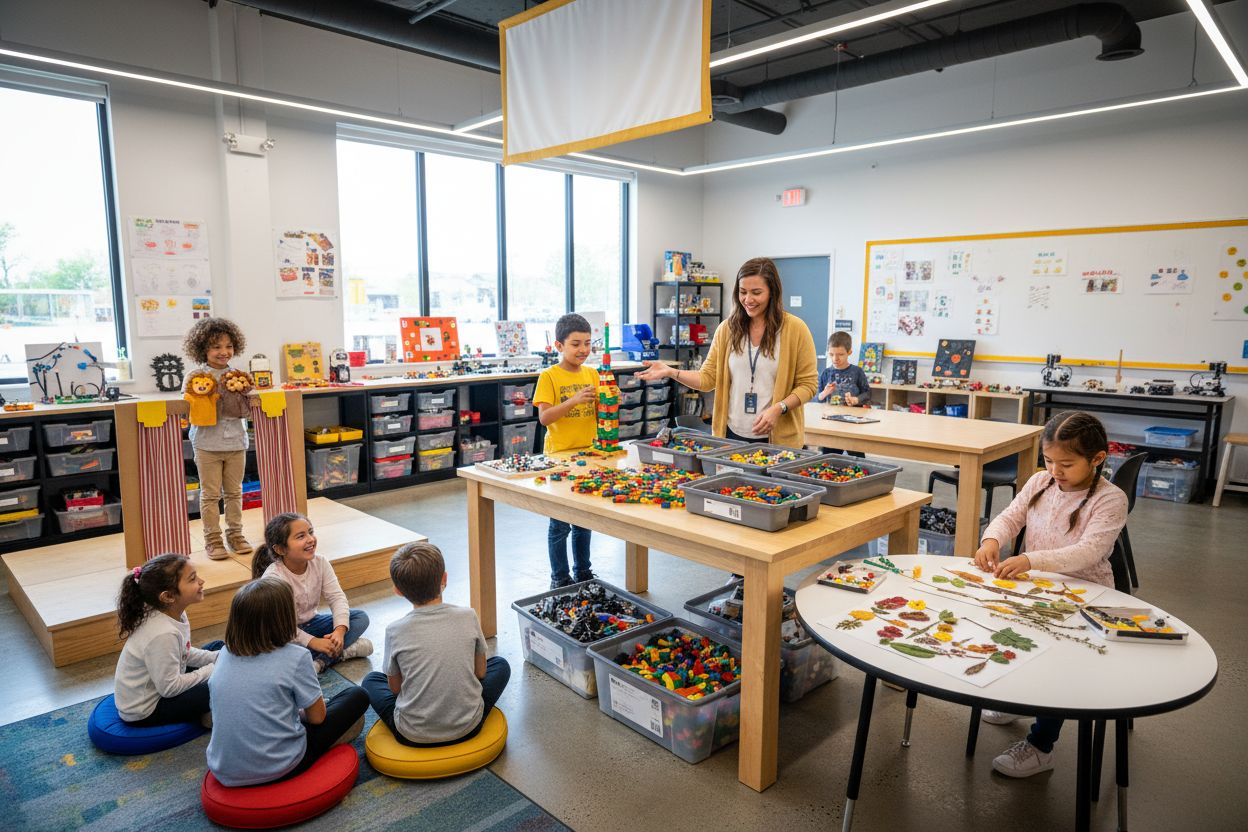
Here’s a comparison of major types of creative expression in children’s development:
| Creative Expression Type | Key Activities | Main Developmental Benefits |
|---|---|---|
| Storytelling | Writing Oral stories Role-play |
Language skills Imagination Confidence |
| Performing Arts | Dance Puppet shows Music |
Self-expression Social skills Coordination |
| Construction Activities | Lego Blocks Sculpting |
Problem-solving Fine motor skills |
| Nature Art | Leaf collages Stone painting |
Environmental awareness Sensory exploration |
| Technology-Assisted | Digital drawing Basic coding Editing |
Digital literacy Logic Creativity |
Proven Methods To Stimulate Creativity
Creative thinking isn’t a mysterious talent but a skill that can be intentionally cultivated through strategic approaches. According to research from child development experts, stimulating creativity requires creating environments that encourage open-ended experiences, imaginative questioning, and supportive interactions.
Parents play a crucial role in nurturing creativity by designing learning experiences that challenge conventional thinking. This means moving beyond structured, prescriptive activities and embracing approaches that invite exploration. Open-ended play becomes a powerful tool, where children are encouraged to experiment without predetermined outcomes, allowing their imagination to flourish naturally.
Key strategies for stimulating creativity include:
- Asking open-ended questions that prompt deeper thinking
- Providing unstructured time for free play
- Exposing children to diverse experiences and environments
- Celebrating unique solutions and divergent thinking
- Creating safe spaces for experimentation without fear of failure
- Limiting screen time and encouraging hands-on interactions
Learn more about engaging activities for kids that spark imagination and creative potential. Research indicates that when parents and educators understand developmental stages and design interventions accordingly, children’s originality and creative thinking can be significantly enhanced.
Nature-Inspired Activities For Young Minds
Nature exploration offers an extraordinary canvas for children’s creativity, transforming outdoor experiences into powerful learning opportunities. According to psychological research, engaging with natural environments activates the brain’s default mode network, encouraging reflective thinking and sensory engagement that stimulates creative potential.
Outdoor activities provide rich, multisensory experiences that go beyond traditional learning methods. When children interact with natural elements, they develop a profound connection with their environment, learning to observe, experiment, and imagine. Sensory exploration becomes a gateway to understanding complex ecological systems and nurturing innate curiosity about the world around them.
Inspiring nature-based creative activities include:
- Nature Art: Creating artwork using leaves, flowers, stones
- Gardening: Planting seeds, observing growth cycles
- Scavenger Hunts: Discovering and collecting natural objects
- Outdoor Sketching: Drawing landscapes, plants, and wildlife
- Natural Sound Exploration: Listening and mimicking environmental sounds
- Ecological Storytelling: Crafting narratives inspired by natural observations
Discover engaging activities that connect kids with nature, transforming outdoor experiences into memorable learning adventures that spark imagination and environmental awareness.
Common Obstacles And How to Overcome Them
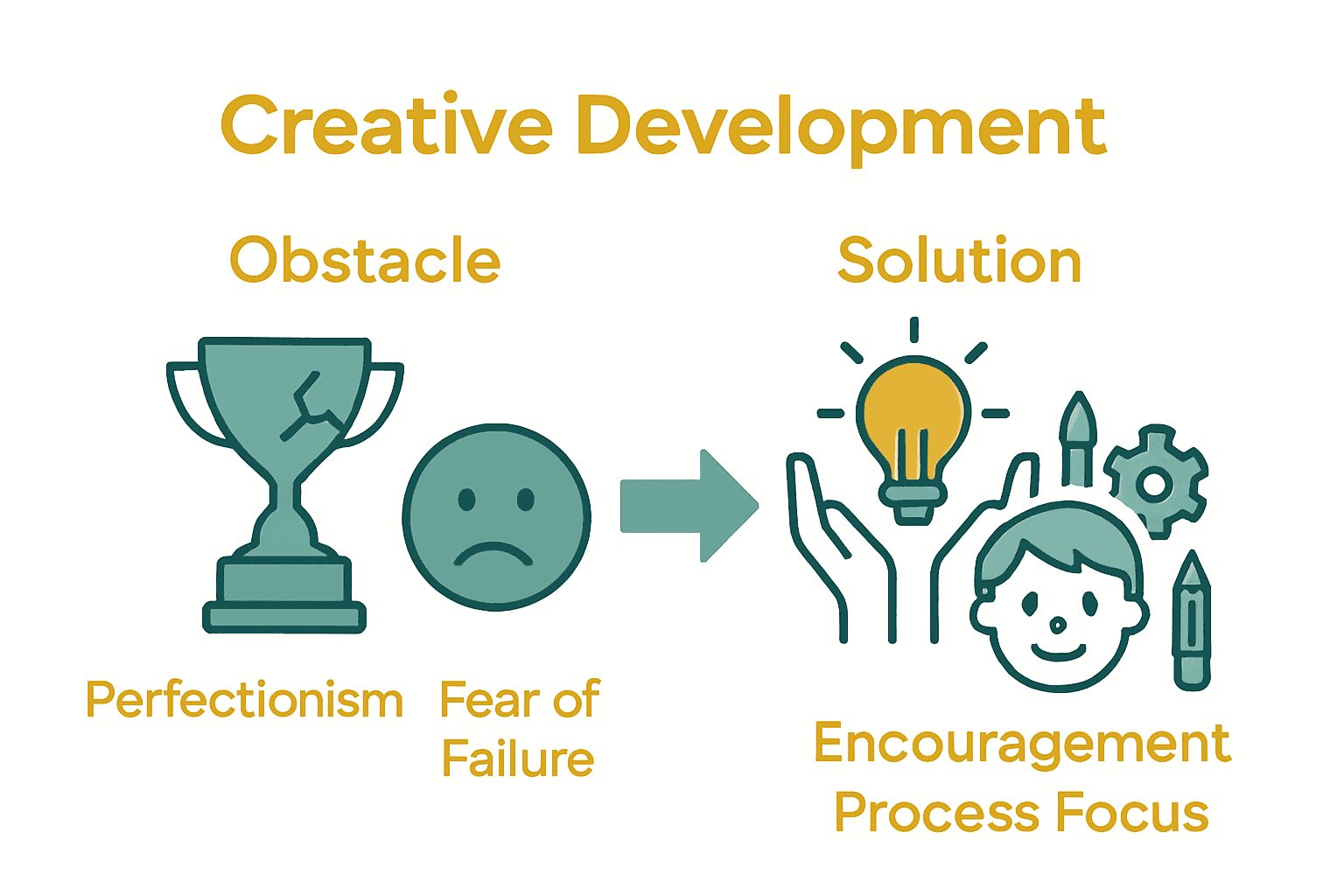
Creative development isn’t always smooth, and parents often encounter subtle roadblocks that can unintentionally limit their children’s imaginative potential. According to parenting research, many well-intentioned approaches can inadvertently stifle creativity, such as over-praising finished products or discouraging children from taking risks in their exploratory process.
One of the most significant barriers is the tendency to focus on perfection rather than the learning journey. Mistake tolerance becomes crucial in nurturing creative resilience. When children feel safe experimenting and understand that errors are valuable learning opportunities, they become more likely to take intellectual risks, think unconventionally, and develop robust problem-solving skills.
Key strategies to overcome common creative obstacles include:
- Asking open-ended questions that provoke deeper thinking
- Celebrating the process, not just the final result
- Creating a judgment-free environment for exploration
- Balancing digital interactions with hands-on creative experiences
- Encouraging divergent thinking and unique problem-solving approaches
- Providing diverse, unstructured play opportunities
Learn more about making learning fun and engaging and discover how to transform potential obstacles into opportunities for creative growth. Remember, creativity thrives in environments that value curiosity, experimentation, and personal exploration.
Inspire Boundless Creativity and Nature Connection with The Zoofamily
You have learned that nurturing your child’s creativity is not only about encouraging artistic skills but also about building confidence resilience and a lifelong love of discovery. Many parents struggle to provide the right environment for curiosity exploration and imaginative play especially when daily routines limit time outdoors and access to stimulating tools. If you are seeking ways to overcome barriers like perfectionism or lack of inspiration at home The Zoofamily provides everything you need to empower creative thinking and meaningful connections with the natural world.
Transform your child’s play into a journey of creative expression and environmental awareness. Discover our unique range of animal-inspired kids’ cameras walkie-talkies and binoculars on The Zoofamily website. Every purchase not only helps your child explore and capture the beauty of nature with joy and confidence but also gives back to the planet by planting a tree with every camera sold. Take the next step towards unlocking limitless imagination and support a greener world by visiting The Zoofamily now.
Frequently Asked Questions
How can I stimulate my child’s creativity at home?
To stimulate your child’s creativity at home, provide unstructured playtime, ask open-ended questions, celebrate unique solutions, and create a safe environment for experimentation. Encouraging imaginative play and exposure to diverse experiences also enhances creativity.
What types of creative expression are beneficial for children’s development?
Beneficial types of creative expression for children include storytelling, performing arts, construction activities, nature art, and technology-assisted creativity. Each of these activities enhances various skills such as language development, problem-solving, and emotional regulation.
How does nature exploration enhance creativity in children?
Nature exploration enhances creativity by providing multisensory experiences that foster observation, experimentation, and imagination. Engaging with natural environments can activate the brain’s creativity centers and encourage reflective thinking.
What common obstacles might hinder my child’s creative development, and how can I overcome them?
Common obstacles to creative development include focusing too much on perfection, discouraging risk-taking, and providing overly structured activities. To overcome these, celebrate the learning process, create a judgment-free environment, and encourage divergent thinking.