

Top rainy day outdoor play ideas for children
Rain is not a reason to stay indoors. Wet weather gives children a completely different sensory experience, and the activities below work for a wide range of ages with little or no special equipment.
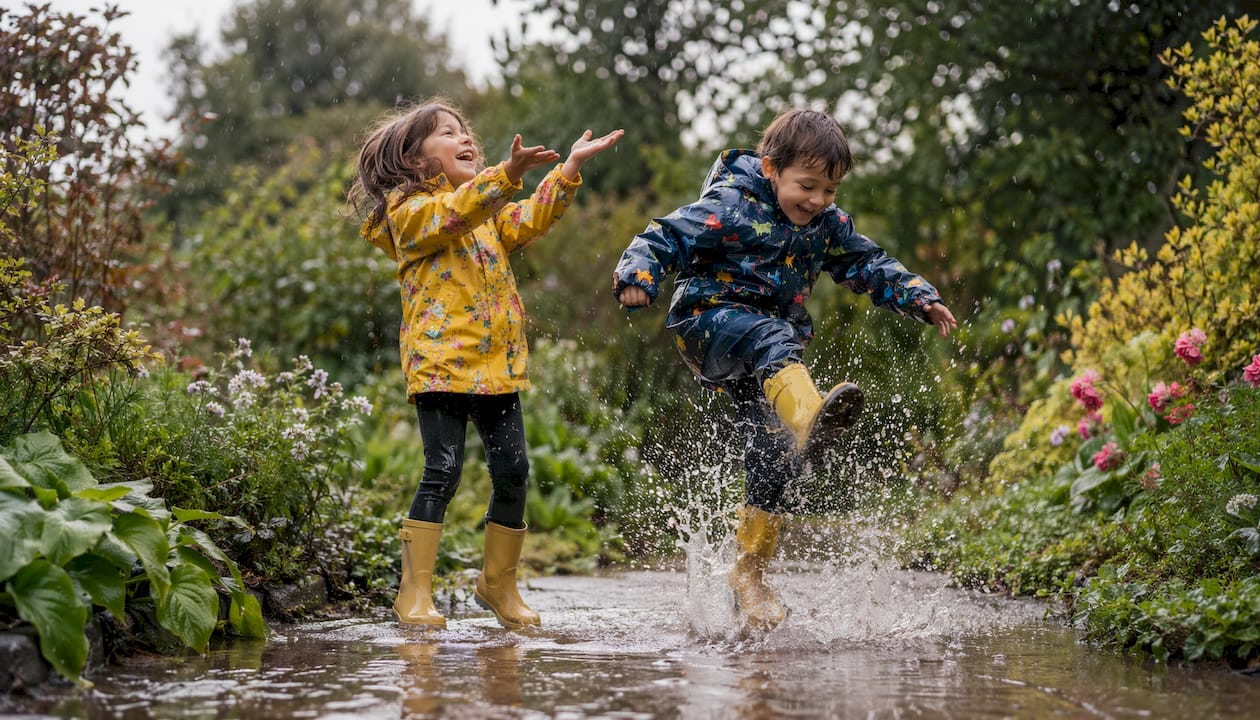
- Puddle jumping. Put on wellies and jump. Simple, physical, and endlessly satisfying for toddlers and primary-age children alike.
- Mud pie making. Collect mud, leaves, stones, and petals to build and decorate pies. Fine motor skills get a real workout here.
- Dam building. Find flowing water in the garden or a local path and use sticks, mud, and stones to redirect it. This is practical engineering thinking for children as young as four.
- Nature walk. Rain brings out slugs, snails, worms, and frogs. Take a magnifying glass and turn the walk into a wildlife survey.
- Mud painting. Dip a stick or old paintbrush in mud and paint on paving slabs, card, or paper. The rain washes it away naturally.
- Leaf boat racing. Collect bark, leaves, and twigs, build small boats, and race them down a stream or gutter.
- Rain art. Draw on paper with washable markers, then leave it in the rain and watch the colours bleed into patterns.
- Rain rhythm orchestra. Set out pots, pans, and metal bowls in the garden and listen to the different sounds raindrops make on each surface.
- Minibeast hunt. Search under logs, around plant pots, and in damp flowerbeds for worms, snails, and beetles.
- Raindrop catching. Cup hands, catch rainwater, and compare how quickly different containers fill up.
These activities support gross and fine motor development, sensory engagement, and early science thinking. None of them require buying anything new.
Creative and educational outdoor activities in the rain
Each activity below has a clear developmental purpose alongside the fun.
- Dam building teaches problem-solving and basic engineering. Children test which materials hold water back, adjust their design, and try again. That trial-and-error process builds persistence.
- Mud pie making engages fine motor skills through moulding, pressing, and decorating with natural materials. For younger children, the imaginative play element (running a mud café, for instance) extends their understanding of everyday routines.
- Leaf boat racing introduces early concepts of buoyancy and design. Children quickly discover that a flat leaf floats longer than a heavy stick, and they start modifying their boats without being prompted.
- Rain art connects mark-making with observation. Children predict what will happen to their drawing, then check the result. That prediction-and-observation loop is the foundation of scientific thinking.
- Minibeast hunting builds vocabulary, classification skills, and genuine curiosity about ecosystems. Bring a nature journal and sketch what you find.
- Mud painting is a full sensory experience: the smell of wet earth, the cool texture of mud, and the visual contrast of dark marks on pale paving. The sensory engagement from wet textures and raindrop sounds activates developing senses in ways indoor play rarely matches.
- Rain rhythm orchestra develops listening skills and an ear for pitch. Metal bowls produce a sharp ring; plastic tubs give a dull thud. Children naturally start experimenting with sequences and rhythm.
| Activity | Key skill developed | Best age range | Equipment needed |
|---|---|---|---|
| Dam building | Problem-solving, engineering | — | Sticks, mud, stones |
| Mud pie making | Fine motor skills, imagination | — | Mud, natural materials |
| Leaf boat racing | Early science, design thinking | — | Leaves, bark, twigs |
| Rain art | Observation, creativity | — | Paper, washable markers |
| Minibeast hunt | Classification, curiosity | — | Magnifying glass, notebook |
| Rain rhythm orchestra | Listening, rhythm | — | Pots, pans, bowls |
Adapting for different abilities is straightforward. Younger children or those with limited mobility can focus on sensory activities at ground level: touching mud, listening to rain, or filling containers with rainwater. Older or more active children can take on the engineering challenges of dam building or shelter construction.
How to prepare children safely for outdoor play in wet weather
Good preparation makes rainy outdoor sessions enjoyable rather than miserable. These guidelines apply specifically to UK conditions, where temperatures can drop quickly even in summer.
- Clothing. A waterproof jacket with a hood, waterproof trousers, and wellies are the minimum. Layering underneath keeps body temperature stable. Avoid cotton as a base layer; it holds moisture against the skin.
- Stop immediately in a storm. Thunder or lightning means play stops at once. Rain alone is safe; electrical storms are not.
- Supervision and boundaries. Clear geographic boundaries and low-key but consistent monitoring are the standard approach for wet conditions. Slippery surfaces, rising water in streams, and blocked drains all need an adult’s eye.
- Slippery surfaces. Wet paving, grass, and mud increase the risk of falls. Choose play areas with soft ground where possible, and check for hidden hazards like fallen branches before children start.
- Hypothermia risk. Children lose heat faster than adults. Watch for shivering, pale skin, or unusual quietness. A good rule of thumb for UK weather: limit sessions to 30–45 minutes in temperatures below 10°C, and come in sooner if a child is visibly cold.
- Puddle depth. Puddles can be deeper than they look. An adult should test depth before children jump in.
- Post-play transition. Set up a “landing strip” near the door: a mat, a bag for wet clothes, dry towels, and a change of clothing ready to go. Getting warm and dry quickly prevents discomfort and keeps the experience positive for next time.
Pro Tip: Lay out dry clothes and a warm drink before you go outside. The faster the transition indoors, the more willing children are to go out again next time.
What experts say about the benefits of rainy outdoor play
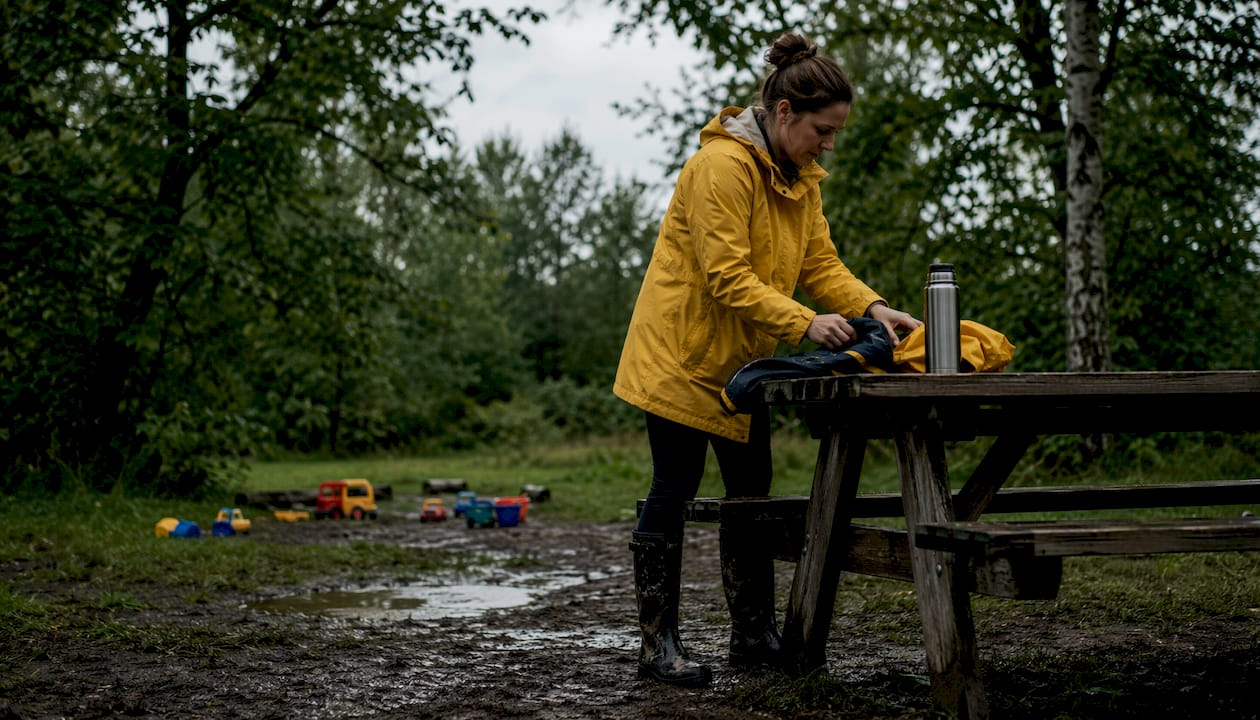
The developmental case for wet-weather play is well established. A 2025 University of Nebraska-Lincoln extension report confirms that wet terrain stimulates gross motor growth and sensory engagement that indoor environments rarely replicate. Navigating slippery ground strengthens balance and coordination. Running through puddles is a genuine cardiovascular workout. Manipulating wet leaves and mud develops fine motor control.
The caregiver’s attitude shapes the child’s response more than the weather does. Research from the University of Nebraska-Lincoln shows that adults who treat rain as a barrier find children mirror that avoidance. Adults who show enthusiasm get children who explore with confidence. Outdoor play advocates describe rain as “magic weather” that turns ordinary environments into something new, and that framing genuinely shifts children’s experience from reluctance to curiosity.
Experts also stress that adults should resist directing play during rainy sessions. Asking open questions (“What happens when you mix mud and water?”) and then stepping back gives children the autonomy to make decisions, which builds problem-solving skills more effectively than structured tasks.
Pro Tip: Before heading out, ask your child to choose one activity from a short list. That small act of choice increases their engagement and willingness to stay outside longer.
Rainy outdoor play supports physical, sensory, emotional, and cognitive development together. That combination is difficult to replicate indoors, regardless of how many toys or activities you provide.
Understanding the UK’s rainy climate for outdoor play
The UK’s weather is genuinely unpredictable, and that is actually useful to know when planning outdoor sessions. Rain can arrive at any time of year, but the character of that rain varies considerably.
Spring and autumn bring frequent light showers, often short-lived, which are ideal for outdoor play. Summer rain tends to be warmer, making it the most comfortable season for children to get thoroughly wet. Winter rain is a different matter: temperatures below 5°C combined with wind and wet clothing create a real hypothermia risk, so sessions should be shorter and clothing layers more substantial.
The Met Office reports that the UK averages around 133 days of rain per year across most regions, with the west of England, Wales, and Scotland receiving considerably more. That frequency means waiting for dry weather before going outside is not a practical approach for most families. Building a habit of wet-weather play is the more realistic strategy.
Wind is often the bigger challenge than rain itself. A light drizzle in still air is easy to manage; the same temperature with a strong wind feels much colder. Check wind speed alongside temperature before deciding on session length. A waterproof jacket with a fitted hood handles most UK conditions well.
Local parks and woodland paths are generally safe for rainy-day visits, but avoid areas near rivers or streams after heavy rainfall. Water levels can rise quickly and unpredictably. Stick to higher ground and open spaces where you can see the full play area clearly.
Thezoofamily’s outdoor tools for rainy day adventures

Thezoofamily makes kids’ cameras, binoculars, and walkie-talkies designed specifically to enrich children’s connection with the natural world. On a rainy day, these tools give outdoor play an extra layer of purpose: children can photograph rain patterns on leaves, spot minibeasts through binoculars, or coordinate a wildlife survey across the garden using walkie-talkies.
Every camera sold plants one tree, so each purchase directly supports the natural environments children are learning to appreciate. The products are built around animal references that prompt curiosity about wildlife, which fits naturally with the minibeast hunts, nature walks, and rainy day adventures described in this article.
Benefits these tools add to wet-weather outdoor exploration:
- Cameras encourage children to observe and document nature rather than just pass through it.
- Binoculars extend the range of wildlife spotting without disturbing animals.
- Walkie-talkies support cooperative play and communication across a garden or park.
- Animal-themed designs connect play directly to nature curiosity.
Browse the full range at Thezoofamily and find the right tool for your child’s next outdoor session.
Key takeaways
Rainy outdoor play develops children’s gross motor skills, sensory awareness, and problem-solving ability in ways that indoor play cannot replicate.
| Point | Details |
|---|---|
| Rain is safe for play | Thunder and lightning stop play immediately; rain alone, with proper clothing, is safe for children. |
| Clothing is the priority | Waterproof jacket, trousers, and wellies are the minimum; layer underneath and avoid cotton base layers. |
| Caregiver attitude matters | Adults who show enthusiasm for wet weather raise children who explore confidently rather than avoid rain. |
| Session length in cold weather | Limit outdoor sessions to 30–45 minutes below 10°C and come in sooner if a child shows signs of cold. |
| Thezoofamily outdoor tools | Kids’ cameras, binoculars, and walkie-talkies from Thezoofamily add purpose and curiosity to rainy day nature play. |