

Children under five ask an average of 300 questions every day, showing a deep desire to understand their world. When parents tap into this natural curiosity, learning transforms from a routine to a meaningful adventure. Child-led exploration encourages kids to follow their interests, build independence, and develop real problem-solving skills that last a lifetime.
Key Takeaways
| Point | Details |
|---|---|
| Child-Led Exploration | A child-led approach empowers children to learn through their natural curiosity, allowing them to follow their interests without adult control. |
| Role of Adults | Parents should act as facilitators by providing resources and support, rather than dictating learning paths or outcomes. |
| Developmental Benefits | This method enhances cognitive skills, social interaction, and confidence, fostering a lifelong love of learning. |
| Creating an Optimal Environment | Design inviting spaces that encourage exploration, and balance guidance with independence to promote natural learning processes. |
Table of Contents
- What Is Child Led Exploration?
- Types Of Child Led Exploration Activities
- Key Benefits For Children’s Development
- How To Foster Exploration At Home
- Common Challenges And Solutions
What Is Child Led Exploration?
Child-led exploration is a dynamic learning approach where children guide their own discovery process, driven by genuine curiosity and intrinsic motivation. Unlike traditional teaching methods where adults dictate learning paths, this strategy empowers children to follow their natural interests and investigate topics that genuinely spark their imagination.
According to research in Child Development, 4-year-olds are remarkably strategic in their exploration, choosing learning activities not just based on novelty but on where they anticipate making the most progress. This sophisticated decision-making reveals children have an innate ability to direct their own learning journey when given appropriate support and freedom.
In practice, child-led exploration means parents become facilitators rather than instructors. Scaffolding becomes key - adults provide resources, ask open-ended questions, and create environments that encourage discovery without controlling the entire process. Psychology Today explains this approach builds on a child’s specific interests, whether that’s fascination with fire trucks, marine animals, or astronomical phenomena.
Key characteristics of child-led exploration include:
- Following the child’s natural curiosity
- Allowing unstructured play and investigation
- Providing supportive guidance without dominating
- Respecting the child’s unique learning rhythm
- Creating safe, stimulating environments for independent discovery
By embracing this approach, parents can nurture their children’s inherent love of learning, boost confidence, and develop critical thinking skills that extend far beyond traditional educational frameworks.
Learn more about engaging kids’ curiosity in our guide on making learning fun.
Types of Child Led Exploration Activities
Child-led exploration encompasses a diverse range of activities that tap into a child’s natural curiosity and learning potential. According to Free Range Scholars, these activities span multiple domains, encouraging children to investigate the world through their unique lens of interest and discovery.
Natural exploration stands out as a primary avenue for child-led learning. Outdoor adventures allow children to engage directly with their environment, investigating plants, insects, rocks, and natural phenomena through hands-on experiences. Research suggests children can create their own learning journeys by collecting specimens, observing wildlife, and asking spontaneous questions about their surroundings.
Creative and imaginative activities form another crucial dimension of child-led exploration. According to Paths of Learning, age-appropriate activities like treasure hunts, role-playing community helpers, storytelling circles, and collaborative problem-solving tasks can stimulate intellectual growth. These activities enable children to:
- Develop critical thinking skills
- Practice social interaction
- Express creativity
- Build confidence through self-directed learning
- Explore diverse interests organically
Artistic expression and building projects also play significant roles in child-led exploration. Whether constructing elaborate structures with blocks, creating artwork, or designing imaginative scenarios, children learn complex skills through unstructured play. Discover more engaging activities in our guide on making learning fun, which provides additional insights into nurturing children’s natural learning instincts.
Here’s a summary of the main types of child-led exploration activities:
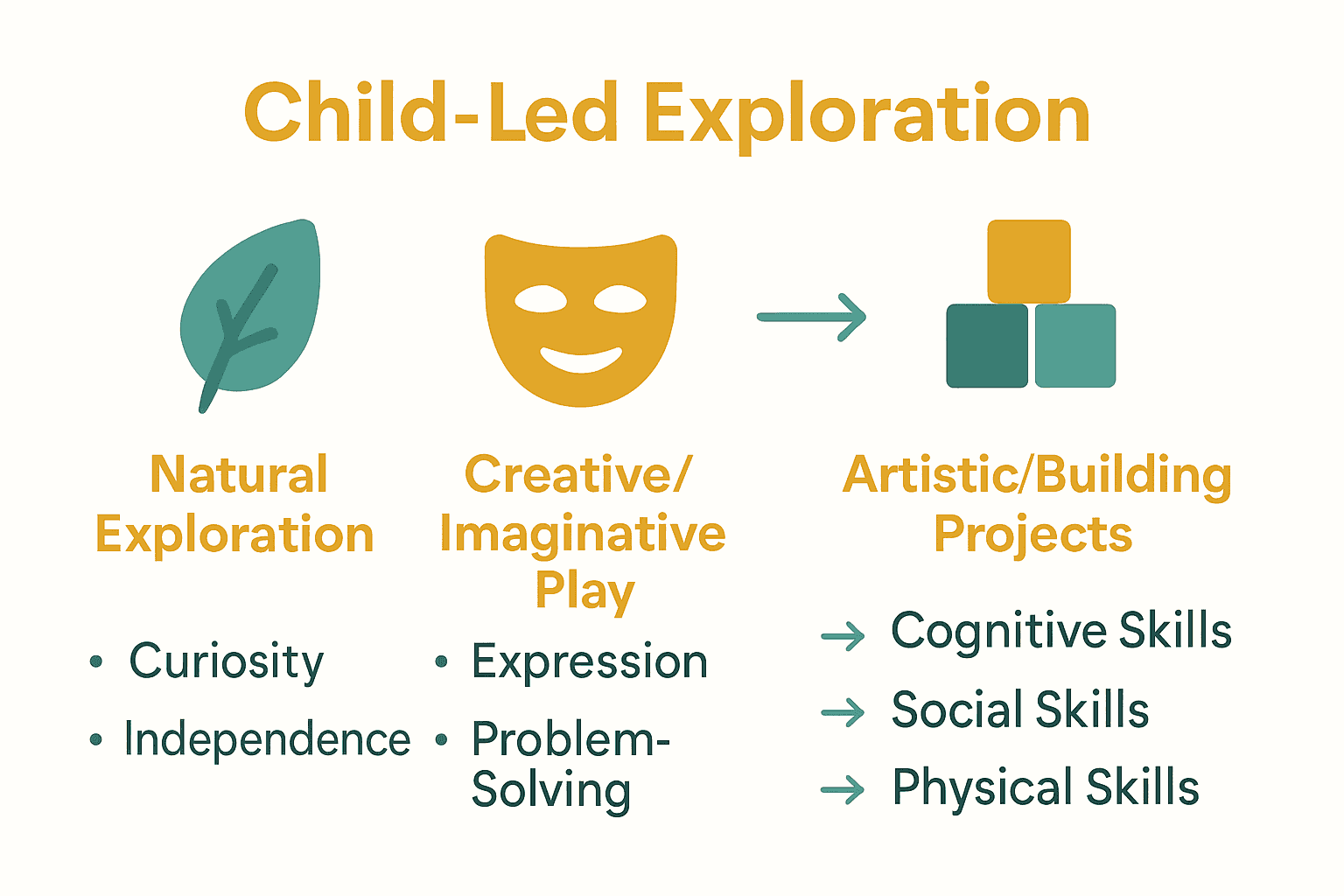
| Activity Type | Description | Key Benefits |
|---|---|---|
| Natural Exploration | Outdoor adventures Investigating nature |
Hands-on learning Curiosity-driven discovery |
| Creative/Imaginative | Role play Storytelling Treasure hunts |
Critical thinking Social interaction Confidence |
| Artistic/Building | Constructing with blocks Artwork |
Fine motor skills Problem-solving Self-expression |
Key Benefits for Children’s Development
Child-led exploration offers profound developmental advantages that extend far beyond traditional learning approaches. According to Psychology Today, this approach fundamentally transforms how children engage with learning, creating a more intrinsic and sustainable educational experience.
Cognitive development stands at the forefront of these benefits. Research indicates that when children direct their own learning, they demonstrate enhanced performance, increased creativity, and stronger critical thinking skills. By following their natural curiosity, children develop deeper understanding and retain information more effectively compared to structured, top-down educational models.
Psychological and social benefits are equally compelling. Entri Blog emphasizes that child-led learning significantly boosts children’s confidence and social skills. When children choose their learning paths, they experience:
- Increased intrinsic motivation
- Greater emotional resilience
- Improved problem-solving capabilities
- Enhanced self-awareness
- Reduced learning-related stress
Moreover, this approach nurtures long-term learning attitudes. Children learn to view challenges as opportunities for growth rather than obstacles, developing a growth mindset that will serve them throughout their lives. Learn more about childhood brain development in our comprehensive guide for modern European parents, which explores how child-led approaches can positively impact cognitive growth.
How to Foster Exploration at Home
Creating an environment that nurtures child-led exploration requires intentional strategy and thoughtful design. According to Jeulli, parents can transform their home into a dynamic learning landscape that encourages natural curiosity and independent discovery.
Environmental design plays a crucial role in stimulating exploration. Research suggests displaying intriguing objects, providing open-ended materials, and creating dedicated spaces that invite investigation.
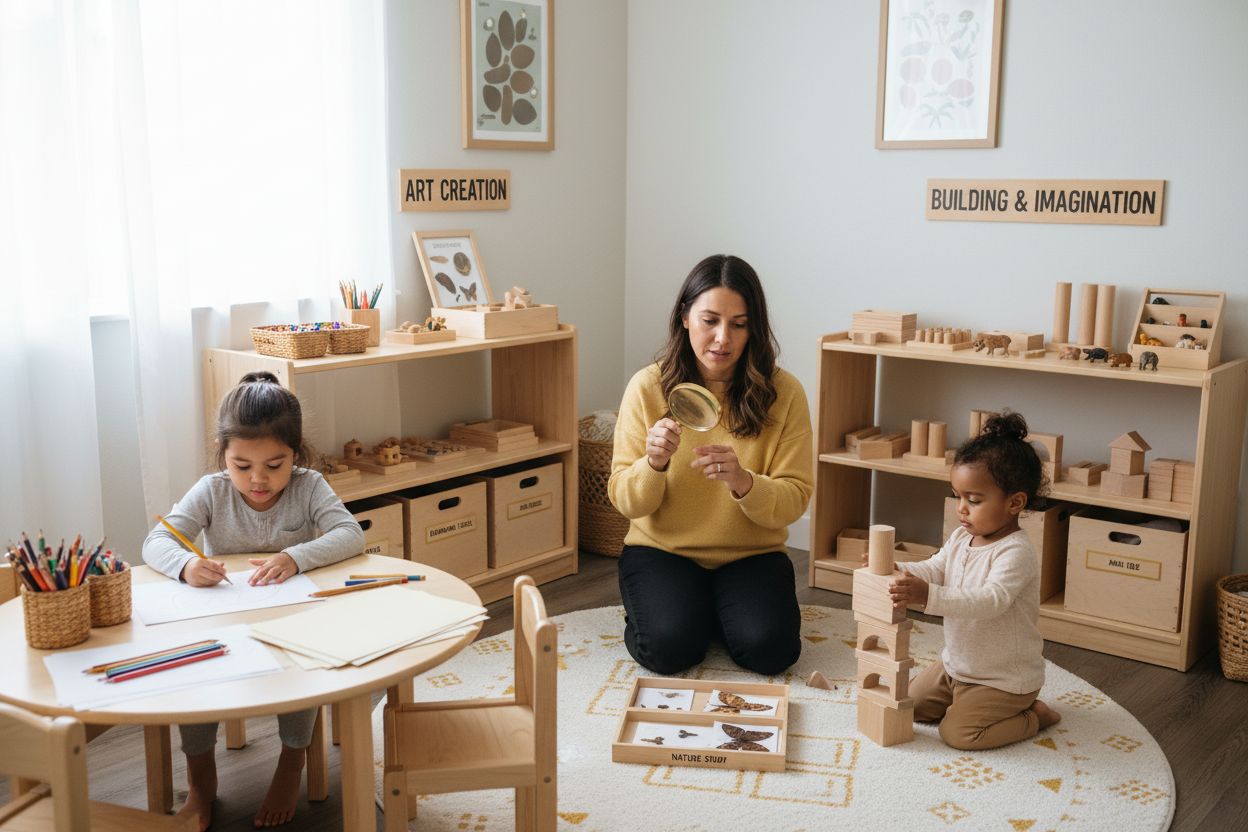 The One Intervention Centre recommends rotating toys periodically to maintain novelty and prevent sensory fatigue, ensuring children remain consistently engaged and motivated to explore.
Parental interaction is equally important in fostering exploration. Key strategies include:
- Asking open-ended questions
- Modeling curious behavior
- Allowing unstructured play time
- Engaging at the child’s developmental level
- Avoiding immediate problem-solving
- Celebrating process over perfect outcomes
Practical implementation means creating inviting spaces with accessible materials, encouraging spontaneous investigation, and supporting children’s natural inclination to learn through hands-on experiences. Explore our guide on nature discoveries and Montessori-inspired learning techniques to further enhance your home’s exploratory potential.
Common Challenges and Solutions
Child-led exploration, while immensely beneficial, can present unique challenges for parents accustomed to more structured learning approaches. Understanding these potential obstacles is crucial for successfully implementing this dynamic educational strategy.
One primary challenge is balancing guidance and independence. According to Harvard’s Playful Learning framework, parents must strike a delicate balance between supporting and directing children’s exploration. The recommended approach involves using a guided play method where parents provide three child-initiated actions for every adult prompt, ensuring children maintain primary control of their learning experience.
Common challenges parents might encounter include:
- Feeling uncomfortable with perceived lack of structure
- Worrying about educational gaps
- Managing time and patience
- Overcoming personal tendency to direct learning
- Creating appropriate exploration environments
- Managing potential messiness of exploration
Successful navigation requires a mindset shift. Parents must view themselves as facilitators rather than instructors, creating environments that invite curiosity while gently supporting children’s natural investigative impulses. Discover more insights on supporting imaginative play and exploration to help transform potential challenges into meaningful learning opportunities.
Make Child-Led Exploration Unforgettable with The Zoofamily
Is your child’s natural curiosity leading you to seek creative ways to nurture their independent discovery? Many parents struggle with creating the right environment for child-led exploration, often feeling uncertain about how to facilitate hands-on learning while supporting their child’s unique learning rhythm. At The Zoofamily, we deeply understand these challenges and have crafted resources especially for parents who want to encourage curiosity, creativity and a strong connection with nature.
Bring your learning journey to life with our thoughtfully designed kids’ cameras, walkie-talkies and binoculars. Each product is inspired by animal themes to spark fascination for the natural world, making every moment of exploration truly engaging. Plus, every purchase at The Zoofamily helps restore the planet because for each camera sold, we plant a tree. Take the next step in supporting your child’s curiosity—explore our guide to making learning fun and browse our Montessori-inspired nature discoveries. Let your child discover the world in their own way and make a positive impact today.
Frequently Asked Questions
What is child-led exploration?
Child-led exploration is an approach to learning where children guide their own discovery process, driven by their curiosity and intrinsic motivation, as opposed to structured teaching methods.
How can I encourage child-led exploration at home?
To foster child-led exploration, create inviting environments with open-ended materials, ask open-ended questions, and allow for unstructured playtime, while supporting your child’s natural curiosity.
What are the benefits of child-led exploration for children’s development?
Child-led exploration promotes cognitive development, enhances critical thinking skills, boosts confidence, nurtures emotional resilience, and fosters a lifelong love of learning.
What types of activities promote child-led exploration?
Activities that encourage child-led exploration include natural exploration (such as outdoor adventures), creative and imaginative play (like role-playing and storytelling), and artistic projects (such as building with blocks or engaging in art), all catering to a child’s unique interests.