

Encouraging exploration in children is defined as the practice of guiding them through repeated cycles of observation, questioning, investigation, and documentation, balanced with the freedom to play and discover on their own terms. Research from Edutopia confirms that inquiry cycles unfolding over days or weeks increase both motivation and depth of learning. The good news is that you do not need a forest school or specialist equipment to make this happen. With the right habits, any parent can build a child who genuinely loves finding things out.
How to encourage exploration through inquiry cycles
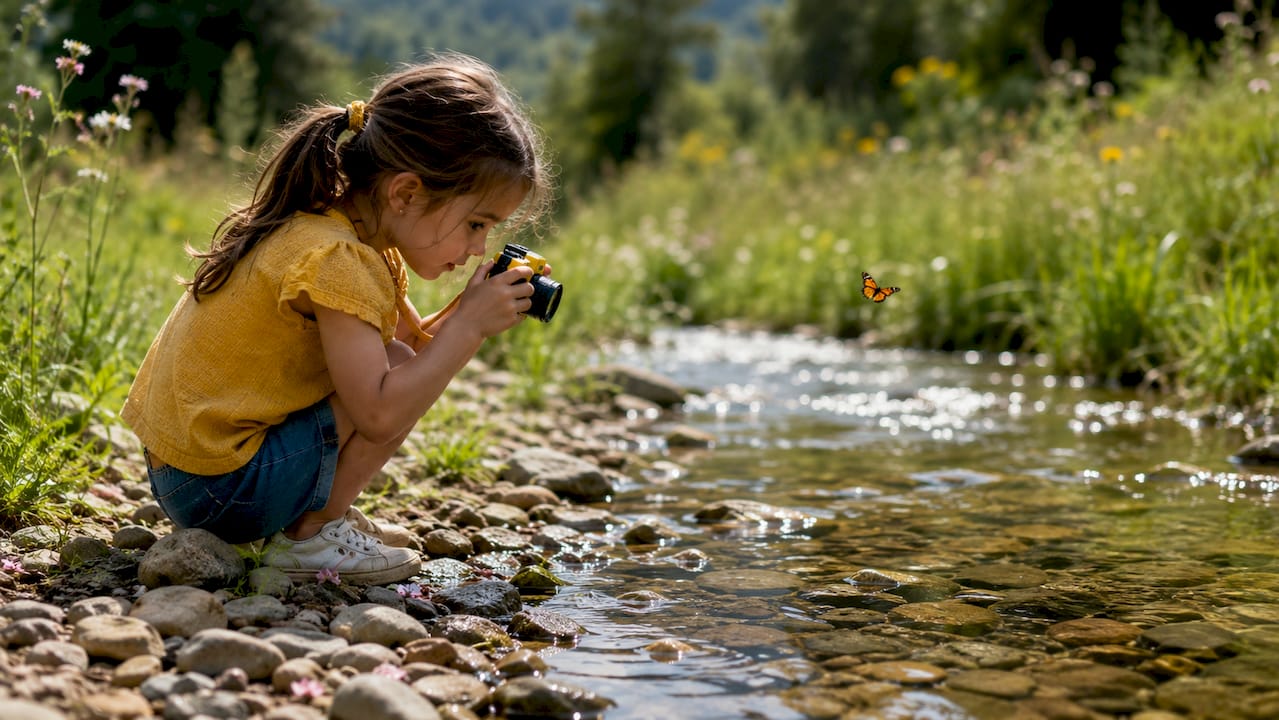
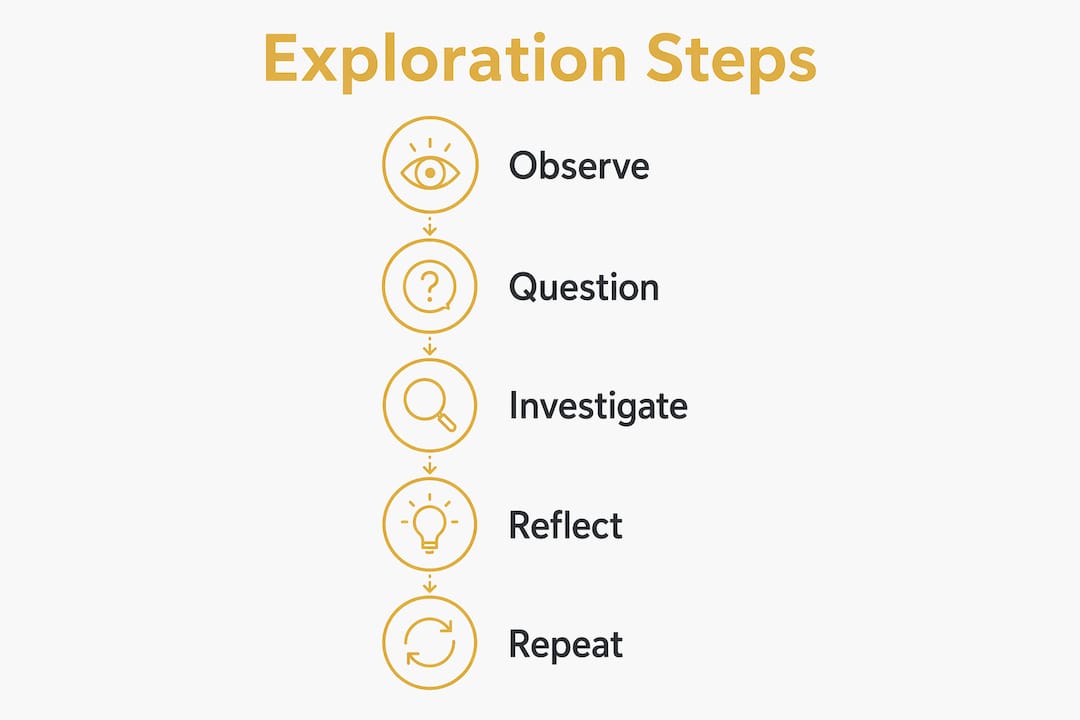
The most reliable method for inspiring discovery in children is the four-step inquiry cycle: observe, question, investigate, and document. Each step builds on the last, and together they turn a single moment of curiosity into a lasting habit of mind.
- Observe. Ask your child to slow down and look carefully at one thing. A spider’s web, a puddle after rain, or the bark of a tree all work well. The goal is noticing detail, not naming it correctly.
- Question. Once they have observed, invite them to ask something. Question-asking practice is directly linked to better epistemic curiosity and learning outcomes in young children. This means the act of forming a question matters as much as finding the answer.
- Investigate. Help them test their question in a simple way. The Exploratorium’s light walk activity is a strong model here. Children change one variable at a time, such as hole size or distance, and observe what shifts. That controlled approach teaches repeatable scientific thinking without any jargon.
- Document. Recording what they found closes the loop. A nature journal, a drawing, a photograph taken with a Thezoofamily kids’ camera, or even a voice note all count. Documentation gives children proof of their own thinking, which builds confidence for the next cycle.
Pro Tip: Treat exploration as a recurring weekly rhythm rather than a one-off outing. Returning to the same spot in the garden or local park across different seasons gives children a living record of change, which is far more motivating than a single visit.
The table below shows how each step of the cycle maps to a practical tool you can use at home.
| Inquiry Step | Practical Tool |
|---|---|
| Observe | Thezoofamily binoculars or magnifying glass |
| Question | Question jar (write questions on slips of paper) |
| Investigate | Simple variable experiments, e.g., the light walk |
| Document | Nature journal, sketchbook, or kids’ camera |
How can parents create environments that promote exploration?
The environment you create matters as much as any activity you plan. Research on Bush School routines shows that sessions combining large blocks of free play with shorter guided activities, such as stories and group reflection, increase exploration and satisfy children’s need for autonomy. The key is not choosing between structure and freedom. It is sequencing them well.
“Combining large blocks of free play with short structured segments satisfies children’s need for autonomy while enabling sense-making.” — Bush School research, 2026
Here is what that looks like in practice:
- Give unstructured time first. Let children roam, dig, collect, and build without direction for at least 20–30 minutes. Resist the urge to narrate or instruct.
- Use natural materials as open-ended props. Sticks, stones, leaves, and water are what researchers call nature’s affordances. They invite imaginative and physical engagement without prescribing a single outcome.
- Step back, then step in gently. Sensitive adult withdrawal, where you observe without intervening, signals to children that their choices are valid. When you do re-engage, use open questions rather than instructions: “What do you think would happen if…?”
- Allow positive risk-taking. Climbing a low tree, balancing on a log, or wading in a shallow stream all build physical confidence and a genuine sense of adventure. Managed risk is not the same as danger.
- Make the space feel emotionally safe. Curiosity thrives when children feel free to express thoughts without fear of being wrong. Research confirms that parental encouragement and positive feedback are direct triggers for sustained curiosity in learning settings.
What activities best inspire a sense of adventure and curiosity?
Specific activities produce far better results than vague encouragement. The following are grounded in research and easy to adapt for different ages and settings.
- The light walk. Inspired by the Exploratorium, this involves taking a torch into a darkened room or outdoor space and experimenting with how light behaves. Change the size of the opening, the distance from a surface, or add a simple lens. Children learn to control variables without realising they are doing science.
- Daily curiosity challenges. A 2025 University of California study found that three weeks of daily curiosity lessons significantly increased trait-level curiosity and creative engagement in participants. Small daily doses beat occasional big events every time.
- Facilitated nature playgroups. Research shows that small-group nature sessions with seasonal engagement help children build science-related skills through repeated observation. If you can organise even an informal group with two or three other families, the peer dynamic accelerates curiosity.
- Nature journalling with prompts. Give your child a specific prompt rather than a blank page. “Draw three things you can see from where you are sitting” or “Write one question about what you found today” focuses attention without limiting imagination. You can find creative journalling prompts that adapt well for children exploring their own observations.
- The question jar. Each week, children add one written or drawn question to a jar. At the end of the month, they pick one and spend a session investigating it. This teaches them that asking questions is a skill worth practising, not just a sign of not knowing something.
Pro Tip: Pair any outdoor activity with a Thezoofamily kids’ camera. Giving children the power to photograph what interests them shifts the dynamic from passive observer to active documentarian. You will be surprised what they choose to capture.
How do you make curiosity a lasting habit, not a one-off event?
Sustained curiosity requires repetition and routine. A single nature walk sparks interest. Twenty nature walks, returning to the same location across seasons, builds a genuine habit of inquiry. The difference is consistency, not intensity.
Here are the habits that make exploration stick over time:
- Revisit the same place repeatedly. Edutopia’s exploration cycle research highlights that multiple revisits allow children to deepen their investigation and build layered documentation. A patch of garden visited weekly across a year becomes a rich scientific record.
- Shift your role from answer-giver to question-prompter. When your child asks “Why is the sky blue?”, resist the urge to explain immediately. Instead, ask “What do you think?” and then investigate together. Research confirms that providing question tools rather than ready answers drives self-directed learning.
- Build exploration into your weekly schedule. Treat it like any other commitment. A set weekly routine removes the friction of deciding when to explore and makes it a normal part of family life rather than a special occasion.
- Celebrate the question, not just the answer. When your child asks something you cannot answer, say so and make finding out a shared project. This models intellectual humility and shows that curiosity is a lifelong practice.
The table below shows how to shift common parental habits to support long-term exploration.
| Old Habit | New Habit |
|---|---|
| Answering questions immediately | Asking “What do you think?” first |
| One-off nature trips | Weekly revisits to the same location |
| Buying activity kits | Using natural materials and open prompts |
| Praising correct answers | Praising interesting questions |
Key takeaways
Encouraging exploration works best when inquiry cycles, free play, and consistent repetition are combined into a weekly family rhythm rather than treated as occasional events.
| Point | Details |
|---|---|
| Use the inquiry cycle | Guide children through observe, question, investigate, and document every session. |
| Balance structure and freedom | Combine large blocks of free play with short guided activities for best results. |
| Repeat visits build depth | Returning to the same location across seasons deepens curiosity and documentation. |
| Shift from answers to questions | Ask “What do you think?” before explaining, to build self-directed learning. |
| Small daily habits win | Brief daily curiosity activities grow trait-level curiosity more effectively than one-off events. |
Why the messiest sessions are often the best ones
I have spent years watching children explore, and the pattern that surprises most parents is this: the sessions with no clear outcome are usually the most productive. A child who spends forty minutes turning over rocks and finding nothing in particular is not wasting time. They are building the tolerance for uncertainty that all genuine inquiry requires.
The temptation to fill every quiet moment with instruction is understandable. You want to add value. But the research on facilitation is clear: sensitive withdrawal, where you observe without directing, is one of the most powerful things you can do. Your presence signals safety. Your silence signals trust.
What I have also noticed is that parents who embrace imperfection get better results faster. The nature journal does not need to be beautiful. The question does not need to be scientifically precise. What matters is that the child chose it. Ownership of the process is what turns a curious moment into a curious child.
Start small. Pick one habit from this article and practise it for three weeks. You will see the shift.
— ALAIN
Thezoofamily: tools built for curious kids
Thezoofamily designs kids’ cameras, walkie-talkies, and binoculars with one purpose in mind: giving children the tools to explore the natural world with confidence and joy. Every product is built around animal references that spark genuine interest in nature, and for every camera sold, Thezoofamily plants one tree. If you are ready to turn the strategies in this article into real adventures, explore the full range of exploration tools at Thezoofamily. You will also find a growing library of nature play ideas and activity guides written specifically for parents who want curiosity to become a family habit.
FAQ
What is the best age to start encouraging exploration?
Exploration can begin as soon as a child shows interest in their surroundings, typically from age two onwards. The inquiry cycle of observe, question, investigate, and document scales naturally with age and ability.
How long should an exploration session last?
Research on Bush School routines suggests sessions of 45–90 minutes work well, with the majority of that time given to unstructured free play. Shorter, more frequent sessions outperform long, infrequent ones.
Do children need special equipment to explore effectively?
No specialist equipment is required, though tools like binoculars, a magnifying glass, or a kids’ camera from Thezoofamily significantly increase engagement. Natural materials such as sticks, stones, and water are equally effective for open-ended investigation.
How do i encourage a child who seems uninterested in nature?
Start with what already interests them and connect it to the outdoors. A child fascinated by vehicles might investigate how water flows downhill. A 2025 University of California study found that daily curiosity prompts build interest over three weeks, so consistency matters more than initial enthusiasm.
How can i tell if exploration is actually building curiosity?
Watch for unprompted questions, repeated returns to the same subject, and a willingness to investigate rather than give up. These behaviours indicate that curiosity is becoming a self-directed habit rather than a response to adult prompting.