

The best outdoor birthday party activities fall into five categories: scavenger hunts, water games, relay races or obstacle courses, craft stations, and nature exploration. Each category flexes to fit almost any age group and budget. Match your pick to the children’s ages, the shade and space you have, and how many adults can supervise, and the party runs itself.
TL;DR:
- For children under 4, keep tasks simple and have an adult beside each child; mixed age groups benefit from parallel stations and buddy pairs.
- Rotate activities every 20 to 30 minutes, keep a calm backup ready, and reserve 30 minutes for food and cake.
- For water play, assign an attentive watcher and rotate the role every 15 to 20 minutes; even a small paddling pool needs supervision.
- Schedule strenuous games outside late morning to midafternoon, reapply sunscreen every two hours, and keep water bottles and spare hats available.
- Visit the site beforehand to check shade, toilet access, permits, and table reservations, then pack water, first aid supplies, spare clothes, and hats.
Table of Contents
- 1. Top 10 outdoor activity types: what they are and what they need
- 2. How to adapt activities by age and group size
- 3. Safety and supervision essentials for outdoor parties
- 4. Quick planning checklist and sample timeline
- 5. Nature-themed activities and how Zoo Friends products enhance them
- 6. Eco-friendly and nature-themed party ideas that align with environmental values
- 7. Tips on encouraging creative connections and interaction among kids through activities
- 8. Guidance on customizing activities to foster appreciation and curiosity about wildlife and nature
- Why outdoor parties stick in children’s memories
- Where to find simple nature-themed party enhancements
- FAQ
- Sources
1. Top 10 outdoor activity types: what they are and what they need
Picking the right mix matters more than picking the most expensive option. Here is a practical shortlist, with who it suits and what it needs.
- Scavenger hunt: works for ages 4 and up, needs a garden or park with hiding spots, and only needs a printed list and small prizes.
- Water games (balloon toss, sprinkler relay, sponge race): best for ages 5 and up on a hot day, needs a flat grassy area and a water source.
- Relay races and obstacle courses: suit ages 6 to 12, need open lawn space of roughly 10 by 10 metres, and use cones, hula hoops and ropes.
- Craft stations (mask making, badge painting): suit all ages with adult help for toddlers, need a shaded table, and use paper, paint and glue.
- Nature trail or nature scavenger hunt: suits ages 4 and up, needs a park or garden with varied plants, and only needs a printed checklist.
- Carnival mini-games (knock-the-cans, ring toss): suit ages 4 to 10, need a small flat corner, and use tin cans, bean bags or rings.
- Giant lawn games (jumbo Jenga, giant noughts and crosses): suit mixed ages, need a few square metres of grass, and use oversized pieces you can build cheaply.
- Glow-in-the-dark evening games: suit ages 7 and up for an early evening party, need dim light, and use glow sticks or torches.
- Treasure dig or archaeological dig: suits ages 4 to 8, needs a sandpit or a dug patch of soil, and uses buried toys or “fossils”.
- Animal and nature-themed exploration: suits ages 3 and up, needs any garden or local green space, and uses simple tools such as magnifying glasses, binoculars or a camera.
Costs stay low across the list. Inexpensive materials such as tubing, buckets, chalk and paper often entertain children as much as rented equipment does, according to Better Homes & Gardens.
2. How to adapt activities by age and group size
Age gaps are the main reason outdoor parties lose momentum, so build in flexibility from the start.
- For toddlers (under 4), keep tasks one step at a time, such as “find something red”, with an adult alongside each child.
- For ages 4 to 7, use picture-based scavenger hunt cards and shorten relay distances to keep legs and attention spans happy.
- For ages 8 to 12, add timed challenges and let children choose a harder scavenger hunt tier if they want more of a test.
- For mixed-age groups, run parallel stations so younger and older children play at the same time without waiting, and pair older children with younger ones using a simple buddy system.
- Keep each activity block to 20 to 30 minutes with a backup low-energy option ready, since rotating activities at this pace keeps energy high and avoids the boredom that triggers meltdowns, a pattern widely used in outdoor birthday party planning.
3. Safety and supervision essentials for outdoor parties
A good activity list means little without basic supervision in place, and a handful of habits cover most risks.
- Assign a rotating water watcher and swap this role every 15 to 20 minutes for any water play, so one adult always has undistracted eyes on the water, following guidance from Healthychildren.
- Avoid strenuous outdoor activity during the hours when UV exposure is strongest, typically late morning to mid-afternoon, and check slides, metal equipment and dark paving for heat mid-morning before children use them.
- Never combine sunscreen and insect repellent in one product, reapply sunscreen every two hours, and keep spare hats and water bottles on hand throughout the party.
- Keep children away from barbecues, open flames and mowing equipment, and only allow swimming in areas with clear supervised boundaries, as recommended by NHS guidance on summer safety.
- For heat illness, move the child to shade, offer water and cool the skin with a damp cloth; for a serious fall, keep the child still and get help immediately.
Drowning is a leading cause of death among young children, and constant, attentive supervision together with swim lessons meaningfully reduces that risk, according to the American Academy of Pediatrics. Even a small paddling pool at a birthday party deserves the same water watcher rule as a full swimming pool.
4. Quick planning checklist and sample timeline
A short checklist beats a long one, because it actually gets used on the day.
- Visit the site beforehand to check shade, toilet access and whether you need a park permit or table reservation.
- Pack activity-specific supplies (balloons and sponges for water games, chalk and cones for relays, paper and paint for craft stations).
- Pack universal essentials: water, sunscreen, a basic first-aid kit, spare clothes and extra hats.
- Plan a loose timeline: 30 to 45 minutes for arrival and setup, three or four activity blocks of 20 to 30 minutes each, 30 minutes for food and cake, and a calm wind-down activity such as a craft table before pickup.
- Brief any helping adults on their roles, including who is the water watcher, before guests arrive.
Outdoor play of this kind supports both physical activity and attention, so a well-paced timeline is not just about logistics, it is part of what makes the day work for the children, according to CDC guidance on outdoor play.
5. Nature-themed activities and how Zoo Friends products enhance them
A nature theme turns ordinary games into small exploration missions, and a few simple tools make that easier to run.
- Set up a photo scavenger hunt where children use a kid-friendly camera to capture a leaf, a feather or a tiny bug.
- Run a binocular bird-spotting station with simple picture cards for common garden birds, so children can match what they see.
- Use walkie-talkies for team-based treasure hunts, letting one child act as base camp while others search and report back.
Pro Tip: Give each child one simple photo task rather than a long list; a single clear goal like “find something spiky” keeps younger children focused.
We use animal designs on purpose, to spark curiosity about wildlife rather than just function as toys. For every camera sold, one tree is planted, so a photo scavenger hunt at a birthday party quietly supports a wider environmental goal too.
6. Eco-friendly and nature-themed party ideas that align with environmental values
A nature-themed party does not need to stop at games, it can carry a small environmental message without feeling like a lesson. A simple seed-planting station, where each child pots a sunflower or bean seed to take home, turns into a living party favour and a quiet introduction to growing things.

Loot bags filled with seed packets, wooden pencils or a small sapling cutting replace plastic trinkets with something that lasts longer than the afternoon. A short “thank you for coming, now go plant something” note on the invitation sets the tone before the party even starts.
Tree planting ties in naturally here. Framing it as “one camera, one tree” at a gift-opening moment gives children a concrete, understandable idea of cause and effect, better than an abstract talk about the environment. A short conservation-themed scavenger hunt, where clues relate to what plants or insects do for a garden, adds a layer of meaning to a game children already enjoy.
None of this needs to dominate the party. One eco-friendly station alongside the usual relay races and craft tables is enough to plant the idea, quite literally, without taking over the day.
7. Tips on encouraging creative connections and interaction among kids through activities
Outdoor games work best when they ask children to do something together rather than simply take turns. A team-based treasure hunt, where two or three children share one list and one walkie-talkie, forces cooperation that a solo scavenger hunt does not.
Rotating partners between activity blocks helps too. If the relay race pairs one set of children, mix those pairs before the craft station starts, so friendships are not locked to one group for the whole party.
Open-ended tasks invite more interaction than rigid ones. Asking children to “build the tallest tower you can with what’s in this basket” produces more conversation and negotiation than a fixed-answer quiz. Giving teams a shared decision, such as which scavenger hunt tier to attempt, also nudges children to talk to each other rather than wait for an adult to decide.
Small roles help shyer children join in without pressure. A “base camp” role on a walkie-talkie game, or a “photographer” role on a nature hunt, gives a child something specific to contribute without needing to compete directly with louder guests.
8. Guidance on customizing activities to foster appreciation and curiosity about wildlife and nature
The simplest way to build curiosity about wildlife is to give children a specific, achievable task rather than a general instruction to “go look at nature.” A card that asks for one photo of something with wings, one photo of something rough, and one photo of something small works better than an open-ended walk.
Matching the task to the local environment keeps it realistic. A seaside party suits a shell or rock pool hunt, a woodland park suits a bark rubbing or leaf shape hunt, and a back garden suits a bug count under a log or plant pot.

Binoculars work well for a slower, quieter activity between high-energy games, letting children settle for a few minutes while they try to spot a bird from a simple identification card. This pairs naturally with a rest point in the timeline, such as just before food, when children need a lower-energy option anyway.

Letting children keep their favourite photo or sketch from the day, rather than collecting everything into one shared pile, gives the activity a personal ending and something to talk about afterwards.
Why outdoor parties stick in children’s memories
A birthday spent running, exploring and building things outdoors tends to stay with a child longer than one spent watching a screen. Outdoor play supports movement, problem solving and imagination all at once, which is part of why it works so well for a celebration.
Adding a nature thread, even a small one, gives children a reason to look closer at the world around them rather than just run through it.
— ALAIN
Where to find simple nature-themed party enhancements
A few well-chosen tools do a lot of work at an outdoor party without adding complexity to the day. Some animal-themed kids’ cameras can turn a scavenger hunt into a photo mission, walkie-talkies add coordination to treasure hunts and team games, and binoculars give children a reason to slow down and spot something in the garden or park.
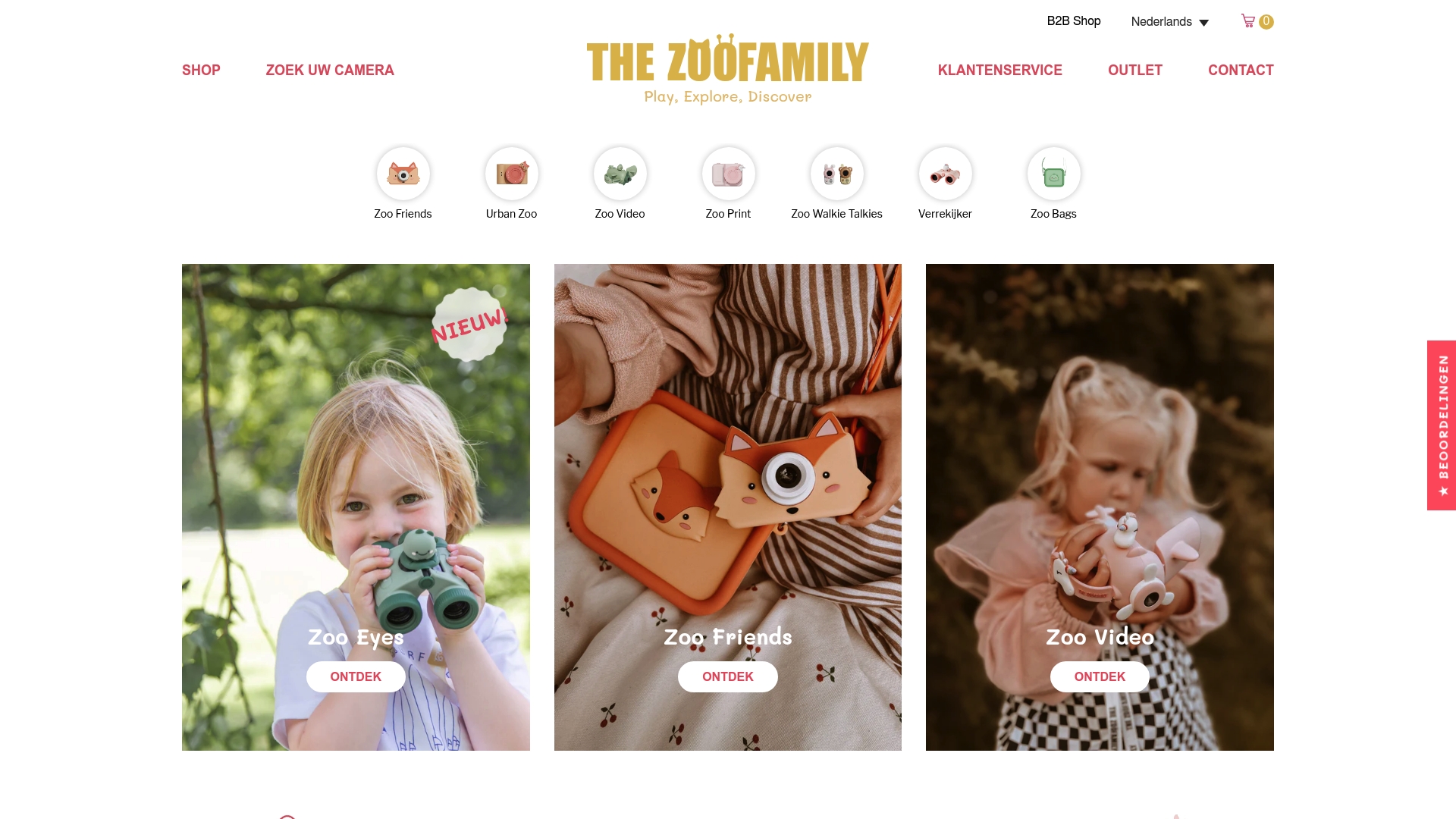
Browse the full range on our Zoofamily site or go straight to the kids’ camera collection to add a photo challenge to your next outdoor birthday.
FAQ
What are some fun activities for an outdoor birthday party?
Scavenger hunts, water games, relay races, craft stations and nature exploration cover most ages and budgets. Pick two or three, rotate them in 20 to 30 minute blocks, and keep a low-energy backup such as a craft table ready for when energy dips.
What are some ideas for outdoor birthday celebrations?
A nature-themed party with a photo scavenger hunt, a bird-spotting station with binoculars, and a seed-planting craft table works well for most gardens or parks. Pairing these with a simple relay race or carnival mini-game keeps the pace varied through the afternoon.
What are some good ideas for an outdoor party?
Pick activities that match your space and the children’s ages rather than the most elaborate option available. A flat lawn suits relay races and lawn games, while a garden with plants and insects suits a nature trail or scavenger hunt with simple printed cards.
What are some good birthday party activities?
Water balloon toss, nature scavenger hunts, relay races and craft stations are widely used because they adapt easily to different ages, according to TODAY’s roundup of outdoor birthday ideas. Pairing a high-energy game with a calmer craft station keeps the whole party balanced.
What should I check before an outdoor party involving water or pets?
Always assign a dedicated water watcher who rotates every 15 to 20 minutes for any water play, and keep dogs or other pets separated from young children during games unless closely supervised, a precaution covered in pet summer safety guidance. Check the UV index and avoid the hottest hours of the day, generally 10:00 to 16:00, for strenuous outdoor games.
Sources
- Healthychildren
- Outdoor play and safety for children in ECE - CDC
- Staying safe over the summer - Healthier Together (NHS)
- Prevention of Drowning policy statement - AAP (Pediatrics)