

The best indoor activities for a two-year-old are short, use things you already own and let your child move, touch and pretend. Cushion tunnels, animal walks, a bowl-to-bowl transfer game and a balloon to keep in the air all work. Most take under five minutes to set up. Below you will find 25 ideas, how to adapt them for three-year-olds, the safety checks that matter and what to do when your child loses interest.
TL;DR
- Pick one idea at a time and sit nearby. Short bursts of play are normal at this age.
- Movement games (tunnels, obstacle courses, animal walks) need only cushions, chairs and tape.
- Sensory and pouring games suit two-year-olds because they have a clear start and finish.
- Keep small objects away from under-threes and stay within reach during any water play.
- For three-year-olds, add steps, rules and storytelling to the same games.
Table of Contents
- How to choose an activity for a two-year-old
- Active games for small spaces
- Sensory and low-mess ideas
- Creative and pretend play
- Calm activities for between the busy games
- Moving up: indoor activities for 3-year-olds
- Keep it safe
- When your toddler loses interest
- Why indoor play matters
- Games for when your child turns three
- Our perspective
- FAQ
- Sources
How to choose an activity for a two-year-old
A good toddler activity is quick to set up, easy to clean and lets your child explore. One blog puts the ideal at five minutes of setup and 15 to 30 minutes of play. Do not worry if your child leaves sooner. Active For Life notes that many two-year-old activities use easy-to-find items and can be set up and cleaned up fast. It also cites an average attention span of about two minutes for this age.
Three simple rules help:
- Offer one idea, not a table full of choices.
- Sit nearby and follow your child’s lead.
- Stop when interest drops. Come back to it another day.
Tovi suggests that from age two to three, activities with a clear finish work well, such as a transfer station. Open-ended play comes later.
Active games for small spaces
You do not need a big room. A living room with the coffee table pushed back is enough.
Cushion tunnel
Drape a blanket over a row of sturdy chairs and let your child crawl through. Active For Life lists this as a way to support gross motor skills and coordination. Put a soft toy at the far end as a goal.
Living-room obstacle course
Use sofa cushions to climb over, a chair to crawl under and a strip of painter’s tape on the floor as a balance line. Blueberry Pediatrics describes this exact set-up. Keep it to three stations for a two-year-old. Walk through it together first.
Animal walks
Waddle like a penguin, hop like a frog, crawl like a bear. The same pediatric guide says animal walks build total-body strength. Name the animal, make the sound and let your child choose the next one. It is also a good way to link play with nature, which is a theme we care about.
Keep it up
Blow up a balloon and ask your child to bat it with the palm of the hand. Active For Life says this builds hand-eye coordination. Pick up any popped pieces straight away, because they are a choking risk (see the safety section below).
Music and dance
Put on a song, stop it suddenly and freeze. The NHS suggests a dance-off, star jumps or hide-and-seek as easy ways to play together.
How much movement is enough?
The National CACFP Association, a US professional body, says children aged two to three should have at least 30 minutes of adult-led physical activity and at least 60 minutes of free active play each day. It also advises no more than an hour of sitting still at a time, apart from sleep. On a wet day, the games above can cover a good part of that.

Sensory and low-mess ideas
Sensory play gives a two-year-old something to do with their hands. It also keeps them in one place for a few minutes.
- Transfer station: two bowls, a tablespoon and dry pasta or large dried beans. Your child scoops from one bowl to the other. Tovi lists this as a sensory pouring activity. Use items too large to swallow.
- Muffin tin colour sort: a muffin tin, paper circles and jumbo pom-poms. Your child matches each pom-pom to a colour.
- Water tray: a shallow bin or baking tray on a towel, with cups and sponges. This needs your eyes on your child the whole time.
- Sensory bag: put a few items and a little shaving cream or liquid in a sealed zip-lock bag and tape it shut. Your child squishes it from outside.
- Playdough: roll, squash and cut. Add cutters once your child is keen.
- Toy matching: trace the outline of favourite toys on paper. Your child puts each toy on its outline. Expressable describes this simple matching game.
Texture ideas from Aspire Early Education include a rice bin for scooping and sifting, and textured items placed on cut-out letters or numbers.
Creative and pretend play
No craft kit is needed.
- Busy box: keep a box of clean recycled materials such as cardboard tubes and paper.
- Kitchen roll puppets: draw a face on a paper tube and let your child give it a voice.
- Big box play: a large cardboard box becomes a house, a boat or a cave. Let your child decorate it with crayons.
- Homemade drum: a plastic tub and a wooden spoon. Aspire lists instruments like this among its creative ideas.
- Dolls and soft toys: feed them, put them to bed, take them to the shop.
Raising Children Network, an Australian parenting service, says drama, music, dance, art and craft help toddlers explore their senses, express emotions and build language. Choose washable, non-toxic paints and glues. Keep a towel or mat under messy play.
Calm activities for between the busy games
Not every activity needs to be active. After a run around, try one of these:
- Read a short picture book and ask your child to point to animals.
- Look at the pictures in a photo album and name the people.
- Sing a song with hand actions.
- Put on a puppet show with socks.
The NHS suggests thinking about what your toddler can see, touch, smell and hear, and joining in when your child invites you. That makes a quiet moment easy to build.
Moving up: indoor activities for 3-year-olds
Most two-year-old games grow with the child. Three-year-olds can follow simple rules, tell stories and stay with a task for longer, according to TinyStepper. Here is how to adapt the same ideas.
| Activity at age 2 | How to adapt at age 3 |
|---|---|
| Cushion tunnel | Build a cushion mountain, then add a story: you are climbing to a castle |
| Obstacle course with three stations | Add a multi-step sequence, such as jump over, crawl through, spin, touch the wall |
| Toy matching | Play a memory game with pairs of cards or socks |
| Transfer station | Use tongs and cotton balls |
| Playdough squashing | Add cutters and a play dough kitchen |
| Box play | Junk modelling with boxes and tape |
| Soft toy play | Small world play in a tray: a dinosaur landscape or an ocean with fabric and sea creatures |
Tic Tac Teach lists 25 ideas for this age, including sock match, first snipping with child-safe scissors, a noodle necklace with large tube pasta and laundry basket toss. It notes that most take five to fifteen minutes. It also suggests adapting supplies by age, for example a glue stick for a younger child.
Play can also be useful. Washing vegetables or matching socks count as chores-as-play for a three-year-old. They also give your child a real job to do.

Skills to expect
By age three, children can usually balance briefly on one foot, kick a ball forward, throw overhand and catch a ball. A laundry basket toss or a soft ball game suits these skills well. Use a soft ball indoors.

Keep it safe
Household items make great toys, but they can also be hazards. These checks take a few minutes.
- Small parts: Stanford Medicine Children’s Health advises that children aged three and under should not play with small toys and parts because they still put objects in their mouths. It recommends a small parts tester to check. A common home rule: if an object fits entirely through a toilet paper tube, it is too small for children under three.
- Balloons: the same Stanford page warns against latex balloons for young children. If you use one for keep it up, stay close and remove broken pieces at once. Ask your health visitor or GP if you are unsure.
- Hidden hazards: Health Canada advises keeping coins, paper clips, pen caps, buttons and keys out of reach of children under three. It also suggests crawling around the room on hands and knees to see what your child can reach. Check under the sofa as well.
- Water play: stay within arm’s reach and keep your eyes on your child all the time. For this reason, tip out trays and buckets when you finish.
- Art materials: Alberta Health Services recommends non-toxic materials, water-based paints, crayons and water-based white glue for young children. It says to avoid powdered clay, solvents, aerosol sprays and permanent markers.
- Dry pasta and beans: use items that are large, and stay close. Do not leave them out afterwards.
When your toddler loses interest
This is normal. Try these steps in order:
- Change the scene. Raising Children Network advises redirecting early, at the first sign of boredom, by pointing out something interesting, starting a simple game or moving to another place.
- Give a starting point. A half-built tower or hidden puzzle pieces invite your child to take over, as Jaques of London suggests.
- Choose open-ended play. Sensory play, mark-making and building can last longer than games with a right answer, says Bright Little Steps.
- Keep a short list. A few reliable go-to toys are easier to swap than a full toy box.
Why indoor play matters
The NHS says playtime activities support language, thinking and motor skills, and help build a strong bond when you follow your child’s lead. Penn State Extension adds that play gives sensory, physical, cognitive and emotional experiences. It suggests naming objects and asking open questions as you play.
So a wet afternoon is not time lost. Name the animal your child is pretending to be. Count the cushions. Ask what happens next.
Games for when your child turns three
Once your child is three or older, you may want to add a tool for exploring. Our products are designed for children aged 3 and up, not for two-year-olds.
Our Zoo Walkie-Talkie costs €54.95. It suits a hide-and-seek game between rooms. Our Zoo Friends camera costs €69.95 and our kids’ cameras come with animal designs. Your child can photograph the stuffed animals in a small world tray. Zoo eyes binoculars cost €39.95 and Zoo light costs €39.95. For every camera sold, we plant one tree.
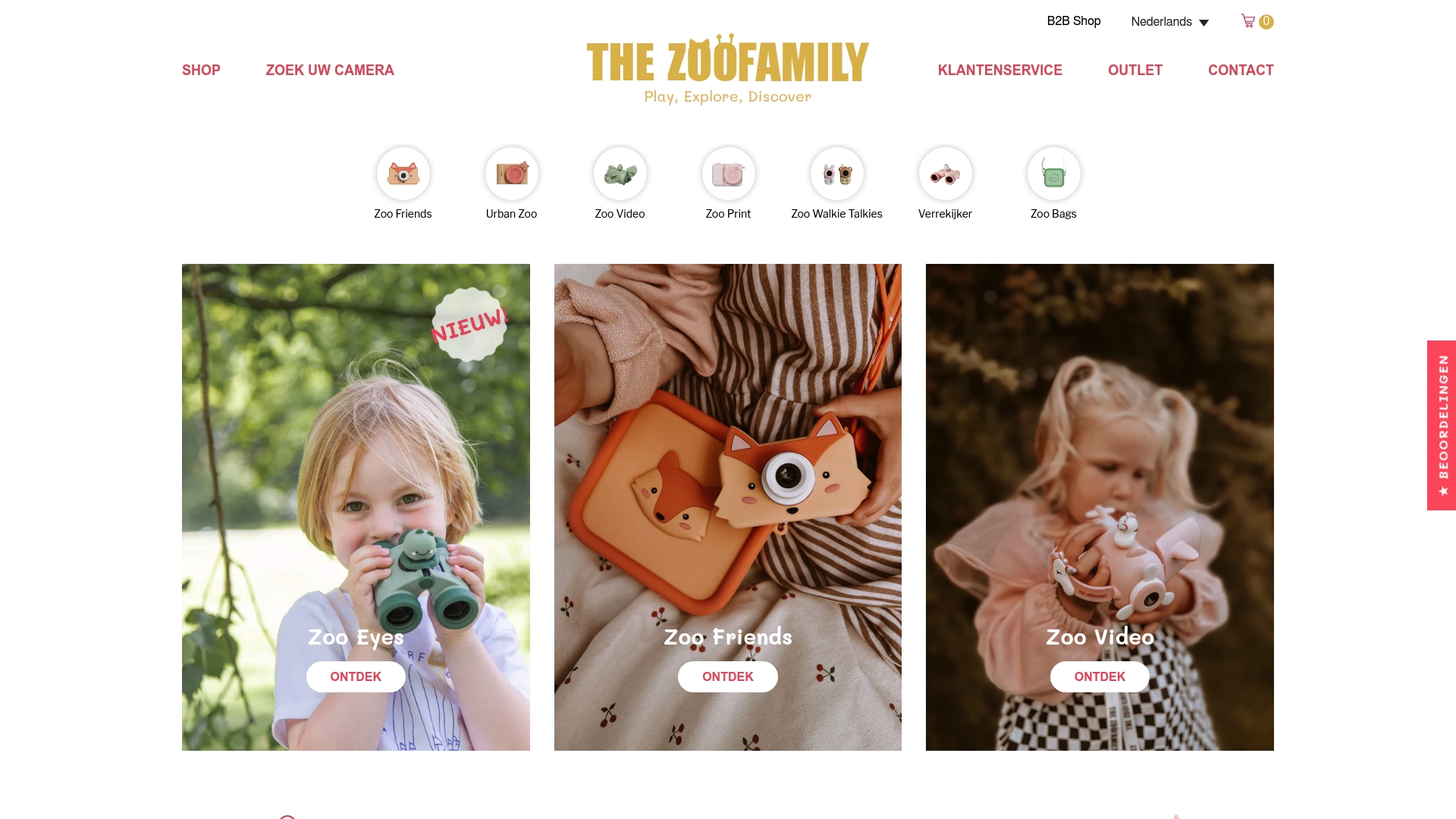
All prices are in euros. See the full range for the current products.
Our perspective
We design The Zoofamily products with animal references to spark children’s interest in nature. We think the best indoor play starts with something familiar: an animal, a sound, a small story.
That is why the games in this guide use animal walks, soft toys and cardboard boxes. They cost nothing and they connect a child to the natural world, even on a rainy day.
When your child is three, a camera or a walkie-talkie can extend those games. Our products are designed for children aged 3 and up. A photo hunt for animal toys around the house gives a child a goal, and a walkie-talkie gives two children a reason to talk to each other. We also plant one tree for each camera sold, so play and care for nature stay linked.
ALAIN
FAQ
What are good indoor activities for a 2.5-year-old?
Try a cushion tunnel, a three-station obstacle course, a transfer station with large dried beans and playdough. At this age children enjoy simple matching, such as toy outlines on paper. Keep each activity short and let your child choose when it ends.
How long should an activity last for a 2-year-old?
Expect short bursts. Active For Life cites an average attention span of about two minutes at this age, although play with a topic your child likes can last much longer. Set up one idea at a time and sit close by.
What can I do with a 2-year-old when I have little space?
Use floor games. Animal walks, a balloon to bat, a blanket tunnel over chairs and a tape line to walk along all fit in a small room. Move the furniture back, then put it back afterwards.
Which indoor activities suit a 3-year-old?
Matching and memory games, play dough with cutters, small world play, junk modelling and longer obstacle courses all work well. Three-year-olds can follow several steps, so add a story or a sequence to the games you already play.
Sources
- NHS: Playtime and bonding with your toddler
- Active For Life: Energy-busting indoor activities for 2 year olds
- Busy Blooming Joy: Simple mess-free toddler activities
- Tovi: Indoor activities for toddlers by age
- Expressable: 8 fun and educational activities for 2-year-olds
- Blueberry Pediatrics: Indoor activities for toddlers
- National CACFP Association: Fitness for toddlers and preschoolers
- Aspire Early Education: Indoor activities for toddlers at home
- Raising Children Network: Creative play and activities for toddlers
- TinyStepper: Screen-free activities for toddlers
- Bright Little Steps: Activities for 3-year-olds
- Tic Tac Teach: Activities for 3 year olds
- Stanford Medicine Children’s Health: Toy safety
- Health Canada: Is Your Child Safe? Play Time
- Alberta Health Services: Arts and crafts safety
- Raising Children Network: Redirecting behaviour
- Jaques of London: What to do when your toddler is bored
- Bright Little Steps: Activities for toddlers at home
- Penn State Extension: Play is Purposeful