

At 6 months, most babies reach for toys, grasp them, bring them to the mouth and pass them from one hand to the other. They also start to rake small objects towards the palm with all their fingers. The thumb and finger pincer grasp comes later, at around 12 months. This guide explains what is typical at 6 months, how skills change up to 18 months, which simple games help, and when to ask a professional.
Babies develop at their own pace. The ages below are guides, not deadlines.
TL;DR
- At 6 months, babies usually grasp and shake toys, bang them, mouth them and transfer them between hands (UNICEF USA).
- The raking grasp, using all fingers together, is the typical grasp at this age. The pincer grasp comes at around 12 months.
- Tummy time, containers, finger foods and simple hand games support hand skills. Always stay close and keep small objects under control.
- In the UK, the NHS advises concern if a baby is not reaching for objects by 6 months. Speak to your health visitor or GP.
Table of Contents
- What fine motor skills are
- What a 6-month-old can usually do
- The stages of grasp, from reflex to pincer
- Why tummy time comes first
- Play ideas for a 6-month-old
- Keeping hand play safe
- From 6 to 10 months
- From 12 to 18 months
- A quick reference by age
- When your child is older: our cameras and walkie-talkies
- When to ask for advice
- FAQ
- Sources
What fine motor skills are
Fine motor skills are small, precise movements of the hands, fingers, feet and toes. They need the muscles, joints and nerves to work together. Cleveland Clinic explains that they start at birth with the involuntary grasp reflex. They improve as muscles get stronger and coordination develops.
For a baby, these skills mean learning to grasp, hold and move objects. They also mean using one hand or both hands together, and building hand-eye coordination. The American Academy of Pediatrics notes that as these skills improve, children gain more control and find new ways to explore the world around them.
What a 6-month-old can usually do
The Royal Hospital for Children Glasgow describes a 6-month-old as a baby who:
- uses a raking grasp, with all the fingers together, to pick up objects
- can poke objects with the index finger
- enjoys banging objects on the highchair tray
Other sources add more detail. Children’s Hospital of Richmond lists these skills for 6 to 9 months:
- shaking and banging rattles
- bringing toys to the mouth
- transferring objects between hands
- keeping the hands open and relaxed most of the time
- starting to pick up small foods
Alberta Health Services adds that when a baby starts solid foods, they may want to hold the spoon. They may try to bring it to their mouth and bang it on the tray. They may also scoop very small pieces of cut-up food into the palm. That scooping is the raking skill.
Why the mouth matters
Putting everything in the mouth is normal at this age. It is one way a baby explores shape, texture and weight. It is also the reason safety comes first when you choose what to hand over. The safety section below covers this.
The stages of grasp, from reflex to pincer
Grasp does not jump from reflex to pincer. Cleveland Clinic’s Dr. Diard describes a series of stages. The ages are approximate.
| Stage | Approximate age |
|---|---|
| Reflexive grasp | First months, up to 6 months |
| Crude palmar grasp | Around 4 months |
| Ulnar palmar grasp | Between the stages above and below |
| Raking grasp | Around 6 months |
| Radial palmar grasp | Between raking and scissors |
| Scissors grasp | Around 8 months |
| Radial digital grasp | Around 9 months |
| Inferior pincer grasp | Before the first birthday |
| Superior pincer grasp | Around 1 year |
At the raking stage, the baby uses the fingers to pull a small object into the palm. The thumb is not yet part of it. So a 6-month-old who cannot yet pick up a single pea with finger and thumb is on track.
Why tummy time comes first
Fine motor skills rest on bigger movements. Therapists at Children’s Hospital of Richmond explain that tummy time builds postural control and core strength. This gives stability to the hands and fingers. They also describe how a baby aged 3 to 6 months who pushes up on the elbows and hands is building shoulder stability and hand arch development. Those are later used for precise tasks such as writing with a pencil.

Rolling, sitting and crawling feed into the same foundation. So if your baby is working on sitting, they are also working on their hands.
Play ideas for a 6-month-old
You do not need special equipment. These ideas come from health services and children’s hospitals.
Offer different sizes and textures
Alberta Health Services advises offering toys and objects of different sizes to explore with one or both hands. It also suggests playing in different positions. Try tummy, back and supported sitting.
Hide and find
Cover a toy with a small towel or scarf and let your baby discover it. It encourages reaching, pulling and grasping in one game.
Containers
Give your baby a container with a few small, light, safe objects to drop in and out. At this age, the baby will mostly take things out. Putting things in comes later.
First finger foods and the spoon
Once your baby has started solid foods, let them hold a spoon and touch their food. Self-feeding with finger foods is another way to build hand skills and hand-eye coordination, according to Norton Children’s. Stay with your baby at every meal.
Banging, shaking and passing
A rattle, a wooden spoon or a soft block gives a baby something to shake and bang. Hold a toy slightly to one side so your baby has to reach and then pass it to the other hand.
Action songs
Norton Children’s also suggests songs with hand gestures, such as Pat-A-Cake and The Itsy Bitsy Spider. They cost nothing and work at any time of day.
Keeping hand play safe
Alberta Health Services gives three safety points:
- Stay with your baby if they are on a high surface such as a changing table, bed or table.
- Avoid choking hazards, such as small objects or toys with parts that can easily break or fall off.
- Make sure toys are made with safe materials that can be cleaned, washed or wiped.
Because babies at 6 months mouth everything, check each item before you hand it over. Choose toys made for babies. Check them often for cracks or loose parts. Supervise all play.
Our view: start with nature, build up to creating
At The Zoofamily we design cameras, walkie-talkies and binoculars for children aged 3 and over. We use animal references on purpose. Our aim is to spark a child’s interest in nature and in creating with others.
We think it helps to see early childhood as a path. In the first year, a baby learns to reach, grasp and let go. Later, those same hands press a shutter button, hold binoculars steady and turn a dial. Everything that happens with a rattle, a scarf and a bowl of safe objects is the base for that.
For this reason, we do not make products for babies, and we do not suggest our products for a 6-month-old. Our range starts at age 3. Our advice for the first year is simple: tummy time, safe objects, songs and your attention. When your child is older, we would be glad to be part of the next step.
ALAIN
From 6 to 10 months
Alberta Health Services describes the change between 6 and 12 months. From 6 to 9 months, a baby turns and reaches for toys, bangs toys or claps hands, and scoops small objects into the palm. Transferring toys between hands becomes easy.
The NHS timeline is stricter about one point. Healthier Together says parents should be concerned if a baby is not transferring toys from one hand to another by 8 months.
Here is what to watch for around 9 and 10 months:
- Smaller toys. The baby begins to hold small toys with thumb, index and middle fingers.
- Two-finger pick up. Small objects are picked up with two fingers.
- Pointing and poking. The index finger is used to poke, and later to point at pictures in a book.
- Letting go. Babies release objects with more control.
According to the Children’s Hospital of Richmond, babies at 9 to 12 months also begin to put objects into a container and turn book pages a few at a time. They may stack two blocks, and bang two toys together.
At this stage, offer egg cartons, blocks, balls and stacking toys. Squeeze toys and cups in the bath are also good. These ideas come from Norton Children’s for 8 to 12 months.
From 12 to 18 months
Around the first birthday, the pincer grasp arrives. The American Academy of Pediatrics says many babies can pick up small objects with thumb and forefinger by 12 months, though they may still be refining it. By 18 months most children do this with greater ease and precision.
12 to 15 months
Modern Pediatrics says a child at this age is perfecting the pincer grasp and picking up small objects with two fingers. It suggests allowing self-feeding at mealtimes and offering a baby fork and spoon. It also suggests showing how to stack two large blocks and encouraging putting an object in a container.
According to the pedscases milestones chart, a child at 15 months uses a spoon and an open-top cup. They also build a tower of 2 blocks.
15 to 18 months
CHOC Children’s says that at 15 to 17 months a child builds a two-block tower and scribbles without being shown how. At 18 to 23 months a child builds a tower of four to six blocks and turns a few thick pages at a time.
The same pedscases chart lists, at 18 months, a tower of four blocks and scribbling with a fisted pencil grasp. MedlinePlus says a toddler scribbles by 15 to 18 months and uses a spoon by 24 months.
A simple 18-month game comes from UNICEF. Give your toddler a box or bucket and ask them to put toys in and take them out. Say the words “in” and “out” as they do it.
Favourite games at one year include building towers and knocking them down, and covering and uncovering boxes. Others are turning knobs and pages, putting round pegs into holes, and scribbling and painting, according to the American Academy of Pediatrics.
A quick reference by age
| Age | Typical hand skills |
|---|---|
| 6 months | Raking grasp, shaking and banging, mouthing, hand-to-hand transfer |
| 9 to 10 months | Holds smaller toys, two-finger pick up, pokes and points |
| 12 months | Pincer grasp developing, releases objects, puts things in containers |
| 15 months | Spoon and open cup, two-block tower |
| 18 months | Scribbling, tower of about four blocks, more precise pincer |
These are the common patterns across the sources above. Some children reach them earlier, some later.
When your child is older: our cameras and walkie-talkies
By age 3, hands that once raked at a bowl of safe objects can press buttons and hold small devices. Our range is designed for children aged 3 and over. It includes animal-themed digital cameras, instant print cameras, walkie-talkies, binoculars and night lights. For every camera sold, we plant one tree.
The kids camera collection shows the cameras we offer. Zoo Friends costs €69.95. Zoo Print costs €109.95. Zoo Walkie-Talkie costs €54.95. The full range is on our shop page.
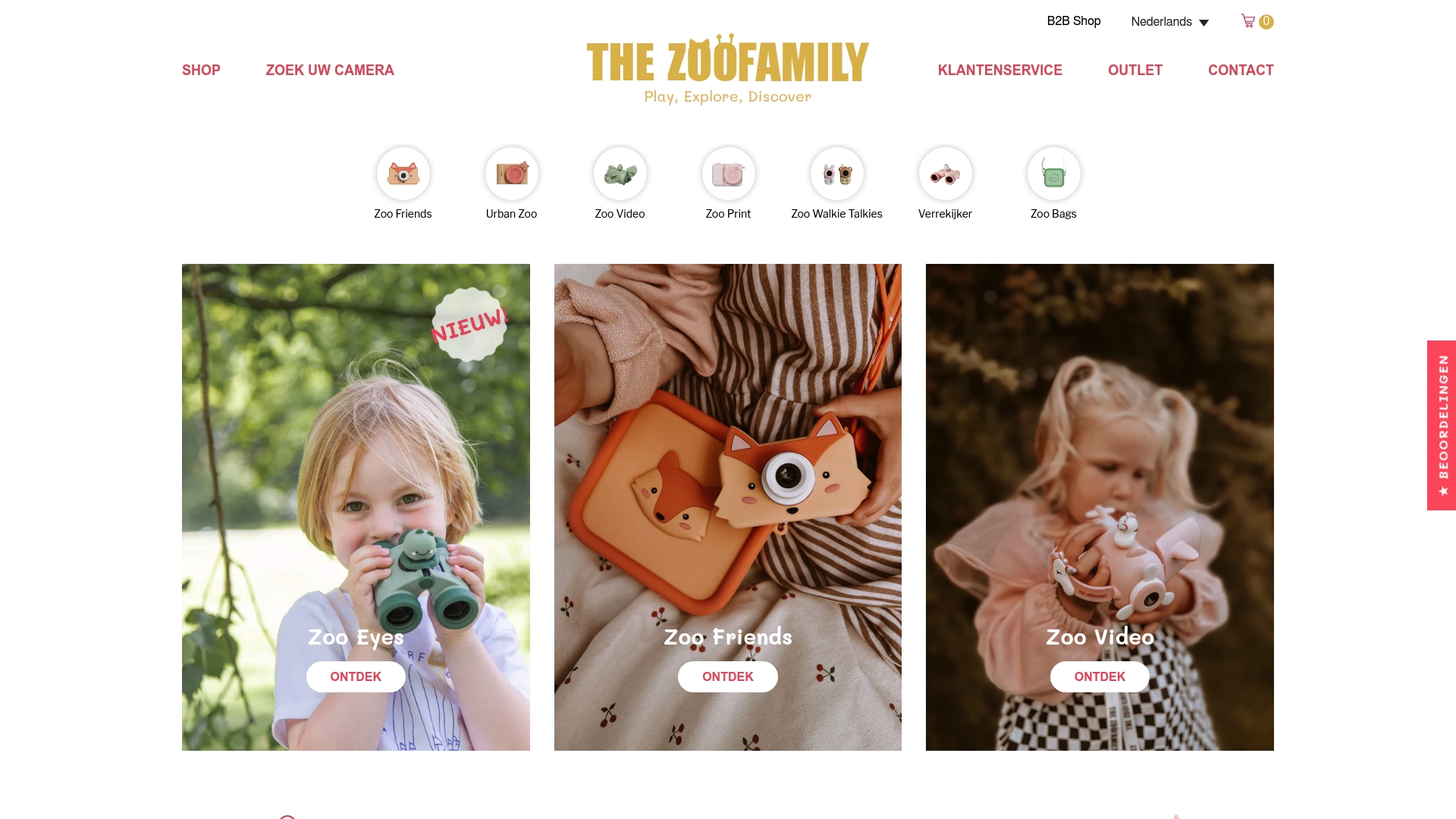
If you are buying a gift for a baby, our products are not made for this age. They may suit a sibling aged 3 or over, or a future birthday.
When to ask for advice

Babies vary, and a small delay is often nothing to worry about. Norton Children’s says there is a wide range of normal development. It advises talking to your doctor about any questions or concerns.
There are also clear markers. Healthier Together, the NHS service, says parents should be concerned about hand skills if a child:
- is not reaching for objects by 6 months
- is not transferring toys from one hand to another by 8 months
- is not using a pincer grip to pick up small objects by 12 months
- does not use both hands equally before 18 months
Alberta Health Services adds signs to look for at 6 months. A baby may need more support if they tend to keep their hands closed or use one hand more than the other. The same applies if they do not reach for toys, hold them or release them on purpose. By 12 months, the signs are not holding an object in each hand at the same time, or not using two fingers to hold small objects.
Healthier Together also advises contacting your health visitor or GP if a baby aged 12 to 18 months:
- has lost skills they could do before
- feels very stiff or very floppy
- moves arms or legs in repetitive, jerky or strange ways
- uses one side of the body more than the other
- finds it hard to stand or walk
In the UK, your health visitor is the first person to ask. Your GP is the other option. Bring examples of what you have noticed, such as which hand your baby uses and what they do when you offer a toy.
FAQ
What fine motor skills should a 6-month-old have?
Most 6-month-olds reach for and grasp toys, bring them to the mouth and pass them between hands. They use a raking grasp, with all the fingers together, and they bang objects on a tray. They may also poke with the index finger. Not every baby does all of these at exactly 6 months.
When does a baby start to use the pincer grasp?
The raking grasp starts at around 6 months, and the pincer grasp follows at around 12 months. Many babies can pick up small objects with thumb and forefinger by their first birthday. They may still be refining it, and by 18 months most do it with greater ease.
How can I help my 6-month-old build hand skills?
Give them tummy time, safe objects of different sizes and containers to empty. Hide a toy under a scarf, let them hold a spoon at mealtimes and sing action songs. Stay with your baby, and avoid small objects and toys with parts that can come off.
Should I worry if my baby keeps their hands closed at 6 months?
Babies at this age usually keep their hands open and relaxed most of the time. Alberta Health Services lists hands that stay closed as a sign a baby may need more support. Speak to your health visitor or GP if this describes your baby.
Can a baby use a toy camera or walkie-talkie?
Our cameras and walkie-talkies are designed for children aged 3 and over, so they are not for a 6-month-old. At this age, stay with simple, baby-safe objects and your own company.
Sources
- Fine Motor Skills: What They Are, Development & Examples (Cleveland Clinic)
- Finger to Thumb: What To Know About the Pincer Grasp (Cleveland Clinic)
- Hand and Finger Skills: Your 1-Year-Old’s Fine Motor Skills (HealthyChildren.org)
- 6 Months (Royal Hospital for Children Glasgow)
- Fine motor skills: birth to 2 years (Children’s Hospital of Richmond at VCU)
- Fine motor development: 6 to 12 months (Alberta Health Services)
- 6-Month-Old Baby Milestones (UNICEF USA)
- Learning, Play, and Your 8- to 12-Month-Old (Norton Children’s)
- Hand Skills (Healthier Together, NHS)
- 12 Months to 15 Months (Modern Pediatrics)
- Developmental Milestones chart (pedscases)
- Developmental Milestones: Fine Motor Skills and Visual Skills (CHOC)
- Toddler development (MedlinePlus)
- 21 learning activities for babies and toddlers (UNICEF)