

TL;DR:
- Children can drive household water conservation efforts effectively by leading fun, engaging challenges. Small behavioral changes like turning off taps and reducing shower times significantly save water and energy. Using playful activities and involving kids fosters lasting habits and a positive conservation culture.
Most families genuinely believe they are fairly water-conscious. A quick shower here, a half-full kettle there. Yet the average person in the UK uses 142 litres every single day, and much of that disappears without anyone noticing. The real opportunity lies not in guilt-tripping adults but in handing children a meaningful role. When kids become the champions of change, the whole household shifts. This guide gives you practical, evidence-backed steps to make water conservation a natural part of family life, without a single lecture or nagging reminder.
Table of Contents
- Why family water conservation matters
- Breaking down family water use: where does it all go?
- Making water conservation fun for kids
- Smart habits and tech: everyday actions to save more water
- Why changing family habits really works (and what most guides miss)
- Next steps: transform your family’s eco-habits
- Frequently asked questions
Key Takeaways
| Point | Details |
|---|---|
| Children lead change | Involving kids using games and positive reinforcement reliably drives the best water-saving habits for the family. |
| Focus on key uses | Targeted actions around showers, toilets, and taps can produce major savings without sacrificing comfort. |
| Tech boosts results | Smart meters and leak detectors magnify your efforts, offering up to 25% decreased water use. |
| Make it fun | Turning conservation into playful challenges motivates the whole family and ensures habits stick. |
Why family water conservation matters
It is easy to look outside on a rainy British afternoon and assume water scarcity is somebody else’s problem. It is not. Water stress exists across parts of Europe despite the appearance of abundance, driven by ageing infrastructure, population growth, and increasingly unpredictable rainfall patterns. Southern England, in particular, is classified as seriously water-stressed by the Environment Agency. The problem is closer to home than most families realise.
The numbers are striking. The average person uses 142 litres per day, and showers, baths, and toilets account for roughly 50% of all household water consumption. A single bath uses around 80 litres. Leave a tap running and you lose approximately 6 litres every minute. These are not abstract statistics. They are the sounds of your water bill climbing and your environmental footprint growing.
Here is where children become genuinely powerful. Research consistently shows that when kids adopt new behaviours, they bring their parents along. A child who turns off the tap while brushing teeth does not just save water once. They remind siblings, question parents, and create a new household norm. That ripple effect is enormous.
Common sources of hidden water waste at home:
- Leaving taps running while washing up or brushing teeth
- Running half-empty dishwashers or washing machines
- Long showers (every extra minute costs around 10 litres)
- Dripping taps (a slow drip wastes up to 5,500 litres per year)
- Watering the garden during the hottest part of the day
- Flushing unnecessarily or using older, high-volume cisterns
| Activity | Approximate water use |
|---|---|
| Bath | 80 litres |
| 8-minute shower | 62 litres |
| Running tap (per minute) | 6 litres |
| Toilet flush (modern) | 6 litres |
| Toilet flush (older) | Up to 13 litres |
| Brushing teeth (tap on) | 12 litres |
| Brushing teeth (tap off) | 1 litre |
“Water conservation is not a lifestyle choice for the environmentally minded few. It is an essential household skill for every family in Europe, and the earlier children learn it, the more powerful the long-term impact.” — Waterwise
For more ideas on building these habits early, the 7 water-saving tips on our blog are a brilliant starting point.
Breaking down family water use: where does it all go?
Now we know why water conservation is crucial, let us look at exactly where families use the most water and how to spot quick wins. Understanding the breakdown makes the solution feel far less overwhelming.
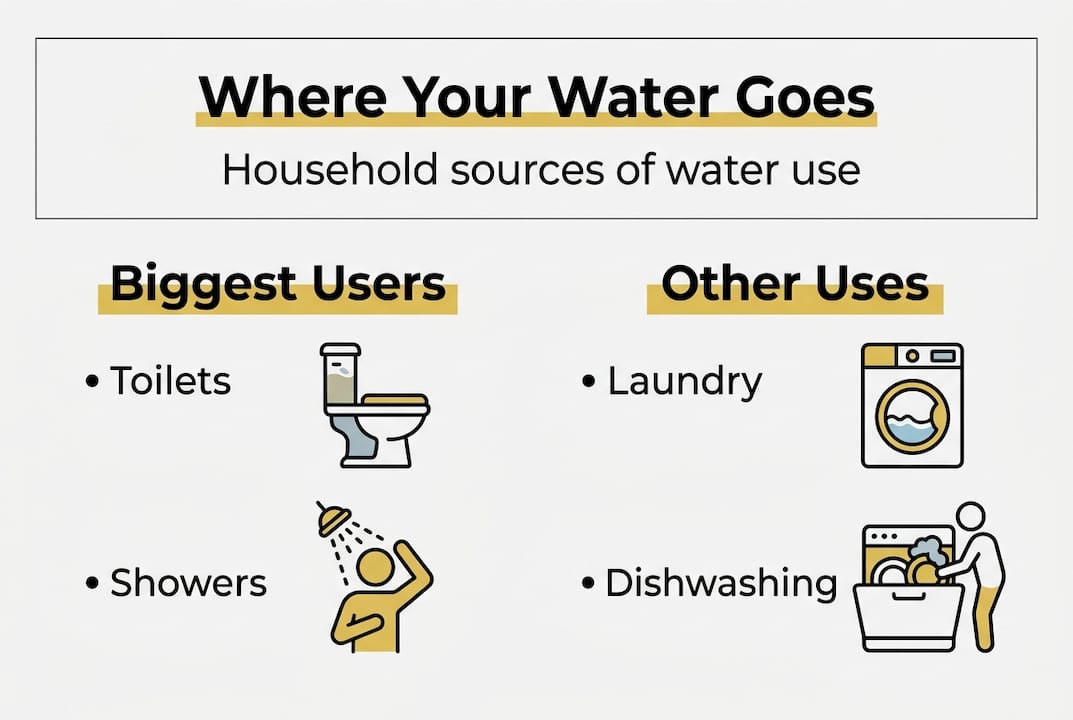
Toilets alone account for 25% of household water use, making them the single biggest target for change. Showers and baths follow closely. Together, these three areas give families the greatest opportunity to make a real dent in daily consumption without dramatically changing their routines.
The most surprising statistic for most parents? Turning off the tap while brushing teeth saves 9,000 litres per year for a family of four. That is not a small tweak. That is a swimming pool’s worth of water, rescued by a habit that takes zero effort once it sticks.
| Activity | Litres used (tap on) | Litres used (tap off/optimised) |
|---|---|---|
| Brushing teeth (2 min) | 12 litres | 1 litre |
| Washing hands | 6 litres | 1 litre |
| Shower (8 min) | 62 litres | 30 litres (4 min) |
| Bath | 80 litres | 50 litres (shallow) |
| Dishwasher (half load) | 15 litres | 10 litres (full load) |
Top 5 quick wins for reducing family water use:
- Turn off the tap every single time you brush teeth
- Swap one bath per week for a four-minute shower
- Only run the dishwasher and washing machine on full loads
- Fix dripping taps immediately (a plumber call costs far less than the wasted water)
- Collect cold water while waiting for the shower to warm up and use it for plants
These are not dramatic lifestyle overhauls. They are small pivots that compound beautifully over a year. For families with young children, turning bath time into a water play savings opportunity is a wonderfully natural way to make the lesson stick without it feeling like a lesson at all.
Making water conservation fun for kids
With major water uses identified, the next step is putting children in the lead through activities that are genuinely enjoyable. The research is clear on this point. Gamified challenges and hands-on activities are far more effective for children than lectures or repeated reminders from adults. The moment saving water becomes a game, children stop resisting and start competing.
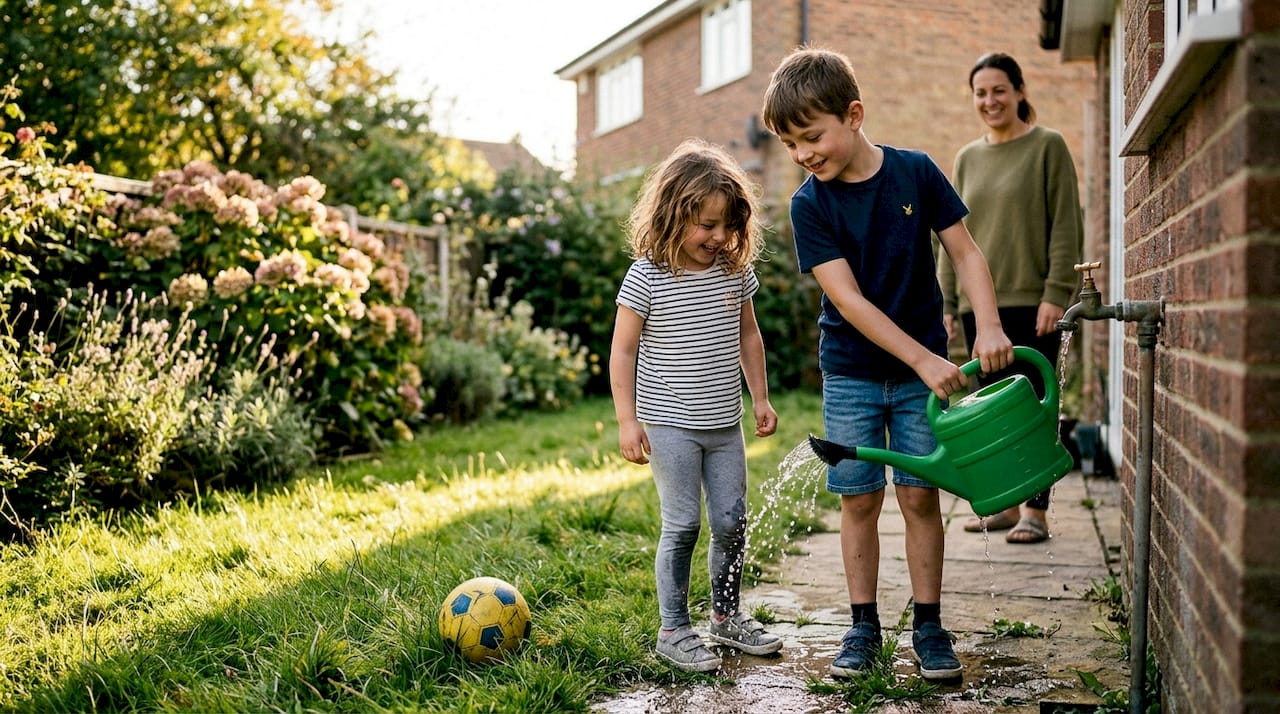
The key is to connect water conservation to things children already care about: animals, nature, adventure, and winning. A timed tooth-brushing challenge with a two-minute sand timer. A superhero chart where each family member earns points for water-saving actions. A drip experiment using a bowl under a leaky tap to show children exactly how much water disappears overnight. These activities create visceral understanding that no amount of explaining can replicate.
Five creative water-saving activities to try this week:
- The shower timer challenge: Give each child a four-minute playlist. If they finish before the music stops, they earn a point on the family chart.
- Drip detective: Place a measuring jug under a dripping tap for one hour, then calculate the daily and yearly waste together.
- Plant watering rota: Assign children responsibility for watering plants using collected rainwater or leftover drinking water.
- Water superhero journal: Children log every water-saving action they spot in the house, earning badges for new discoveries.
- The bucket experiment: Fill a bucket to show how much water a bath uses, then compare it to a shower. Visual impact works brilliantly with younger children.
Pro Tip: Link water awareness to tasks children already own, such as caring for a pet or tending a small garden patch. When a child understands that their fish or their tomato plants depend on water being available, conservation becomes personal rather than abstract.
“Children who are actively involved in water-saving decisions at home are significantly more likely to maintain those behaviours into adulthood and to influence the habits of those around them.” — Water Wisdom for Kids
For a full collection of fun water activities and outdoor experiments that connect children to nature, our blog has plenty to inspire your next family afternoon.
Smart habits and tech: everyday actions to save more water
Now you have ways to make saving water enjoyable, here is how to lock in those savings using smart habits and a little technology. The goal is to make conservation automatic rather than effortful.
Smart water metering is one of the most powerful tools available to families right now. Smart metering can cut household water use by up to 25%, with digital meters delivering 5 to 8% savings and leak detection alone accounting for 7 to 14%. These are not marginal gains. For a family of four, a 25% reduction translates to tens of thousands of litres saved annually.
Beyond the meter, water heating represents 15% of residential energy use across EU households. Shorter showers do not just save water. They cut your energy bill in a genuinely meaningful way. Every four-minute shower you replace with an eight-minute one costs you twice the energy and twice the water.
Top 4 family routines for lasting water savings:
- Morning check-in: One child is designated the daily water monitor, checking for dripping taps and reporting to the family.
- Full-load rule: Nothing runs unless it is full. Dishwasher, washing machine, no exceptions.
- Shower countdown: A visible timer in the bathroom keeps showers honest for every family member, adults included.
- Weekly meter reading: Read the meter together every Sunday evening. Children love tracking numbers, and the data makes savings feel real and rewarding.
Pro Tip: Give your child the job of reading the water meter each week and recording it in a notebook. When they see the number drop after a week of good habits, the pride is immediate and the motivation to continue is entirely self-generated.
For practical eco-friendly routines that weave water awareness into everyday family life, our resources are designed to make this genuinely easy.
Why changing family habits really works (and what most guides miss)
Most water-saving guides hand you a list of tips and leave you to it. The assumption is that information creates behaviour change. It rarely does, and the research backs this up. Lasting change comes from strong social norms, not from rules. When families focus on nagging and reminders, they create resistance. When they focus on active, enjoyable involvement, they create identity.
This is the insight that most guides miss entirely. A child who is told to save water will forget. A child who identifies as a water-saving champion will remind you. The shift from external rule to internal value is everything, and it happens through play, ownership, and positive reinforcement, not through lectures.
“Families who frame conservation as a shared adventure rather than a set of restrictions see dramatically better long-term results. The goal is not compliance. It is culture.”
At The Zoofamily, we see this play out constantly. The families who build the most lasting creative family habits are not the ones with the strictest rules. They are the ones where children feel genuinely involved, where their ideas are taken seriously, and where saving water feels like something the family chooses rather than something imposed from outside. That distinction is subtle but transformative.
Next steps: transform your family’s eco-habits
You now have the knowledge, the activities, and the routines to make water conservation a genuine part of your family’s identity. The next step is simply to begin, and you do not have to do it alone.
At The Zoofamily, we build tools and resources that help children connect with the natural world in ways that are joyful and lasting. From nature-inspired cameras that make kids curious about the outdoors to a growing library of teaching activities designed to turn everyday moments into learning adventures, we are here to support your family every step of the way. For every camera sold, we plant one tree. Because the world your children are learning to protect deserves to be protected in return.
Frequently asked questions
How much water can a family save each year with a few changes?
A typical family can save over 9,000 litres per year simply by turning off the tap while brushing teeth, with thousands more saved by reducing shower and bath times.
Is smart water metering worth installing at home?
Yes. Smart water meters reduce use by up to 25%, providing instant feedback that helps families spot waste and track their progress in real time.
What is the easiest way to get kids interested in saving water?
Hands-on challenges and family competitions make saving water genuinely enjoyable, turning a daily habit into something children actively look forward to.
Does saving water also reduce energy bills?
Absolutely. Since water heating accounts for 15% of home energy use across EU households, shorter showers and fewer baths lower both your water and energy costs simultaneously.
Are there mistakes families make when trying to save water?
The biggest mistake is nagging. Playful, hands-on approaches consistently outperform rule-setting, because children respond to fun and ownership rather than repeated reminders.