

The best nature activities for children need very little: a patch of green, a free hour and something to look at closely. Scavenger hunts, art made from fallen leaves, bug hotels and puddle play all work in a garden, a local park or a wood. Add a camera or a pair of binoculars and a walk becomes a mission. This guide gives you ideas by type, the ages they suit, what to bring and how to keep wildlife safe.
TL;DR
- Start small and local. A garden, a street tree or a park bench is enough, and following your child’s interest beats a planned route.
- Scavenger hunts, natural art and simple wildlife homes are the easiest activities to start with, from about age 3.
- A small exploration kit (a magnifier, a notebook, binoculars, a camera) gives children a job to do outdoors.
- Use only fallen materials, return every creature you find and supervise anything that involves tools or water.
- Every season has something to offer, including rain.
Table of Contents
- Start small and follow your child’s interest
- Scavenger hunts and wildlife spotting
- Art and craft with natural materials
- Build something for wildlife
- Activities for every season and every kind of weather
- What to bring: a simple exploration kit
- Keep it safe and respect wildlife
- What children gain from nature activities
- Our view: give children a reason to look closely
- A starter kit for your next outing
- FAQ
- Sources
Start small and follow your child’s interest
You do not need a forest. One parenting writer suggests that a backyard, a pavement tree or a patch of waste ground all count as nature, and that forty-five minutes watching one caterpillar is worth more than a long planned walk. Deep looking matters more than distance.
There is research behind this. A peer-reviewed review on outdoor play argues that care and respect for nature grow from feeling connected to it, so familiarity from an early age helps children behave in more sustainable ways later in life. Short, regular visits to the same place do more than one big day out.
A few habits make any activity easier:
- Let your child choose what to look at, and follow it.
- Ask questions instead of giving facts. “Why is the snail on the wall, not the path?” gets more thinking than a lecture.
- Go back to the same spot through the year and notice what has changed.
- Keep some time unstructured. Children learn through free exploration whether or not an adult explains it.
Scavenger hunts and wildlife spotting
The scavenger hunt is the most flexible nature activity there is. It needs no preparation, it suits a wide age range and it turns a short walk into a game.
The Woodland Trust suggests seasonal or colour-themed hunts, spotting wildlife with a magnifying glass or binoculars, and acting as a “nature detective” by looking for animal tracks and droppings. For a younger child, use a picture list instead of words. The Slow Childhood rates scavenger hunts as suitable from age 3, with picture lists for toddlers.

Ways to make a hunt more fun
The Nature Conservancy recommends mixing easy finds such as rocks, sticks and leaves with harder ones, and picking a goal animal that is common but hard to spot, based on what your child likes. That gives a small challenge without frustration.
The early-years body NAEYC lists categories that work well for young children, such as a certain colour, something tiny or huge, or things that crawl. Some more ideas:
- Five senses walk. Stop and name one thing you can see, hear, smell and touch.
- Listening walk. Children draw or write every sound they hear and where it came from.
- Ant watch. Follow an ant trail and put a tiny crumb nearby to see what happens.
- One tree, four seasons. Visit the same tree each season and compare.
- Animal signs. Look for feathers, prints and nests, and talk about which animal might live there. Pages about wild parrots in a city setting show how animals adapt to the places they live, which is a good starting point for a conversation with an older child.
For more themed routes, see our own list of nature scavenger hunt ideas for families.
Art and craft with natural materials
Collecting is half the fun. Children gather leaves, petals, pebbles and sticks, then turn them into something. Nature art is also a good rainy-day activity, since the collecting can be done on a dry day and the making indoors.
The RHS offers ten family nature activities, including:
- paper-plate animal pictures made with fallen leaves and flowers
- leaf crowns
- bark and leaf-vein rubbings, revealed with watercolour paint
- pressed flowers, left under a heavy book for a week
- twig pen pots
- a nature diary
For younger children, keep it sensory. The American Academy of Pediatrics’ parent site advises that nature art for little ones should be about touch and exploration, such as finger painting with mud, stamping with leaves or drawing in dirt with sticks. It adds that around age 3, simple tools such as safety scissors can be introduced for cutting leaves. If you want to understand why messy, hands-on play matters, this guide to sensory play and child development is a clear read for parents.
Two more ideas to try:
- Mud creatures. Build a small animal from mud, twigs and leaves, then photograph or draw it. Forest school guides for ages 4 to 12 include this one.
- Pressed-flower placemat. Press leaves and flowers in a heavy book, then cover them with sticky-backed plastic. NAEYC describes this as a keepsake children can use at the table.
Build something for wildlife
Children stay interested longer when what they make has a purpose. Wildlife homes and feeders give a reason to return and check what has happened.
The Woodland Trust lists bug hotels, nest boxes and hedgehog houses as family projects. The RHS gives exact recipes for two simple ones:
- Seed bombs. The mix is one cup of seeds, five cups of peat-free compost and two to three cups of clay powder, rolled into golf-ball-sized balls and left to dry. The full method is on the RHS page.
- Bottle bird feeder. A 2-litre bottle with an 8 to 10 cm hole cut in it. An adult should do the cutting.
A bee hotel can be made from bamboo canes and straws. Hang it in a sunny spot and check it through the season. For a longer project, our guide to creating a wildlife-friendly garden for children shows how to plan a space that keeps giving, and our backyard play ideas cover simple set-ups for smaller spaces.
Growing and measuring
Planting is a quiet activity with a clear result. The Slow Childhood suggests sunflowers, beans and radishes as seeds to plant from age 2 upwards. National Geographic Education suggests choosing one plant and measuring it every week through the growing season, noting buds, flowers and growth. A mini garden or a rain gauge makes a good next step, and our outdoor science activities explain both.

Activities for every season and every kind of weather
There is no bad season for nature, only different things to look at.
| Season or weather | Activity | Suggested age |
|---|---|---|
| Spring | Puddle-jumping, seed planting, spring scavenger hunt | 2+ for puddles and seeds, 3+ for hunts |
| Summer | Pond dipping, bee hotel, stargazing | Supervised, from early years |
| Autumn | Den building, leaf rubbings, collecting for art | From about 3 with help |
| Winter | Bird feeders, tracks and signs, nature diary | From about 3 |
| Rain | Puddles, mud pizzas, slug and snail search | 2+ |
Age guidance for the spring items comes from The Slow Childhood’s seasonal list, which also labels dam building with sticks, rocks and mud as suitable from age 5. The other rows are our suggestions, so adjust to your child.
A few notes by season:
- Autumn dens. A den can be built any time, but a Healthy Planet booklet notes that autumn is ideal because there are more branches and leaves on the ground. Once built, it becomes a place for games, listening or reading a story.
- Rain. The Woodland Trust includes puddle-jumping, mud pizzas and searching for slugs and snails under rain play. Waterproofs and wellies turn a grey day into an activity.
- After dark. PBS Kids for Parents suggests a nighttime observation kit to explore what is outside your front door after dark. A small night light or torch is enough.
For days out, our ideas for nature-loving family days help you plan around the weather.
What to bring: a simple exploration kit
National Geographic Education suggests an exploration bag holding binoculars, a hand lens, a small trowel, a tape measure, a camera, a torch, a collecting bag and a weatherproof notebook. You do not need all of it. Start with three things: something to look through, something to record with and something to carry finds in.
This is where our products fit. Our range is made for children aged 3 and over, and every item carries an animal design meant to spark interest in nature:
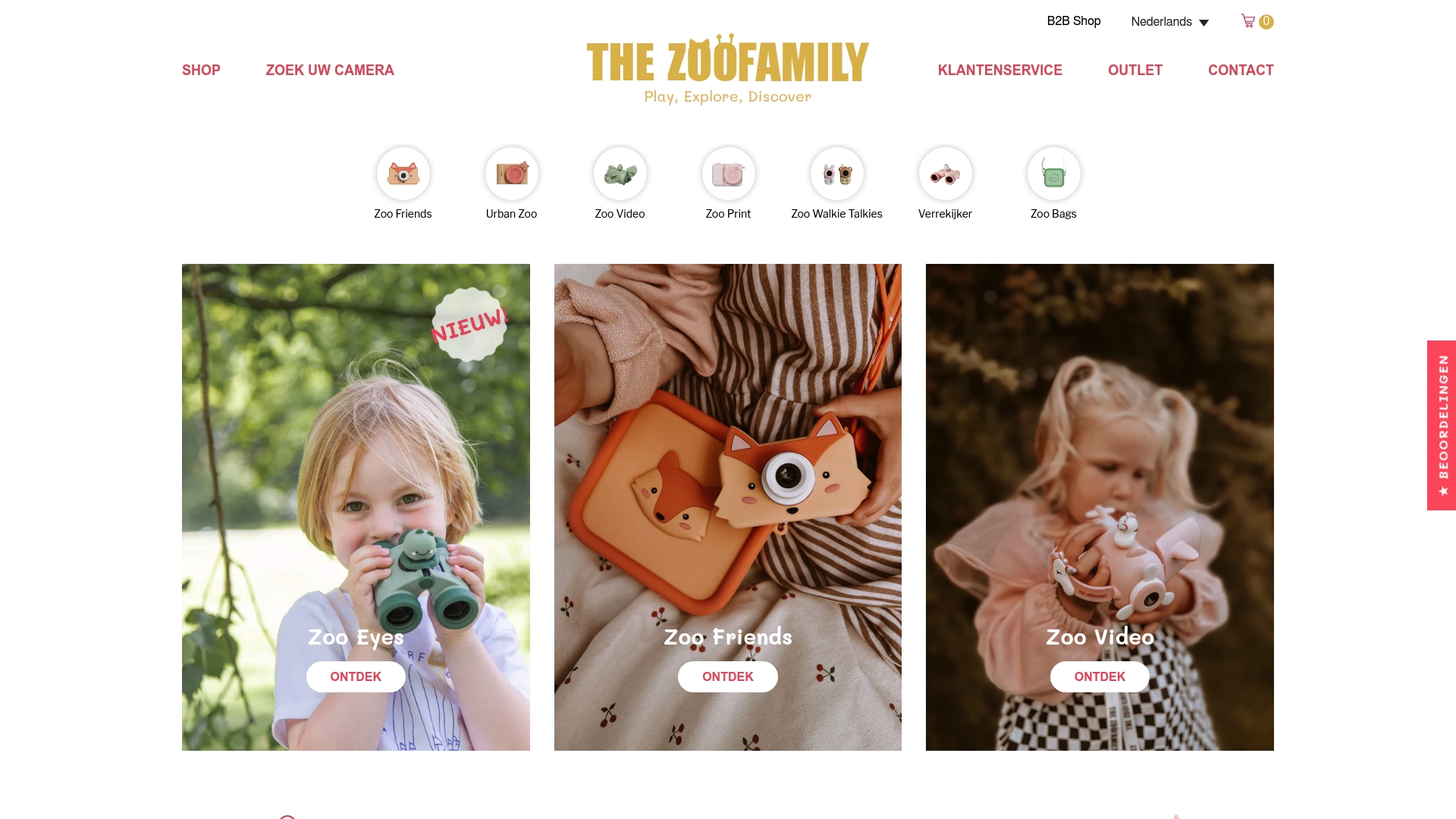
- Cameras for photographing finds, such as the Zoo Friends camera at €69.95, the Urban Zoo at €89.95 and the Zoo video at €79.95.
- Zoo eyes binoculars at €39.95, for spotting birds and insects.
- Zoo Walkie-Talkie at €54.95, handy when children explore in a garden or park and want to talk to each other.
- Zoo light at €39.95, for evening or dusk nature walks.
- Zoo bags at €19.95, to carry the kit and the day’s finds.
A camera also gives children a way to keep what they find without taking it. Photographing a flower, a bug or a mud creature leaves the habitat as it was, and the photos can later go into a nature diary.
Keep it safe and respect wildlife
Nature play is good for children, and a few simple rules keep it that way.
- Use fallen materials only. The Woodland Trust asks families to build dens from fallen branches, never to break twigs off living trees, and to skip den building in ancient woodland.
- Return every creature. Pond dipping is best on warm spring or summer days, and everything caught goes back in the pond.
- Check before a smell hunt. Forest school guidance says to check the area first for anything that should not be handled before children crush leaves to identify plants by scent. Teach children not to taste plants or berries.
- Stay close to water and tools. Pond dipping, whittling and cutting bottles need an adult within reach.
- Wash hands afterwards, especially before food.
Do not wrap children up in worry either. The same review on outdoor play notes that a culture of fear can make learning more dangerous, because children lose the chance to learn about safety through experience. Stay near, let them try things at a sensible level and step in when it matters.
What children gain from nature activities
PBS Kids for Parents says nature play gets children moving, builds creativity and curiosity, and increases confidence. Other findings point the same way:
- A 2025 study of 46 children aged 5 to 6 found that nature-based art with natural materials improved visual expression and fostered ecological awareness. Thirty-eight of the children could explain the meaning of their artwork.
- A Nature Conservancy writer notes that scavenger hunts teach observation without lessons: children start to ask their own questions about habitats and animal habits.
- The outdoor-play review reports that a sense of discovery drives meaningful learning and a lasting emotional connection with the environment.
For parents, the practical point is that the effort needed is small and the benefit is shared. You spend an hour together, away from screens, with something to talk about afterwards.
Our view: give children a reason to look closely
We make cameras, binoculars and walkie-talkies for children, and we planted the idea behind them in nature. Each product has an animal design, because animals are often a child’s first way into the natural world.
What we see in the research is simple. Children care about what they know, and they know what they have looked at closely. A child with a camera or a pair of binoculars has a reason to stop, look and come back to the same tree or hedge. That is why we build tools for exploring, and not only toys.
We also think the planet should benefit from the things we make. For every camera we sell, we plant one tree. A child who photographs a leaf and a family that adds a tree to the world have something in common: both are paying attention to nature.
Start with one small outing this week. Pick a spot near home, bring one tool and let your child lead.
ALAIN
A starter kit for your next outing
If you are looking for a gift that sends children outdoors, our range is designed for ages 3 and over. The kids’ cameras are a good place to begin, and the Zoo Walkie-Talkies suit children exploring a garden or park together. Prices start at €9.95 for the zoo sleeves, and you can see the full range on our shop. For each camera sold, we plant one tree.
FAQ
What are the easiest nature activities for young children?
Scavenger hunts, leaf and bark rubbings, puddle-jumping and seed planting are the easiest to start with. They need almost no preparation and suit children from about 2 or 3 years old. Use picture lists for toddlers and keep the time short.
How can I make nature fun for children who get bored quickly?
Give them a job. A mission such as finding five colours, spotting a goal animal or photographing three different leaves keeps attention. Following their interest and mixing easy finds with harder ones also helps, as does letting them hold the camera or binoculars.
Can we do nature activities in the rain or in winter?
Yes. Rain play such as puddle-jumping and searching for slugs and snails is a favourite, and winter suits bird feeders, tracks and a nature diary. Dress for the weather and keep outings short. Collected leaves and sticks can become art indoors.
What do I need to bring?
Start with a notebook, a bag for finds and something to look through, such as a magnifier or binoculars. A camera lets children record what they see without picking it. Add waterproofs, wellies and a drink for longer trips.
Sources
- Nature Activities for Kids and Families, Woodland Trust
- 10 nature activities to do with kids, RHS
- Nature Art: Outdoor Inspiration to Boost Your Child’s Development, HealthyChildren.org
- Tips for a Fun Nature Scavenger Hunt, Nature Conservancy
- 10 Ideas to Get You and Your Child Exploring Outdoors, NAEYC
- Observing Nature, PBS KIDS for Parents
- Outdoor Family Fun, National Geographic Education
- 30 Outdoor Nature Activities for Kids (By Season), The Slow Childhood
- Healthy Planet eco-activities booklet
- The importance of outdoor play for young children’s healthy development, PMC
- Journal of Educational Sciences, 2025 nature-based art study
- Forest School Activities and Games for Kids, Educate Outside
- Wild parrots FAQ, California Parrots
- Sensory Play and Child Development: A Parent’s Guide