

An insect is a small animal with three body parts and six legs. Look closer and you will find antennae too, and sometimes wings. That one sentence is the whole starting point for learning about insects at home or in the classroom.
Try these three starter actions right now:
- Count the legs. Six means insect; more or fewer means something else.
- Check the body segments. Look for a head, thorax and abdomen.
- Go on a five minute bug hunt. Look under a leaf, log or plant pot.
Trusted places to check your findings include the Smithsonian National Museum of Natural History, home to some of the world’s biggest insect collections, and university entomology departments that publish free classroom guides.
Key Takeaways
Recognising an insect always comes down to the same rule: three body segments, six legs, and antennae on the head.
| Point | Details |
|---|---|
| Use the three-part rule | Head, thorax and abdomen, plus six legs, confirm any insect identification. |
| Match the life cycle type | Complete metamorphosis has four stages; gradual metamorphosis skips the pupa. |
| Record more than a photo | Note time, location and behaviour to help confirm tricky identifications. |
| Run two core activities | A bug hunt and an invent-an-insect task cover both observation and adaptation. |
| Equip young explorers | Thezoofamily’s child-sized cameras and binoculars support closer, safer observation on any bug hunt. |
Where can you check these facts yourself?
- Britannica — Insect — a clear anatomical definition for classroom reference.
- UNL entomology life-cycle guide — printable stages for modelling metamorphosis.
- CalAcademy Invent an Insect lesson plan — full activity template for teaching adaptation.
Table of Contents
- What makes an insect an insect?
- How do insects grow up?
- How do you identify an insect in the field?
- Which hands-on activities work best for kids?
- Why do insects matter to the ecosystem?
- Where can you find more insect resources?
- Can you answer these insect quiz questions?
- Frequently asked questions
- Sources
What makes an insect an insect?
Every insect shares the same basic build. The head carries the eyes, mouth and antennae, so it does all the sensing and eating. The thorax is the middle section, and it is the anchor point for legs and wings, which is why the thorax works as a foolproof identification clue once children learn to spot it. The abdomen at the back holds the organs for digestion and breathing.
A quick classroom checklist:
- Are there six legs, all attached to the thorax?
- Can you see a pair of antennae on the head?
- Does the body split into three clear sections?
- Are there wings (some insects have none, and that is fine)?
An arthropod only counts as a true insect when it has three body segments and six legs as an adult. Ask children to draw and label a simple insect outline, marking head, thorax and abdomen in three colours.
Pro Tip: Print one large diagram and let each child add their own antennae, legs and wings with a dry-wipe pen. Wipe clean and reuse it with the next class.
How do insects grow up?
Insects grow in two very different ways. Complete metamorphosis runs through egg, larva, pupa, then adult, and the young look nothing like the grown-up. Butterflies, beetles and flies all follow this path. Gradual metamorphosis skips the pupa stage: eggs hatch into nymphs that already look like small, wingless adults and simply moult as they grow. Grasshoppers and dragonflies both grow this way.
Because larvae and adults can look so different, identification keys built for grown insects rarely work on caterpillars or grubs.
Model a butterfly life cycle:
- Gather pipe cleaners, pom poms, paper and a paper plate marked into four stages.
- Build an egg, a caterpillar, a chrysalis and a butterfly using the craft materials.
- Glue each stage onto the plate in order and talk through what changes at each step.
How do you identify an insect in the field?
Spotting an insect is easy. Naming it takes a little method. Start with the same checklist used indoors, then add detail about where and how the insect was behaving.
Follow this sequence on any bug hunt:
- Count the legs. Six confirms an insect.
- Look for antennae on the head.
- Note the habitat: under bark, on a flower, in soil, on a leaf.
- Watch what it is doing: flying, crawling, feeding, resting.
- Take a photograph if you can, without touching the insect.
Teachers can turn this into a poster with a simple flowchart: “Six legs? Yes → check antennae and wings. No → not an insect, try a spider or woodlouse key instead.”
Recording more than just a photo genuinely helps. Community identification resources work far better when the note includes time, location and behaviour, not just an image, because those details narrow down the possible species. Keep in mind that most printed and online identification keys are built for adult insects only, so a caterpillar or grub may need a different guide entirely.
Safety tip: never touch bees, wasps or an insect you cannot name. Observe from a short distance, let it move away in its own time, and treat every creature as if it were more fragile than it looks.
Pro Tip: Give each child a small notebook with three columns: where, what it was doing, and how many legs. It turns a wander into real fieldwork.
Which hands-on activities work best for kids?
Two structured activities give children the most to learn from in a single session.
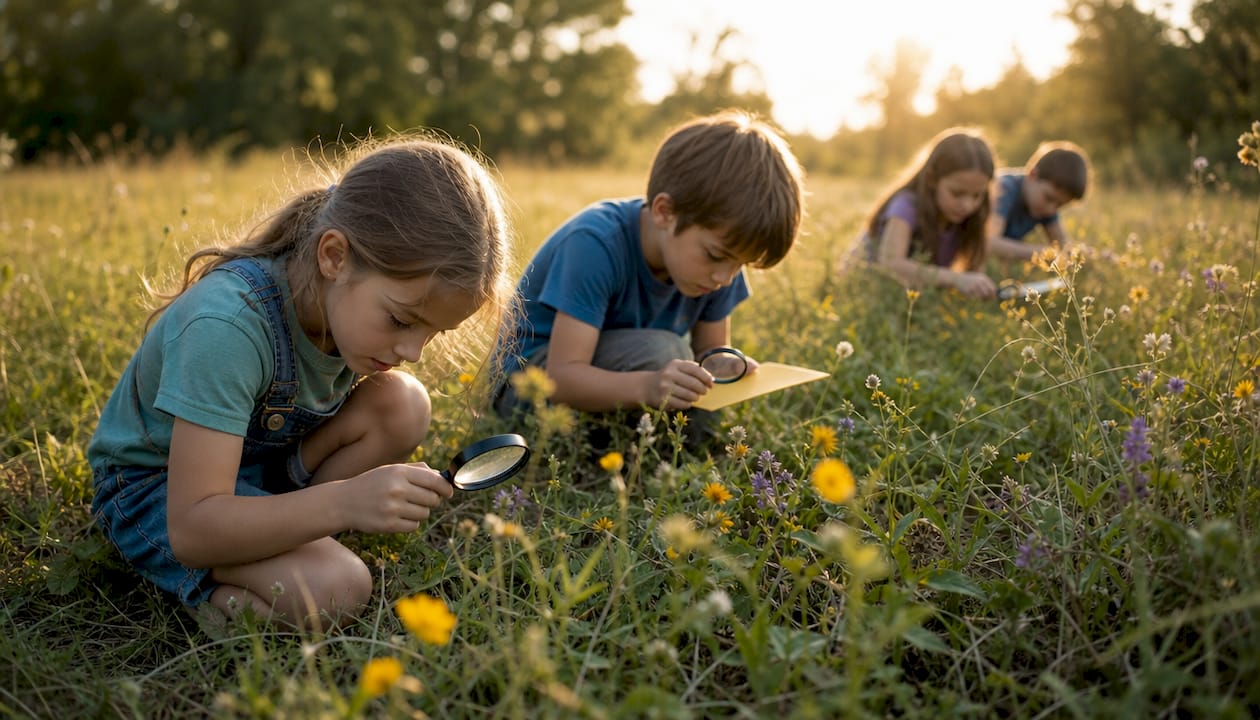
Bug hunt. Materials: notebooks, magnifying glasses, a simple ID checklist. Steps: 1) mark out a small search area, 2) record every insect found using the where/what/legs columns, 3) group findings back in class by number of legs and habitat. Learning objective: apply the six-legs rule to real specimens. Assess with a short group presentation, as recommended in structured insect investigation lesson plans that build toward a final class share-out.
Invent an insect. Materials: paper, pens, craft scraps. Steps: 1) pick a habitat (desert, pond, rainforest), 2) design an insect with features suited to that place, 3) explain each adaptation to the class. This mirrors invent-an-insect lessons that teach adaptation directly rather than through memorising facts. Assess by checking whether each feature has a clear habitat reason.
Two shorter ideas round out a unit: build an insect hotel from garden offcuts, or try photographing insects up close.
Pro Tip: For mixed-age groups, pair an older child with a younger one on the bug hunt. The older child records; the younger one spots.
Why do insects matter to the ecosystem?
Bees and other pollinators move pollen between flowers, without which many fruits and vegetables would not grow. Beetles and flies break down dead plants and animals, recycling nutrients back into the soil, and some insects prey on pests that would otherwise damage crops.
The scale is genuinely hard to picture: insects make up roughly 80% of all known animal species, with about 900,000 species described so far and an estimated 10 quintillion individual insects alive at any one time.
Try this: pick one flowering plant in a school garden and watch it for a short time. Count how many different insects visit.
- Pollination keeps flowering plants reproducing.
- Decomposition returns nutrients to soil.
- Natural pest control reduces damage to other plants.
Where can you find more insect resources?
Museum and university pages tend to give the most reliable starting point. The Oxford University Museum learning zone offers short, child-friendly explainers on insect traits and habitats, good for a five-minute classroom introduction.
- Museum pages — accurate, kid-tested explainers; use before a unit starts.
- Lesson-plan PDFs — ready-made objectives and vocabulary; print and adapt directly.
- Simple ID keys — best for adult insects; pair with a life-stage chart for larvae.
- Videos — good for showing metamorphosis in real time rather than describing it.
- Printable worksheets — hand out after a bug hunt to consolidate what was found.
Older students and curious adults wanting more depth might try Bugs 101, a beginner-friendly course linking insect biology to ecology and conservation. For practical fieldwork skills, revisit the guide to photographing bugs.
Can you answer these insect quiz questions?
Use these as a warm-up before a lesson or a plenary check at the end.
- How many legs does an insect have?
- Name the three body parts of an insect.
- What are the four stages of complete metamorphosis?
- Give one example of gradual metamorphosis.
- Name one job insects do that helps plants grow.
- True or false: all insects have wings.
Two short practice tasks work well alongside the quiz:
- Label an insect diagram. Print a blank outline and score out of five labelled parts.
- Five-minute nature journal. Children write or draw one insect they spotted, noting where and what it was doing.
What is one teaching tip worth trying with insects?
The best insect lessons start with a question, not a fact sheet. Asking children to design a tool inspired by an insect’s body part, a beetle’s shell for armour, a fly’s eye for a wide-angle lens, turns curiosity into genuine inquiry rather than memorisation. Keep group sizes to four or five, allow twenty minutes outdoors, and bring only notebooks and magnifying glasses. Simple materials keep the focus on observation, not equipment.
Which tools make bug-hunts easier for young explorers?
A bug hunt goes further when children can look closer and capture what they find without breaking concentration to fiddle with settings. A child-friendly camera or a pair of binoculars sized for small hands lets a five-year-old photograph a beetle or watch a bee from a safe distance, then bring that record straight into the classroom checklist or nature journal above.
Thezoofamily makes cameras, binoculars and walkie-talkies built specifically around how children explore, sturdy enough for a garden scramble and simple enough to use one-handed while the other hand holds a magnifying glass. Every camera sold funds a tree planted, so a bug hunt this weekend supports the same habitats the insects in it depend on. Browse the current range on the Thezoofamily website and pick a camera or binoculars before your next outdoor lesson or family bug hunt.
Frequently asked questions
What is the simplest way to explain what an insect is to a child? Tell them an insect has three body parts, head, thorax and abdomen, and six legs. Anything with more or fewer legs, like a spider or woodlouse, is not an insect.
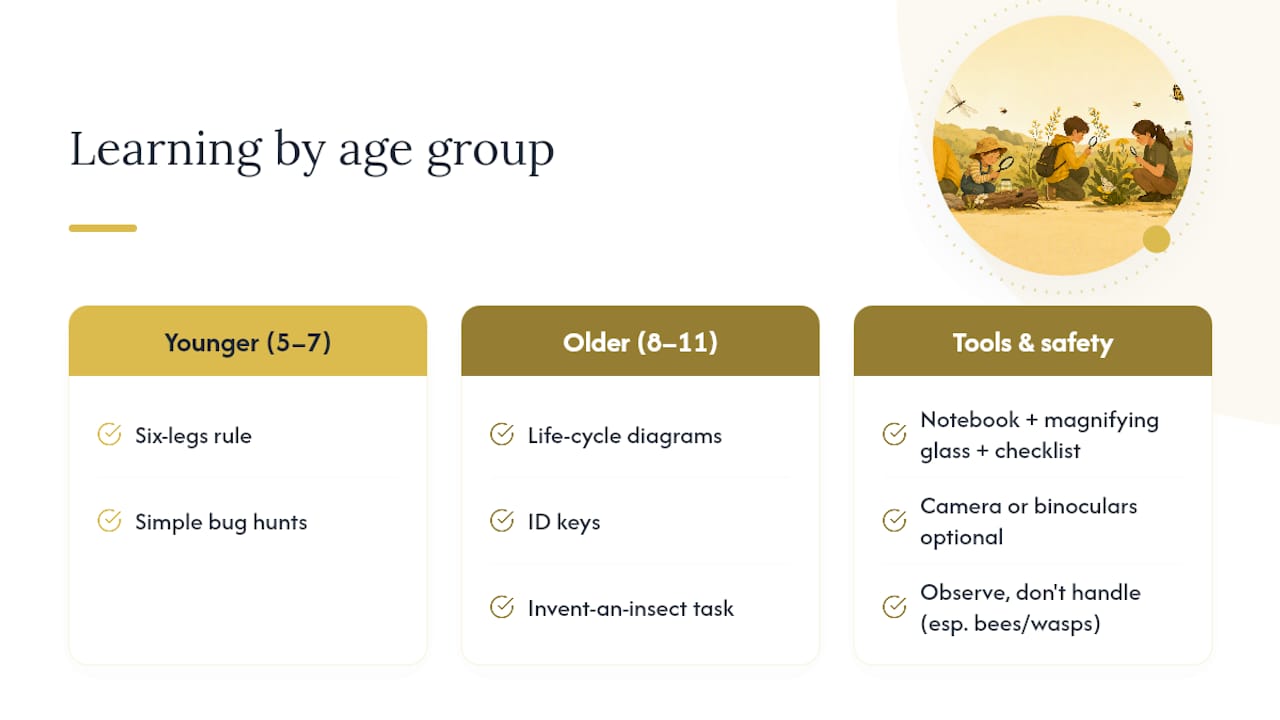
How is learning about insects different for younger versus older children? Younger children (5–7) do best with the six-legs rule and simple bug hunts. Older children (8–11) can handle life-cycle diagrams, ID keys, and the invent-an-insect adaptation task.
Can children identify insects without any special equipment? Yes. A notebook, a magnifying glass and the three-part checklist cover most classroom or garden identifications. A camera or binoculars simply make closer observation easier.
Why do larvae look so different from adult insects? Insects that go through complete metamorphosis change shape entirely between larva and adult stages, which is why most identification keys only work reliably on adults.
Is it safe for children to handle insects during a bug hunt? Children should observe rather than handle insects, especially bees, wasps or anything unfamiliar. Watching from a short distance keeps both the child and the insect safe.