

You take care of the planet through many small, repeated habits at home: use less energy and water, waste less, choose longer-lasting things, eat more plants, travel in lower-carbon ways and protect nature near you. Children learn these habits by doing them with you. This guide gives clear steps, with figures from the United Nations and UNICEF, that a family can start this week.
TL;DR
- Start at home: turn off lights, unplug unused devices and keep showers to 5 minutes or less.
- Waste less: buy only what you need, repair and reuse, and set up clearly labelled recycling bins.
- Food, travel and shopping have the largest effect: cut food waste, eat more plants and walk, cycle or use public transport.
- Help nature nearby: plant flowers, let part of the lawn grow and put up bird boxes.
- Children who feel connected to nature are more motivated to protect it, so do these things together outdoors.
Table of Contents
- Why taking care of the planet matters
- At home: energy, water and air
- Reduce, reuse and recycle
- Food, travel and shopping
- Help wildlife and green spaces near you
- Get children involved
- Our perspective
- Take care of the planet together with our products
- Act together in your community
- A simple monthly plan
- FAQ
- Sources
Why taking care of the planet matters
Nature gives people a lot for free. According to UNEP, these benefits include food, water, fresh air, climate regulation and the pollination that our food supply depends on. When ecosystems are damaged, these services are damaged too.

For parents, there is a second reason. UNICEF notes that children who feel connected to nature are more motivated to protect it. So the way you care for the planet is also the way your child learns to care for it.
You do not need to change everything at once. Pick one area, make it a routine, then add the next. We cover the main areas below, from the most local to the widest.
At home: energy, water and air
Home is where habits form. These steps cost little and children can own them.
Use less energy
- Turn off the lights when you leave a room.
- Unplug devices that are not in use.
- Give children a job, such as being the family “light monitor” for the week.
These are the everyday actions UNICEF recommends for families. Bigger changes also matter. The United Nations says that improving home energy efficiency, for example with better insulation or by replacing an oil or gas furnace with an electric heat pump, can reduce a household’s carbon footprint by up to 900 kilograms of CO2e per year. In the UK, this is worth raising when you next plan home improvements.
Save water
Aim for showers of 5 minutes or less. UNICEF points out that this helps conserve water as climate change makes droughts more frequent and severe. A shower timer or a short song works well with young children.
Reuse water where you can. UNICEF told the story of a family in Jordan who reused dish-washing water to keep a household garden going during water scarcity. In a British home, the same idea can be as simple as watering plants with the water used to rinse vegetables.
Keep indoor air clean
UNICEF advises families not to burn candles or incense indoors, because they add toxic chemicals to the air. It also lists cleaner ways to cook, heat and light a home, including electricity, natural gas, liquefied petroleum gas, biogas and solar stoves or ovens.
Cleaning products matter as well. National Geographic’s education team says children should work with an adult to store, use and dispose of harmful household products such as cleaners and fertilisers safely. For a full routine, see our guide to sustainable cleaning.
Reduce, reuse and recycle
The United Nations reports that people throw out 2 billion tons of trash every year, and about a third of it causes environmental harm. Family habits can reduce your share.
UNICEF suggests teaching children the four Rs and choosing longer-lasting and reusable items. In practice:
- Refuse and reduce. Buy only what you need. Ask before each purchase: will this be used often, and for a long time?
- Reuse. Give household items a new purpose. A jar becomes a pencil pot. A cardboard box becomes a den.
- Repair. Fix a torn bag or a loose button before replacing it.
- Recycle properly. Set up clearly labelled bins and let children sort the materials. Check your local council’s rules, as they differ across the UK.
Cut food waste
The UN states that cutting food waste can reduce a person’s carbon footprint by up to 300 kilograms of CO2e per year. Plan meals, freeze leftovers and let children choose a “use it up” meal each week.
Small paper habits
The American education body NAEYC suggests children can help cut paper towels in half, since half a sheet is usually enough for most uses. It is a small change, and children can see the result in a bin that fills more slowly.
Food, travel and shopping
These three areas often have the biggest effect on a household’s footprint.
Food
The Natural History Museum in London suggests eating seasonal, locally grown fruit and vegetables, reducing meat and dairy and choosing more plant-based meals. The UN gives figures: moving from a mixed to a vegetarian diet can reduce a person’s footprint by up to 500 kilograms of CO2e per year, or up to 900 kilograms for a vegan diet.
You can start with one meat-free day a week. Let your child pick the recipe.
Travel
Walk, cycle or use public transport where you can, and fly less. The same Natural History Museum guide lists these as ways to travel responsibly. The UN says that living car-free can reduce a person’s footprint by up to 2 tons of CO2e per year compared with a lifestyle that uses a car. Most families will not go fully car-free, but the school run is a good place to begin. A walking bus or a bike day is easy to try.
Shopping
The museum also advises choosing products with minimal packaging. Before buying, check these points:
- Is it built to last?
- Can it be repaired or passed on?
- Will the child use it for years?
- Does the packaging need to be that large?
Gifts follow the same rule. One well-made item that a child uses often is better than several that end up in a drawer.
Help wildlife and green spaces near you
Caring for the planet is easier to understand when a child can see the result. The Natural History Museum lists steps that children can take: plant nectar-rich flowers, include a variety of plants, let lawns grow wild, build ponds or hedgehog homes, put up bird boxes or bee hotels, avoid harsh chemicals and help look after a nearby park or community garden.
The museum stated in 2019 that mowing less often lets a garden grow wild and gives birds food. If you have only a balcony, a pot of flowers for pollinators still helps. Our guide to wildlife-friendly gardens for children has more ideas by space and age.
Bird watching is a simple next step. It needs patience, a quiet spot and a pair of binoculars. We explain how to start in our guide to bird watching for the whole family.

Get children involved
Children act on what they love. Time outdoors, close to plants and animals, builds that care. Outdoor play, such as garden play and walks in the fresh air, gives young children daily contact with nature, and that contact is what later makes them want to protect it.
Some ways to build this at home:
- Give a job. A child can water the plants, fill the bird feeder or sort the recycling.
- Make it a game. Count the species you spot on a walk. Take a photo of each one.
- Explain simply. Say what the action does: “This stops water going to waste.”
- Celebrate small wins. Check the bin together at the end of the week.
For more, read about playful eco education, eco-friendly routines for modern families and 7 outdoor science activities. If you like a themed day, try our Earth Day ideas for kids.
Our perspective
We make kids’ cameras, walkie-talkies and binoculars. We also want children to care about nature.
That is why we give our products animal designs. An animal is something a child can name and remember. A child who knows a deer or a bird by sight is more likely to ask where it lives and what it needs.
We believe a camera is a good way into this. A child who takes a photo of a bee on a flower looks closely at the bee. A child with binoculars waits quietly and notices birds. This is how interest in nature starts.
We also plant one tree for each camera we sell. This is our own commitment, and we want it to be part of how a family starts talking about the planet.
Our advice is simple. Go outside with your child, bring a tool for looking closely, and talk about what you see.
ALAIN
Take care of the planet together with our products
If your child enjoys looking closely at nature, our products are made for it. Our kids’ cameras are designed for children aged 3 and up, with animal themes. Prices are as published on our site:
- Zoo Friends camera: €69.95
- Urban Zoo camera: €89.95
- Zoo video camera: €79.95
- Zoo Print instant print camera: €109.95
- Zoo Walkie-Talkie: €54.95
- Zoo eyes binoculars: €39.95
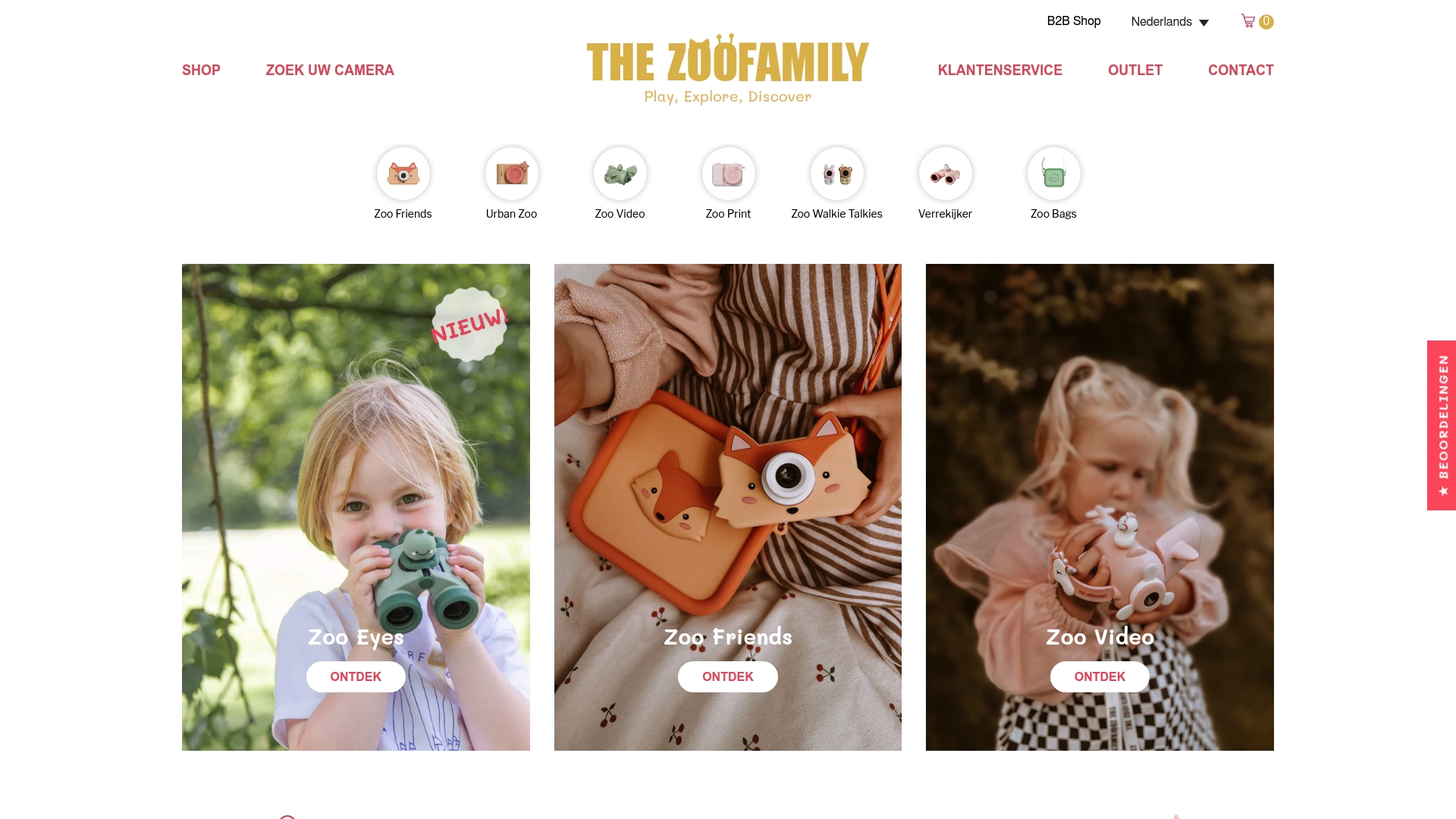
See our full kids’ camera collection, the Zoo Video cameras for filming wildlife, or the Zoo Walkie Talkies for outdoor games. For each camera sold, we plant one tree.
Act together in your community
Families can have an effect beyond the home. UNICEF suggests that families take part in community clean-ups, write to local leaders about environmental concerns and join activities such as tree planting.
In the UK, you can look for a local litter-pick, a school garden project or a community tree-planting day. Check your council or school newsletter for the current dates. Children see that a problem can be shared and that people nearby care about it too.
A simple monthly plan
Trying everything at once rarely lasts. This plan adds one habit at a time.
| Week | Focus | What to do |
|---|---|---|
| 1 | Energy | Switch off lights and unplug unused devices |
| 2 | Water | Keep showers to 5 minutes or less |
| 3 | Waste | Label recycling bins and plan meals to cut food waste |
| 4 | Nature | Plant flowers or put up a bird box |
After a month, repeat the weeks and add one more habit, such as a meat-free day or a walk to school. Write each habit on a chart so children can tick it off.
For a longer read on the topic, see our mum’s guide to taking care of the environment.
FAQ
What can I do to help the planet as a busy parent?
Start with the habits that take no extra time: switch off lights, unplug devices, keep showers short and plan meals to avoid food waste. Then add one change, such as walking part of the school run. UNICEF lists these as everyday actions for families.
Which actions make the biggest difference?
According to the UN, home energy efficiency, car-free travel, a plant-based diet and less food waste all carry measurable savings in CO2e per year. Home energy efficiency can save up to 900 kilograms, and living car-free up to 2 tons. Choose the one that fits your life best.
How do I teach young children to care about nature?
Go outside with them often. Children who feel connected to nature are more motivated to protect it, says UNICEF. Give them small jobs, such as watering plants or sorting recycling, and let them look closely at insects, birds and plants.
Can children help wildlife in a small garden or on a balcony?
Yes. The Natural History Museum suggests planting nectar-rich flowers, putting up bird boxes or bee hotels and avoiding harsh chemicals. Even a pot of flowers gives pollinators food, and a bird feeder brings birds close enough to watch.
Sources
- Why does nature action matter? | UNEP
- Climate action for families | UNICEF Parenting
- Actions for a healthy planet | United Nations
- What you need to know about air pollution | UNICEF Parenting
- The Karaman Family: Nurturing Life with Water Conservation | UNICEF Jordan
- Going Green | National Geographic Education
- Going Green at Home: Get Your Child Involved | NAEYC
- What you can do to help the planet: An illustrated guide | Natural History Museum
- Ogród w przedszkolu – zabawy i spacery na świeżym powietrzu