

Hands-on learning reliably boosts engagement, memory and real-world skills when activities connect to a clear aim and time for reflection. Children who learn by doing recall more, think more flexibly, and build motor and social skills that passive lessons rarely touch. The evidence is strongest for science achievement and general academic skills, and it works best when adults guide without taking over.
TL;DR:
- Hands-on activities significantly boost retention and understanding only when paired with reflection and conceptual discussion.
- Short, well-structured sessions with clear goals and guided reflection are more effective than lengthy unplanned activities.
- Guided play and project-based learning can match or outperform formal instruction in early literacy and numeracy, especially for young children.
- Technology enhances hands-on learning when used as an extension, not a replacement, for physical activities, such as digital logging or photographing observations.
- Long-term benefits include the development of problem-solving, social skills, and resilience, but they require deliberate child-led exploration and adult guidance.
Table of Contents
- What is hands-on learning, and how does it relate to experiential learning?
- What are the core benefits of hands-on learning for children?
- What does the research actually say about hands-on learning?
- How do you structure a hands-on activity for real learning?
- Activity examples by age you can try this week
- How do you know if a hands-on activity actually worked?
- Where hands-on learning delivers the most value
- How does hands-on learning compare with theoretical or passive learning?
- What are the challenges and limits of hands-on learning?
- How can hands-on learning be adapted for diverse learners?
- Should technology be part of hands-on learning?
- What long-term impact does hands-on learning have?
- Why child-led exploration is the part most adults get wrong
- Bring hands-on exploration home with The Zoofamily
- Sources
What is hands-on learning, and how does it relate to experiential learning?
Hands-on learning means children build knowledge through direct physical engagement with materials, tools or problems, rather than absorbing information passively through listening or reading. Building a bridge from blocks to test which shape holds weight is hands-on. Watching a video about bridges is not, however well-produced that video is.
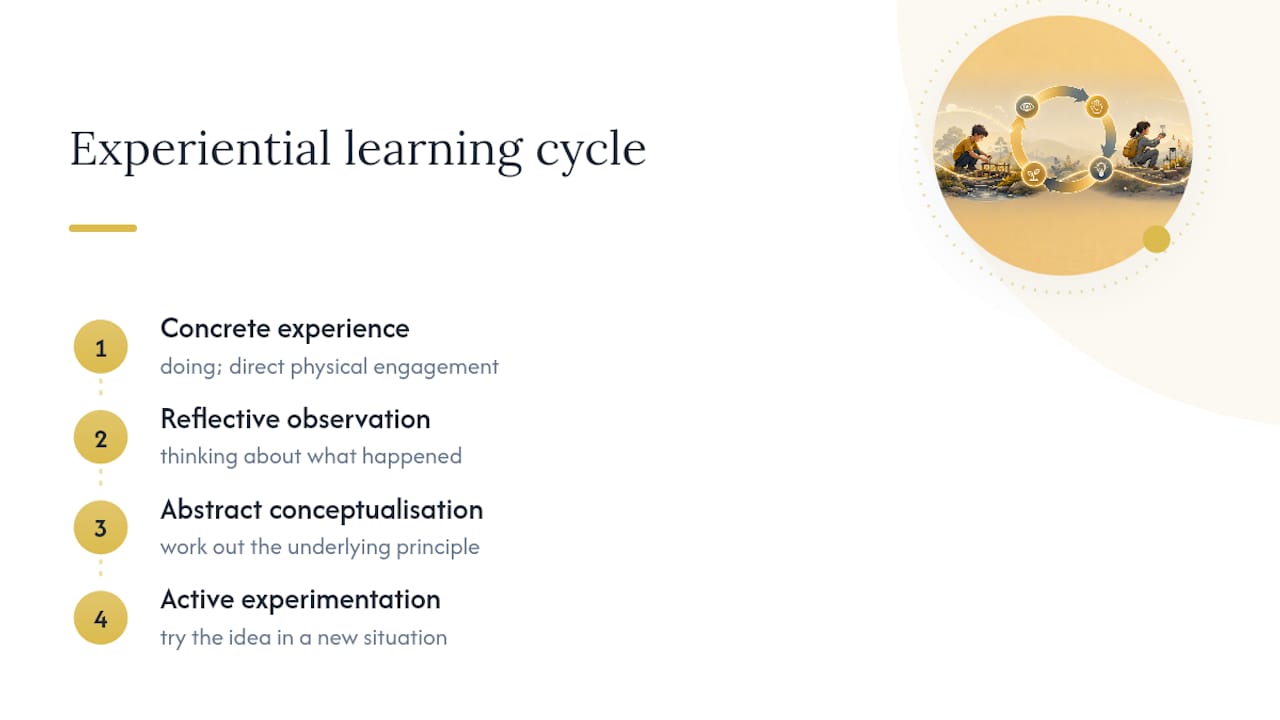
The concept sits inside a bigger framework: experiential learning. David Kolb’s experiential learning cycle describes four stages: concrete experience (doing something), reflective observation (thinking about what happened), abstract conceptualisation (working out the underlying principle), and active experimentation (trying the idea in a new situation). Hands-on activity supplies the first stage. Without the other three, a child might have fun stacking blocks without ever grasping why the tall tower fell down. This is where a lot of well-meaning hands-on activities in classrooms and homes fall short. The experiential learning framework treats reflection as equally important as the doing itself.
Guided play and project-based learning both overlap heavily with hands-on approaches. Guided play keeps a child’s exploration open and self-directed, but an adult nudges the activity toward a learning goal with a well-timed question or a subtly adjusted material. Project-based learning stretches hands-on work over days or weeks, usually ending in something a child can show or explain. All three share the same backbone: children construct understanding through action, supported rather than lectured.
What are the core benefits of hands-on learning for children?
Engagement comes first, and it’s not a soft benefit. When a child manipulates real materials, attention narrows onto the task in a way that a worksheet rarely achieves. A systematic review of experiential learning found that well-structured, teacher-facilitated hands-on activities increase classroom motivation and attainment together, not one at the expense of the other.
Retention follows a similar pattern. Doing something and then reflecting on it creates more retrieval pathways than simply reading about it once. This is partly why a child who has planted a bean and watched it grow remembers photosynthesis years later, while a diagram often fades within weeks.
Statistic callout: A rapid evidence assessment reviewing 44 studies of children aged 4 to 14, published between 2013 and 2023, found experiential learning has a consistent, positive impact on academic achievement, with the strongest gains in science and in domain-general skills such as memory and vocabulary.
Beyond the headline figures, hands-on tasks build several distinct capabilities at once:
- Critical thinking and creativity, because open-ended tasks (build the tallest tower, design a shelter) have no single correct answer, forcing genuine problem-solving.
- Social and emotional skills, since most hands-on activities for younger children happen alongside peers, requiring negotiation, turn-taking and shared decisions.
- Fine and gross motor skills, developed through pouring, cutting, balancing and building, which matter as much for a three-year-old’s development as any academic outcome.
- Subject-specific strength, particularly in early numeracy, early literacy and science, where concrete manipulation of quantities or materials precedes abstract symbols.
Younger children gain the most from the physical and social dimensions. Older children and teenagers gain more from the critical-thinking and design elements, particularly when a project runs long enough to require planning and revision.
What does the research actually say about hands-on learning?
The evidence base is more nuanced than most parenting articles suggest, and the nuance matters if you want activities that genuinely work.
The clearest signal comes from the 2023 rapid evidence assessment mentioned above: 44 studies of children aged 4 to 14 showed a consistent overall positive effect, strongest in science achievement and in general skills like memory and vocabulary. That is a meaningful sample size for education research, and the consistency across studies is the encouraging part.
For younger children specifically, a meta-analysis of 39 studies on guided play found it matches formal instruction for literacy and numeracy outcomes, and outperforms it for certain mathematical concepts.
Statistic callout: In that meta-analysis of children aged three to eight, guided play was notably effective for shape recognition, outperforming formal, adult-led instruction for this specific mathematical concept.
Two honest caveats deserve equal weight:
- Hands-on training does not automatically transfer to deeper conceptual understanding. Comparative research on physical versus virtual materials found task-specific gains that did not reliably generalise without deliberate reflection.
- Longer, unstructured practical sessions often teach less content than shorter sessions built carefully around a pre-activity briefing and a post-activity discussion, according to recent classroom research on practical science work.
The practical implication is simple: don’t assume the activity itself does the teaching. It creates the raw material. Reflection turns that material into understanding.
How do you structure a hands-on activity for real learning?
Think of every hands-on session as a sandwich, with two thin, deliberate layers around a thick middle.
- Prepare (5 to 10 minutes). State the aim in one sentence a child could repeat back to you. Set out only the materials needed, no more, so choice doesn’t become a distraction.
- Do (the bulk of the time). Let the child work with minimal interference. Step in only with open questions (“What do you notice?”, “What would happen if…?”) rather than instructions or corrections.
- Reflect (5 to 10 minutes, non-negotiable). Ask the child to explain what happened and why, out loud or in a drawing. This is the step most often skipped, and the one that converts a fun afternoon into retained learning.
Pro Tip: Resist the urge to demonstrate the “correct” way first. A brief model showing one possible approach, followed by open exploration, tends to produce more creative problem-solving than a full demonstration a child then simply copies.
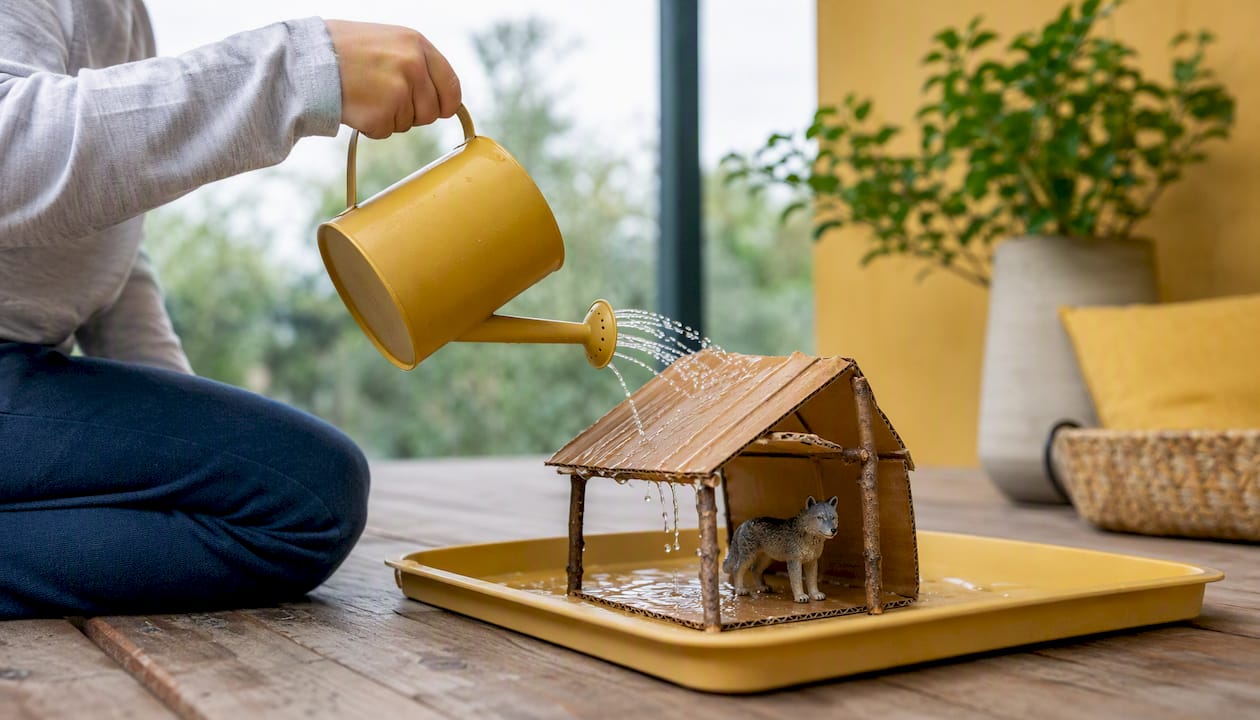
Shorter, scaffolded tasks (20 to 40 minutes) suit specific skills, such as measuring liquids accurately. Longer projects spanning several days suit open design problems, such as building a shelter for a toy animal that must survive “rain” from a watering can. Match the length to the complexity of the aim, not to how much time is available.
Resource planning matters more than it seems. Check materials are age-appropriate and safe before the activity starts, not mid-task, and always have a simple extension ready for a child who finishes early rather than letting momentum stall.
Activity examples by age you can try this week
Concrete templates beat vague inspiration. Each of these ties a specific aim to a specific material and a short reflection prompt.
- Early years (3 to 5): Sensory tables with water, sand or dried pasta, paired with new vocabulary (“pour”, “float”, “sink”); block play with prompts like “which one is taller?”; guided nature walks using a simple magnifying glass to spot insects, discussed in more detail here.
- Lower primary (6 to 8): Simple experiments with a prediction step first, such as testing which household objects float, followed by a one-sentence explanation of the result. Counting and measuring games using everyday objects work well here too, and this outdoor science activity collection offers ready-made versions.
- Upper primary (9 to 11): Mini-projects involving data collection, such as tracking daily weather over a fortnight and presenting findings as a simple chart. These nature-based science experiments map well onto this age group.
- Secondary (12+): Curriculum-linked lab work and design-build-test cycles, where a hypothesis is tested, refined and retested, mirroring real scientific method rather than a single scripted experiment.
Each template needs the same three ingredients: a clear one-line aim, materials gathered in advance, and a reflection question ready before the activity begins, not invented afterwards.
How do you know if a hands-on activity actually worked?
A child who has had fun for an hour hasn’t necessarily learned anything, and the only way to tell the difference is a quick check afterwards.
Three checks work without turning play into a test:
- Ask the child to explain back what happened and why, in their own words.
- Give a short application task using a slightly different scenario to see if the idea transfers.
- Observe the skill directly, such as watching whether a measuring technique has actually improved.
The most common pitfalls are predictable: an activity with no clear link to a learning objective, no time set aside for reflection, or a session so long and resource-heavy that enthusiasm fades before the point lands. The remedy for each is straightforward. Set one or two success criteria before starting. Build in a five-minute reflective task, even a drawing. Keep a scaffolded extension ready for children who need more challenge, rather than letting the original task run indefinitely.
Where hands-on learning delivers the most value
Hands-on learning earns its place most clearly in science, early numeracy and early literacy, and wherever a skill needs practising rather than just describing. It is not a replacement for every lesson, but a well-planned combination of doing, guiding and reflecting consistently outperforms activity without structure or instruction without any physical engagement at all. Design the aim first, then choose the material, and always leave room to talk about what happened.
How does hands-on learning compare with theoretical or passive learning?
Passive learning, listening to a lecture, reading a textbook chapter, watching a demonstration, has a real place. It transmits information efficiently and works well for building background knowledge quickly. Where it consistently underperforms is retention and transfer: information received passively fades faster and applies less flexibly to new situations than knowledge built through direct action.
Active learning research from Carnegie Mellon makes the comparison explicit. Hands-on approaches paired with “minds-on” cognitive prompts, meaning guided questions and feedback during the task, consistently outperform passive lectures for learning outcomes. The gap widens further when feedback is timely rather than delayed to the end of a unit.
The realistic answer isn’t hands-on versus theoretical, it’s sequencing. A short passive input (a two-minute explanation, a simple diagram) followed by hands-on practice and reflection tends to beat either approach alone. Pure theory without application leaves children able to recite facts they can’t use. Pure hands-on activity without any conceptual framing risks the opposite problem: a child who can complete a task but can’t explain why it worked, the same transfer gap noted in the research on physical versus virtual materials.
For parents choosing between a worksheet and an activity on a given evening, the practical takeaway is this: if the child has already grasped the basic idea, hands-on practice cements it. If the idea is entirely new, a brief explanation before the activity saves frustration and speeds up the reflection stage afterwards.
What are the challenges and limits of hands-on learning?
Hands-on learning isn’t free of drawbacks, and pretending otherwise sets parents and teachers up for disappointment.
Time is the biggest constraint. A well-run hands-on session with proper preparation and reflection takes longer than delivering the same content by explanation, which matters in a classroom with a fixed curriculum to cover. Resources cost money and storage space, and not every family or school has easy access to varied materials.
Assessment is genuinely harder. It’s straightforward to mark a written test; it’s much less straightforward to judge whether a child’s understanding of buoyancy has deepened from an afternoon with a water table, which is partly why formative checks matter so much (see the measuring-success section above).
Group management adds friction too. Hands-on activities with several children sharing limited materials can create conflict over turns and tools, particularly with children under six who are still developing negotiation skills. And as the caveat from comparative research makes clear, hands-on activity without reflection risks producing a child who can perform a task without understanding why it works, superficially impressive, structurally weak.
None of this argues against hands-on learning. It argues for realistic planning: shorter, well-prepared sessions rather than ambitious all-day projects, clear success criteria set in advance, and acceptance that some content is still taught more efficiently through direct explanation.
How can hands-on learning be adapted for diverse learners?
Hands-on approaches often work better than passive instruction for children with additional needs, precisely because they don’t depend on sustained listening or reading alone. A child with attention difficulties frequently engages longer with a physical task than a lecture. A child with dyslexia can demonstrate understanding of a science concept through a build-and-test task without the reading barrier a written test imposes.
Adjustments still matter, though. For children with sensory sensitivities, offer alternatives to messy-play materials such as sand or paint, textured objects with a similar exploratory purpose work just as well. For children with motor difficulties, adapt tools rather than removing the activity altogether: larger-grip implements, pre-measured quantities, or a shared task where a peer handles one physical step.
For children on the autism spectrum, predictable structure inside the activity (a visual sequence of steps, a consistent reflection routine) tends to reduce anxiety without diminishing the exploratory value. For English language learners, hands-on tasks reduce the language load needed to demonstrate understanding, since a child can show comprehension through action even before vocabulary catches up.
The underlying principle holds across every adaptation: change the format of participation, not the depth of the learning aim. A child using an adapted tool to measure water should still be working toward the same understanding of volume as a peer using standard equipment. Accessibility means changing the route, not lowering the destination.
Should technology be part of hands-on learning?
Technology and hands-on learning aren’t opposites, though a lot of educational marketing implies otherwise. The Carnegie Mellon research on active learning specifically found that guided digital prompts can amplify learning in mixed-reality hands-on tasks, meaning technology works best as a layer on top of physical activity, not a replacement for it.
A tablet used to photograph and log observations during a nature walk extends the activity rather than diluting it. Simple data-logging apps used during a science experiment let children see a graph update in real time as they add ingredients or record temperatures, connecting the physical action to the abstract concept faster than manual charting alone.
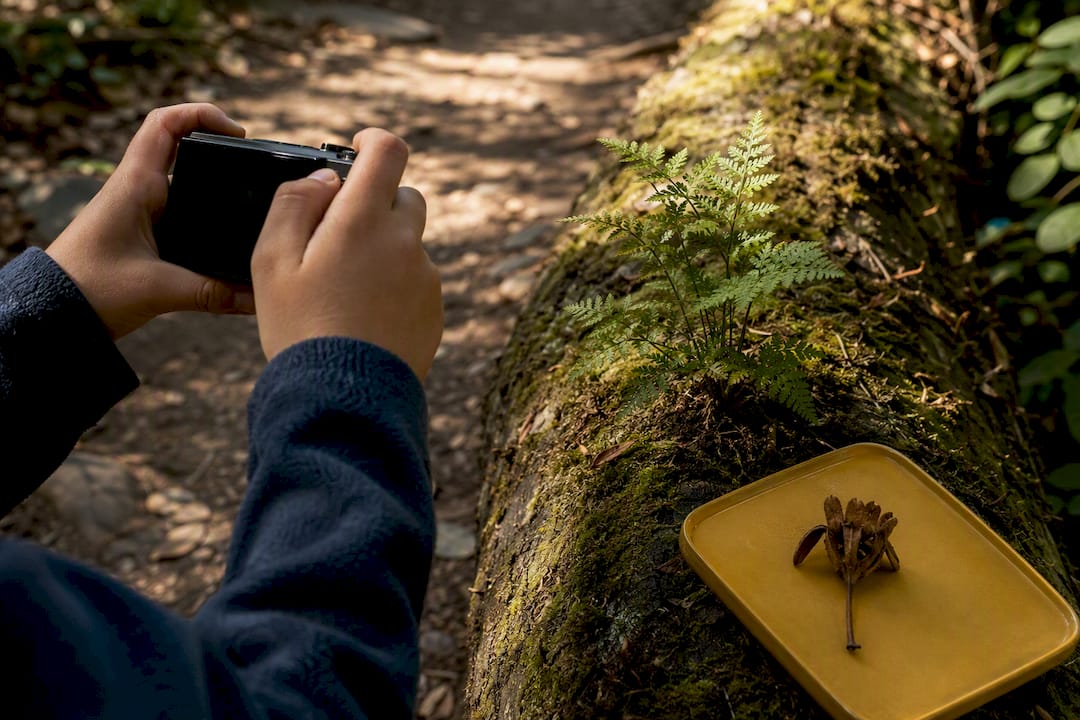
The risk is substitution rather than support. A virtual simulation of an experiment is not the same experience as running it with real materials, and where possible, physical manipulation should come first, with digital tools used to extend, record or analyse rather than replace the doing. A simple camera that a child controls themselves, deciding what to photograph and when, sits closer to open-ended hands-on exploration than most screen-based apps, because the agency stays with the child rather than the software.
Used this way, technology becomes another material on the table: a magnifying glass, a measuring cup, a camera, each extending what a child can observe and record.
What long-term impact does hands-on learning have?
The academic gains documented in the 44-study evidence review are strongest in the short to medium term, but the life-skills impact runs longer and matters just as much.
Children who regularly engage in hands-on, reflective activity build habits of problem-solving that outlast any single subject: forming a prediction, testing it, and adjusting based on results is the same process used in science, in a trade, and in everyday decision-making. Longitudinal research on play-based early years programmes links play-rich early education to stronger vocabulary, grammar and social skills years later, well beyond the preschool classroom itself.
The motor, social and emotional skills built through early hands-on play, negotiating turns, managing frustration when a tower collapses, coordinating fine movements, transfer directly into workplace and life competencies: collaboration, resilience, and the confidence to attempt something without a guaranteed outcome. None of this shows up on a single test score, which is exactly why it’s easy to undervalue and important not to.
Why child-led exploration is the part most adults get wrong
Most advice on hands-on learning focuses on the activity: the experiment, the materials, the worksheet. What gets underestimated is how much of the value comes from the child deciding something themselves, even something small, like which direction to point a camera or which leaf to examine first.
Adults, myself included, tend to over-instruct. Every product Thezoofamily designs starts from the opposite instinct: give a child a genuinely open tool, a camera, binoculars, a walkie-talkie, and let curiosity decide what happens next. That’s also why we plant a tree for every camera sold, because the same instinct that drives a child to peer through binoculars at a bird is the one worth protecting at scale. Hand a child a simple tool this weekend and see what they choose to explore. You’ll likely learn more from what they photograph than from anything you’d have told them to look at.
— ALAIN
Bring hands-on exploration home with The Zoofamily
Thezoofamily gives families a direct, low-effort way to put everything above into practice, without designing a curriculum or buying specialist equipment. A child-friendly camera or a pair of binoculars turns an ordinary walk into an observation task: what did you spot, what changed, what would you photograph again? That’s the reflection step built into the object itself, not an extra worksheet you have to create.
These tools work alongside the structured activities covered above, such as the nature exploration templates, rather than replacing the planning and reflection that make hands-on learning stick. A camera doesn’t teach photosynthesis on its own, but it gives a child a reason to look closely, ask questions and want to explain what they found. If you want a practical starting point for this weekend, browse the current range at Thezoofamily and pick one tool that matches your child’s age and curiosity.
Sources
- The effect of experiential learning on students’ progress (UCL/IOE summary)
- Can guidance during play enhance children’s learning and development? (UEA research portal)
- The role of experiential learning on students’ motivation and classroom engagement (PMC)
- Active learning: ‘hands-on’ meets ‘minds-on’ (Carnegie Mellon news)
- Practical work in science education: pre- and post-activity effects (Nordina, 2026)