

The best indoor activities for children use things already in your home: blankets, cushions, cardboard boxes, socks and a bit of music. Build a den, run an obstacle course, hold a scavenger hunt or put on a puppet show. This guide groups the ideas by what they do for your child (burn energy, spark creativity, bring nature inside), then covers adapting them by age and keeping play safe.
TL;DR
- Most good indoor games need no shopping: pillows, laundry baskets, string, paper and old socks are enough.
- Mix active games with calm, creative ones so the day has a rhythm.
- Children should be active for at least 60 minutes a day, and indoor games count towards it.
- A window, a notebook and child-sized binoculars turn a wet afternoon into a wildlife-watching session.
- Clear the space first: keep play away from stairs, hot surfaces, cords and small objects if a child is under three.
Table of Contents
- Active games that use up energy
- Creative and imaginative play
- Bring nature indoors
- Scavenger hunts for every age
- Matching activities to age and energy
- Our perspective
- Games to play with a camera or walkie-talkies
- Safety checks before you play
- Our kids’ cameras, walkie-talkies and binoculars
- A simple plan for a whole rainy day
- FAQ
- Sources
Active games that use up energy
After a few hours indoors, energy has to go somewhere. The NHS says children need at least 60 minutes of physical activity a day, and it publishes free indoor games and activities so children can still reach that target when they cannot go outside. Its guidance also includes strengthening activities on three sessions a week.
These are the games that work best in a living room.
Obstacle course
PBS KIDS for Parents suggests obstacle courses built from household items such as laundry baskets and pillows. Toddlers can follow an adult through the course. Older children can try multi-step directions, for example crawl under the table, hop to the sofa, then carry a cushion back, which adds a memory challenge.
Some simple stations to include:
- Crawl under a blanket stretched between two chairs.
- Step only on cushions, as if the floor were water.
- Toss rolled-up socks into a laundry basket.
- Walk a “tightrope” made from string or tape on the floor.
Dance, freeze and balloon games
Put on music and let everyone dance. Mirror dancing is a good variation: one person leads and the other copies. Freeze dance adds a listening game, because everyone stops when the music does.
Balloons suit small spaces. One 2026 article from The Slow Childhood explains that balloons move slowly enough for young children to track and hit, and they do not break things when they go sideways. Balloon volleyball over a line of tape is an easy start. Keep burst balloon pieces away from very young children.
Active storytime
Read a story and add movements for each animal or event. When the bear walks, everyone stomps. When the bird flies, arms go out. PBS KIDS lists active storytimes among its ideas for releasing kids’ energy, and it works well just before a quiet period.
Paper aeroplane competition
Fold a few paper aeroplanes each, then test which flies furthest down the hallway. Children can change the wings and fold, then test again. It is active, it is a small experiment, and the only equipment is paper. ParentKind’s list of indoor activity ideas includes a paper aeroplane competition alongside dance parties and origami.
Creative and imaginative play
Quieter play gives your child space to invent. The ideas below need almost nothing.
Build a den
Blankets over chairs and sofa cushions make a hideout in minutes. Quality Care for Children recommends fort building for imaginative play, and Raising Children Network suggests a special play space made with cardboard boxes or cloth draped over chairs. Once the den exists, the story starts: it can be a cave, a ship or a vet clinic.

Small-world play
Take a shoebox and fill it with open-ended materials such as fabric scraps, stones, twigs and small toy animals. Quality Care for Children describes this as small-world play, and it can be themed as a farm, forest or sea. Children arrange the scene and make up what happens in it.
Open-ended play like this also feeds the senses. For more ideas on touch, texture and exploration, read this parent’s guide to sensory play and child development.
Puppet shows and sock puppets
UNICEF suggests making sock puppets from socks or discarded clothes. Add buttons, felt or drawn faces, then put on a show behind the sofa. Story-telling is part of the fun: ask your child to invent a new ending for a story they know.
Guess the animal
In the same UNICEF list, “Guess the animal” asks children to act out or draw an animal while others guess. UNICEF notes that hands-on play like this is an opportunity to teach and talk about animals and feelings while keeping digital distractions off. It works for a group of two or ten.
Mystery box challenge
Fill a box with everyday objects: a spoon, a sponge, a key ring, a pine cone. Children put a hand in, guess each item by touch only and say what they feel. ParentKind describes this as a mystery box challenge, and you can add clues or a timer for older children.
Bake, fold and draw
Simple baking, origami, drawing and scribbling are all on the lists from ParentKind and Raising Children Network. Baking with a young child is a good way to practise counting and measuring. Origami suits children who like to follow steps.
Bring nature indoors
A wet day does not have to mean no nature. Observation is a skill, and it can happen at a window.
Set up a wildlife-watching window
The National Wildlife Federation suggests an indoor wildlife-watching space near a window with child-sized binoculars and picture books or identification guides. Children then describe and identify the animals they see. The Children & Nature Network makes a similar suggestion: a world-watching window with a nature notebook and, if you have them, binoculars or a camera.
A simple routine helps:
- Put a chair or cushion at the window.
- Add a notebook, pencils and a bird or insect picture book.
- Ask your child to draw or describe one thing they see.
- Look together for five minutes, then repeat on another day.
Birds, squirrels, clouds and raindrops running down the glass are all worth noting. Watching in the rain even changes what you see: puddles, wet leaves and birds sheltering.
Indoor nature scavenger hunt
The American SPCC suggests an indoor nature scavenger hunt. Collect or hide natural or nature-inspired items such as pine cones, rocks, feathers, leaves and toy animals, then give children a written or picture checklist. If you want more ideas, we have a guide to nature scavenger hunt ideas for families.
Grow a mini garden
The same source suggests a miniature indoor garden in pots or recycled containers, so children can water plants, watch them grow and talk about where food comes from. Cress and herbs on a windowsill give quick results.
A camera hunt inside the house
A camera turns any room into an expedition. Give your child a list: something round, something soft, something that looks like an animal. They photograph each item, then you look through the pictures together. We cover the method in our tips for photography scavenger hunts.

Scavenger hunts for every age
Scavenger hunts are one of the few games that grow with your child. UNICEF recommends a home scavenger hunt with familiar, child-safe objects hidden around the home and clues to help children find them.
Indy’s Child notes that hunts adapt across ages: picture-based for preschoolers, clue-based for school-age children, and designed by the children themselves for tweens.
| Age | Hunt format | Example |
|---|---|---|
| 3 to 4 | Picture checklist | Find the item that matches each picture |
| 5 to 7 | Simple written clues | “I keep your feet warm” leads to the socks |
| 8 and over | Child sets the hunt | Your child hides objects and writes the clues for you |
For wider ideas, see our 7 fun ideas for rainy days.
Matching activities to age and energy
One activity rarely suits every child in the house. A few adjustments help.
- Toddlers: stories, action rhymes, drawing and scribbling, and a special play space, as Raising Children Network suggests for toddler play.
- Preschoolers (3 to 5): dens, small-world play, dress-up and sock puppets. Picture-based hunts work well.
- School-age children: multi-step obstacle courses, clue-based hunts, origami, baking and photo challenges.
- Mixed ages: let the oldest child design the game and the youngest act as the explorer.
PBS KIDS for Parents advises changing each idea to fit children’s interests and following the child’s lead. An obstacle course can become an imaginary adventure. Hide-and-seek can become an animal rescue mission. A child who loves dinosaurs does not need a new game, just a new story on the same game.
For energy levels, alternate. After a loud, active game, move to something calm such as drawing or a story. Reading aloud suits the end of the day: if your child is around five, this guide to books to read aloud to 5 year olds may help you choose ones that hold their attention.
Our perspective
We design our products around one idea: animals make children curious about nature, and curious children want to look closely at the world.
That is why indoor days are not wasted days for us. A child at a window with binoculars, a camera and a notebook is already doing what a naturalist does: noticing, naming and recording. The rain is just a different kind of weather to watch.
Our cameras, walkie-talkies and binoculars are made for children aged 3 and up, and they fit into games like the ones in this guide. A camera makes a scavenger hunt. Walkie-talkies make a hide-and-seek game across two rooms. Child-sized binoculars make a window into a wildlife hide.
For each camera we sell, we plant one tree. We would like children to enjoy nature today and help restore it for the next generation.
ALAIN
Games to play with a camera or walkie-talkies
These are our own game ideas. They use the products we make, and they are designed to give a rainy afternoon a clear goal.
- Photo safari: list ten things to find in the house, such as a round object, a soft object or something that looks like an animal. Your child photographs each one.
- Walkie-talkie missions: one child hides a toy animal while the other stays in a different room. The hider gives directions by walkie-talkie until the toy is found.
- Window wildlife log: your child spots a bird or insect from the window, photographs it if possible, then draws it in a notebook.
- Animal story set: build a small-world scene in a shoebox, photograph it from different angles, and tell the story with the pictures.
- Print and display: pick the best photos and put them up as a gallery in your child’s room.
If you prefer to be outside when it clears, our guide to wildlife-friendly gardens for children has ideas, and a treasure hunt in the garden is a good next step.
Safety checks before you play
Indoor games still need room and attention. A few checks help before you start.
- See the room as your child does. Health Canada recommends scanning the home for hazards from a child’s point of view. It also advises keeping small choking hazards away from children under three, keeping children away from liquid-filled containers, and removing cords and drawstrings.
- Stay one step ahead. UNICEF advises that you manage the environment and never rely on supervision alone, including to reduce choking, fall and burn risks.
- Clear the space. Move breakable objects and keep movement games away from stairs, hot surfaces and windows, as Acrossplanner suggests. Use age-appropriate materials and avoid small pieces, cords, balloons and button batteries with young children.
If you have a specific worry about your child’s safety, such as swallowing small objects, speak to your GP or health visitor.
Our kids’ cameras, walkie-talkies and binoculars
If you want to make indoor days more adventurous, our range is made for children aged 3 and up. Prices are as published on our site.
| Product | What it is | Price |
|---|---|---|
| Zoo Friends | Animal-themed digital camera | €69.95 |
| Urban Zoo | Digital camera | €89.95 |
| Zoo video | Camera line | €79.95 |
| Zoo Print | Instant print camera | €109.95 |
| Zoo Walkie-Talkie | Walkie-talkies | €54.95 |
| zoo eyes | Binoculars | €39.95 |
| Zoo light | Night light | €39.95 |
| zoo bags | Kids’ bag | €19.95 |
| zoo sleeves | Camera accessory | €9.95 |
Browse our kids’ cameras, the Zoo Print instant print cameras for printing photos from a hunt, or the Zoo walkie-talkies. You can see the full range on our shop. For each camera sold, we plant one tree.
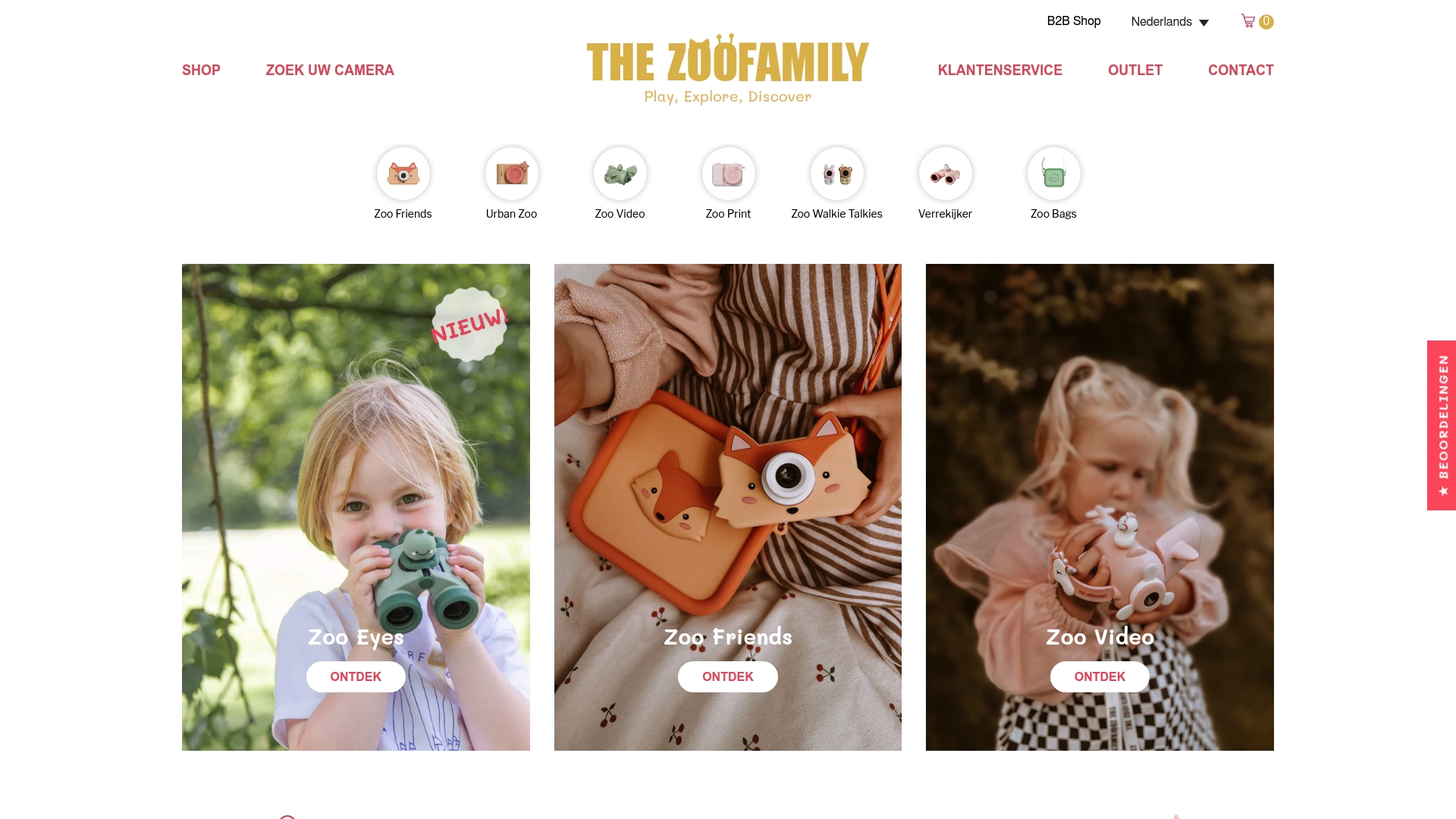
If you want to carry a camera around, Zoo bags are made for children, and our accessories complete the set.
A simple plan for a whole rainy day
Structure helps more than a long list of ideas. Here is one way to split the day.
- Morning, active: an obstacle course and a dance party. Aim to get children moving for a good part of their 60 minutes.
- Late morning, creative: build a den, then make sock puppets for a show inside it.
- Lunch: let children help to make a simple meal or bake a treat for afterwards.
- Early afternoon, nature: set up the window watch with binoculars and a notebook, then run a photo safari.
- Late afternoon, calm: draw what you saw, put the best pictures together and read a story.
You do not need to do all of it. Choose one active, one creative and one nature activity, and let your child lead. If a game flops after five minutes, change it. The aim is to spend time together, not to complete a list.
FAQ
How much exercise do children need on days they stay indoors?
The NHS recommends that children are active for at least 60 minutes a day, including strengthening activities on three days a week. Indoor games such as obstacle courses, dancing and balloon volleyball count. You can split the time into short bursts across the day.
What can I do with a three-year-old indoors?
Choose short, hands-on games: a blanket den, stories with actions, drawing, sock puppets and a picture-based scavenger hunt. Keep small objects and cords out of reach, because children under three are at higher choking risk. Stay close and join in.
How can I do nature activities indoors?
Set up a chair at a window with a notebook, a picture book of local birds and child-sized binoculars. You can also run an indoor nature hunt with pine cones, leaves and toy animals, or grow cress in a pot on a windowsill.
Do indoor activities need to be screen-free?
No, but hands-on play gives children something different. UNICEF lists screen-free ideas such as guessing animals and sock puppets. A camera or walkie-talkies can still keep children moving and looking around, which is different from watching a screen.
Sources
- NHS Healthier Families: free indoor activities for kids
- PBS KIDS for Parents: 8 indoor activities to release kids’ energy
- The Slow Childhood: best indoor games for kids
- ParentKind: indoor activity ideas
- Raising Children Network: imaginary play for preschoolers
- Raising Children Network: play ideas for toddlers
- Quality Care for Children: supporting creative play at home
- UNICEF Parenting: screen-free activities for children
- National Wildlife Federation: bringing nature indoors
- Children & Nature Network: indoor expeditions
- American SPCC: 7 ways to bring nature indoors
- Indy’s Child: things to do with kids at home
- Health Canada: play time safety
- UNICEF Parenting: how to babyproof your home
- Acrossplanner: indoor activities for kids
- Sensory play and child development
- Books to read aloud to 5 year olds