

The best child-friendly outdoor activities are simple, short and close to home: a nature walk with a small mission, a scavenger hunt, a game of tag, a den built from fallen branches. You do not need a forest or a day out. A garden, a park or a pavement verge is enough. This guide gives you ideas by type, how to adapt them to age and weather, what kit you need, and the safety points to keep in mind.
TL;DR
- Start small: 15 to 30 minutes in a familiar place works better than a long trip, according to Colorado State University Extension.
- Give every outing one task, such as a colour hunt, a bug search or a photo mission. A task keeps young children focused.
- Most activities need only sturdy shoes, layers, water and sun protection. A hand lens, notebook or camera is a bonus.
- Take only photos and leave living things where they are. Use fallen branches for dens and keep your distance from wildlife.
- Adapt the idea to the child: short sensory play for toddlers, longer observation and recording for older children.
Table of Contents
- Nature walks and exploring
- Scavenger hunts
- Outdoor games that need no equipment
- Creative and messy outdoor play
- Science and discovery outdoors
- Family activities for evenings and weekends
- Adapting activities by age, group and weather
- What you need to take
- Staying safe and looking after nature
- Our perspective
- Outdoor kit from The Zoofamily
- FAQ
- Sources
Nature walks and exploring
A nature walk is the easiest outdoor activity to start with. The U.S. National Park Service suggests short hikes or nature walks, from a backyard to a nearby park, and bringing a notebook or camera to record the plants and wildlife you see.
The trick is to make the walk slow. Children who are told to “walk” will march. Children who are told to “find three kinds of leaf” will stop, crouch and look.
Some ways to slow a walk down:
- Use the senses. Colorado State University Extension suggests moving slowly, using the senses, listening quietly and sharing what you notice. Ask: what can you hear? What is the softest thing you can touch? Do not let children taste plants, berries or mushrooms.
- Follow an ant trail. NAEYC recommends following an ant trail, watching one tree through the seasons and exploring nature in urban cracks and edges. A pavement crack can hold more life than you expect.
- Adopt a tree. Visit the same tree once a month and look at what changed. Take a photo from the same spot each time and compare them.
- Press and sketch. NAEYC also suggests observing and sketching flowers, leaves and other natural objects as a child-friendly form of scientific recording, and pressing leaves or flowers to take home.
In the UK, the Woodland Trust lists wildlife spotting with a magnifying glass or binoculars, tree identification and pond dipping among its family ideas. Any of these turns an ordinary family walk into something with a purpose.
Scavenger hunts
A scavenger hunt is the most flexible outdoor activity there is. It works in a garden, a park, on a beach or on the walk to school. Educate Outside says a simple hunt can take 30 to 45 minutes and needs only a printed sheet, a pencil and a clipboard or piece of card.
Pick a theme
NAEYC recommends hunts based on colour, texture, size, movement and animal characteristics. Some examples:
- Colour: find something red, something yellow, something green and something brown.
- Texture: find something rough, smooth, soft and bumpy.
- Size: find something smaller than your thumbnail and something taller than you.
- Season: an autumn hunt for conkers, seed pods and fallen leaves; a spring hunt for buds and birdsong.
- Sensory: the Woodland Trust also suggests seasonal, colour-based and sensory hunts.
For older children, NAEYC suggests harder versions, such as identifying flowers by smell or sorting natural objects into categories.
Set the ground rules first
Educate Outside recommends setting boundaries first, agreeing a find-not-take rule for living things, working in pairs, holding a halfway check-in and ending with show-and-tell. The rule about not taking living things matters. It is how a hunt stays kind to the place you are visiting.
Try bingo or a photo hunt
If your child dislikes writing, use a bingo card instead of a list. Nature Play WA describes a free nature bingo with four 25-item boards that works in a backyard, park, playground or picnic spot. Younger children can complete one row or one column rather than the whole card, which keeps it winnable.
Another option is to swap the pencil for a camera. Children photograph each item instead of collecting it, so nothing is picked or moved. We have more on this in our guide to photography scavenger hunts and in our nature scavenger hunt ideas for families. Our summer bingo page is another way to turn a walk into a game.
Outdoor games that need no equipment
Games are the quickest way to get a group of children moving. The Genius of Play says play helps children develop physical, social, emotional, cognitive, creative and communication skills, and lists classics such as hopscotch, Simon Says, tug of war and Rock Paper Scissors.
Mommypoppins describes 40 outdoor games, most needing no equipment or only simple household items. Examples include tag, hide-and-seek, capture the flag, Red Light Green Light, Freeze Dance and I Spy.
A quick guide to choosing:
| Group | Good games | Why they work |
|---|---|---|
| One child, one adult | I Spy, hopscotch, shadow drawing | No setup, easy to stop and start |
| Two or three children | Red Light Green Light, Simon Says | Simple rules, no one is left out |
| Larger group or party | Tag, hide-and-seek, capture the flag | Lots of running, flexible team sizes |
| Mixed ages | Freeze Dance, hopscotch | Older children can add rules for younger ones |
Chalk is a cheap extra. The Children and Nature Network lists chalk art, obstacle courses, classic games and shadow drawings among its free or near-free ideas for getting a family outside.
Creative and messy outdoor play
Some activities are better outside precisely because they are messy. Parents.com suggests rock painting, homemade bubbles, forts, paper airplanes, mud pies, hopscotch, sprinkler play and outdoor dance parties.
The Woodland Trust mentions nature art, rainy-day puddle play and den building. Some low-cost ideas using paper and pencils come from the North Carolina Botanical Garden: leaf and bark rubbings, tracing natural objects, nature mosaics, shadow studies and nature journals.
For the same garden, the garden itself can become the activity. See our guide to creating a wildlife-friendly garden for children to explore.
Building a den
Dens are a favourite from about age four. The Woodland Trust says to use fallen branches and twigs rather than breaking living trees, and to avoid den building in ancient woodland or follow the site’s own guidance. Check the rules for the wood you are in before you start.

Science and discovery outdoors
Older children, roughly from 5 up, often like activities with a question to answer. Colorado State University Extension suggests five-senses lists or “I wonder” lists for school-age children.
Ideas that turn curiosity into a small experiment:
- Plant experiments. Parents.com lists plant watering experiments, bug searches and cloud watching. Water two identical plants differently and record what happens over a week.
- Bird feeders and mobiles. The same guide suggests homemade bird feeders and leaf-and-stick mobiles.
- Sound maps. The North Carolina Botanical Garden suggests sound maps, homemade paper-tube binoculars and soil painting. A child sits still, marks each sound on a page and sees how many they find.
- Gravity and simple physics. Dropping, rolling and throwing things outdoors is a natural way to explore how objects fall. These gravity experiments for children aged 4 to 11 are low-cost and suit many learning styles.
- Mud and water. NAEYC recommends investigating mud and water, which needs nothing but old clothes.
We also have a list of outdoor science activities for kids and a step-by-step guide to photographing bugs if your child likes small creatures.
Family activities for evenings and weekends
Not every outing has to happen at midday. The U.S. National Park Service suggests backyard camping, scavenger hunts before dark, star-gazing with a red flashlight and star chart, and picnics. A red torch helps because it is gentler on night vision than white light.
The Children and Nature Network also lists neighbourhood walks, bike rides, nature journaling, birdwatching, stargazing, bug hunts and water play as free ways to get a family outside. Pick one for each weekend and you will not run out of ideas for months.
Adapting activities by age, group and weather
Toddlers and under-fives
The ACES guide says toddlers generally do best with short sensory activities and freedom to move at their own pace. Colorado State University Extension suggests colour and shape searches for young children. Puddles, mud, leaves and water pots all work. For more on why this kind of play matters, read this parent’s guide to sensory play and child development.
School-age children
At this age, children can manage longer projects. ACES says older children can handle longer observation, tracking and journaling projects. Let them lead: they choose the question, the route and what to record.
Teenagers
Colorado State University Extension suggests photography or journaling choices for teens. Giving a choice matters more than the activity itself.
Bad weather and limited mobility
Rain is not a reason to stay in. The Woodland Trust includes rainy-day puddle play in its ideas, and in the UK a waterproof and wellies will cover most weather. If a family member has limited mobility, Colorado State University Extension notes that accessible paths, benches, patios or windows can work for nature time.

What you need to take
You need less than you think. ACES says most nature activities need only sturdy shoes, layered clothing, water and sun protection, and that a hand lens, notebook and field guide are useful but optional.
A simple kit:
- Weather-appropriate clothes and a spare layer
- A water bottle and a snack
- A small notebook and a pencil
- A magnifying glass or binoculars for close and distant looking
- A camera or a bag for safe, lightweight carrying
- A bag for litter you find
The Woodland Trust suggests binoculars or a magnifying glass for wildlife spotting. You can also make binoculars from paper tubes, as the North Carolina Botanical Garden describes.
Staying safe and looking after nature
A few habits make outdoor time safer and kinder to wildlife.
- On a bike or scooter. The U.S. National Park Service recommends a helmet, visible or reflective clothing, bicycle lighting and attention to road rules.
- Near water. The same guidance says water activities need appropriate preparation, and that a lifejacket should stay on while boating.
- Check the ground. The Scottish Government’s outdoor play guidance recommends checking emergency access, addressing slippery paths and maintaining boundaries. It is written for play spaces, and the same thinking applies to a garden or park.
- Stay on the path. Leave No Trace says families should stay on durable surfaces or existing trails, pack out waste, respect sensitive habitats and never feed wild animals.
- Keep your distance from animals. Leave No Trace advises teaching children not to approach, pet or feed wild animals and keeping children close. If an animal looks in trouble, tell a ranger or the relevant wildlife authority rather than handling it yourself.
- No tasting. Never let children eat plants, berries or mushrooms they find.
Children copy what adults do. Leave No Trace treats outdoor recreation as stewardship education: when you pick up litter and keep to the path, they learn to do the same.
Our perspective
We designed The Zoofamily around one idea: children care for nature when they get to know it. That is why our products carry animal references, and why we plant one tree for every camera sold.
In our view, the best outdoor activity gives a child a small job. “Find three kinds of leaf” or “photograph something that moves” turns a walk into a mission. A camera, a pair of binoculars or a walkie-talkie is a tool for that mission, designed for children aged 3 and up.
Photography fits our idea of a find-not-take rule well. A child can collect a whole day of finds and leave every one of them in place. Then they can look through the pictures with you at home and talk about what they saw.
We do not think you need a special trip. A garden, a park and a short walk are enough, as long as you slow down and let your child look.
ALAIN
Outdoor kit from The Zoofamily
If your child enjoys recording what they find, we make animal-themed kit for children aged 3 and up. Our range includes digital cameras, instant print cameras, binoculars and walkie-talkies. The Zoo Friends camera costs €69.95, Zoo Print costs €109.95, Zoo eyes binoculars cost €39.95 and the Zoo Walkie-Talkie costs €54.95. Zoo bags cost €19.95. For each camera sold, we plant one tree.
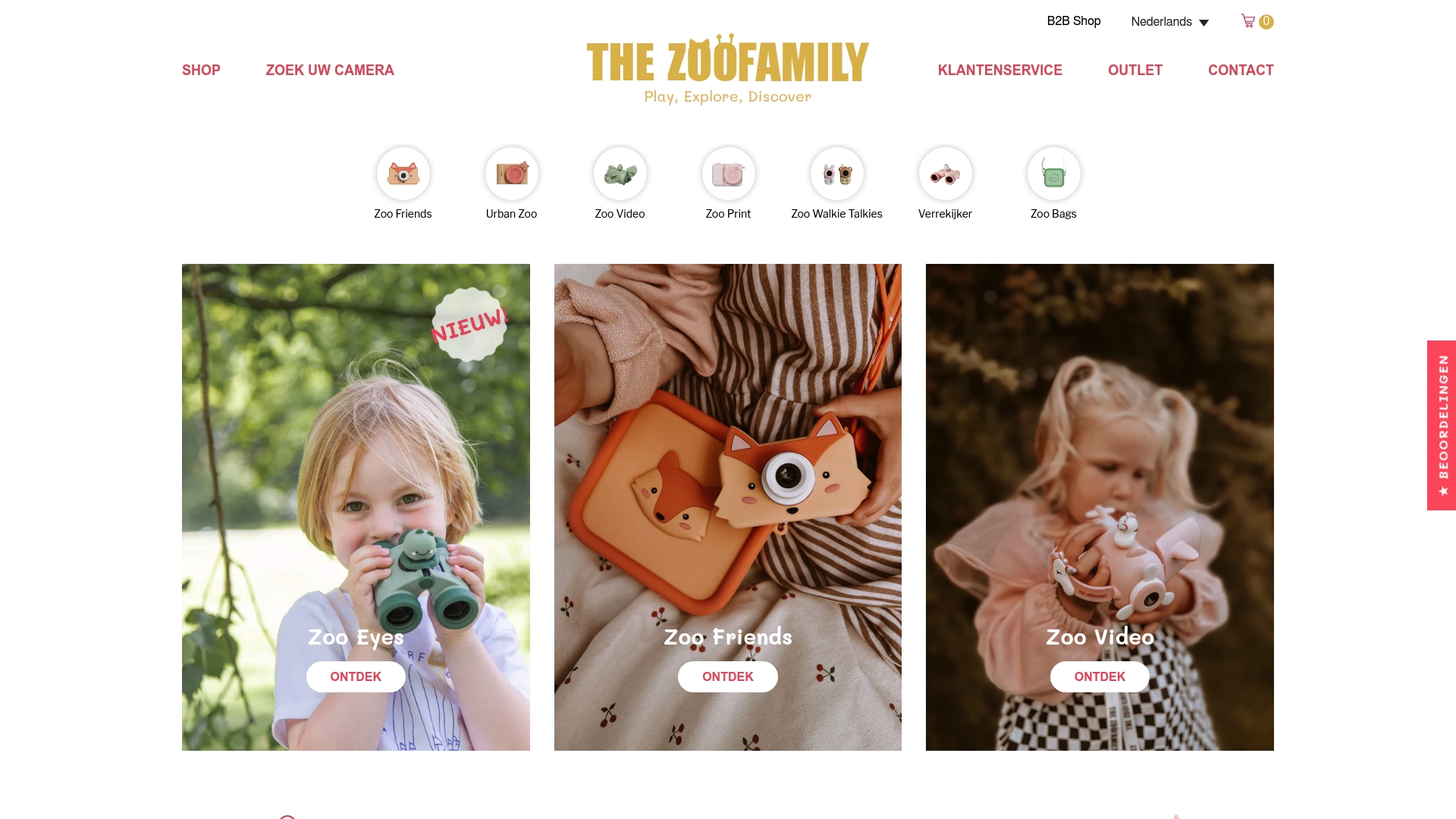
Browse the full range on our shop or see our kids’ cameras. If you are planning a green-themed day, our ideas for celebrating Earth Day with kids work at any time of year.
FAQ
What outdoor games can children play with no equipment?
Tag, hide-and-seek, Red Light Green Light, Simon Says, I Spy and hopscotch all need little or nothing. Mommypoppins notes that most of its 40 games use no equipment or simple household items. Chalk is the only extra worth having for hopscotch.
How long should an outdoor activity last for young children?
Start with 15 to 30 minutes in a familiar, safe space, as Colorado State University Extension recommends. A simple scavenger hunt can run for 30 to 45 minutes. Stop while your child is still enjoying it, so they want to go out again.
What do children need for outdoor activities?
Sturdy shoes, layers, water and sun protection cover most activities. A hand lens, notebook or field guide helps but is not required, according to ACES. Add a camera or binoculars if your child likes to record or look closely.
How can I do a nature walk with a toddler?
Keep it short and let your child set the pace. Look for colours and shapes, touch leaves and listen for sounds. Stay close, and do not let them put plants or berries in their mouth.
Is it fine to build dens in the woods?
Yes, in many places, if you use fallen branches and twigs and do not break living trees. The Woodland Trust advises avoiding ancient woodland or following the site’s guidance.
Sources
- Get Outdoors: Have Fun Responsibly, U.S. National Park Service
- Take a “Bath” in Nature: Forest Bathing for the Whole Family, Colorado State University Extension
- 10 Ideas to Get You and Your Child Exploring Outdoors, NAEYC
- Nature Activities for Kids and Families, Woodland Trust
- 52 Outdoor Activities Kids Will Love, Parents.com
- Fun and Classic Children’s Games, The Genius of Play
- Nature Walk Bingo Game, Nature Play WA
- 40 Fun Outdoor Games for Kids, Mommypoppins
- Nature Scavenger Hunt for Kids, Educate Outside
- 30 Easy, free ways to get your family outside, Children and Nature Network
- 101 Nature Activities for Kids and Families, ACES
- Nature Activities for Kids, North Carolina Botanical Garden
- Out to Play: Caring for Our Outdoor Spaces, Scottish Government
- On and Nearshore Reference Card, Leave No Trace
- Skills and Ethics Guide, Leave No Trace