

The best questions to spark curiosity in a child are open ones. They have no single right answer, they cannot be answered with yes or no, and they ask the child to use what they already know. Below you will find 40 ready-to-use questions, sorted by moment (the day, nature, stories, art and play) and by age, plus simple ways to keep the conversation going.
TL;DR
- Ask open-ended questions. “What was the funniest thing about your day?” works better than “Was your day good?”
- Give your child a few seconds to think before you speak again.
- Use sense-based questions outdoors: what can you see, smell, hear or feel?
- Match the question to the age. Three-year-olds think concretely. Children begin to think more abstractly around age 4.
- When you do not know the answer, say “Let’s find out” and look it up or test it together.
Table of Contents
- What makes a question spark curiosity
- Everyday questions for the kitchen table and the car
- Questions about nature and the world outside
- Questions for stories, art and play
- Questions by age
- Keeping the conversation going without a quiz
- Our perspective: let the child lead with their own eyes
- Tools that give questions something to look at
- A simple 10-minute routine
- FAQ
- Sources
What makes a question spark curiosity
A good curiosity question is not answerable with yes or no, with an obvious answer, or with only one answer. NAEYC guidance on high-level questions says such a question invites each child to use what they know and are learning to share their own ideas.
The National Science Teaching Association makes a similar point. Open-ended questions call for reasoning, elaborating and explaining, which sets them apart from questions with memorised or fixed answers.
Compare these pairs:
| Closed question | Open question |
|---|---|
| Did you have a good day? | What was the funniest thing about your day? |
| Is that a bird? | What do you notice about that bird? |
| Did you like the story? | How would you change the ending? |
| Is your picture finished? | Can you tell me a story about your picture? |
The open version asks the child to look, remember, compare or invent. That is where curiosity starts.
There are two useful types to mix. Person-oriented questions link to what a child already knows, such as “What does this remind you of?” Process-oriented questions ask a child to observe closely, such as “What do you see on this page?” NAEYC authors Linder and Eckhoff note that a mix of the two builds inquiry skills.
Everyday questions for the kitchen table and the car
Daily routines are the easiest place to start. You do not need props or a plan. Try one or two a day, not all at once.
- What was the funniest thing about your day?
- What did you see today that you had never seen before?
- What was the hardest part of your day, and what helped?
- What made you wonder about something today?
- If you could ask any animal one question, which animal would it be?
- What would you change about our street if you were in charge?
- What do you think the people in that car are going to do today?
- What is something you know how to do that you could teach me?
- What does this remind you of?
- If you could invent a machine to help us at home, what would it do?
Question 9 is worth repeating often. PBS KIDS reports that linking a new experience to a past one, with a question like “How does this remind you of…?”, helps children retain information.
Model the wondering yourself
Children copy what they hear. The Greater Good Science Center at UC Berkeley suggests saying your own wonders aloud, for example “I wonder why the moon looks so big tonight.” This shows a child that curiosity is something adults keep doing for life.
PBS KIDS gives a related tip: say your own questioning process out loud. If you are choosing a route or fixing a toy, say “What could I try first?” Your child learns how to ask questions of themselves when you are not there.
Questions about nature and the world outside
Nature gives children something real to look at, touch and compare. The simplest approach is to ask about the senses. The Raising Children Network, an Australian parenting resource, recommends nature walks for children aged 3 to 8, with parents asking what children can see, smell, hear or feel, and whether the ground is rough or smooth.
Here are 12 questions for a walk in the park, a garden or a street with a few trees:
- What can you see that is moving?
- What can you hear if we stand still for ten seconds?
- What does this leaf feel like? Is it rough or smooth?
- What does the air smell like here?
- What is the smallest living thing you can find?
- Where do you think this insect is going?
- Why do you think this tree has so many cracks in its bark?
- What do you notice that is the same on these two leaves? What is different?
- Where would you live if you were a squirrel?
- What do you think happened here before we came?
- What do you think the bird is looking for?
- How is this place different from the last place we walked?
PBS KIDS points out that questions starting with “What do you notice?” help children learn to experience things with all five senses.
Turn questions into a hunt
A list of sensory words becomes a game. NAEYC suggests scavenger hunts built on attributes such as dry, wet, shiny, tiny, huge, or a certain number of legs. Ask: “Can you find something shiny and something tiny?”
If you want more ideas, we have written about nature scavenger hunt ideas for families, and about photography scavenger hunts for children who like to take pictures of what they find.
Look closer, then ask again
Sensory questions work best when a child has something to hold or watch. A magnifying glass, a pair of binoculars or a simple camera gives a child a reason to look for longer. Then a second question comes naturally: “What can you see now that you could not see before?” For hands-on ways to build observation skills, see this guide to sensory play and child development.

Questions for stories, art and play
Books and drawings are full of material for questions. The NAEYC suggests several prompts for creative thinking:
- Tell me a story about your picture.
- If you were a [doctor, builder, vet], what tools would you need?
- How could the character have solved the problem differently?
- What other ending could this story have?
More to try:
- If you had written this story, how would you have changed it?
- What do you think the character is thinking right now?
- What happens on the next page, before we turn it?
- What would you do if you were the smallest animal in this book?
- Which colour did you pick first, and why?
- What would the sounds in your picture be?
- If your toy could talk, what would it say about today?
- What would you build if you had no rules?
These questions have no wrong answers. That matters for shy children. They can say what they imagine without worrying about being corrected.
Questions by age
The same question does not work for every child. NAEYC explains that most 3-year-olds are concrete thinkers who focus on what is physically in front of them, while children begin to think more abstractly around age 4. The NAEYC high-level questions guide also advises scaffolding: if a question is too hard, break it into smaller steps and help the child work through it.
| Age | What works | Example |
|---|---|---|
| 3 | Questions about what is in front of them | What can you see on this page? What does this feel like? |
| 4 to 5 | Simple “why” and “what if” questions | What if the rabbit were bigger than the house? |
| 6 and over | Comparing, predicting and explaining | Why do you think this plant grew taller than that one? |
How to scaffold a question that is too hard
Say you ask a 3-year-old, “Why do birds fly south?” and get a blank look. Do not repeat it. Make it smaller and concrete:
- “Look at the bird. What is it doing?”
- “Is it warm or cold today?”
- “What do you do when you feel cold?”
Each step is easy to answer. Together they lead toward the bigger idea.
Keeping the conversation going without a quiz
A run of questions can feel like an exam. A few habits stop that.
Wait. Children need time to process a question before they answer. NAEYC advises giving at least a few seconds, and varying the wait to suit the child. A pause feels long to an adult. It is normal for a child.
Listen, then follow up. Use the answer you were given. The NAEYC 2024 guidance suggests follow-ups such as “Tell me more about that” or “What else can we add to that?” The same guidance says open questions support language development and critical thinking, because children analyse, evaluate and create instead of giving a one-word reply.
Ask fewer questions. One good question and a long listen beat five quick ones. Mix in plain statements: “I noticed the sky went grey.”
Accept odd answers. If a child says a tree is sad, do not correct it. Ask, “What makes it look sad to you?”

When your child asks something you cannot answer
Children ask hard questions. The Greater Good Science Center recommends a simple reply: “That’s a great question! Let’s find out.” Then research it or test it together. You show that not knowing is a good place to start.
Small experiments suit this well. Here are some kids science experiments to try at home when a question can be tested with items from the kitchen.
Our perspective: let the child lead with their own eyes
We design cameras, binoculars and walkie-talkies for children aged 3 and up. We give them animal names and shapes on purpose. An animal on a product is a small invitation to ask, “What does this animal eat? Where does it live?”
What we see is that a tool changes a question. A child with binoculars asks “What is that bird doing?” A child with a camera asks “What should I take a picture of?” They start to choose what to look at. That choice is the first step of curiosity.
Our advice is plain:
- Ask one open question, then wait.
- Let the child decide where to look.
- Ask the child to show you, not tell you. A photo or a drawing is an answer.
- Go outside often, even for ten minutes.
We also plant one tree for each camera sold. Children can follow that thread too: “What does a tree need to grow? Who lives in it?” It links their play to the world they are exploring.
— ALAIN
Tools that give questions something to look at
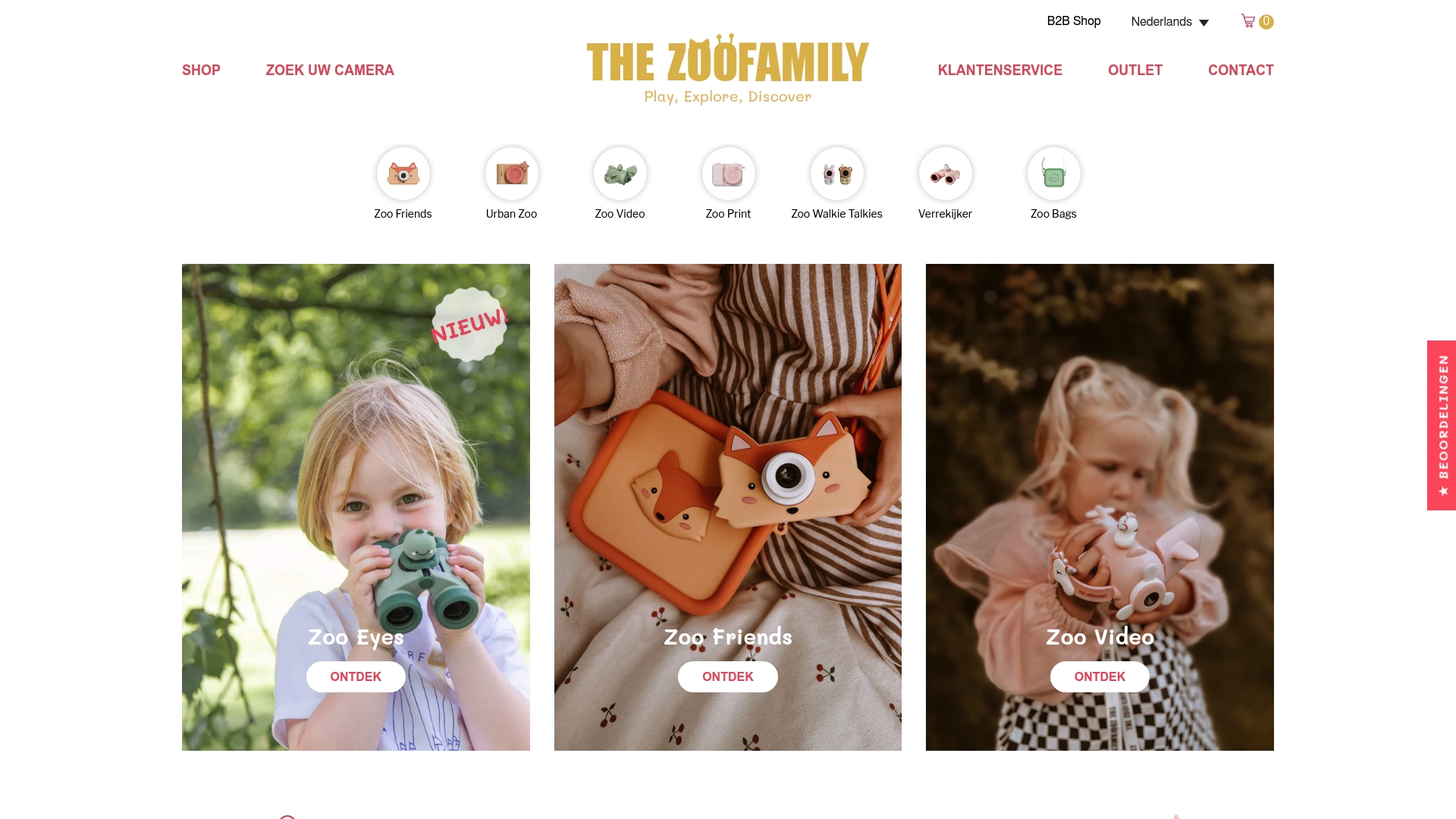
Questions work best with something real in front of the child. Our kids’ cameras start at €69.95 for Zoo Friends, with Urban Zoo at €89.95, Zoo video at €79.95 and Zoo Print at €109.95. Zoo Walkie-Talkie costs €54.95 and is useful for two children exploring a garden together. Zoo eyes binoculars cost €39.95. You can see the full range on our shop.
If you plan a garden hunt, our guide to organising a treasure hunt in the garden and our article on guiding a first nature exploration are both written in French.
A simple 10-minute routine
You do not need a special activity. This routine fits into a normal day.
- Start with one sense question. “What can you hear right now?”
- Wait for the answer. Count to five in your head.
- Follow up once. “Tell me more about that.”
- Add a link to memory. “What does that remind you of?”
- End with a wonder. “I wonder where that sound comes from.”
Repeat it on the walk to school, at bath time or while you cook. A short, regular habit works better than one long session.
FAQ
What are some good questions to ask a child to spark curiosity?
Open questions work best, such as “What was the funniest thing about your day?”, “What do you notice?” or “What would you change in this story?” They cannot be answered with yes or no. They ask the child to think, observe or imagine.
How long should I wait for a child to answer?
Give at least a few seconds, and more if your child needs it. NAEYC advises varying the wait according to each child. Do not rush in with a hint too soon, as this ends the thinking.
What if my child answers every question with “I don’t know”?
Make the question smaller and more concrete. Ask what they can see or touch, not why something happens. You can also say your own thought aloud first, then ask whether they agree. Scaffolding in small steps helps children who are not yet ready to answer alone.
At what age can I start asking these questions?
You can start at age 3 with concrete questions about what is in front of the child. From about age 4, children begin to think more abstractly, so “what if” and “why” questions fit better.
Sources
- NAEYC: Message in a Backpack, Asking Questions to Stretch Your Child’s Thinking (2024)
- NAEYC: Message in a Backpack, Spark Creative Thinking (2020)
- NAEYC: What High-Level Questions Aren’t, and Are
- NAEYC: Breaking Down STEAM for Young Children, Part 3
- NAEYC: 10 Ideas to Get You and Your Child Exploring Outdoors
- NSTA: Building Better Questions
- PBS KIDS: 5 Engaging Questions to Discover Your Child’s Thinking
- Greater Good Science Center: Nurturing Children’s Wonder and Curiosity
- Raising Children Network: Noticing nature walk activity
- Sensory Play and Child Development: A Parent’s Guide
- Kids Science Experiments At Home That Teach