

TL;DR:
- Trauma-sensitive parenting is a holistic approach that focuses on safety, trust, and emotional regulation by understanding a child’s nervous system and past experiences. It emphasizes daily practices, boundaries, and co-regulation techniques rooted in trauma-informed care principles, differing significantly from traditional parenting styles. Consistent, evidence-based programmes support healing, but parent wellbeing and patience are essential, as progress is often slow and non-linear.
Love is not always enough. Many parents pour every ounce of patience and warmth into their children, yet still watch them struggle with fear, outbursts, or withdrawal they cannot explain. Trauma leaves marks that good intentions cannot simply erase. Trauma-sensitive parenting is a practical, evidence-grounded approach that goes beyond kindness, equipping you with specific tools to reduce re-traumatisation, rebuild safety, and genuinely support your child’s emotional recovery from the inside out.
Table of Contents
- What is trauma-sensitive parenting?
- How trauma-sensitive parenting differs from traditional styles
- Practical strategies: techniques for everyday situations
- Evidence behind trauma-sensitive parenting programmes
- Common challenges and what to do when things get tough
- What most guides miss about trauma-sensitive parenting
- Learn more and find support
- Frequently asked questions
Key Takeaways
| Point | Details |
|---|---|
| Principles matter | Trauma-sensitive parenting is grounded in safety, trust, and empowerment, not just kindness. |
| Action over intention | Evidence-based routines and co-regulation strategies help children recover more effectively than willpower alone. |
| Boundaries and empathy | Structure and clear expectations can coexist with warmth and healing for traumatised children. |
| Evidence is mixed | Programme effectiveness varies, so focus on approaches with systematic research and real-world results. |
| Self-care counts | Your resilience and support network are crucial for providing lasting, trauma-sensitive care. |
What is trauma-sensitive parenting?
Trauma-sensitive parenting is not a single technique. It is a whole way of seeing your child’s behaviour through the lens of their nervous system and past experiences, then adjusting how you respond accordingly. At its heart, it draws directly from trauma-informed care, a framework developed in clinical settings and now widely adapted for families.
According to NCBI research, trauma-sensitive parenting is built on six core principles that translate into everyday caregiver behaviour to reduce re-traumatisation:
- Safety: Your child needs to feel physically and emotionally safe at home before any healing can begin.
- Trustworthiness and transparency: Consistent, predictable behaviour from you builds the trust a traumatised child desperately needs.
- Peer support: Connection with others who understand, whether other children or supportive adults, reduces isolation.
- Collaboration and mutuality: Healing happens in relationship, not through control. You and your child work together.
- Empowerment, voice, and choice: Giving children age-appropriate choices restores the sense of agency trauma often strips away.
- Humility: Recognising that trauma affects every child differently, and that you will not always get it right, keeps you open to learning.
Understanding how childhood trauma affects the brain helps make sense of why each principle matters. When a child has experienced overwhelming stress, their brain’s threat-detection system becomes highly sensitive. This means that what looks like defiance or overreaction is often a nervous system alarm going off without the child’s conscious control.
“Trauma-sensitive parenting is typically operationalised through trauma-informed care principles and translated into day-to-day caregiver behaviours that reduce re-traumatisation.” — NCBI Bookshelf
These principles are not ideals to aspire to occasionally. They are daily practices woven into how you speak, set limits, and respond when things go wrong.
How trauma-sensitive parenting differs from traditional styles
Understanding the core principles, readers often wonder how these differ from more familiar parenting techniques. The differences are genuinely significant, and getting them clear can save you months of frustration.
| Feature | Trauma-sensitive | Traditional authoritative | Permissive |
|---|---|---|---|
| Response to misbehaviour | Curiosity about the cause | Consistent consequence | Little or no limit |
| Emotional regulation | Co-regulation first | Child expected to self-regulate | Emotion avoided or indulged |
| Boundaries | Warm, clear, and consistent | Firm, rule-based | Minimal or absent |
| Child’s voice | Central to decision-making | Consulted sometimes | Dominant |
| Goal | Safety, healing, connection | Obedience, responsibility | Happiness in the moment |
The table above reveals something important. Trauma-sensitive parenting is not permissive, and this is one of the most common misunderstandings parents encounter. It does not mean “anything goes” or that you abandon structure to avoid upsetting your child. As child development guidance makes clear, trauma-informed parenting frames healing-focused empowerment as entirely compatible with clear, consistent boundaries delivered with warmth and safety.
The critical difference is why limits exist and how you deliver them. In traditional models, a consequence follows behaviour to teach cause and effect. In trauma-sensitive parenting, you still hold a boundary, but you do it with your child’s nervous system in mind. You stay regulated yourself, you name what you see, and you keep the relationship intact through the difficulty.
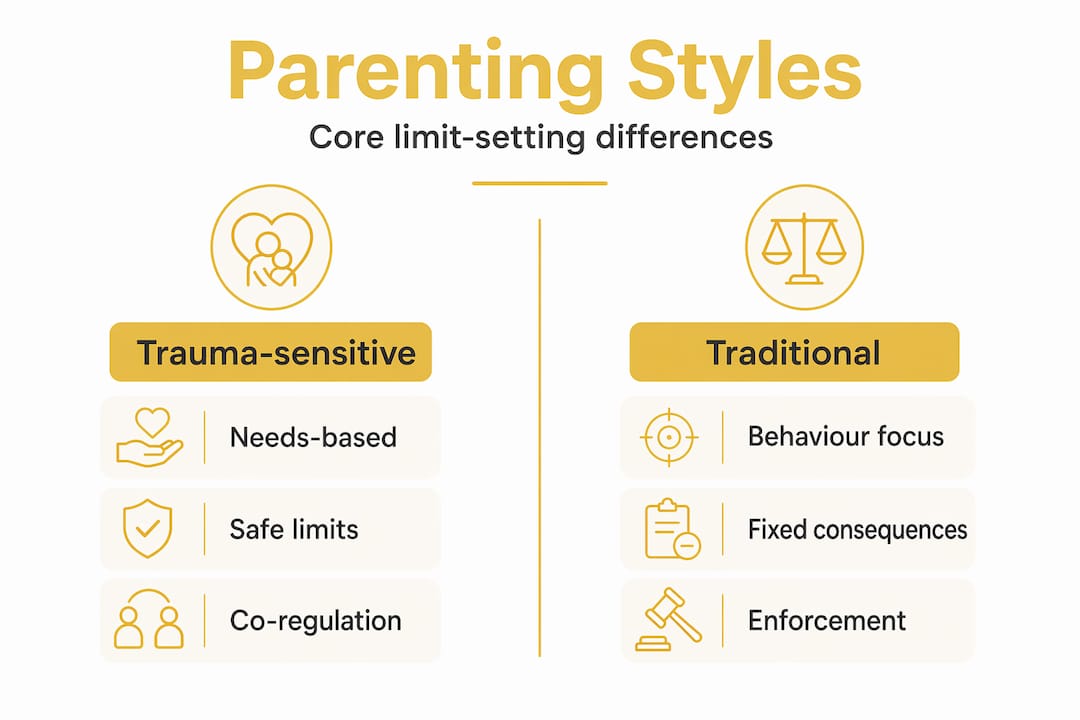
Understanding the effects of trauma on development shows why this matters so much. A child whose brain is operating in survival mode literally cannot learn from a consequence in the way a settled child can. Connection and safety must come first.
Pro Tip: When your child pushes against a boundary, try asking yourself “what does my child need right now?” before deciding how to respond. This single habit can shift you from reactive to responsive within seconds.
Practical strategies: techniques for everyday situations
With those distinctions in mind, families need reliable techniques they can apply the next time a child struggles. The good news is that evidence-based strategies are not complicated. They do require practice and consistency, but you can begin today.
The 3 Rs model from paediatric guidance offers a practical framework for supporting children after stressful or traumatic experiences: Reassure, Return to routine, and Regulate. Here is how to apply each step:
-
Reassure. Start by letting your child know they are safe and that you are there. Use simple, calm language. “I am here. You are safe. I am not going anywhere.” Avoid rushing to solve the problem or explaining what they should have done differently. Physical closeness, if your child welcomes it, is powerful here.
-
Return to routine. Predictability is medicine for a dysregulated nervous system. After a difficult moment, gently guide your child back to familiar activities. A regular mealtime, a bedtime story, or a walk together signals that life is stable. Do not skip routines because your child is upset. Keeping them signals safety.
-
Regulate. Help your child move from a state of high activation back to calm. This is called co-regulation, and it works because your nervous system literally influences theirs. Slow your own breathing. Lower your voice. Soften your face. You are not being passive; you are actively providing the neuroscience of emotional recovery in real time.
Scripts for difficult moments:
During an emotional outburst, try: “I can see something big is happening for you. I am staying right here.” This communicates presence without demands.
When a child refuses to comply: “I understand this feels really hard. The rule stays the same, and I am going to help you through it.” This holds the boundary while keeping connection central.
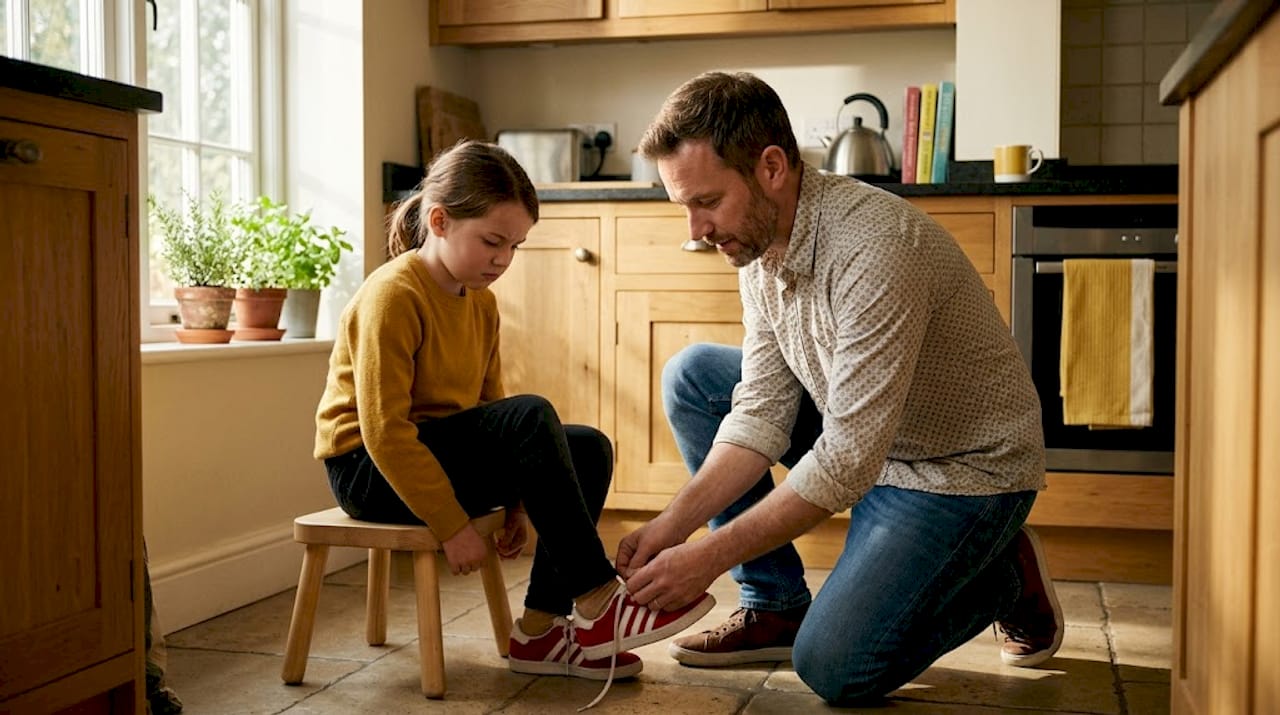
After a meltdown: “That was a lot. I am glad we got through it together. Want a glass of water?” Simple re-connection matters more than a lengthy debrief.
Research consistently shows that children who experience consistent co-regulation from a caregiver develop stronger self-regulation skills over time. The relationship is the intervention. Your calm is not just comforting; it is actively teaching your child’s brain how to settle.
Evidence behind trauma-sensitive parenting programmes
Good intentions are not enough. What does the research actually say about outcomes, and which approaches are genuinely effective?
A pan-European parenting trial studying a trauma-informed adaptation of the GenerationPMTO programme across multiple European countries found that parents reported meaningful satisfaction and initial improvements, with small to moderate effects on child adjustment and parenting-related outcomes for refugee families. This is significant. It tells us that structured, culturally adapted, trauma-sensitive programmes can work, and that Europe is actively studying and implementing them.
| Programme feature | Evidence strength | Outcome area |
|---|---|---|
| Systematic and manualised approach | Strong | Consistency and fidelity |
| Cultural and trauma adaptation | Moderate | Engagement and retention |
| Universal delivery (all families) | Limited/variable | Broad mental health outcomes |
| Selective/indicated (high-risk families) | Moderate to strong | Disruptive and behavioural outcomes |
A 2025 BMJ Mental Health meta-review of parenting interventions found that evidence is genuinely mixed in strength. Many selective and indicated programmes, those targeting families already experiencing difficulty, show meaningful benefits for disruptive and behavioural outcomes. Universal programmes, offered to all families regardless of need, tend to show more limited and variable effects across mental health outcomes.
What does this mean for you, practically? It means:
- Look for programmes that are systematic. A well-structured curriculum with trained facilitators matters far more than an inspiring weekend workshop.
- Check for independent evaluation. Look for trials published in peer-reviewed journals, not just testimonials or marketing language.
- Be realistic about timescales. Even the most effective child brain resilience studies show that change happens gradually, over months and sometimes years.
- Seek programmes that support you as a parent. The most effective approaches include peer support and professional guidance, not just written materials.
“Parenting programmes are generally more likely to show benefits when they are systematic and evidence-based.” — BMJ Mental Health
The honest picture is that trauma-sensitive parenting works best when it is part of a broader support system. A single book or one-day course is a start, not an end point.
Common challenges and what to do when things get tough
Armed with strategies and knowledge, parents still face tough days. Here is what to expect and how to adapt when your best efforts seem to make no difference.
The most important thing to understand is that when children are highly dysregulated, reasoning simply does not work. A child in the middle of an emotional storm cannot process logic, weigh consequences, or respond to explanations. Their brain’s survival system has taken over. Trying to reason your way through it escalates things rather than calming them.
This is not failure on your part or your child’s. It is biology. Trauma-informed approaches emphasise meeting regulation needs first, and only using relationship-based co-regulation before expecting any self-regulation from your child.
Common mistakes to avoid:
- Attempting lengthy explanations during a meltdown
- Withdrawing connection as a consequence (“if you act like that, I won’t talk to you”)
- Comparing your child’s behaviour to siblings or peers
- Expecting linear progress, where things get better and stay better
- Neglecting your own regulation and emotional state
What actually helps in tough moments:
- Staying physically close without making demands
- Using slow, rhythmic breathing that your child can hear or see
- Offering something sensory: a glass of water, a blanket, a gentle hand on the shoulder if welcomed
- Saying very little until your child’s breathing slows
- Acknowledging what happened quietly after calm is restored, without assigning blame
Setbacks are a normal part of this journey. The research on trauma’s impact on behaviour consistently shows that recovery is not a straight line. Expecting it to be one sets you up for unnecessary guilt and discouragement.
Pro Tip: After a particularly hard day, write down one moment where you stayed regulated or offered connection, however small. This builds your awareness of what is working and counteracts the negativity bias that makes tough days feel like total failure.
What most guides miss about trauma-sensitive parenting
Most articles on this topic stop at the techniques. They give you scripts and checklists, which are genuinely useful, but they rarely address the harder, longer story.
Trauma-sensitive parenting is not a phase you move through in a few months. Progress is frequently slow, non-linear, and frankly confusing. You will have weeks where everything clicks, followed by a period of regression that feels devastating. This is not evidence that you are doing it wrong. It is evidence that healing is real work.
We also see a growing marketplace of programmes labelled “trauma-sensitive” or “trauma-informed” that have little to no research behind them. The language is compelling, the marketing is warm and reassuring, and the price tag is sometimes substantial. Not all of them are harmful, but not all of them help either. The long-term recovery challenges your child faces deserve approaches that have actually been tested and evaluated, not simply ones that sound wise.
There is something else that rarely gets said plainly: you cannot pour from an empty cup, and this is not a metaphor. A parent who is chronically stressed, unregulated, or unsupported is physiologically less able to offer the co-regulation their child needs. This is not a character flaw. It is neuroscience. Real healing in your child requires you to take your own emotional wellbeing seriously, not as a luxury but as a clinical necessity.
The approach we believe in at The Zoofamily is built on honest connection, curiosity, and the understanding that children thrive when they feel genuinely seen. That means resisting the pull toward quick fixes and staying committed to the slow, meaningful work of relationship. It also means being honest with yourself about what you can and cannot do alone, and seeking support when you need it.
Learn more and find support
Parenting a child who has experienced trauma is one of the most demanding things a person can do, and you deserve support that is as committed to your wellbeing as it is to your child’s.
At The Zoofamily, we offer further trauma-informed resources, expert-led guidance, and a community of parents who understand exactly what you are navigating. You do not need to figure this out alone. Whether you are just beginning to explore trauma-sensitive approaches or you are deep in the work and looking for fresh insights, our community is here for you. Share your questions, your challenges, and your wins. Every parent on this journey deserves to feel supported, informed, and genuinely connected.
Frequently asked questions
What is the difference between trauma-sensitive and trauma-informed parenting?
Trauma-informed parenting refers to understanding trauma’s effects on a child’s development and behaviour, while trauma-sensitive parenting focuses specifically on adapting your daily interactions to prioritise safety, regulation, and healing, as outlined in trauma-informed care principles.
How can I spot if my child needs trauma-sensitive support?
Look for persistent changes in behaviour, disrupted sleep, social withdrawal, or disproportionately large emotional reactions after a stressful experience. If these signs continue, paediatric guidance supports using trauma-sensitive approaches to help your child stabilise and recover.
Are trauma-sensitive parenting programmes evidence-based?
Some are, but not all. A pan-European GenerationPMTO trial showed promising results for refugee families, while a BMJ Mental Health review found that selective and indicated programmes tend to produce the strongest outcomes. Always look for independent evaluation before committing to a programme.
What do I do if my trauma-sensitive approach isn’t working?
First, focus on safety and regulation rather than behaviour change during difficult moments. If setbacks continue over a sustained period, co-regulation-first approaches suggest seeking guidance from an evidence-based professional or a peer support group who can offer tailored, ongoing support.