

Finding engaging and eco-friendly gifts for curious children often feels like a challenge for European families living in cities like Paris or Berlin. Urban life makes outdoor exploration harder but parents remain devoted to nurturing environmental awareness at home. A blue walkie talkie offers wireless independence, encouraging genuine outdoor adventures and purposeful play, transforming simple outings into opportunities for learning and nature connection.
Table of Contents
- What Is A Blue Walkie Talkie?
- Types And Child-Friendly Features Explained
- How Walkie Talkies Encourage Outdoor Learning
- Safety, Environmental Impact, And Responsible Use
Key Takeaways
| Point | Details |
|---|---|
| Child-Friendly Communication | Blue walkie talkies provide intuitive, push-to-talk functionality, fostering independence and confidence in outdoor play. |
| Promoting Outdoor Exploration | These devices encourage children to engage in nature-based learning and exploration while maintaining communication with parents. |
| Environmental Awareness | Walkie talkies designed with nature-inspired aesthetics support a child’s curiosity about the environment, connecting technology with outdoor adventure. |
| Safety and Responsibility | Clear communication protocols are essential for outdoor safety, allowing children to explore while staying connected to their guardians. |
What Is A Blue Walkie Talkie?
A blue walkie talkie is simply a portable handheld two-way radio distinguished by its blue colour, typically designed for children’s outdoor adventures. These devices enable wireless communication over short distances without requiring mobile networks or subscriptions. The colour choice isn’t random—blue appeals to young explorers and makes these gadgets feel accessible and fun.
Think of it as a miniature communication station your child carries in their pocket. Unlike mobile phones, walkie talkies don’t need towers or data plans. They work through radio frequency signals, making them ideal for garden play, forest exploration, or coordinated outdoor activities.
How Blue Walkie Talkies Actually Function
These devices operate using a push-to-talk system. Your child presses a button, speaks their message, then releases to listen. Only one person talks at a time—this is called half-duplex communication, and it’s what makes walkie talkies simple and intuitive for young users.
Most blue walkie talkies transmit on VHF or UHF radio bands. Here’s what matters for parents:
- Operate on specific radio frequencies assigned for consumer use
- Range typically extends 100 metres to several kilometres, depending on terrain and model
- Don’t interfere with mobile networks or professional communications
- Require no monthly contracts or data plans
Blue walkie talkies give children genuine independence whilst keeping them connected to you—a balance many eco-conscious parents value when encouraging outdoor exploration.
Why Blue, Specifically?
The colour choice serves multiple purposes. Blue appears calming and natural, connecting to water and sky. More practically, blue makes these devices visible during outdoor play, reducing the risk of loss. Many brands choose blue because it resonates with children whilst remaining nature-inspired.
For the target audience of eco-conscious parents, this colour selection matters. The Zoofamily designs walkie talkies with animal references and nature-inspired colours to trigger children’s interest in the natural world. A blue walkie talkie becomes part of a broader philosophy—outdoor exploration that builds environmental awareness.
What Makes Them Perfect for European Families
Walkie talkies suit urban European living patterns. You’re in dense cities like Paris or Berlin, yet seeking ways to encourage your children toward outdoor exploration. These devices facilitate independent play without constant phone connectivity.
Your child explores the local park whilst maintaining contact with you. They conduct nature observations, identify birds, or track wildlife—activities that feel purposeful rather than aimless screen time. The device becomes a tool for discovery rather than distraction.
Key advantages for your family:
- No ongoing costs or subscriptions
- Encourage face-to-face communication with peers
- Build independence and confidence
- Support nature-based learning and exploration
- Work reliably in urban green spaces and forests
Pro tip: Teach your child simple communication protocols before first use—brief messages, turn-taking, and clear language—transforming their walkie talkie into a tool for genuine outdoor adventures and environmental discovery.
Types And Child-Friendly Features Explained
Blue walkie talkies come in different varieties, each designed with your child’s needs in mind. The most common type features simplified controls—large buttons, clear labelling, and intuitive operation that young children can manage independently. These aren’t complicated gadgets requiring instruction manuals; they’re built for immediate, confident use.
The second category emphasises durability and safety. These models withstand drops, bumps, and outdoor weather whilst incorporating protective features like emergency alert buttons. Your child can explore confidently, knowing the device will survive their adventures.
To better understand blue walkie talkie models, here is a comparison of their child-friendly feature focus:
| Model Type | Main Benefit | Ideal Age Range |
|---|---|---|
| Simplified controls | Easy, independent use | 4-7 years |
| Durable and safe | Withstands rough play | 6-10 years |
| Feature-rich (VOX, alerts) | Supports advanced play | 8 years and older |
Key Features That Make Them Child-Friendly
Modern children’s walkie talkies include thoughtful design elements that matter for outdoor play. Automatic channel scanning eliminates confusion about frequency selection—your child simply presses a button and listens across available channels. This removes technical barriers and focuses attention on communication rather than equipment management.
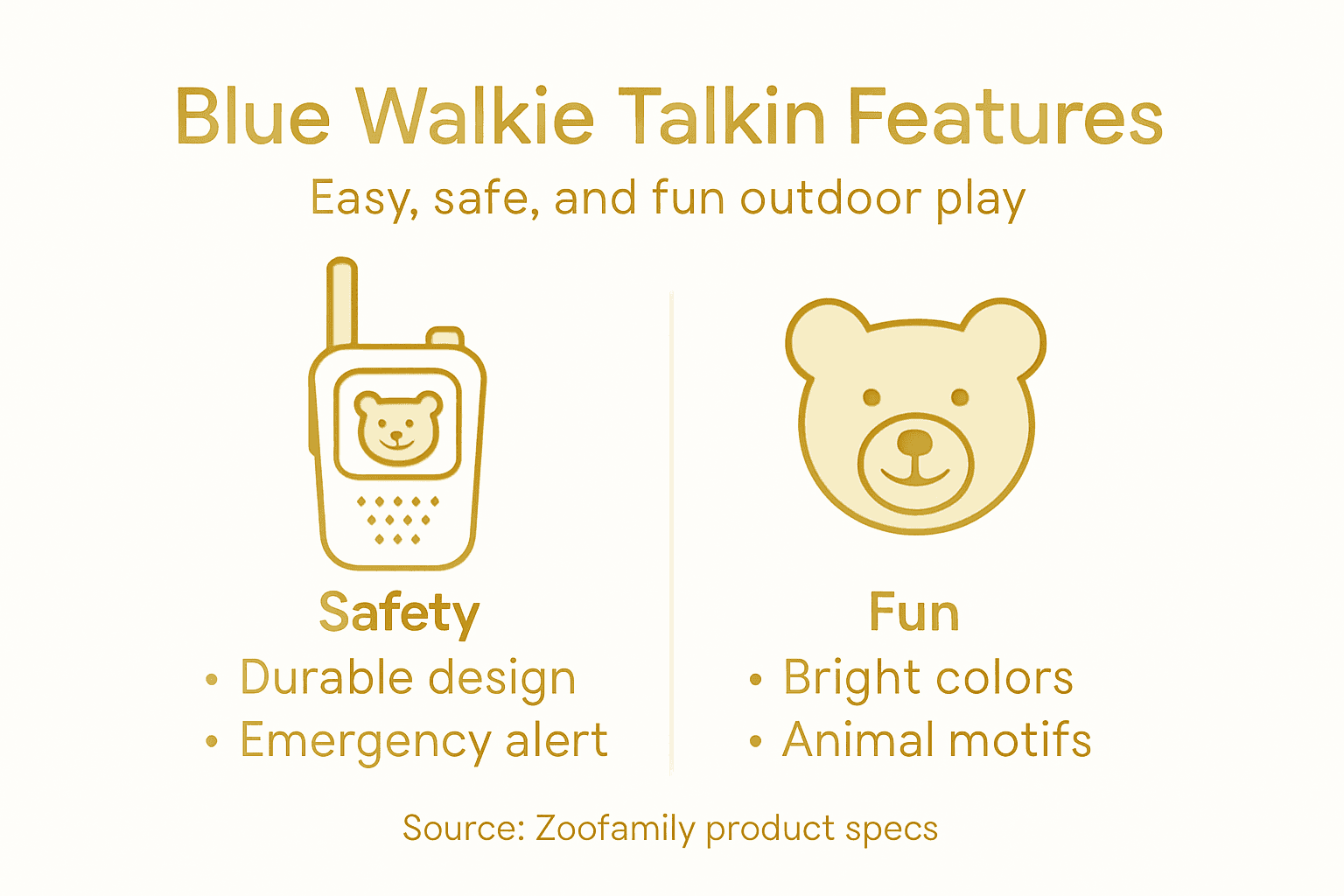
Voice activation (VOX) represents another smart feature. Your child speaks without pressing buttons constantly, enabling hands-free communication during active play. When climbing trees or navigating woodland paths, this matters tremendously.
Other essential features include:
- Emergency alert buttons for quick attention-getting between users
- Visual indicators showing battery status and signal strength
- Lightweight construction suitable for small hands
- Weather-resistant casings protecting against rain and mud
- Extended battery life supporting full days of outdoor adventure
Child-friendly walkie talkies transform communication from a technical exercise into natural, playful interaction—precisely what eco-conscious parents want when encouraging outdoor exploration.
Why These Features Support Development
The design choices reflect genuine understanding of how children learn and play. Simplified controls build confidence and independence. Your child masters technology without frustration, developing problem-solving skills and self-reliance.
Colourful designs and animal references—particularly The Zoofamily’s nature-inspired approach—trigger genuine interest in outdoor exploration. The device becomes associated with adventure and discovery rather than screen time.
These features also facilitate cooperative play. Walkie talkies encourage children to work together, coordinate activities, and communicate purposefully. Your child learns negotiation, turn-taking, and collaborative problem-solving through genuine outdoor interaction.
Choosing The Right Type For Your Family
Consider your child’s age and outdoor habits. Younger children benefit from extremely simplified models with just a few functions. Older children appreciate slightly more sophisticated options offering extended range and additional features.
Your urban European environment influences selection too. Dense urban areas may suit shorter-range models, whilst families near forests or parks benefit from extended range capabilities.
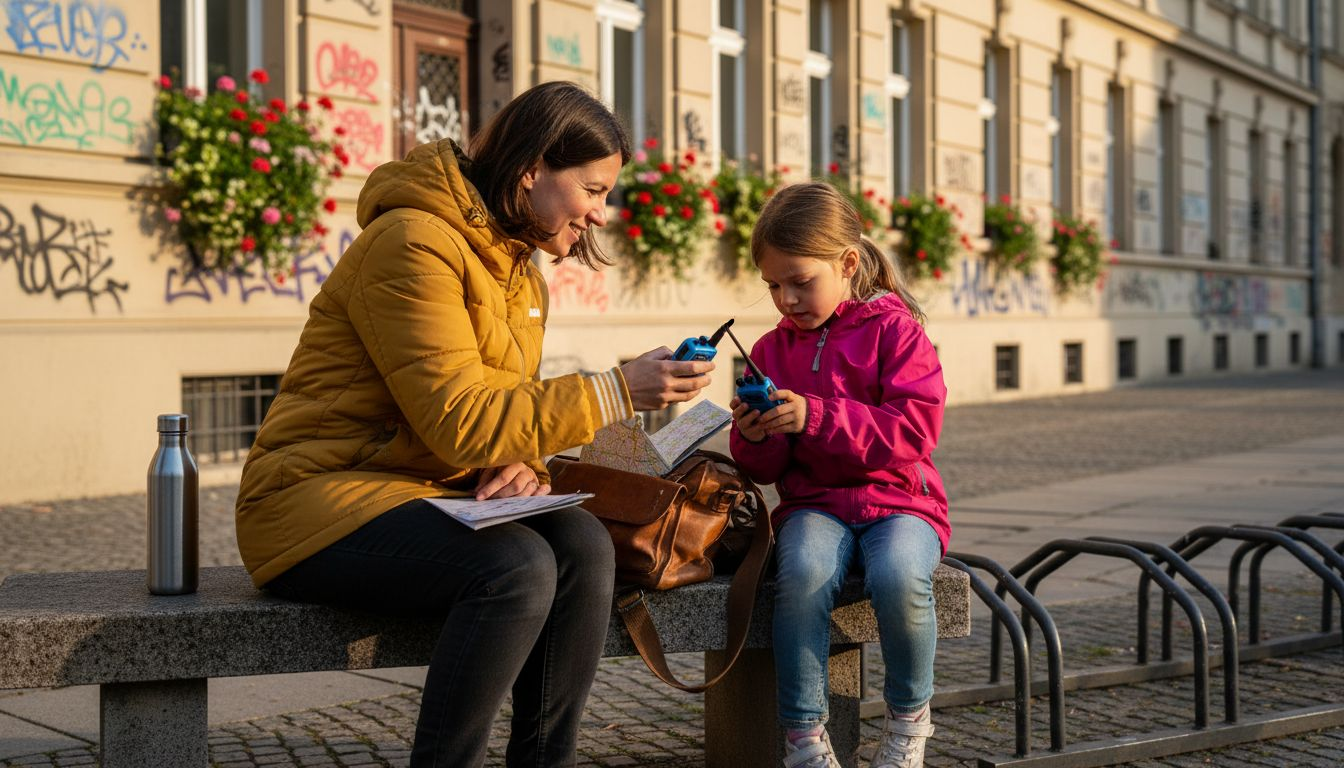
Pro tip: Test walkie talkies together before purchasing—let your child hold and operate the device to ensure it feels comfortable in their hands and matches their communication needs for upcoming outdoor adventures.
How Walkie Talkies Encourage Outdoor Learning
Walkie talkies transform outdoor play from simple recreation into genuine learning experiences. When your child uses these devices during nature exploration, they’re not just having fun—they’re developing critical thinking, problem-solving, and communication skills simultaneously. The device becomes a catalyst for deeper engagement with the natural world.
Consider what happens during a typical outdoor adventure. Your child spots an unusual bird and uses the walkie talkie to describe it to a friend. They collaborate on identifying the species, discuss habitat preferences, and coordinate observations. This is hands-on learning that sticks far better than classroom instruction.
Building Communication And Teamwork
Outdoor teaching methods encourage collaboration where children actively work together. Walkie talkies facilitate this teamwork naturally. Your child learns turn-taking, active listening, and clear expression through authentic communication needs rather than forced exercises.
These skills develop organically during play. One child reports findings from the woodland edge; another coordinates from a different location. They negotiate exploration routes, share discoveries, and solve problems together. Communication becomes purposeful and genuinely necessary.
Key learning moments include:
- Describing observations with precise language
- Following instructions from peers during coordinated activities
- Negotiating and compromising about exploration plans
- Problem-solving together when facing obstacles or challenges
- Building confidence through successful peer interaction
Walkie talkies transform solo wandering into collaborative exploration, where communication serves a real purpose rather than feeling like a contrived educational exercise.
Fostering Environmental Curiosity
Your eco-conscious values align perfectly with walkie talkie-enabled learning. The Zoofamily’s nature-inspired designs remind children that technology serves environmental connection, not distraction from it. A blue walkie talkie in hand signals genuine outdoor adventure.
Children using walkie talkies develop environmental awareness naturally. They track wildlife movements across different locations, identify plants by discussing features, and notice seasonal changes whilst maintaining observation records. The device encourages sustained attention to natural patterns.
This structured observation supports genuine scientific thinking. Your child learns to notice details, form hypotheses about animal behaviour, compare observations across time, and share findings meaningfully with peers.
Creating Independence Within Safety
Walkie talkies grant your child supervised independence. They explore further from you whilst maintaining reliable contact. This balance matters tremendously for urban European families managing limited green spaces.
Your child develops confidence exploring larger parks or nearby forests, knowing they can communicate instantly. They learn to navigate space, make safe decisions, and manage their own activities whilst remaining connected to parental oversight.
Pro tip: Assign your child specific observation missions before outdoor sessions—count particular bird species, sketch tree shapes, or photograph different moss types—transforming walkie talkie conversations into structured scientific investigations that deepen their environmental learning.
Safety, Environmental Impact, And Responsible Use
Parent concerns about walkie talkie safety are valid but easily addressed. Walkie talkies emit radiofrequency energy considered safe for public use, complying with strict regulatory standards. These devices transmit non-ionising radiation at levels far below exposure limits set by authorities.
Your child can use walkie talkies confidently without health concerns. The devices have undergone rigorous safety testing and are approved for all age groups when used as intended. Avoid extended antenna contact near the ear during transmission—standard practice with any radio device—and follow manufacturer guidelines.
Here is a quick reference to walkie talkie environmental and safety factors for parents:
| Factor | Positive Impact | Recommended Practice |
|---|---|---|
| Rechargeable batteries | Reduces electronic waste | Charge fully before outings |
| Rugged construction | Extends device lifespan | Store carefully after use |
| Low radiofrequency output | Safe for all age groups | Avoid antenna near ear |
Environmental Responsibility Matters
As an eco-conscious parent, you’ll appreciate that walkie talkies support sustainable values. Energy-efficient rechargeable models generate considerably lower carbon footprints than smartphones, especially when charging overnight rather than requiring constant power throughout the day.
Durability extends environmental benefits significantly. Quality walkie talkies feature water, dust, and shock resistance rated by IP standards, meaning they withstand years of outdoor adventures. A device lasting five years creates far less electronic waste than cheaper alternatives requiring replacement annually.
Responsible use practices include:
- Recharging batteries fully before extended outdoor sessions
- Avoiding unnecessary transmissions when silence suffices
- Maintaining devices properly to maximise lifespan
- Recycling walkie talkies appropriately at end-of-life
- Teaching children to value durability over novelty
Quality walkie talkies represent environmental responsibility—durable tools that reduce waste whilst encouraging nature connection, perfectly aligned with eco-conscious parenting values.
Teaching Responsible Communication
Walkie talkies offer teachable moments about responsible technology use. Your child learns that communication tools serve genuine purposes rather than constant entertainment. They understand when to transmit, when to listen, and how to respect shared communication channels.
This contrasts sharply with smartphone culture, where constant connectivity dominates. Walkie talkies create natural boundaries—they work for specific activities and locations, then rest. Your child develops healthy technology relationships through genuine practical necessity.
Encourage responsible practices by establishing simple family guidelines. Discuss battery conservation, respectful communication, and environmental stewardship. These conversations build awareness that technology choices carry environmental consequences.
Safe Outdoor Use Guidelines
Walkie talkies enhance outdoor safety when used thoughtfully. Establish clear communication protocols before outdoor adventures. Your child knows when to check in, what to do if separated, and how to signal for adult attention.
Keep devices within reasonable range, typically 100 metres to several kilometres depending on terrain. Urban buildings reduce range; open woodland extends it. Ensure your child understands practical limitations and knows when to return to designated areas.
Pro tip: Establish a simple communication schedule—check-ins every 10 minutes during independent exploration—transforming walkie talkies into safety tools whilst maintaining independence and environmental responsibility throughout outdoor adventures.
Discover The Perfect Blue Walkie Talkie for Your Child’s Outdoor Adventures
The article highlights how blue walkie talkies build children’s independence, encourage cooperative play, and deepen their connection with nature. If you want to overcome challenges like limited urban green space and the distraction of screen time you need a reliable device designed specifically to spark creativity and environmental curiosity. The Zoofamily offers walkie talkies crafted with nature-inspired colours and animal themes to make outdoor exploration safe and engaging for your kids.
Explore our carefully designed range that balances simplicity, durability, and fun features like VOX and emergency alerts. Give your child the gift of meaningful outdoor communication without monthly costs or complicated tech. Visit The Zoofamily now to find walkie talkies and other tools that inspire real-world adventure and foster a lifelong bond with the planet. Start transforming screen time into green time today with products that support your eco-conscious values.
Frequently Asked Questions
What is a blue walkie talkie?
A blue walkie talkie is a portable handheld two-way radio, typically designed for children, which allows wireless communication over short distances without mobile network dependency. Its blue colour appeals to young users and enhances visibility during outdoor play.
How do blue walkie talkies work?
Blue walkie talkies operate using a push-to-talk system where users press a button to speak and release it to listen. They transmit on VHF or UHF radio bands and don’t interfere with mobile networks, providing a range generally from 100 metres to several kilometres depending on the terrain.
What are the main features to look for in a child-friendly walkie talkie?
When choosing a child-friendly walkie talkie, look for simplified controls for easy use, durability to withstand rough play, and features like emergency alert buttons and voice activation (VOX) for hands-free communication during active play.
How can walkie talkies promote outdoor learning for children?
Walkie talkies encourage outdoor learning by facilitating communication during nature exploration, allowing children to describe observations, collaborate on findings, and develop critical thinking and problem-solving skills while engaged in outdoor activities.
Recommended
- Understanding How Walkie Talkies Work for Kids – The Zoofamily
- Why Walkie Talkies Matter for Children’s Growth – The Zoofamily
- Why Walkie Talkies Matter for Children’s Growth – The Zoofamily
- Understanding How Walkie Talkies Work for Kids – The Zoofamily
- Bnei Mitzvah | Bar Mitzvah Tour Production | Hiking Tours
- 7 Outdoor Adventure Alternatives For Families In Kailua-Kona | Flight Of Aloha
- Campground Slut: Trash, Rage, and Pure Freedom – The Mansion Press