

The best Earth Day giveaway for children aged 3 and up pairs an animal-themed kids’ camera with a small activity bundle, a magnifying glass, a nature journal, or a scavenger hunt card. That combination turns a gift into an outdoor session, not just an unwrapped box. Pick by age bracket below, or jump straight to the first gift idea if you know roughly what your child needs.
TL;DR:
- Most children aged 3 to 4 benefit from simple, durable tools like a basic camera or magnifying glass paired with a journal to encourage early observation skills.
- For children aged 5 to 7, drop-resistant animal-themed cameras and activity prompts help sustain engagement and support basic task-following abilities.
- Children aged 8 and up prefer more advanced cameras with features like video or printing, along with tools like field notebooks for deeper nature investigation.
- Budget options range from under £20 for basic magnifiers or zoo sleeves to over £80 for full kits with cameras capable of recording and printing.
- When organizing a public Earth Day giveaway, confirm compliance with local regulations, venue policies, and data privacy rules, especially if photos or personal info are involved.
Table of Contents
- Earth Day giveaway ideas by age and group
- How do you choose the right Earth Day giveaway?
- Fun activities to pair with your Earth Day gift
- Budget-friendly ways to package and give the gift
- What legal rules apply to running an Earth Day giveaway?
- Why these gifts matter more than they look
- Ready-made Earth Day giveaway bundles from Thezoofamily
- Sources
- FAQ
Earth Day giveaway ideas by age and group
Choosing the right gift comes down to matching the tool to what a child can already do, not what looks impressive on a shelf. A three-year-old doesn’t need buttons and menus; a seven-year-old is often bored by a gift with none. Here’s how to split it by age, with a benefit line for each so you know what the gift is actually doing.
Ages 3 to 4:
- A simple point-and-shoot camera or a sturdy magnifying glass from Wevision paired with a blank nature journal for scribbles and stickers.
- Benefit: builds early observation habits without demanding fine motor skills the child doesn’t have yet.
Ages 5 to 7:
- A durable, drop-resistant animal-themed camera such as Thezoofamily’s Zoo Friends range, a pair of child-sized binoculars, and a short activity kit with prompt cards.
- Benefit: children this age can follow a two or three-step task, so a “find and photograph” prompt card gives structure without overwhelming them.
Ages 8 and up:
- A camera with slightly more advanced features plus a nature detective kit that includes a field notebook and simple identification cards.
- Benefit: older children want a bit more challenge, and features like short video or instant printing keep the gift interesting for longer.
Group and party bundles:
For a class party or a playdate group, buy a mixed set: a handful of lower-cost items like zoo sleeves or zoo bags to hold cameras and journals, one or two shared binoculars, and a stack of printed scavenger hunt cards. Single-gift shoppers can go straight for one camera plus one small add-on, which keeps costs sensible while still giving a complete experience.
Whichever you choose, the giveaway works best when it does two things: gets a child looking closely at something, and gives them a way to record what they noticed. A camera without a prompt often sits in a drawer. A prompt without a tool is just homework.
How do you choose the right Earth Day giveaway?
Matching a gift to a child means thinking past the packaging. Four things decide whether a giveaway gets used all season or forgotten by the weekend.
- Ergonomics and durability: look for a strap, a grip sized for small hands, and a casing that survives a drop onto a patio. A camera a toddler can’t hold steady becomes a frustration, not a joy.
- Learning goals: decide if you want observation (binoculars, magnifying glass), creative expression (camera, journal), or cooperative play (walkie-talkies for two children exploring together). Different tools serve different goals.
- Safety: check for choking-hazard-sized parts on any accessory, confirm battery compartments are properly secured, and supervise any water-based exploration or insect handling closely, particularly with children under six.
- Budget tiers: a basic single gift can sit under £20 (a zoo sleeve or magnifier), a mid-tier bundle around £40 to £70 (camera plus journal), and a fuller kit above £80 for cameras with printing or video features.
Pro Tip: Let your child hold and press every button on the gift indoors before the first outdoor trip. A five-minute “how does this work” session at home prevents most of the frustration that ruins a first nature outing.
Fun activities to pair with your Earth Day gift
A gift is only half the giveaway. What you do with it in the first hour decides whether it becomes a habit or a one-off.
- Start with a noticing walk. Ask what your child can see, hear, smell, and touch during a short stroll around the garden or park. This structured sensory approach is recommended specifically for ages 3 to 6 and works without any equipment at all.
- Introduce the camera at home first. Practise turning it on, holding it steady, and taking one photo of a toy or a houseplant. Classroom research on children aged 5 to 6 found that a learn-then-practise-then-express sequence produces faster skill gains than handing over a camera outdoors cold.
- Run a short photo scavenger hunt. Give two or three simple prompts, “something green,” “something small,” “something that moves”, rather than a long list. Photography educators suggest varying the angle or getting close to the subject, which even young children can manage with a little coaching.
- Try bug photography for older children. A step-by-step approach to holding still and getting close works well for ages 6 and up; Thezoofamily’s guide to photographing bugs walks through it.
Nature play and development: structured reviews link unstructured nature play with gains in physical activity, imaginative play, and self-regulation, though the researchers note that study quality varies and results should be read as a promising signal rather than a guarantee. Keep sessions under 20 minutes for children aged 3 to 5 to avoid fatigue.
Budget-friendly ways to package and give the gift

Packaging doesn’t need to be elaborate. Recycled brown paper, a hand-drawn animal tag, and a short note work better than plastic wrap, which undercuts the whole environmental point of an Earth Day gift. Skip glitter and anything with loose small parts if the recipient is under four.
Add-ons that punch above their cost: a magnifying glass, a nature journal, or a printed activity card with two or three prompts already written out.
| Budget tier | Approximate cost | What to include |
|---|---|---|
| Low | Under £20 | Magnifying glass or zoo sleeve, paper journal, recycled wrap |
| Mid | £40 to £70 | Basic camera or binoculars, activity card, fabric bag |
| High | £80 and above | Advanced camera or video-capable model, printed photo book add-on, gift box |
What legal rules apply to running an Earth Day giveaway?
If you’re a parent buying a single gift for your own child, none of this applies. But if you’re organising a giveaway for a school event, playgroup, or community Earth Day activity, a handful of practical points matter.
First, check whether the giveaway counts as a promotional contest under local consumer protection rules, which typically require clear entry terms, an eligible-participant age range, and a stated method for selecting winners if it’s a draw rather than a straightforward gift. Many jurisdictions distinguish between a genuine no-purchase-necessary giveaway and a promotional sweepstake, and the paperwork requirements differ.
Second, if the giveaway happens on school or nursery premises, get sign-off from whoever runs the venue. Schools often have their own policies on outside gifts, food items, or branded materials being distributed to children, and some require parental consent forms if a child’s photo will be used afterwards for a class display or social post.
Third, if a business or sponsor is involved, be transparent about who’s providing the gifts. A giveaway that’s actually a marketing promotion should say so plainly, particularly if children’s personal data (names, ages, photos) gets collected for a prize draw. Keep any data collection to the minimum needed and store it securely.

None of this is complicated for a small, informal giveaway among a handful of families, but a public or school-wide event benefits from a five-minute check with the venue or organiser before you start.
Why these gifts matter more than they look
Nature play doesn’t need to be complicated to work. What matters is repetition: a child who picks up a camera or a magnifying glass three times gets more out of it than one who uses an elaborate kit once. Animal-themed designs are built around that idea, and each camera purchase ties to a larger environmental habit rather than a one-day event. My practical tip for parents: keep the gift visible, on a hook by the door, not in a cupboard, so the next walk is one step away rather than a search through a toy box.
— ALAIN
Ready-made Earth Day giveaway bundles from Thezoofamily
If you want a gift that’s ready to give without assembling one yourself, Thezoofamily’s product lines are built exactly for this. The Zoo Friends range suits younger children just starting out with a first camera, while the Zoo video and Zoo Print lines give older children more to do with video clips or instant prints. Pair either with the Zoo Walkie-Talkie for playdates or sibling exploration, or zoo eyes binoculars for a quieter, observation-led afternoon.
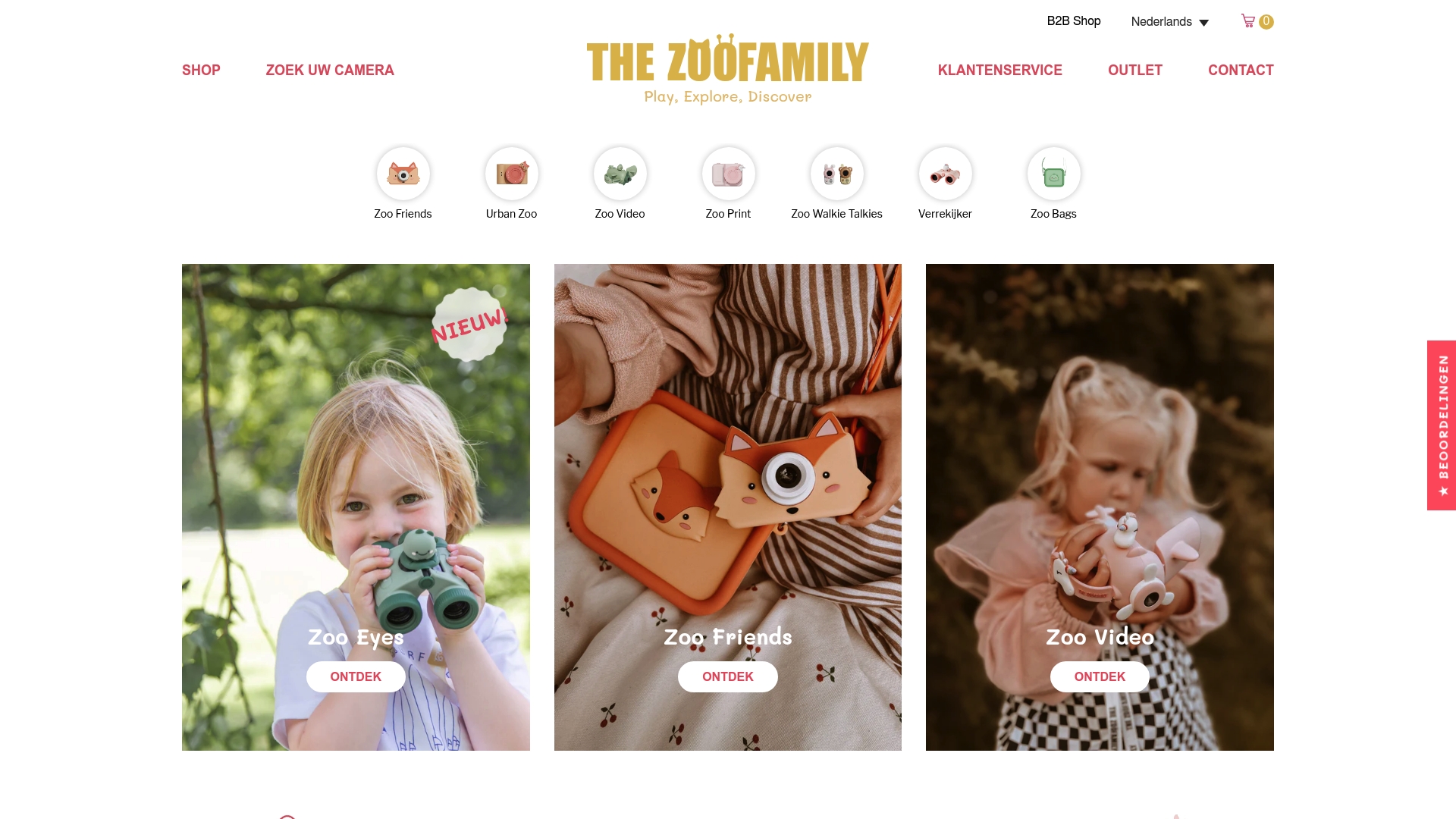
Every camera sold means a tree planted, so the gift itself carries the same message an Earth Day giveaway is meant to send. Browse the full range of cameras, binoculars, and walkie-talkies to pick a bundle that matches your child’s age, then wrap it in recycled paper and take it outside before the day is done.
Sources
- Kids, cameras and the curriculum (JEHD)
- The impacts of unstructured nature play on health in early childhood (PLOS ONE)
- Challenge your kids: six nature photography projects (Audubon)
- Noticing nature walk activity for children 3–6 (Raising Children Network)
FAQ
What is the best Earth Day giveaway for a 3-year-old?
A simple point-and-shoot camera or magnifying glass paired with a blank nature journal works best for this age, since fine motor skills are still developing. Pair it with a short noticing walk rather than a camera-heavy activity.
Does nature play actually help child development?
Systematic reviews link unstructured nature play with gains in physical activity, imaginative play, and self-regulation, though researchers note study quality varies and results should be read as a promising signal rather than a guarantee.
How much should I budget for an Earth Day gift?
Low-cost gifts sit under £20, mid-range bundles run £40 to £70, and fuller kits with advanced camera features start around £80. Thezoofamily’s zoo sleeves start at €9.95 and its Zoo Friends camera range is priced at €69.95, giving options across most of that range.
What age should a child get their first camera?
Most guidance points to age 5 or 6 as the sweet spot, when children can follow a simple learn-practise-express sequence with measurable skill gains. Younger children can still benefit from a basic point-and-shoot model paired with close supervision.
Do I need permission to run an Earth Day giveaway at school?
Yes, check with the school or venue before distributing gifts to a group, since many have policies on outside items and photo consent. If the giveaway involves a prize draw rather than gifts for all, confirm local rules on promotional contests before collecting any entries.