

Free play is defined as child-led, unstructured activity where children choose what to do, how to do it, and for how long. The American Academy of Pediatrics confirms that this kind of play builds brain structure, executive function, and secure caregiver-child bonds. Professor Paul Ramchandani from the University of Cambridge links imaginative play directly to the cognitive breakthroughs that underpin lifelong learning. Understanding why is free play important in early childhood is not a philosophical question. It is a practical one, with clear answers backed by science.
Why is free play important in early childhood for brain development?
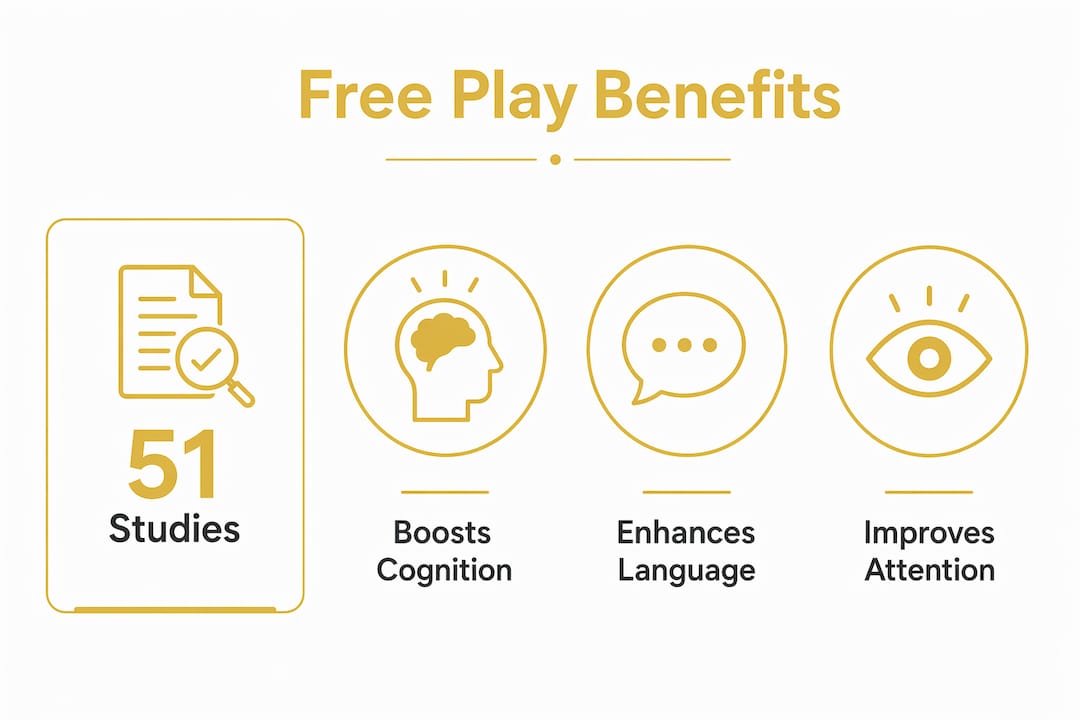
Free play is the single most effective driver of cognitive growth in children aged 4–6. A systematic review of 51 studies conducted between 2015 and 2023, spanning multiple continents, confirmed that play-based approaches improve cognitive, academic, and socio-emotional outcomes across this age group. That breadth of evidence is striking. It means free play does not just help in one area. It lifts development across the board.
Language skills grow through child-led play
Language acquisition accelerates when children choose their own play activities. The same 51-study review found that child-selected and complex non-verbal cooperation activities produce the strongest gains in language development. This matters because language is the foundation for reading, writing, and social communication throughout school. Structured drills rarely replicate the rich, spontaneous dialogue that emerges when children play freely together.
Executive function and attention improve through playfulness
Longitudinal research shows that playful interactions improve attention performance, response times, and social bonds more effectively than physical activity alone. This effect is measurable from as early as 6 months of age and continues through to 24 months. Executive function, which covers planning, impulse control, and mental flexibility, is precisely what children need to succeed in school and beyond. Free play builds it naturally, without a lesson plan.
Children absorb academic concepts through play goals
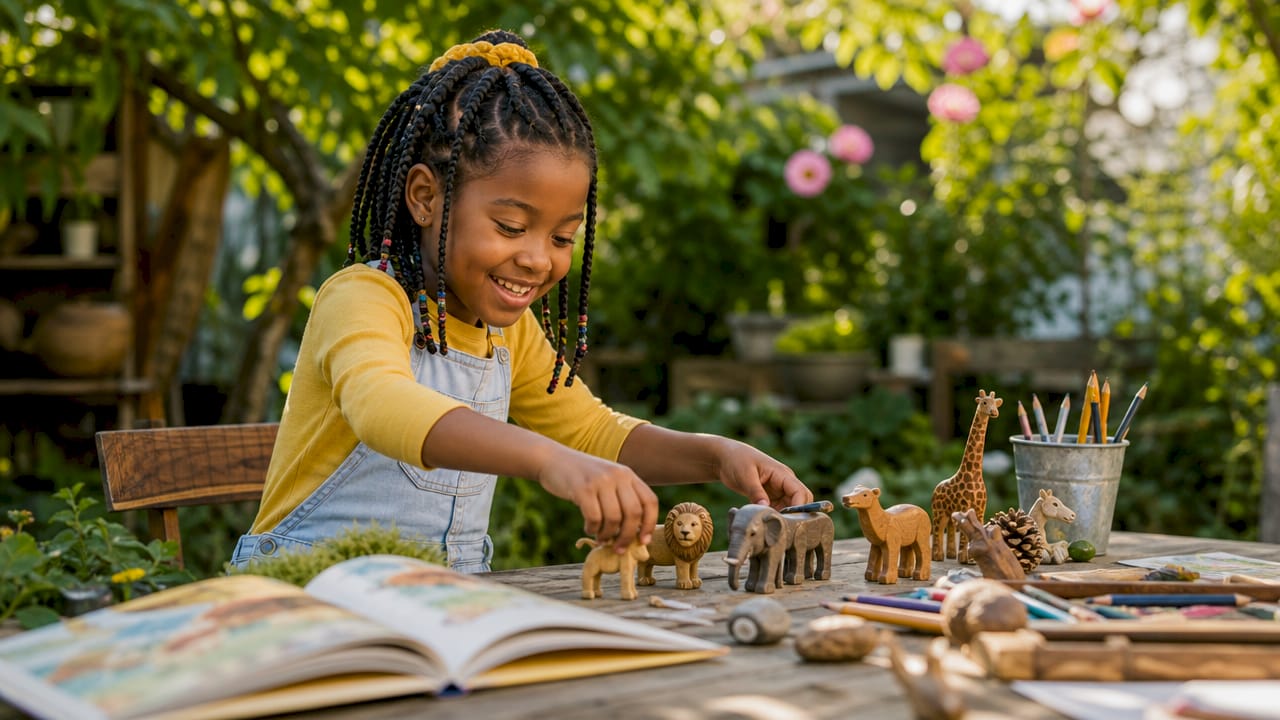
Children naturally incorporate counting, basic physics, and spatial reasoning into their play without any adult instruction. A child building a tower is experimenting with gravity. A child sorting toy animals by size is practising classification. These are not trivial observations. They show that free play delivers academic learning as a by-product of genuine curiosity, which is far more durable than rote instruction.
| Cognitive skill | How free play develops it |
|---|---|
| Language | Child-selected activities spark spontaneous, complex dialogue |
| Executive function | Playful interactions build attention and impulse control from infancy |
| Problem-solving | Self-directed challenges require children to test and adapt strategies |
| Academic concepts | Play goals naturally embed counting, physics, and spatial reasoning |
How does free play support social and emotional development?
Free play gives children a safe space to rehearse emotions and social situations before they encounter them in real life. Dramatic and pretend play builds emotional regulation, resilience, and the ability to cope with stress by letting children simulate difficult scenarios at their own pace. A child playing “hospitals” is not just having fun. They are processing fear, practising empathy, and learning to manage uncertainty.
Peer play teaches cooperation and conflict resolution
When children play together without adult direction, they negotiate rules, take turns, and resolve disagreements. These interactions are the earliest form of social training. Children who regularly engage in peer-led play develop stronger communication skills and greater tolerance for frustration. Neither of those outcomes comes from a worksheet.
Play strengthens the caregiver-child bond
Play is not only peer-to-peer. When caregivers join in on a child’s terms, the interaction deepens attachment and emotional security. The American Academy of Pediatrics specifically recommends daily child-led play as a way to reinforce safe, trusting relationships between children and the adults who care for them. That bond is a protective factor against anxiety and behavioural difficulties later in childhood.
Key social and emotional skills built through free play:
- Empathy: Pretend play requires children to take on other perspectives and feelings.
- Resilience: Navigating play setbacks, like a tower falling or a game going wrong, builds tolerance for failure.
- Communication: Children practise expressing needs, making requests, and listening to peers.
- Emotional regulation: Simulating stressful situations in play reduces their emotional charge in real life.
Pro Tip: If your child is working through a difficult emotion, offer open-ended play materials like clay, puppets, or dress-up clothes. Children often process what they cannot yet say through what they create and enact.
What is guided play, and why does child-led play matter most?
Guided play is adult-steered activity where a caregiver sets a learning goal but allows the child to explore within that frame. An analysis of 39 studies by the University of Cambridge PEDAL Centre found guided play is equally or more effective than formal teaching for literacy, numeracy, and social skills in children aged 3–8. That is a strong result. It means structure is not the enemy of play. Too much structure is.
Why adult direction can backfire
Interrupting a child’s self-directed play disrupts both creativity and executive function. When adults redirect, correct, or take over, children lose the opportunity to solve problems independently. Excessive focus on early academic drills carries a similar risk. It can crowd out the natural development of cognitive and socio-emotional capabilities that free play builds far more efficiently.
The “watch and wait” approach
Research advises caregivers to stay physically close and emotionally available during free play without offering intrusive direction. This “watch and wait” posture preserves the child’s sense of agency. It also means you are present when your child genuinely needs support, which is the moment to step in gently rather than preemptively.
| Approach | Adult role | Child outcome |
|---|---|---|
| Free play | Observer, available if needed | Highest creativity and executive function |
| Guided play | Sets goal, child explores freely | Strong literacy and numeracy gains |
| Formal instruction | Directs activity and outcome | Useful for specific skills, limited for creativity |
Pro Tip: When your child pauses during play and looks to you, that is your cue. Offer a question rather than a solution: “What do you think would happen if you tried it a different way?” This keeps them in the lead while you stay connected.
How to create more free play opportunities at home and outdoors
Time is the first ingredient. Children need long, uninterrupted stretches to develop complex play scenarios. Short windows between structured activities rarely allow the depth of engagement where real learning happens. Aim for at least one extended free play period each day, ideally outdoors.
The role of materials and nature
Outdoor and nature play stimulates motor skills, imagination, and self-expression in ways that indoor environments cannot fully replicate. Sticks, stones, mud, and open space are not primitive alternatives to toys. They are superior play materials because they have no fixed purpose, which means children must invent one. Thezoofamily’s kids’ cameras, binoculars, and walkie-talkies are designed with exactly this principle in mind. They give children tools to explore nature actively rather than consume content passively.
Protecting device-free time
Harvard’s Center on the Developing Child notes that device-free free play is under genuine threat from rising digital schedules. Screen time displaces the physical, low-tech interactions that build executive function and social cooperation. This is not about banning screens entirely. It is about protecting specific windows where children engage with the physical world and each other.
Practical steps to build free play into daily life:
- Set a daily outdoor window. Even 30 minutes of unstructured outdoor time produces measurable benefits for attention and mood.
- Rotate open-ended materials. Cardboard boxes, fabric scraps, and building blocks outlast most purpose-built toys for imaginative value.
- Limit scheduled activities. Every extra class or club reduces the unstructured time children need to self-direct.
- Follow your child’s lead indoors. Let them choose the game, the rules, and the ending. Resist the urge to improve or correct.
- Use nature as a classroom. Encourage your child to observe insects, collect leaves, or sketch birds. These activities build a love of nature alongside curiosity and focus.
Pro Tip: Resist the temptation to fill every quiet moment with an activity. Boredom is not a problem to solve. It is the condition in which children invent their most creative play.
Key takeaways
Free play is not a break from learning. It is the primary mechanism through which young children build the cognitive, social, and emotional foundations they will rely on for the rest of their lives.
| Point | Details |
|---|---|
| Free play drives brain development | A review of 51 studies confirms play-based approaches improve cognitive and language outcomes in children aged 4–6. |
| Emotional skills grow through pretend play | Dramatic play builds resilience, empathy, and emotional regulation by letting children rehearse real-life situations safely. |
| Child-led play outperforms over-directed activity | Interrupting self-directed play disrupts creativity and executive function; the “watch and wait” approach preserves both. |
| Nature and device-free time are non-negotiable | Outdoor play stimulates senses and imagination in ways screens cannot replace; protecting this time is a parenting priority. |
| Guided play has a role, but free play leads | Adult-steered guided play supports specific skills, but unstructured child-led play produces the broadest developmental gains. |
Why I think we underestimate what children do when we leave them alone
Parents often feel guilty when they are not actively teaching their child something. I understand that instinct. The pressure to prepare children for school, to fill their time with enriching activities, is real and relentless. But the research is unambiguous. The moments when a child disappears into their own world, building something, acting out a story, or just staring at a beetle on a leaf, are not wasted moments. They are the moments when the most important development is happening.
What I have observed, both in research and in practice, is that children are far more capable than adults give them credit for. Left to their own devices (the non-digital kind), they construct remarkably complex social rules, solve genuine problems, and regulate emotions in ways that no structured programme can teach directly. The benefits of imaginative play are not soft or supplementary. They are foundational.
The hardest part for most caregivers is tolerating the mess, the noise, and the apparent chaos of free play. But that chaos has structure. It is just structure the child built, not you. Trust it.
— ALAIN
How Thezoofamily supports child-led play and exploration
Thezoofamily designs tools that put children in charge of their own discovery. Kids’ cameras, binoculars, and walkie-talkies are built to take outdoors, to spark curiosity about the natural world, and to give children a reason to look up from screens and engage with what is around them.
Every product Thezoofamily makes is rooted in the same principle that underpins free play: children learn best when they lead. For every camera sold, Thezoofamily plants one tree, connecting the act of play directly to the health of the planet children are exploring. If you want to give your child tools that support creative, child-led play, visit Thezoofamily to see the full range.
FAQ
What is free play in early childhood?
Free play is child-led, unstructured activity where children choose what to do without adult direction. It is the primary way young children develop cognitive, social, and emotional skills.
How much free play does a young child need each day?
No universal daily minimum is publicly listed, but research consistently recommends at least one extended, uninterrupted free play period each day, ideally outdoors and away from screens.
Is free play better than guided play for child development?
Free play produces the broadest developmental gains, particularly for creativity and executive function. Guided play, where adults set a goal but children explore freely, is effective for specific skills like literacy and numeracy.
Can pretend play really help with emotional development?
Yes. Dramatic and pretend play builds emotional regulation and resilience by letting children simulate stressful situations in a safe context, reducing their emotional charge in real life.
How does screen time affect free play?
Screen time displaces the physical, low-tech interactions that build executive function and social cooperation. Harvard’s Center on the Developing Child identifies device-free free play as essential for optimal development, particularly as digital schedules expand.