

Start with a 30-second silent listen outdoors, then model one animal call, and ask your child to repeat it. That three-step warm-up, recommended by educator Alain and the team at Thezoofamily, is all you need to begin.
Your three-step starter:
- Step 1: Stand still and listen for a short period (no talking).
- Step 2: Name one sound you both heard and demonstrate it yourself.
- Step 3: Ask your child: “Can you make that sound?” Celebrate any attempt.
Key takeaways
Short, live, repeated listening sessions with one adult modelling sounds are the most effective way to build animal sound recognition in children.
| Point | Details |
|---|---|
| Start with a warm-up | Use a 30-second silent listen before every session to tune children’s attention. |
| Match activity to age | Infants need 2–3 minute face-to-face sessions; early primary children can sustain 10 minutes outdoors. |
| Prioritise live interaction | Live modelling produces stronger gains than recordings alone; use devices to supplement, not replace, adult interaction. |
| Build a small sound library | Record 6–10 local animal sounds, name files by season and location, and reuse them across sessions. |
| Thezoofamily devices | Thezoofamily cameras, binoculars, and walkie-talkies are designed for safe, child-led outdoor sound discovery. |
Table of Contents
- Why animal sound recognition supports early learning
- Age-by-age guide: what to try at each stage
- Ready-to-run activities for home and outdoors
- How to use kid-friendly devices safely and effectively
- How to build a simple sound library and a two-session lesson plan
- Low-pressure ways to track progress and keep children motivated
- Safety, consent, and wildlife ethics for families and classrooms
- Connecting animal sounds to storytelling and literacy
- Alain’s perspective: what success actually looks like
- Thezoofamily: kid-friendly devices for outdoor sound discovery
- Sources
Why animal sound recognition supports early learning
Animal sound activities strengthen phonemic awareness and vocabulary by linking repeated, imitable sounds to words and objects. Simple onomatopoeia such as “moo” or “woof” gives young children a low-risk way to practise sound segmentation and imitation before they tackle more complex words.
Two findings are worth knowing:
- A systematic review of nature-based early childhood education found positive associations with social, emotional, and cognitive development, though the authors noted the overall certainty of evidence was low to moderate. That is an honest signal: the direction is clear, but the work is still developing.
- A 2026 quasi-experimental study found that preschoolers in hands-on forest programmes achieved larger and more durable biodiversity knowledge gains than children in classroom-only programmes.
Live, interactive modelling produces stronger language gains for babies and toddlers than passive digital examples. Recordings and apps can supplement a session, but they cannot replace a caregiver who models a sound, waits, and responds. Prioritise outdoor, interactive listening wherever possible.
Age-by-age guide: what to try at each stage
| Age | Session length | Recommended first activity | Sample prompt |
|---|---|---|---|
| 0–12 months | 2–3 minutes | Caregiver models one animal sound face-to-face | “Listen — moo! Can you say moo?” |
| 1–2 years | 3–5 minutes | Imitation game with soft toy animals | “What does the dog say?” |
| 3–5 years | 5–10 minutes | Listening walk with one target sound | “Stop — what can you hear right now?” |
| 6–8 years | 10 minutes | Sound mapping or sound hunt outdoors | “Draw where you think that bird is.” |
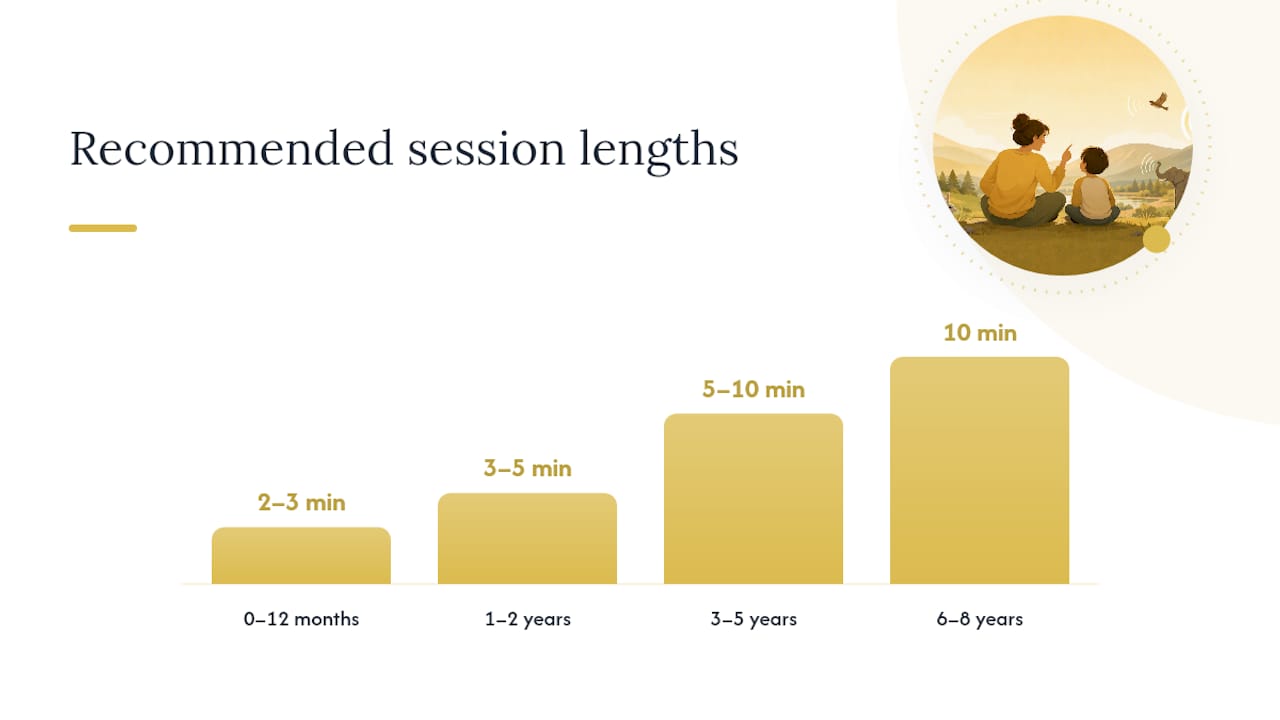
Infants (0–12 months): Keep sessions to two or three minutes. Use exaggerated facial expressions and repeat the same sound across multiple days before introducing a new one. Avoid background noise.
Toddlers (1–2 years): Introduce simple matching: hold up a picture of a cow and make the sound. Short, playful, and repetitive works best. Do not correct errors; model the correct sound again instead.
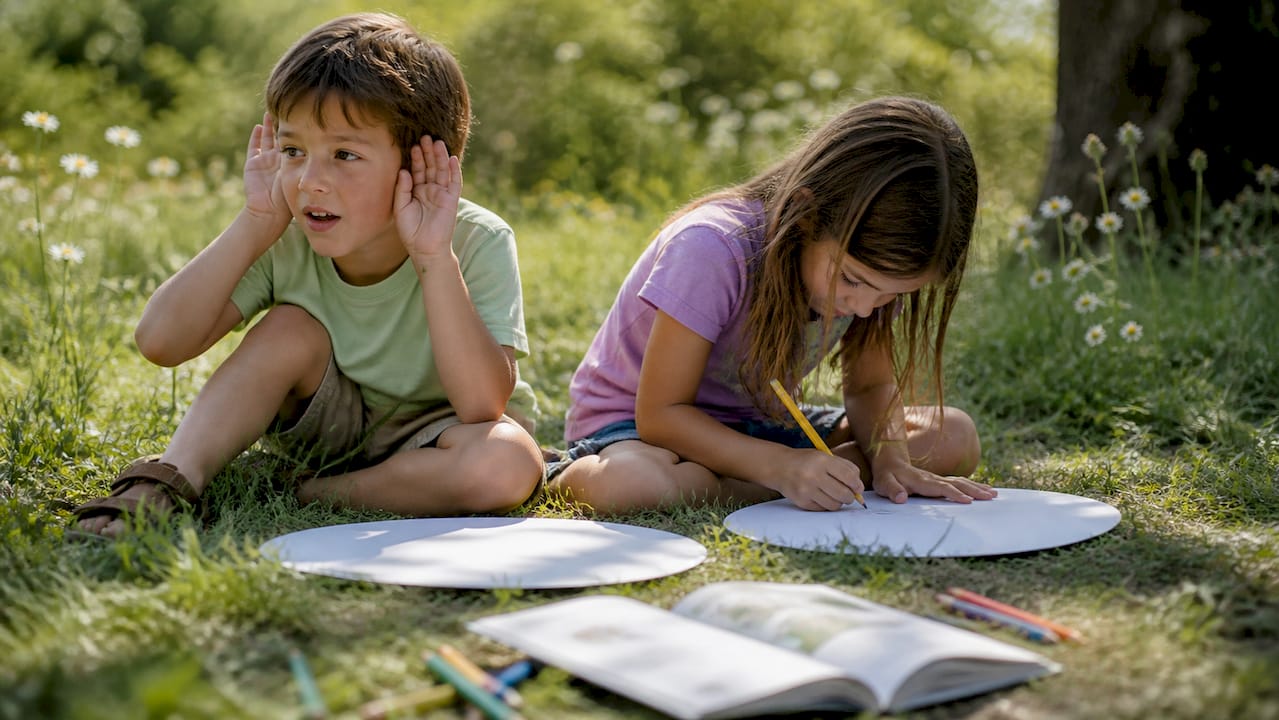
Preschoolers (3–5 years): Move outdoors. Use directional prompts: “Is that sound close or far away?” Cup your hands behind your ears (the “fox ears” technique) to amplify faint sounds. Sessions of five to ten minutes are enough.
Early primary (6–8 years): Children at this stage can handle sound mapping, where they draw a simple diagram placing sounds relative to where they are standing. Fifteen minutes is a productive upper limit before attention dips.
Ready-to-run activities for home and outdoors
The single most effective activity is a listening walk with one target sound. It is low-prep, works across ages, and produces immediate, observable results.
1. Listening walk
- Choose one target sound before you leave (e.g., a bird call or a dog bark).
- Walk slowly for two minutes without talking.
- Stop. Listen for one minute. Ask: “Did you hear it?”
- Continue. Repeat three or four times.
- Back home, replay any recording you made and compare.
Materials: none required. Optional: a simple recorder or a Thezoofamily kids’ camera with audio capture.
2. Sound hunt
Set a list of five to eight common animal noises to find. Sound hunts train auditory discrimination and phonological awareness, skills linked to later reading success. Tick each sound off when heard. Younger children use pictures; older children write the animal name.
3. Sound mapping
Give each child a blank circle on paper with a dot at the centre (that is them). Every time they hear a sound, they draw a small symbol in the direction it came from. The “fox ears” technique (cupping both hands behind the ears) helps locate faint or distant sounds.
4. Matching game
Record five short clips at home or outdoors. Play each clip and ask children to match it to a picture card. Vary the difficulty by including two similar sounds (e.g., a crow and a pigeon).
5. Recording and playback
Children record a sound, then listen back and describe what they hear. This builds animal call identification skills and gives them ownership of the learning.
Troubleshooting similar sounds: When a child confuses two similar calls (e.g., a sparrow and a robin), isolate one feature. Ask: “Is it fast or slow?” or “Is it high or low?” Focus on a single difference rather than the whole sound.
Pro Tip: Use the “sound sandwich” method on group walks: walk quietly for two minutes, stop and listen for one minute, then continue. This keeps mixed-age groups engaged without losing focus.
How to use kid-friendly devices safely and effectively
The three device features that matter most for animal sound activities are simple audio playback, a robust build that survives outdoor use, and easy hands-free operation so children focus on listening rather than managing the device.
Cameras:
- Look for a shutter button large enough for small hands.
- Audio capture or video mode lets children record a sound clip alongside a photo.
- A drop-resistant casing is non-negotiable outdoors.
Binoculars:
- Short focus distance (under 3 metres) lets children observe garden birds without moving closer and disturbing them.
- Lightweight models (under 200g) reduce fatigue on longer walks.
- Wide field of view helps children locate a moving bird quickly.
Walkie-talkies:
- Volume-limited models (85 dB maximum) protect young ears during extended use.
- Push-to-talk buttons teach children to listen before speaking, which reinforces the listening habit central to animal sound recognition.
Safety notes:
- Keep playback volume at or below 85 dB. Prolonged exposure above this level risks hearing damage in children.
- Always obtain consent before recording other people, including other children.
- Supervise all device use outdoors, particularly near roads or water.
Thezoofamily designs its cameras, binoculars, and walkie-talkies specifically for children’s outdoor use, with Alain contributing educator guidance to the product development process.
How to build a simple sound library and a two-session lesson plan
Start with 6–10 local, high-frequency animal sounds your children are likely to encounter: a robin, a pigeon, a dog, a cat, a crow, and a frog cover most gardens and parks.
File-naming and folder structure:
| Folder | Filename example | Notes |
|---|---|---|
| Spring/Garden | spring_robin_song.m4a | 3–10 seconds per clip |
| Summer/Park | summer_pigeon_coo.m4a | Label location and season |
| Autumn/Forest | autumn_crow_call.m4a | One sound per file |
Organise recordings by season and acoustic texture so you can select calming or energising sounds to match the session’s mood or learning goal.
Two-session starter plan:
Session 1 — Listening and mapping (20 minutes):
- 5-minute listening warm-up outdoors using fox ears.
- 10-minute sound mapping activity (children draw what they hear).
- 5-minute group share: name each sound together.
Session 2 — Matching and recall (20 minutes):
- Play back three recorded clips from Session 1.
- Children match each clip to a picture card.
- Introduce one new sound and repeat the matching step.
Success criteria: a child can correctly match three out of five clips without prompting.
Low-pressure ways to track progress and keep children motivated
The simplest assessment tool is a sound tally card: a small card with five to eight animal pictures. Each time a child correctly identifies a sound, they colour in or tick the matching picture. No scores, no rankings.
Tracking and motivation tips:
- Celebrate any correct identification, including partial ones (“You heard a bird — well done. It was a robin.”).
- Use sticker charts for younger children to mark sounds they have heard this week.
- Avoid comparing children’s progress with each other; compare each child only with their own previous week.
- Short, frequent sessions (five minutes daily) build more durable memory than one long weekly session.
Troubleshooting: If a child consistently confuses similar sounds (e.g., a blackbird and a thrush), reduce the set to two sounds only and alternate them until the child can distinguish them reliably. Then reintroduce the wider set. Sound hunts are particularly useful here because they make the discrimination task feel like a game rather than a test.
Safety, consent, and wildlife ethics for families and classrooms
The first rule: never approach, disturb, or handle wildlife to get a recording. Observe from a distance and let the animal continue its natural behaviour.
Recording dos and don’ts:
- Do record from a distance using a directional microphone or a zoom camera.
- Do obtain verbal consent from any adult before recording them.
- Do not record other children without parental consent.
- Do not play recordings back loudly near nesting sites or dens.
- Do not share classroom recordings online without written consent from all families involved.
Hearing safety: Keep device volume at or below 85 dB. In noisy outdoor settings, use ear defenders rather than raising playback volume.
Pro Tip: Before any outdoor session, brief children on one simple rule: “We listen first, then we move.” This prevents the instinct to run towards a sound and disturb the animal.
For guidance on responsible interaction with animals, including how to observe behaviour safely, Thezoofamily’s blog covers the topic in practical terms.
Connecting animal sounds to storytelling and literacy
Animal sound recognition fits naturally into story-based activities. After a listening walk, ask children to invent a short story about the animal they heard: “Where was the robin going? What was it saying?” This links the auditory experience to narrative structure, vocabulary, and sequencing skills.
For early readers, use picture books that feature animal sounds as repeated refrains. Children who have heard a real crow call will engage differently with a story that includes one. The sound becomes an anchor for the word. You can extend this by having children create their own nature-based learning activities that combine drawing, recording, and storytelling in a single session.
For family pets, understanding how dogs communicate through sound and behaviour gives children a starting point for interpreting animal vocalisations they encounter every day, which transfers directly to wildlife listening skills.
Alain’s perspective: what success actually looks like
The conventional advice is to teach children as many animal sounds as possible, as quickly as possible. That approach misses the point. A child who can reliably identify three local bird calls and explain what each one signals has learned something durable. A child who has been drilled on twenty sounds and can recall none of them a week later has not.
The research points consistently in one direction: short, repeated, live interactions with real sounds produce the best outcomes. Recordings and devices are useful tools, but they work only when a caregiver or teacher is present to model, respond, and celebrate. The device does not do the teaching. You do.
Thezoofamily’s products are built around this principle. The cameras, binoculars, and walkie-talkies are designed to extend what a child can observe and record outdoors, not to replace the adult in the room. For every camera sold, Thezoofamily plants one tree, which is a small but concrete commitment to the natural world these activities are meant to connect children with.
Thezoofamily: kid-friendly devices for outdoor sound discovery
Thezoofamily produces cameras, binoculars, and walkie-talkies built for children’s outdoor use: drop-resistant, volume-safe, and simple enough for a five-year-old to operate independently. Each product is designed to support the kind of hands-on, outdoor learning this guide describes, with educator input from Alain shaping the product features. Many solutions exist for outdoor learning, and the right device depends on your child’s age and your setting. To see the current range and find a device that fits your next listening walk or sound hunt, visit Thezoofamily’s full product range.
Sources
- Why learning animal sounds can be crucial to children’s language development — The Conversation
- Animal sounds and early speech development — ReadBrightly
- Enhancing biodiversity literacy in early learners: The impact of direct outdoor experience versus classroom instruction
- Backyard sound hunt: a nature-based listening game for early childhood development — The Music Scientist