

TL;DR:
- Empathy develops gradually through childhood, shaped by social interactions and guided experiences by parents.
- Practicing emotion naming, validation, role-play, and emotional regulation helps children internalize empathy skills effectively.
Empathy does not arrive fully formed the moment a child is born. Many parents assume it will simply emerge as their child grows, but nurturing social interaction is what actually builds this skill over time. Empathy involves recognising other people’s feelings, sharing in those emotions, and choosing to respond with kindness. The good news is that parents are perfectly placed to shape this skill from the toddler years onwards, using everyday conversations, conflicts, and even nature walks as teaching opportunities. This guide walks you through how empathy develops and exactly what you can do to foster it in children aged 3 to 10.
Table of Contents
- Understanding how empathy develops in children
- The parent’s role: Techniques for nurturing empathy
- Real-life examples: Guiding empathy through everyday moments
- Fostering empathy for nature and the wider world
- A fresh perspective: It’s not one skill, and why small, repeated moments matter
- Support your child’s empathy journey with Zoofamily resources
- Frequently asked questions
Key Takeaways
| Point | Details |
|---|---|
| Empathy is multi-layered | Children develop empathy through a blend of emotional recognition, perspective-taking, and social practice. |
| Parents are key guides | Caregivers shape empathy most through direct interaction, role-modelling, and guided reflection. |
| Nature boosts empathy | Connecting with animals and nature can encourage children to develop kindness and eco-responsibility. |
| Practice builds capacity | Everyday moments—especially conflict or collaborative tasks—provide opportunities for empathy-building. |
Understanding how empathy develops in children
To lay the groundwork for actionable parenting, let’s look at what empathy really means and how it grows in children.
Most people think of empathy as one thing: being kind. In reality, researchers describe it as having multiple components, namely emotion recognition, affective sharing (actually feeling something of what another person feels), and cognitive perspective-taking (understanding another person’s viewpoint). These components do not all switch on at the same time, which is why a toddler might cry when another child cries but still grab a toy right out of their hands.
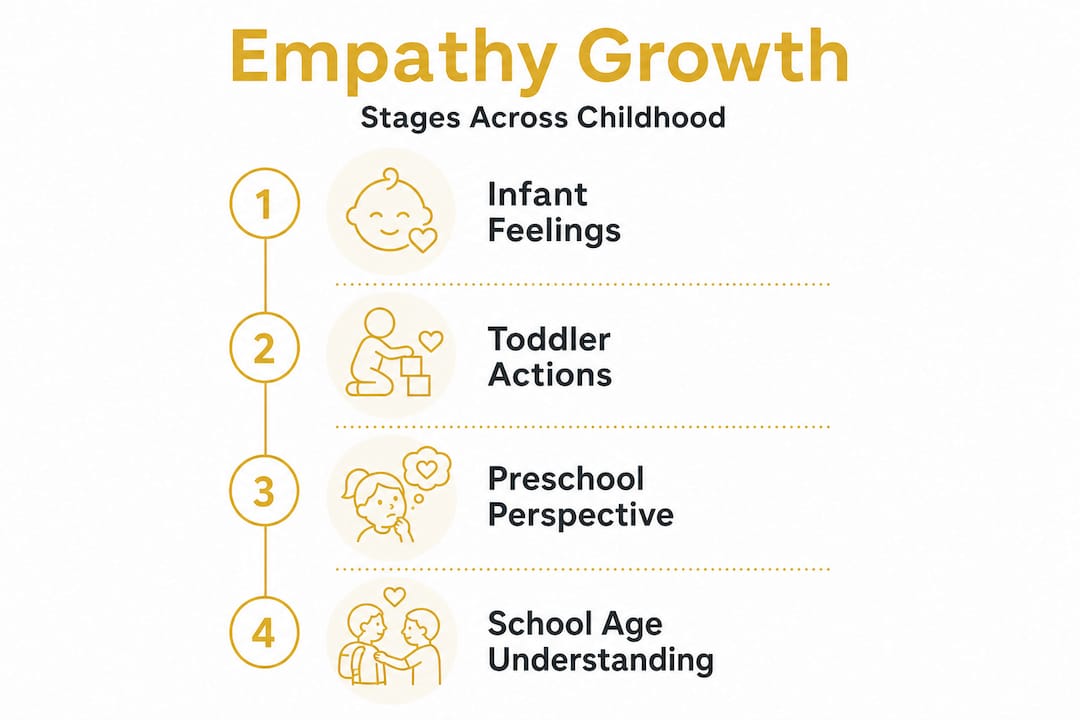
Here is how these capacities typically unfold across early childhood:
| Age range | What develops | What it looks like |
|---|---|---|
| 0 to 2 years | Emotional contagion | Baby cries when others cry; mimics facial expressions |
| 2 to 4 years | Emotion recognition | Names basic feelings; starts to comfort others |
| 4 to 6 years | Early perspective-taking | Begins to understand others may feel differently |
| 7 to 10 years | Cognitive empathy | Thinks about motivations, background, and consequences |
This progression matters enormously. Research confirms that affective responses in infants form the foundation, but cognitive empathy only becomes truly complex through the primary school years. A five-year-old and a nine-year-old need completely different conversations.
One fascinating developmental milestone is the link between empathy and theory of mind. Theory of mind is the understanding that other people have their own thoughts, feelings, and beliefs that differ from yours. Studies confirm that empathy and theory of mind develop together in the preschool years, which means activities that support one will often support the other.
Key things to keep in mind as your child grows:
- Toddlers respond to feelings more through instinct than reasoning; they need gentle, repeated guidance.
- Preschoolers are starting to name and express emotions but still struggle with conflicting feelings.
- Children aged 5 to 7 can begin cooperative play and benefit from structured discussions about how others feel.
- Children aged 8 to 10 are ready for deeper reflection, including thinking about a person’s background or circumstances.
“Empathy is not a light switch. It is a spectrum of abilities that children build piece by piece, with the right support at the right time.”
You can also deepen this understanding by exploring how photos and empathy connect, a wonderfully concrete way to help young children study faces, expressions, and emotional cues.
The parent’s role: Techniques for nurturing empathy
Now that we understand how empathy develops, here is how parents can nurture it step by step.
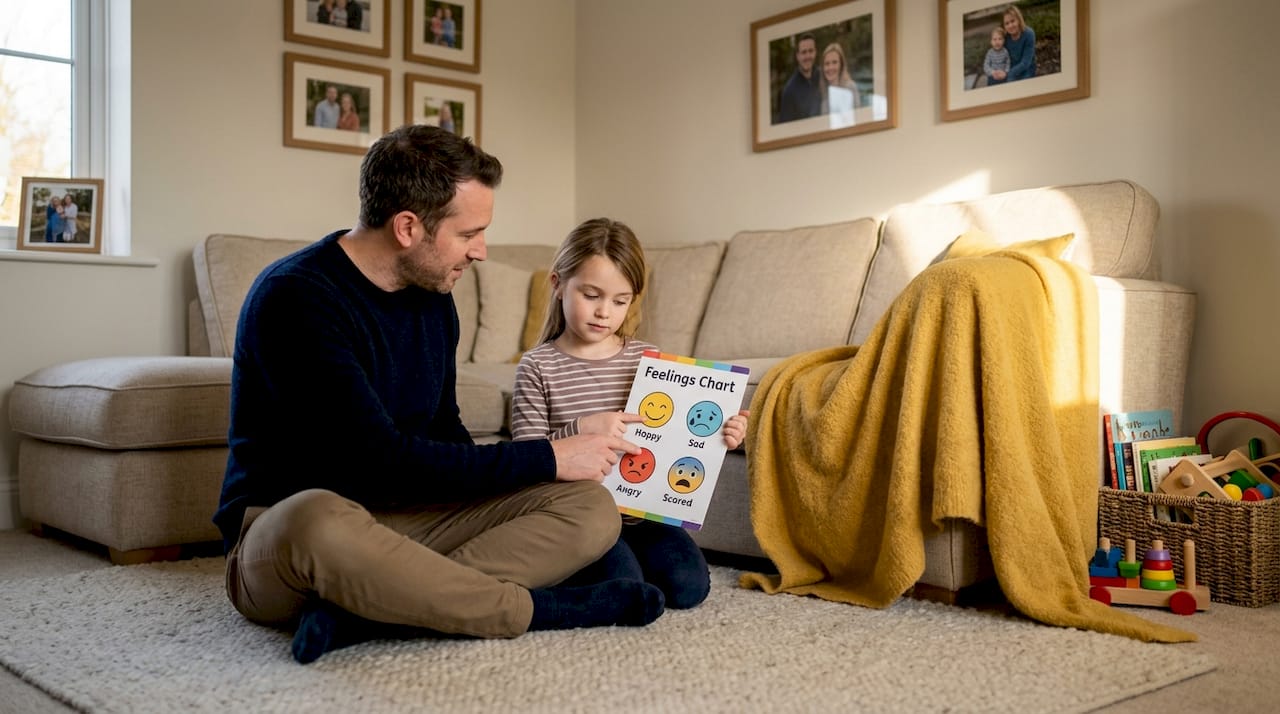
The single most powerful thing a parent can do is consistently respond to their child’s emotions with warmth and curiosity rather than dismissal or instruction. Caregiver support in the form of emotional communication, social role-play, and shared reading has been shown to help empathy flourish. This is not about grand gestures; it is about consistent, small daily habits.
Here is a practical, age-sensitive framework you can start using today:
- Name emotions out loud. When your child is upset, say “You look really frustrated right now.” This builds their emotional vocabulary, which is the foundation for recognising feelings in others.
- Validate before you problem-solve. Before jumping to solutions, acknowledge the feeling. “That sounds really hard” goes a long way before “Let’s think about what to do.”
- Use check-in prompts. Ask “How do you think your friend felt when that happened?” after a conflict or story. This shifts attention to someone else’s experience.
- Try social role-play. Act out scenarios with toys or puppets. “The bear took the rabbit’s carrot. How do you think the rabbit feels? What should the bear do?”
- Model your own emotions. Say “I felt a bit sad today when my plans changed” so children see that adults have feelings too.
- Structured reflection for older children. With children aged 8 and above, try asking “What do you think made them act that way?” to encourage thinking about root causes, not just surface behaviour.
Emotion coaching specifically, the practice of helping children notice, name, and validate their own feelings, has strong evidence behind it as a tool for building empathy. And role-modelling combined with structured reflection helps children internalise empathy as a habit rather than a one-off lesson.
Pro Tip: If your child is in the middle of a meltdown, they cannot access empathy for someone else yet. Pause, help them regulate their own feelings first, and revisit the empathy conversation once they are calm.
Helping your child with expressing emotions is a complementary skill that works hand in hand with empathy. The more fluent a child becomes in their own emotional language, the more easily they can read that language in others. You can also tie empathy to teaching responsibility by showing children how their actions have real effects on the people and world around them.
“Children do not learn empathy from being told to be kind. They learn it by experiencing kindness, practising it, and being guided through the moments when it is hard.”
Real-life examples: Guiding empathy through everyday moments
With practical techniques in hand, see how these moments play out in real family life.
Everyday family life is actually full of natural empathy-building opportunities. The trick is recognising them and using them rather than rushing past. Consistent caregiver relationships and guided conflict resolution are two of the most powerful ways caregivers can foster empathy skills in young children.
Here are some common situations and how to handle them:
- Sibling conflict over a toy: Rather than just enforcing a rule, pause and say, “Your brother was really excited to play with that. How do you think he feels right now?” Then guide both children towards a solution together.
- A child excludes a classmate: Use it as a private conversation opener. “How do you think they felt standing alone? Can you remember a time you felt left out?”
- Reading a picture book: Stop mid-story and ask, “Why do you think this character is crying? What would you do if you were there?”
- Caring for a pet: Feeding, stroking, and noticing a pet’s behaviour teaches children that other living things have needs and feelings too.
Sample scripts can really help when you are caught off-guard in the moment. Some phrases that work well include:
- “I see you’re upset. How do you think your friend feels right now?”
- “What do you think she needed when that happened?”
- “You didn’t mean to hurt him, and it still hurt. What could we do?”
Boundaries as a vehicle for empathy is an often-overlooked idea. When children understand that boundaries exist because everyone has needs, including adults, they develop a richer, more realistic picture of empathy. Saying “I need quiet right now because I’m tired” teaches children that empathy runs in all directions.
| Situation | Empathy-building approach | Skill developed |
|---|---|---|
| Toy dispute | Name both children’s feelings aloud | Emotion recognition |
| Exclusion at school | Discuss the excluded child’s experience | Perspective-taking |
| Story time | Stop and ask “How does she feel?” | Affective sharing |
| Pet care routine | Observe and discuss animal needs | Extending empathy |
| Parent sets a boundary | Explain your own needs clearly | Understanding others’ limits |
Pro Tip: Daily routines like feeding a pet or helping prepare a meal are underrated empathy lessons. They show children that others, animals included, depend on care and attention.
Tying these habits to wider values, such as those explored in eco-friendly family habits, can reinforce the idea that empathy is not just about people, it extends to all living things.
Fostering empathy for nature and the wider world
Empathy for the people around us can extend naturally to animals and the earth. Here is how to broaden this horizon.
One of the most powerful insights from recent research is that empathy does not stop at the boundary of human relationships. Children who develop an emotional connection to animals and nature show more helping behaviours across the board. This is not a side topic; it is central to raising children who care.
Research shows that empathy with nature can increase pro-environmental helping behaviour in young children. Eye-tracking studies have found that children show more attention to and preference for eco-friendly choices after an empathy-focused activity. In practical terms, a child who has spent time genuinely connecting with a bird, a beetle, or a river is more likely to want to protect them.
Practical ways to extend empathy into the natural world:
- Nature walks with emotional check-ins. Ask “How do you think the worms feel when it rains?” or “What do you think the robin needs right now?” These questions sound simple, but they build a habit of caring attention.
- Storybooks about animal feelings. Books that place children in the perspective of animals are a brilliant bridge between human and nature empathy.
- Community clean-ups. Participating in a litter pick or garden tidy gives children a concrete way to act on empathy for their local environment.
- Observing animals closely. Binoculars or a camera help children notice behaviour, posture, and expression in creatures they might otherwise ignore.
- Growing something together. Tending a plant and watching it grow teaches patience and attentiveness to non-human needs.
Building eco-awareness in children from an early age creates a foundation that lasts a lifetime. Encouraging local animal discovery is one of the most joyful ways to start this journey. Children who know the names and habits of local creatures feel a personal connection to them that abstract environmental lessons simply cannot create.
Empathy fact: Studies using eye-tracking technology found that children who had engaged in a nature empathy activity spent significantly more time looking at pro-environmental choices, showing that emotional connection drives real behavioural change.
A fresh perspective: It’s not one skill, and why small, repeated moments matter
Most parenting guides on empathy treat it as a single skill to be ticked off a list. Teach empathy in March, sorted. But the evidence tells a very different story, and it is one worth sitting with.
Empathy is multi-component and changes across childhood. What works for a four-year-old is largely irrelevant to a nine-year-old, and vice versa. The parent who tries one script and sticks with it for years is missing most of the picture.
One of the most common mistakes we see is parents waiting for a “teachable moment.” They hold back, hoping for a clear incident where they can deliver a neat empathy lesson. The truth is that empathy is built in the ordinary, unglamorous moments: the rushed breakfast where you still take ten seconds to ask how your child is feeling, the evening walk where you stop to watch a hedgehog, the bedtime story where you pause and wonder aloud together about how the character must feel.
Another myth worth challenging is the idea that conflict is something to fix as quickly as possible. Conflicts, sibling rows, friendship fall-outs, disagreements over games, are actually the richest training ground empathy has. When parents rush to resolve these too quickly, children miss the chance to practise sitting with discomfort, taking another person’s perspective, and working through repair. A little mess is where the real learning happens.
The other overlooked truth is that empathy requires emotional regulation first. A child who is flooded with their own feelings cannot think about someone else’s. Prioritising emotional regulation, helping your child name, manage, and move through their own emotional states, is not a detour from empathy work. It is the foundation of it. We often say at Zoofamily that photo-driven empathy activities are powerful precisely because they create a calm, focused moment for children to study feelings without being in the middle of one.
Empathy is less a destination and more a practice. The parents who nurture it most effectively are not the ones with the cleverest techniques. They are the ones who show up consistently, stay curious about their child’s inner world, and model the very qualities they hope to inspire.
Support your child’s empathy journey with Zoofamily resources
Ready to keep building a more caring family culture? We created Zoofamily to do exactly that: to spark connection between children, and between children and the natural world.
At Zoofamily, our cameras, binoculars, and walkie-talkies are designed with animal references that genuinely ignite children’s curiosity about nature. Every camera sold plants a tree, because we believe empathy for the planet starts young. Beyond our products, our blog is full of guides, activity ideas, and inspiration specifically crafted to help parents like you nurture emotional intelligence alongside a love of nature. Whether you are looking for your next nature activity or a new conversation starter, explore the Zoofamily blog for practical, parent-tested ideas that make empathy a living part of your daily routine.
Frequently asked questions
At what age do children start showing empathy?
Displays of affective empathy start in infancy, with babies responding emotionally to the distress of others. True perspective-taking, where a child consciously considers another’s viewpoint, typically develops through the preschool and primary years.
Which activities are most effective for teaching empathy?
Joint reading, social role-play, emotion coaching, and guided conflict resolution are all highly effective. Research highlights emotional communication and shared reading as particularly valuable supportive experiences for building empathy in young children.
How can parents help when a child struggles to share or take turns?
Calm, repeated guidance works best here. Caregivers who guide conflict resolution consistently and help children name what they are feeling build both social skills and empathy over time, even if progress feels slow.
Does empathy for nature affect children’s behaviour?
Yes, meaningfully. Studies show that children who cultivate empathy with nature are more likely to engage in pro-environmental and helping actions, suggesting that emotional connection to the natural world translates into real behavioural change.
Can empathy be taught to every child?
Every child has the capacity to develop empathy, though the right approaches vary with age and temperament. Empathy does not develop automatically; children need consistent, nurturing social interactions with caregivers to build this skill across childhood.