

TL;DR:
- Children benefit from learning emotional expression through modeling, storytelling, and outdoor play.
- Consistent, small moments of validation help develop emotional literacy over time.
- Nature and creative activities support emotional regulation, especially in neurodivergent children.
Children who grow up in loving, attentive homes still struggle to express their feelings. This is one of the most common surprises parents face, and it is not a sign of failure. Emotions are complex, and naming them is a skill that must be taught and practised, much like reading or riding a bike. Between the ages of 4 and 10, children’s emotional brains are developing rapidly, and the habits they build now will shape their relationships, their resilience, and even their performance at school for years to come. The good news is that you do not need a special programme or a psychology degree to make a real difference.
Table of Contents
- Why emotional expression matters for children
- Evidence-based methods to help your child express emotions
- The power of nature and creative play in emotional development
- Adapting approaches: Neurodiversity, empathy, and challenges
- What most guides miss about children and emotions
- Find more ideas and support
- Frequently asked questions
Key Takeaways
| Point | Details |
|---|---|
| Modelling matters | Children learn emotional expression best when adults consistently model and label their own feelings. |
| Play is powerful | Nature and creative play support emotional growth and help children process feelings in engaging ways. |
| Consistency over perfection | Regular, simple emotional check-ins are more impactful than occasional big conversations. |
| Adapt for unique needs | Neurodivergent children may benefit from sensory or play therapy techniques to express emotions comfortably. |
Why emotional expression matters for children
Many parents assume that if a child is upset, they will naturally say so. In reality, most children experience a jumble of physical sensations and do not have the vocabulary or the framework to translate those sensations into words. Teaching them to do so is one of the most powerful investments you can make.
Research into emotional development shows that emotion comprehension improves steadily from ages 3 to 5, with happiness typically the first emotion children learn to recognise, followed gradually by more complex feelings like shame or jealousy. This tells us something important: emotional literacy has a developmental sequence, and parents can work with that sequence rather than against it.
The long-term stakes are high. Children who can identify and express their emotions tend to perform better academically, maintain stronger friendships, and show greater resilience when things go wrong. Crucially, SEL programmes improve academic achievement by 4.2 percentile points overall, rising to 8.4 for longer programmes. That is a meaningful gain, and it does not come from extra maths lessons.
“Children who are able to identify and express their emotions are better equipped to manage relationships, handle stress, and succeed academically.” This consensus is echoed across developmental psychology.
Here is why this matters practically for you as a parent:
- Recognising emotions in themselves and others is a learned skill, not an inborn trait
- Early intervention with simple tools like labelling and validation can change developmental trajectories
- Modelling your own emotional awareness teaches children that feelings are safe to discuss
- Empathy in children grows when adults consistently name and acknowledge feelings aloud
- Naming feelings reduces the intensity of difficult emotions, helping children feel less overwhelmed
With the importance established, let’s look at what actually helps children learn to share their feelings.
Evidence-based methods to help your child express emotions
Now that we know emotional skills can be learnt, here are the most effective ways you can help your child.
Key methodologies for supporting emotional expression include creating safe environments, modelling, using stories and books, engaging in creative play, and practising coping strategies together. None of these requires special equipment or professional training.
| Strategy | Best age range | Core benefit |
|---|---|---|
| Emotional labelling | 4 to 6 | Builds vocabulary for feelings |
| Adult modelling | All ages | Normalises emotional honesty |
| Stories and books | 4 to 8 | Builds empathy through characters |
| Creative play | 4 to 10 | Safe distance to explore big feelings |
| Coping skill practice | 6 to 10 | Builds self-regulation tools |
Here is a simple sequence you can follow at home:
- Create a safe space. Make it clear that all emotions are welcome, even the uncomfortable ones. Never punish a child for crying or feeling angry.
- Label emotions in the moment. When your child is frustrated, say: “I can see you feel really frustrated right now. That makes sense.”
- Model your own feelings. Say aloud, “I felt a bit nervous before that meeting, but I took some deep breaths and it helped.”
- Use stories and books. Read picture books featuring characters navigating emotions and pause to ask, “How do you think she is feeling here?”
- Explore through play. Let your child act out scenarios with figures, puppets, or during creative play where feelings can surface without pressure.
European resources highlight the value of empathy-building, role-modelling, and playful approaches such as emotion cards and movement games like dance. These are not abstract concepts; they are things you can weave into an ordinary Tuesday afternoon.
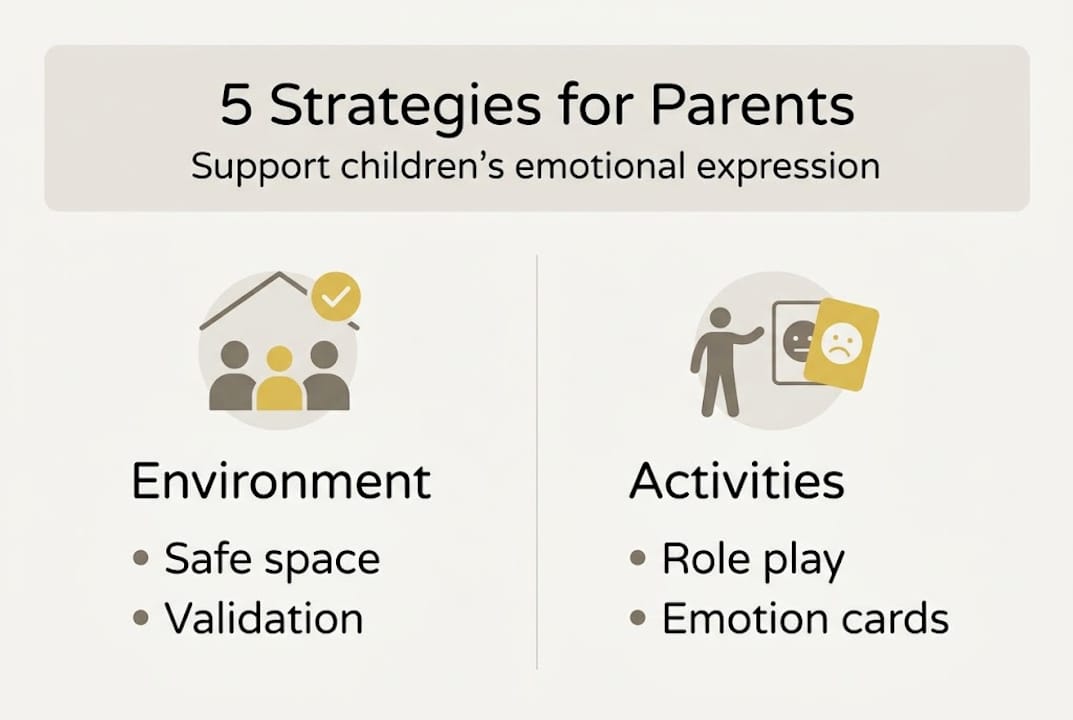
Pro Tip: Resist the urge to immediately fix a difficult emotion. When your child feels sad or angry, validation comes first. Saying “That sounds really hard” before offering solutions teaches your child that all feelings are acceptable, not just the easy ones.
The power of nature and creative play in emotional development
Building on these methods, nature and creativity offer unique avenues for expression.
Spending time outdoors does far more than simply burn off energy. Research consistently shows that nature play supports self-regulation in young children, with connection to nature acting as a mediating factor that reduces behavioural problems and enhances emotional control. This means that a child who regularly plays outside is likely better placed to manage big feelings than one who does not, even before any specific emotional coaching takes place.
Creative play works in a similar way. Painting, building, storytelling, and imaginative games give children a language for experiences they cannot yet put into words. Pairing these with nature multiplies the effect.
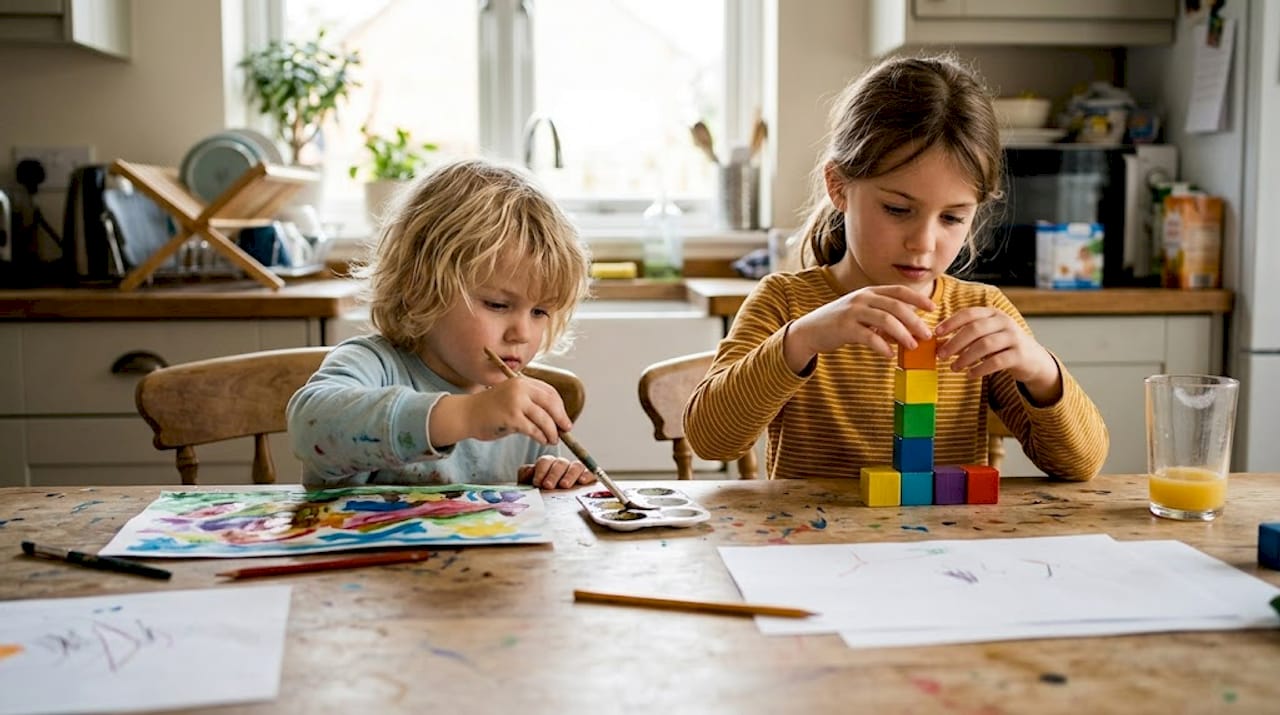
| Activity | Emotional outcome | Best age fit |
|---|---|---|
| Outdoor storytelling | Builds narrative emotional skills | 5 to 9 |
| Nature journalling or painting | Externalises inner feelings | 6 to 10 |
| Gardening together | Develops patience and calm | 4 to 8 |
| Guided nature walks | Encourages mindful observation | 4 to 10 |
| Collecting and sorting (leaves, stones) | Supports focus and self-soothing | 4 to 7 |
Here are five practical ways to bring nature and creativity together for emotional development:
- Storytelling walks: On an afternoon stroll, take turns inventing a story where the main character feels a big emotion and finds a way through it
- Feeling paintings: After being outdoors, ask your child to paint the colours of how they feel right now, with no right or wrong answer
- Gardening conversations: Weeding or planting creates a relaxed side-by-side atmosphere where children often open up without prompting
- Mood stones: Collect small stones on a walk and assign each one a feeling; revisit them at home to spark conversation
- Nature play therapy ideas and nature-based play guides can offer structured starting points if you want more direction
Pro Tip: The benefit of nature and creative play builds over time. Aim for regular short sessions rather than occasional long outings. Even fifteen minutes in a garden or park, three or four times a week, has measurable impact on children’s emotional wellbeing.
Adapting approaches: Neurodiversity, empathy, and challenges
For some children, especially those with unique needs or when empathy is a core focus, it is important to adapt approaches.
Not every child will respond to verbal conversations about feelings. For neurodivergent children, including those with autism, ADHD, or sensory processing differences, the path to emotional expression often runs through the body and the senses before it reaches words. Play therapy techniques such as sensory play and puppets are especially effective for supporting expression in neurodivergent children, offering a way to externalise feelings without requiring direct verbal communication.
Natural sensory play with materials like sand, water, clay, or leaves can serve the same purpose in everyday settings. The key is offering varied expressive routes and observing which ones your child gravitates towards.
Empathy, too, is not automatic. Children learn it by watching adults who genuinely practise it, and by being given structured opportunities to consider how others might feel. Activities like role-playing, reading books with a focus on character perspectives, and discussing animals’ needs during nature time all contribute meaningfully.
It is also worth noting that parents and teachers sometimes see different children. A child who holds everything together at school may fall apart at home, or vice versa. This is normal, but it can cause confusion. If you notice a gap between what teachers report and what you observe, consider these steps:
- Talk to your child’s teacher about specific situations that seem to trigger emotional difficulty, and agree on a shared language or signal the child can use
- Building empathy at home through consistent modelling bridges the gap between different environments
- Seek specialist support early if difficulties persist despite consistent effort; speech therapists, play therapists, and occupational therapists all work with emotional expression
Consistency matters more than perfection. Children thrive when the adults around them respond to emotions in a broadly predictable, accepting way, even if that does not mean perfectly every single time.
What most guides miss about children and emotions
Most articles on this subject present emotional development as a series of steps to follow carefully, giving the impression that if you do everything correctly, your child will simply become emotionally fluent. That picture does not match the reality of family life, and it leaves many parents feeling quietly inadequate.
The truth is that emotional literacy grows through thousands of small, imperfect moments, not through structured sessions or perfect responses. The day you are too tired to validate your child’s feelings thoughtfully and simply say “I hear you, that was hard” is still a good day. It still counts.
What works is not the occasional elaborate activity but the steady, repeated signal that feelings are safe in your home. A walk with no agenda. A moment noticing a bird together. A question asked without expectation of a particular answer. These ordinary things, done regularly, build something lasting. For more vivid, everyday inspiration, outdoor play ideas can help you make the most of even the simplest outdoor moments with your child.
Let go of the checklist. Lean into the routine.
Find more ideas and support
If you’re eager for even more inspiration and expert guidance, here’s where you can find it.
At The Zoofamily, we believe that the connection between children and the natural world is one of the most powerful forces in their development. That is why our cameras, binoculars, and walkie-talkies are designed to make every outdoor moment feel like an adventure worth noticing. And for every camera sold, we plant a tree.
Our nature-based connection guide is a great place to start if you want practical, playful ideas that weave emotional development naturally into your family’s everyday life. Whether you are just beginning or looking to deepen what you already do, you will find plenty of inspiration to keep the conversation going.
Frequently asked questions
What is the best way to start talking about feelings with my 5-year-old?
Begin by naming your own emotions aloud in everyday situations, then invite your child to do the same with open questions. Safe environments and modelling are consistently identified as the most effective starting points.
How can nature help my child deal with anger or sadness?
Spending time outdoors lowers stress and builds emotional self-regulation, creating the right internal conditions for processing difficult feelings. Nature play supports self-regulation and reduces behavioural problems over time.
What if my child refuses to talk about their emotions?
Try creative routes such as drawing, painting, or using puppets, and allow your child to come to expression in their own time. Sensory play and puppets are particularly effective for children who find direct conversation difficult.
How does emotional expression affect my child’s learning?
Children with stronger emotional regulation settle into school life more easily and perform better academically. SEL programmes improve academic achievement by 4.2 percentile points on average, and significantly more in longer programmes.
Recommended
- How photos teach empathy: nurturing caring kids – The Zoofamily
- How to Encourage Teamwork for Kids: Build Lifelong Skills – The Zoofamily
- Making Learning Fun: Engaging Activities for Your Kids – The Zoofamily
- Why Naming Your Feelings Helps — The Caia Journal