

TL;DR:
- Consistent responsiveness from infancy builds deep, lasting trust rooted in safety and reliability.
- Everyday actions like active listening and keeping promises foster secure parent-child relationships.
- Flexibility, humility, and repair are essential for maintaining and rebuilding trust over time.
Trust between a parent and child feels like it should be natural, something that simply grows alongside your child. But consistent responsiveness to your child’s needs, particularly from infancy, is actually the core mechanic behind building real, lasting trust. It does not happen on its own. Parents who understand this early gain a genuine edge in raising children who are emotionally resilient, empathetic, and confident. This guide walks you through the foundations of trust, the everyday habits that nurture it, how different parenting styles shape it, and what to do when things go wrong.
Table of Contents
- Understanding trust: foundations and why it matters
- The mechanics of building trust: everyday actions
- Parenting styles and their impact on trust
- Repair, rupture, and special situations: when trust is tested
- Our perspective: what most guides miss about trust with kids
- How The Zoofamily supports your parenting journey
- Frequently asked questions
Key Takeaways
| Point | Details |
|---|---|
| Consistency builds trust | Meeting needs reliably and responding with care helps children feel safe and strengthens relationships. |
| Authoritative approach works best | Warmth and clear boundaries lead to resilience, cooperation, and lasting trust compared to other parenting styles. |
| Repair after mistakes | Apologising and making amends when trust breaks models honesty and helps rebuild secure relationships. |
| Daily actions matter | Small, regular interactions—like quality time and active listening—have a bigger impact than one-off gestures. |
Understanding trust: foundations and why it matters
Trust in a parent-child relationship is not simply about your child believing you will keep your promises. It is a deep, felt sense of safety. It is your child knowing, at a gut level, that you will show up, respond, and care. This kind of trust begins forming in the very first weeks of life, long before your child can speak.
Bonding with your child is the foundation on which everything else is built. When you respond warmly and consistently to a baby’s cries, you are not spoiling them. You are teaching their nervous system that the world is safe and that people can be relied upon. This is called secure attachment, and its effects are far-reaching. Secure attachment from consistent care predicts better emotional regulation, empathy, and resilience well into adulthood.
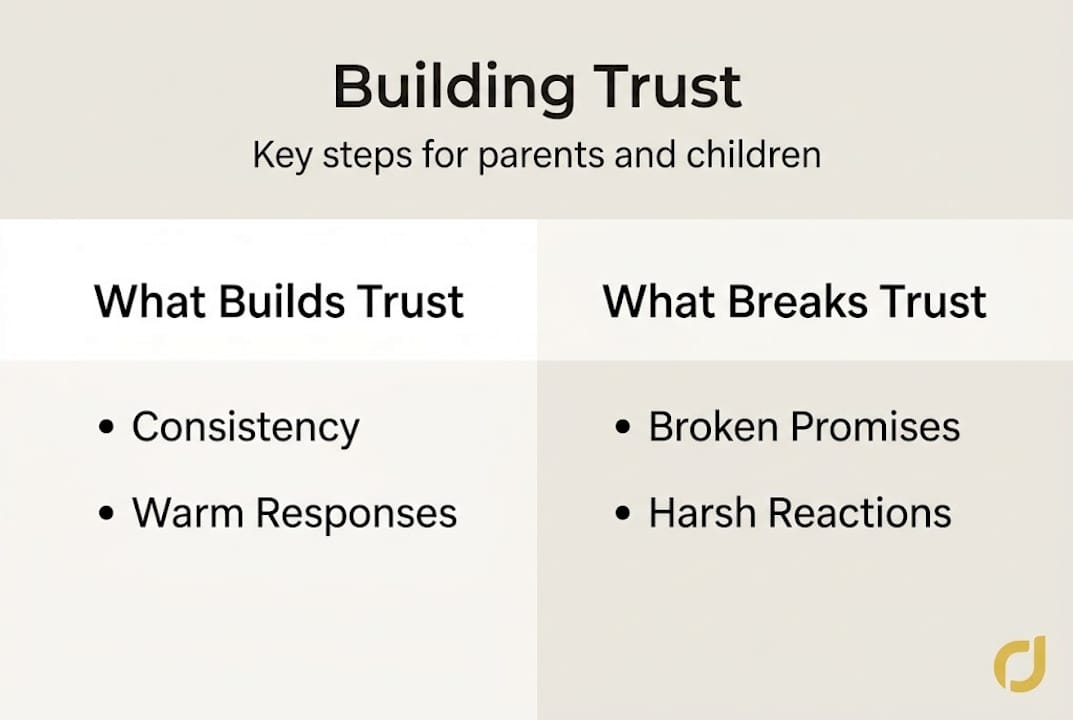
The parenting style you adopt also plays a significant role. Research consistently shows that authoritative parenting leads to healthier, more resilient children. Authoritative parenting combines genuine warmth with clear, consistent boundaries. It is not about being your child’s best friend, nor about strict control. It is about being a reliable, caring guide.
Here are the key markers that show trust is developing well in your child:
- They seek you out for comfort when upset or frightened
- They share their feelings and experiences with you freely
- They feel confident enough to explore new environments
- They ask for help rather than shutting down or acting out
- They accept your guidance without excessive resistance
The table below summarises how different levels of responsive caregiving shape outcomes for children:
| Parenting approach | Emotional outcomes | Social outcomes | Long-term resilience |
|---|---|---|---|
| Warm and consistent | Strong self-regulation | Healthy peer relationships | High |
| Warm but inconsistent | Anxiety, confusion | Moderate social skills | Moderate |
| Cold but consistent | Low self-worth | Compliance without warmth | Low to moderate |
| Cold and inconsistent | Poor regulation | Withdrawal or aggression | Low |
“Children who feel securely attached to a caregiver carry that sense of safety into every new relationship and challenge they face throughout their lives.”
Understanding this gives you a powerful reason to invest in trust now, not later.
The mechanics of building trust: everyday actions
Knowing that trust matters is one thing. Knowing what to actually do each day is another. The good news is that trust is built through small, repeated actions rather than grand gestures. Core trust-building mechanics include responsiveness, following through on promises, active listening, offering choices, and providing a safe, stable base.
Here are the five most effective daily habits for building trust with your child:
- Respond promptly to needs. Especially in the early years, quick and warm responses to distress teach your child that they matter and that you are reliable.
- Follow through on promises. If you say you will do something, do it. Children notice inconsistency far more than adults realise.
- Practise active listening. Let your child finish their sentences. Reflect back what they say. Avoid jumping straight to solutions or reassurances.
- Offer choices in daily routines. Giving your child small decisions, such as which top to wear or which book to read, builds their sense of agency and deepens their trust in you as a fair partner. You can find practical ideas for offering choices in daily routines that work well even with toddlers.
- Give quality time daily. Research points to 20 or more minutes of focused, undivided attention each day as a meaningful benchmark for connection.
The table below compares trust-building interactions with those that quietly erode it:
| Effective interaction | Ineffective interaction |
|---|---|
| Getting down to your child’s eye level | Talking at them from a distance |
| Acknowledging feelings before solving | Dismissing feelings with “you’re fine” |
| Keeping promises, even small ones | Cancelling plans without explanation |
| Allowing safe mistakes | Rescuing immediately to avoid discomfort |
| Celebrating effort, not just results | Only praising outcomes |
Pairing attuned responses with these habits creates a rhythm your child begins to depend on and feel safe within.

Pro Tip: Choose one non-negotiable daily connection ritual, whether that is a short walk, bedtime story, or a simple check-in question at dinner. Consistency matters far more than duration.
Parenting styles and their impact on trust
Your overall parenting approach shapes the environment in which trust either grows or struggles. Psychologists typically describe four main parenting styles, and their effects on trust are markedly different.
- Authoritative: Warm, responsive, and consistent with clear expectations. Children raised this way tend to be confident, emotionally regulated, and socially skilled.
- Authoritarian: High on control, low on warmth. Rules are enforced without much explanation. Children may comply but often lack internal motivation and struggle to trust their own feelings.
- Permissive: Warm but with few boundaries. Children feel loved but may lack the structure needed to feel truly secure.
- Uninvolved: Low warmth and low structure. This approach is associated with the weakest trust outcomes and the greatest emotional difficulties.
“Decades of research confirm that authoritative parenting, combining warmth with firm, fair boundaries, consistently produces the most trusting, resilient, and emotionally healthy children.”
Authoritative parenting outperforms all other approaches for building trust and resilience. The key is balance. Connection without limits leaves children feeling unmoored. Limits without connection feel punishing. Together, they create the conditions in which trust genuinely flourishes.
The encouraging truth is that parenting style is not fixed. You can shift your approach at any stage. A parent who has been overly authoritarian can begin introducing more warmth and explanation. A permissive parent can introduce gentle, consistent boundaries. Montessori parenting insights offer a useful framework here, emphasising respect for the child’s autonomy alongside clear, predictable structure.
Conscious Discipline is another well-researched approach that helps parents shift from reactive to intentional responses, which is particularly useful when you are trying to remodel trust after a period of difficulty.
Even small, consistent changes in how you respond to your child day to day can meaningfully reshape the trust between you over weeks and months.
Repair, rupture, and special situations: when trust is tested
No parent gets it right every time. You will lose your temper. You will break a promise. You will misread your child’s needs. This is not failure. What matters enormously is what happens next.
Repair is one of the most powerful tools in a parent’s repertoire. In fact, trauma-informed approaches prioritise safety and predictability, and they make clear that repair is crucial when trust is breached. Children who witness their parents acknowledge mistakes and make amends actually develop stronger trust than those whose parents never appear to err at all.
Here are the steps for repairing trust after a rupture:
- Calm yourself first. You cannot repair a relationship while still emotionally activated. Take a breath and wait until you are genuinely settled.
- Acknowledge what happened. Name it clearly and without minimising. “I shouted at you and that was not okay.”
- Apologise sincerely. Keep it simple and age-appropriate. Young children do not need lengthy explanations.
- Make a concrete repair. Offer a hug, spend time together, or do something your child enjoys.
- Recommit to consistency. Follow through on your next promise, however small, to begin rebuilding.
For children with trauma histories, neurodiversity, or particularly sensitive temperaments, predictability and co-regulation are even more important. Co-regulation means staying calm yourself so your child can borrow your steadiness. Gentle parenting approaches are especially well suited to these situations, prioritising the relationship above compliance.
Pro Tip: When apologising to a young child, get down to their level, use their name, and keep your words short. “I’m sorry I got cross, [name]. I love you.” That is enough.
Our perspective: what most guides miss about trust with kids
Most articles on building trust with children read like checklists. Follow these five steps. Use this script. Implement this routine. And while practical guidance genuinely helps, it can quietly suggest that trust is something you achieve and then maintain on autopilot.
At The Zoofamily, we see it differently. Trust is not a destination. It is a living, breathing quality of your relationship that shifts depending on stress, life changes, and your child’s developmental stage. What works beautifully at three may feel completely wrong at seven.
The parents who build the deepest trust are not the ones who follow every guideline perfectly. They are the ones who stay curious about their child, who can say “I got that wrong” without shame, and who keep showing up even after difficult days. Flexibility and humility, not perfection, are the real foundations.
“Real trust is built in small moments, lost in silence, and repaired with humility.”
Let go of the idea that you need a perfect script. Your child does not need a flawless parent. They need a present, honest, and genuinely engaged one.
How The Zoofamily supports your parenting journey
Building trust with your child is a daily practice, and having the right resources alongside you makes a real difference.

At The Zoofamily, we have brought together inspiration rooted in Montessori philosophy, attachment parenting, and gentle parenting principles, all designed to help you connect more deeply with your child. Whether you are looking for practical ideas, reassurance, or a community of like-minded parents, you will find it here. Explore our collection of gentle parenting advice and discover tools, articles, and products that support meaningful, nature-inspired connection with your child every single day.
Frequently asked questions
How can I tell if my child trusts me?
Trust shows when your child seeks comfort, shares feelings, and feels safe to explore or try new things around you. A trusting child will come to you with problems rather than hiding them.
Can you rebuild trust after making a mistake as a parent?
Yes, trust can absolutely be rebuilt. Repair is crucial after a rupture, and a sincere apology paired with renewed consistency is often enough to restore the connection.
Does trust-building differ for very young children aged 0 to 5?
For young children, responsiveness and routines are the most important factors. Consistent daily rhythms and quick, warm responses to needs build the secure base from which all later trust grows.
What role do routines play in trust-building?
Simple routines provide predictability for children, helping them feel secure and reinforcing their confidence that you will always be there. Predictability is one of the quietest but most powerful forms of trust.