

Infants develop motor skills in a predictable sequence, but the pace varies from child to child. The single most effective thing you can do today is give your baby regular, supervised floor time, including tummy time, every day. This one habit supports nearly every gross and fine motor milestone from birth through toddlerhood.
Start here — things you can do today:
- Place your baby on their tummy for short sessions after each nappy change (awake and supervised)
- Offer toys just out of reach to encourage rolling and reaching
- Vary your baby’s position throughout the day: on their back, side, and tummy
- Respond to their movements with eye contact, smiles, and simple sounds
- Keep floor play free from restrictive seats as much as possible
Milestones are time windows, not deadlines. Independent sitting typically appears between seven and nine months; both are within the typical range.
Table of Contents
- What are fine and gross motor skills?
- What motor milestones should you expect from birth to 36 months?
- Practical activities to build motor skills at every age
- How everyday routines support your baby’s development
- Common pitfalls to avoid when supporting motor development
- When should you contact your GP or health visitor?
- What happens after a referral to children’s therapy services?
- Key takeaways
- The part of infant development most parents overlook
- Simple toys that encourage your baby to move and explore
- Useful sources for further reading
What are fine and gross motor skills?
Motor skills are the controlled movements your baby makes using their muscles. They fall into two categories, and both matter for your child’s long-term independence.
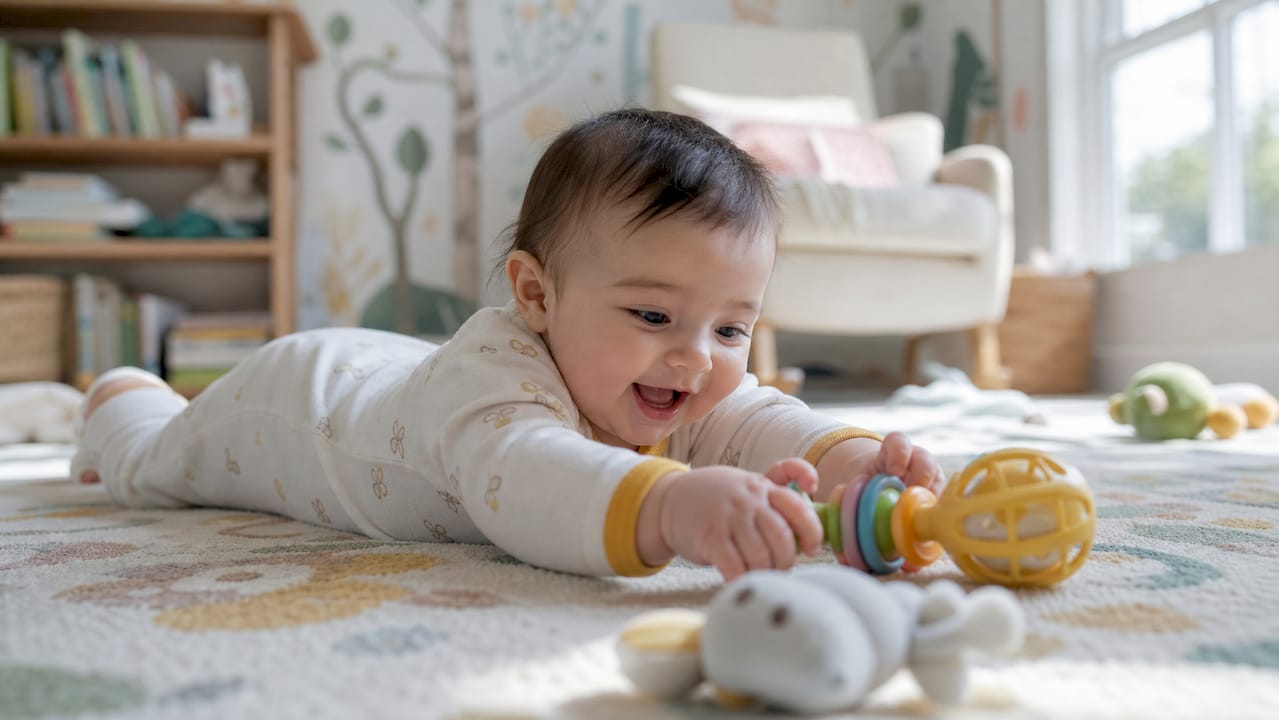
Fine motor skills involve the small muscles of the hands and fingers. Examples include grasping a rattle, picking up a piece of food, or eventually holding a crayon. Hand control develops from the outer (pinky) side of the hand inward toward the thumb, which is why babies rake objects before they can pinch them.
Gross motor skills involve the large muscles of the body — the arms, legs, and core. Crawling, rolling, pulling to stand, and walking are all gross motor skills.
The two types are closely linked. A baby who builds core strength through tummy time is also developing the stable base they need for precise hand movements. Motor development also connects to cognition and social interaction: reaching for a toy is both a physical act and an early problem-solving step.
- Fine motor skills: pincer grip, stacking blocks, self-feeding
- Gross motor skills: rolling, crawling, cruising along furniture, walking
What motor milestones should you expect from birth to 36 months?
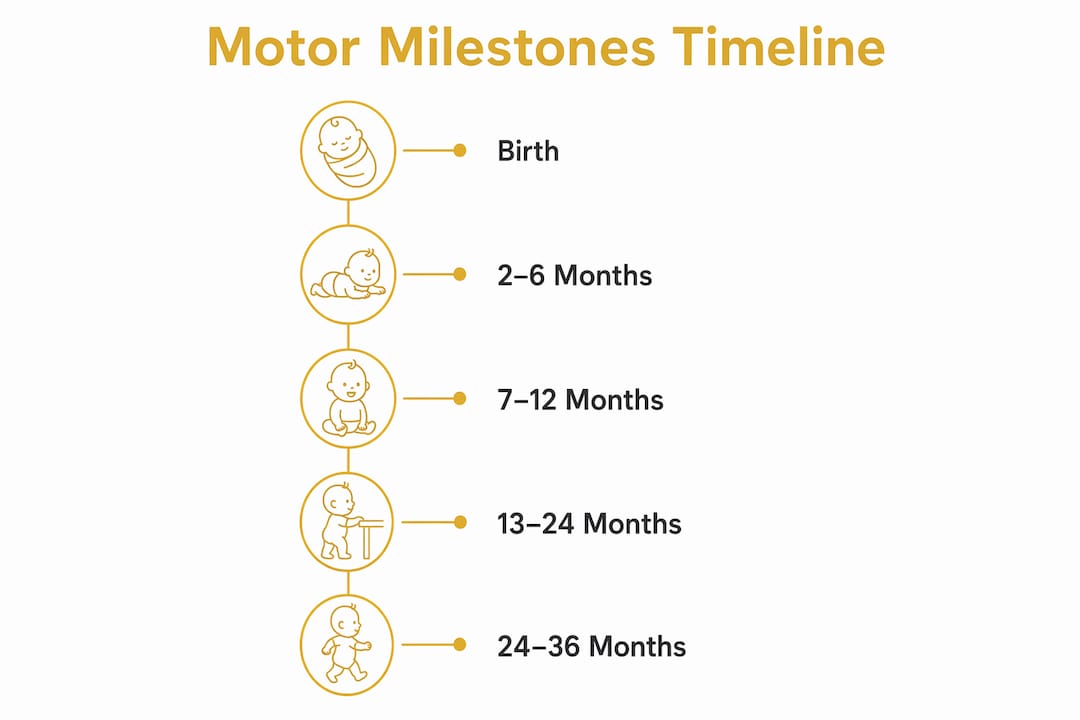
Paediatric guidance uses time windows rather than fixed ages. The ranges below reflect typical development; individual babies vary, and premature babies are assessed from their corrected age.
0–3 months
- Lifts head briefly when placed on tummy
- Turns head side to side
- Hands remain fisted most of the time; begins to open them
- Brings hands to face
3–6 months
- Pushes up onto forearms and then straight arms during tummy time
- Rolls from tummy to back (usually before back to tummy)
- Reaches for objects and bats at them
- Transfers objects from hand to hand begins toward the end of this period
6–9 months
- Rolls in both directions
- Sits with hand support (tripod sit) typically appears during the middle of the first year
- Begins to sit independently typically within a few months after developing supported sitting
- Raking grasp: sweeps objects toward the palm using all fingers
- Begins to bear weight on legs when supported standing
Pro Tip: Many parents expect their six-month-old to sit independently. Supported or tripod sitting at six months is entirely typical; independent, hands-free sitting usually appears between seven and nine months. If your baby consistently uses only one hand to reach at this stage, mention it to your health visitor — persistent one-sided reaching can be an early sign worth checking.
9–12 months
- Pulls to standing using furniture
- Cruises (walks sideways holding furniture)
- Pincer grasp develops later, when babies gain precise thumb and index finger control
- By around one year, many babies develop the ability to pick up small objects using the thumb and index finger
- Points with index finger
12–18 months
- Walks independently, typically sometime around the end of the first year and into the second year
- Stoops to pick up objects from the floor
- Stacks two or three blocks
- Uses a spoon with some spilling
- Scribbles with a crayon
18–24 months
- Walks up stairs with support
- Kicks a ball
- Runs, though with frequent falls
- Stacks four to six blocks
- Turns pages of a board book
24–36 months
- Jumps with both feet
- Walks up and down stairs alternating feet (with support)
- Throws and catches a large ball
- Draws simple lines and circles
- Begins to dress and undress with minimal help
Practical activities to build motor skills at every age
These activities require little or no equipment. Tummy time, reach-and-grasp games, and action songs are consistently recommended across authoritative sources. For more structured ideas, Thezoofamily’s activities for motor development guide offers additional age-by-age suggestions.
0–3 months
- Tummy time on a firm, flat surface for two to three minutes several times a day; build up gradually
- Hold a high-contrast toy 20–30 cm from their face and move it slowly to encourage head turning
- Skin-to-skin time on your chest counts as supported tummy time
3–6 months
- Place a toy just beyond reach during tummy time to encourage pushing up and rolling
- Offer a soft rattle or ring for them to grasp and transfer between hands
- Supported sitting in your lap with their hands free to explore
6–9 months
- Sit on the floor with your baby and roll a soft ball back and forth
- Place interesting objects on a low, firm surface to encourage pulling up onto knees
- Offer a range of textures: a wooden spoon, a soft cloth, a smooth plastic cup
9–12 months
- Cruising practice: arrange sturdy furniture with small gaps for them to navigate
- Stacking cups or soft blocks for grasp and release practice
- Finger foods of appropriate size (soft, dissolvable pieces) to practise the pincer grasp
12–18 months
- Push-along toys to support early walking confidence
- Low steps or a gentle slope in the garden for climbing practice
- Simple puzzles with large knobs to develop hand control
18–36 months
- Ball play: rolling, kicking, and throwing at a target
- Water play with cups and jugs for pouring (fine and gross motor combined)
- Drawing with chunky crayons; tearing and scrunching paper
Pro Tip: Household items often work better than commercial toys at this age. A set of plastic containers, a wooden spoon, and a cardboard box give babies more varied sensory and motor input than many purpose-built products. Nature-based materials — pine cones, smooth pebbles (supervised), leaves — add texture and curiosity.
Safety note: Avoid objects small enough to fit entirely in a young baby’s mouth. Always supervise floor play, and keep sessions short enough that your baby stays engaged rather than frustrated.
How everyday routines support your baby’s development
Daily interactions and social games are among the most powerful drivers of motor development. You do not need a structured session to make progress.
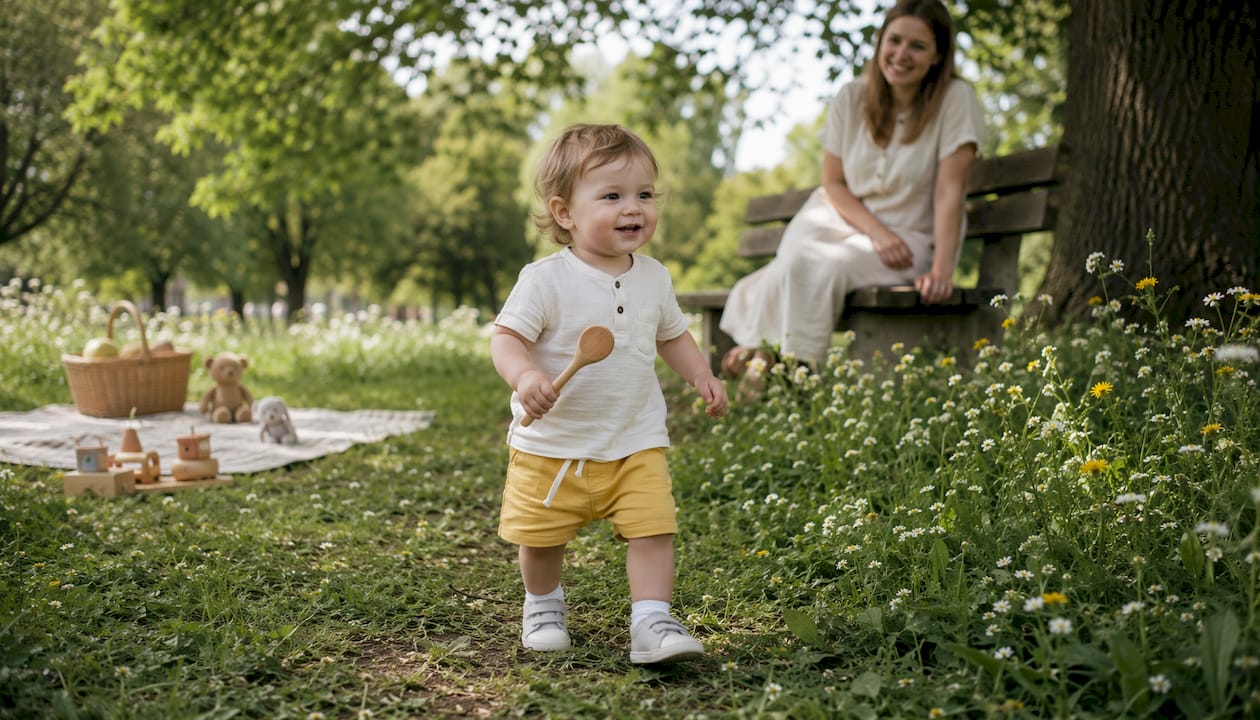
Nappy changes, mealtimes, and bath time all involve movement, handling, and position changes that build strength and coordination. Singing action songs (such as “Round and Round the Garden” or “Pat-a-Cake”) combines fine motor practice with social interaction. Carrying your baby in varied positions — upright, over your forearm, facing outward — gives their core and neck muscles different challenges throughout the day.
- Fold short tummy sessions into nappy-change routines rather than scheduling them separately
- Let your baby reach for the spoon during mealtimes rather than always directing it for them
- During dressing, pause and let them push an arm through a sleeve or pull off a sock
- Narrate what you are doing: language and movement develop together
Pro Tip: Your role is to set up the environment, not to coach every move. Babies learn motor skills most effectively through free exploration in a safe space. Resist the urge to steady every wobble — controlled falling and self-correction are how balance develops.
Common pitfalls to avoid when supporting motor development
Some well-meaning habits can slow progress. The most common ones involve restricting movement rather than encouraging it.
- Prolonged time in car seats, bouncers, or buggies limits the active positions that build strength. Evidence links greater time in prone and standing positions with more advanced motor outcomes; use restraining seats only when necessary for safety or transport.
- Baby walkers are not recommended by the NHS or most paediatric bodies. They allow movement without the muscle work that builds genuine walking ability, and they carry a significant injury risk.
- Forcing skills before readiness — propping a baby who cannot yet hold their head steady, for example — adds stress without benefit.
- Offering tiny objects too early is ineffective. The neuromuscular control for a pincer grip does not mature until around nine to twelve months; small objects before then are a choking risk with no developmental gain.
Simple safety checklist for floor play:
- Use a firm, flat surface (a play mat on a hard floor is better than a soft sofa cushion)
- Stay within arm’s reach during tummy time
- Check toys for loose parts before each session
- Keep the play area clear of cords, sharp edges, and small objects
Pro Tip: You do not need a dedicated play room. A cleared section of the living room floor, a blanket in the garden, or a mat in the kitchen all work. Varied surfaces — carpet, wood, grass — give different sensory feedback and challenge balance in useful ways. For ideas on setting up a low-cost outdoor space, Thezoofamily’s outdoor play area ideas offers practical, budget-friendly suggestions.
When should you contact your GP or health visitor?
Most variation in motor development is normal. Some signs, however, warrant a prompt conversation with your GP or health visitor rather than a wait-and-see approach.
Red flags to act on:
- Not rolling in either direction by six months
- Persistent head lag when gently pulled from lying to sitting after four months
- Consistently using only one hand to reach (before ten months, some preference is normal; persistent one-sidedness is not)
- Hands remain fisted most of the time beyond three months
- Loss of a skill your baby previously had (regression is always worth reporting)
- Persistent primitive reflexes beyond the expected age, or a thumb that is constantly tucked inside the fist (cortical thumb)
- Not walking independently by 18 months
Next steps in the UK: Contact your GP or health visitor and ask for a referral to your local Children’s Integrated Therapies service, which typically includes paediatric physiotherapy and occupational therapy. Many areas also accept self-referrals; check your local NHS trust’s website.
Pro Tip: Before your appointment, note the dates when you first noticed a concern and write down two or three specific examples. A short video clip of the movement in question — rolling, sitting, reaching — is particularly useful. Therapists often ask for exactly this because a brief, dated clip shows real-world behaviour more reliably than a single clinic observation.
What happens after a referral to children’s therapy services?
Knowing what to expect makes the process less daunting. Assessments in the UK typically follow a similar pattern across NHS and community paediatric services.
At the first appointment, the therapist will usually:
- Take a developmental history (pregnancy, birth, early milestones)
- Observe your baby moving freely on a mat
- Carry out standardised developmental checks appropriate for the age
- Conduct a brief physical examination (muscle tone, reflexes, range of movement)
Common early interventions include:
- A home programme of specific positioning and activity suggestions, reviewed at follow-up
- Parent coaching on how to handle and carry your baby to support development
- Advice on equipment (wedges, rolls) if needed for positioning
- Onward referral to a paediatrician if a medical cause is suspected
Bring any previous health records, your Red Book (Personal Child Health Record), and the video clips you have taken. Outcomes are usually reviewed at a follow-up appointment four to eight weeks later, with the programme adjusted based on progress.
Key takeaways
Floor-based play and tummy time, started from birth and built into daily routines, are the single most effective ways to support infant motor development across every milestone stage.
| Point | Details |
|---|---|
| Prioritise floor time | Daily tummy time and varied floor positions build the strength behind every major milestone. |
| Milestones are time windows | Independent sitting typically appears between seven and nine months; do not use six months as a strict deadline. |
| Watch for asymmetry | Persistent one-sided reaching or fisting beyond three months is worth reporting to your health visitor. |
| Use everyday routines | Nappy changes, mealtimes, and action songs all count as motor practice — no extra sessions needed. |
| Thezoofamily for play ideas | Thezoofamily’s nature-inspired toys and guides support exploratory play as a complement to daily floor time. |
The part of infant development most parents overlook
There is a tendency to treat motor milestones as a checklist — a set of boxes to tick by a certain date. That framing creates unnecessary anxiety and, more practically, it misses the point of how development actually works.
The research is consistent: babies do not learn to roll, sit, or walk because a parent drilled them. They learn because they were given a safe space, interesting things to reach for, and a caregiver who responded when they tried. The environment does most of the work. A baby who spends two hours a day on a firm floor with a few simple objects will, in most cases, outpace one who spends those same hours in a bouncer with a screen in front of them — not because the floor is magic, but because it demands something of them.
What parents often underestimate is how much ordinary daily life already provides. The nappy change, the bath, the meal, the walk in the sling — these are not gaps between development. They are development. The structured “motor activity” is the supplement, not the foundation.
Thezoofamily’s approach — encouraging curiosity, nature-based play, and simple tools that prompt children to look, reach, and explore — fits this picture well. A pair of child-sized binoculars or a simple camera does not teach a child to walk. But it gives them a reason to move, to look more carefully, and to engage with the world around them. That motivation is where motor learning actually begins.
Simple toys that encourage your baby to move and explore
Thezoofamily designs tools that give children a reason to reach, look, and move. A child-sized camera prompts a toddler to crouch, turn, and frame a shot. A pair of binoculars encourages them to scan, focus, and walk toward what interests them. These are not substitutes for floor time or caregiver interaction — the free activities in this guide come first. But as your child moves into toddlerhood, a simple, nature-focused toy can add a new layer of motivation to get up and explore.
Thezoofamily plants one tree for every camera sold, so your purchase supports both your child’s development and the natural world they are learning to notice. Browse the full range at thezoofamily.com and find the right starting point for your child’s age and interests.
Useful sources for further reading
The following authoritative sources are recommended for parents who want to read further. Your GP or health visitor remains the first point of contact for any specific concern about your child.
- CDC “Learn the Signs. Act Early.” — Milestones by 6 Months: practical milestone checklists with activity tips
- Oxford Health NHS Foundation Trust — Gross Motor Skills (Babies and Toddlers): NHS-produced guidance from a Children’s Integrated Therapies service
- Buckinghamshire Healthcare NHS Trust — Development Guide from Birth to 18 Months: age-by-age developmental reference from an NHS Foundation Trust
- BBC Tiny Happy People — What are motor skills and how does my baby develop them?: accessible, evidence-informed overview for parents
- Physio-pedia — Gross Motor Milestones in Infants 0–14 Months: clinical reference on milestone ranges and influencing factors
- MyHealth Alberta — Fine Motor Development: 6 to 12 Months: detailed fine motor progression for the six-to-twelve-month period
This article is general information for parents and caregivers, not professional medical advice. If you have concerns about your child’s development, contact your GP, health visitor, or local children’s therapy service for guidance specific to your child’s situation.