

TL;DR:
- Encouraging children’s questions fosters cognitive, language, and emotional development, especially for those with less background knowledge.
- Using open-ended questions during everyday interactions and outdoor activities nurtures curiosity and critical thinking.
- Creating a safe, enthusiastic environment for questions helps children build confidence and lifelong inquisitiveness.
How encouraging questions in kids builds curiosity and learning
Many parents assume curiosity is simply part of a child’s personality: either they have it or they don’t. But the truth is more surprising and more hopeful. Curiosity can be actively nurtured, and the way adults respond to children’s questions plays a huge role in whether that questioning spirit grows or quietly fades. Encouraging question-asking increases children’s valuation of new information, with even greater benefits for children who start with less prior knowledge. This article gives you practical, research-backed strategies and activity ideas to turn everyday moments into curiosity-building opportunities.
Table of Contents
- Why encouraging questions matters for children’s development
- Unlocking curiosity with everyday conversations
- Nature and creative activities as curiosity engines
- Overcoming common barriers and building confidence
- Why nurturing children’s questions matters more than ever
- Discover more ways to nurture curiosity
- Frequently asked questions
Key Takeaways
| Point | Details |
|---|---|
| Curiosity can be nurtured | Children’s question-asking thrives when parents engage and model curiosity. |
| Open-ended questions work best | Asking children thoughtful, open questions fosters deeper engagement and learning. |
| Nature and play fuel inquiry | Outdoor and creative activities provide rich prompts for children to ask more questions. |
| All children benefit | Even kids with little background knowledge make big gains when encouraged to ask questions. |
| Setbacks are normal | Obstacles are common, but small shifts in approach can rekindle curiosity at home. |
Why encouraging questions matters for children’s development
Having introduced the value of curiosity, let’s explore why encouraging questions makes such a remarkable difference to how children learn and grow.
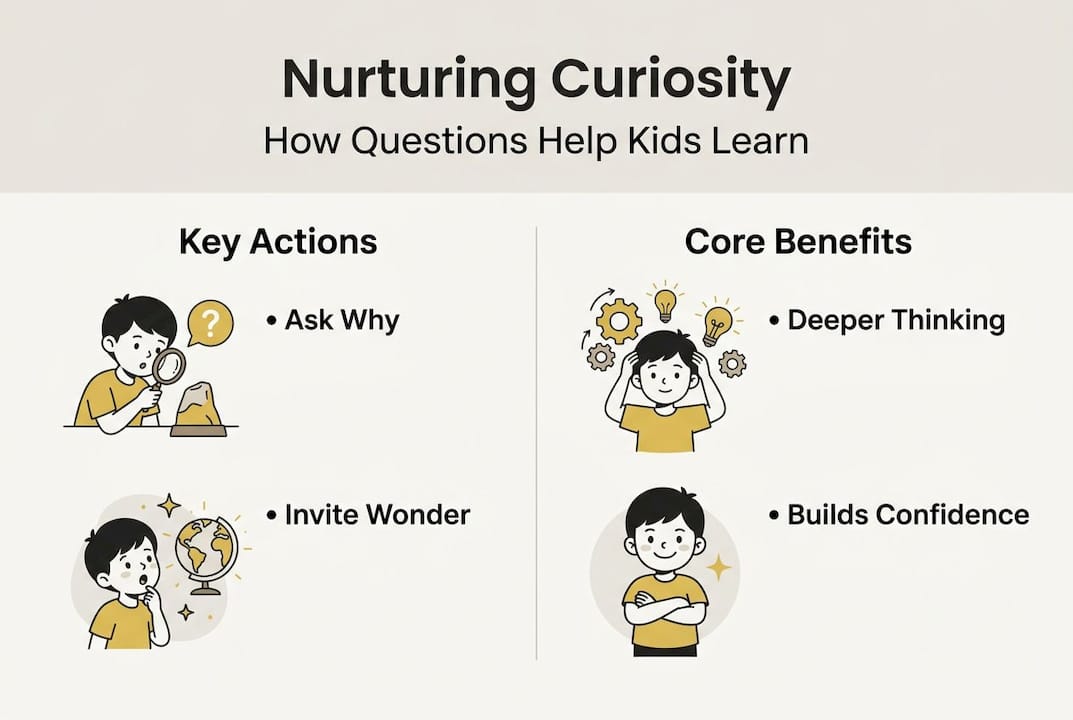
When a child asks “Why is the sky blue?” or “What happens to a caterpillar inside its cocoon?”, something powerful is happening in their brain. They are not simply seeking information. They are building the mental habit of noticing what they don’t yet understand, which is the foundation of all genuine learning. Research consistently shows that children who regularly practise asking questions develop stronger problem-solving skills, richer vocabulary, and greater confidence in social settings.
One of the most encouraging findings from recent research is that the children who benefit most are not the ones who already know the most. Children with low background knowledge benefit most from question-asking practice, directly countering the “Matthew Effect” idea that only the already-advantaged get richer in learning. This means that for children who feel behind, or who come from homes with fewer educational resources, actively practising question-asking can be genuinely transformative.
“Questions are the engine of understanding. A child who feels safe asking is a child who never stops learning.”
The developmental gains from question-asking span several areas:
- Cognitive growth: Children who ask questions regularly build stronger reasoning and critical thinking skills because they are constantly making connections between new and existing knowledge.
- Language development: Forming and articulating a question requires children to organise their thoughts clearly, which strengthens vocabulary and sentence structure.
- Emotional confidence: When adults take children’s questions seriously, children learn that their curiosity has value, which builds self-esteem and a willingness to take intellectual risks.
- Motivation to learn: Children who know their questions will be welcomed are far more likely to engage actively in lessons and conversations rather than sitting passively.
| Developmental area | Impact of active question-asking | Benefit for children with less prior knowledge |
|---|---|---|
| Problem-solving | High improvement | Very high improvement |
| Language skills | Moderate to high | Moderate improvement |
| Confidence | Significant boost | Significant boost |
| Motivation to learn | High improvement | Very high improvement |
Exploring inspiring curiosity in children through consistent everyday habits is one of the simplest and most powerful things a parent can do. The habit doesn’t require specialist knowledge or expensive resources. It requires presence, patience, and a genuine interest in what your child is wondering about.
Unlocking curiosity with everyday conversations
Knowing the importance, what can you do at home to nurture these question-asking skills? The good news is that ordinary daily interactions are already full of opportunity.
One of the most impactful shifts you can make is moving from closed to open-ended questions. A closed question has one correct answer and shuts conversation down. An open-ended question invites exploration and can go anywhere.
Consider the difference in these two exchanges after school:
Closed version: Parent: “Did you have a good day?” Child: “Yes.”
Open version: Parent: “What’s something that confused you today?” Child: “Well, we were doing maths and I didn’t understand why you need to carry the number…”
Open-ended questions like “What’s something that confused you today?” directly activate curiosity and are linked to better learning outcomes compared to vague questions like “How was school?”. The confusion your child shares becomes a doorway for discussion, investigation, and growth.
You can weave this approach into the fabric of each day:
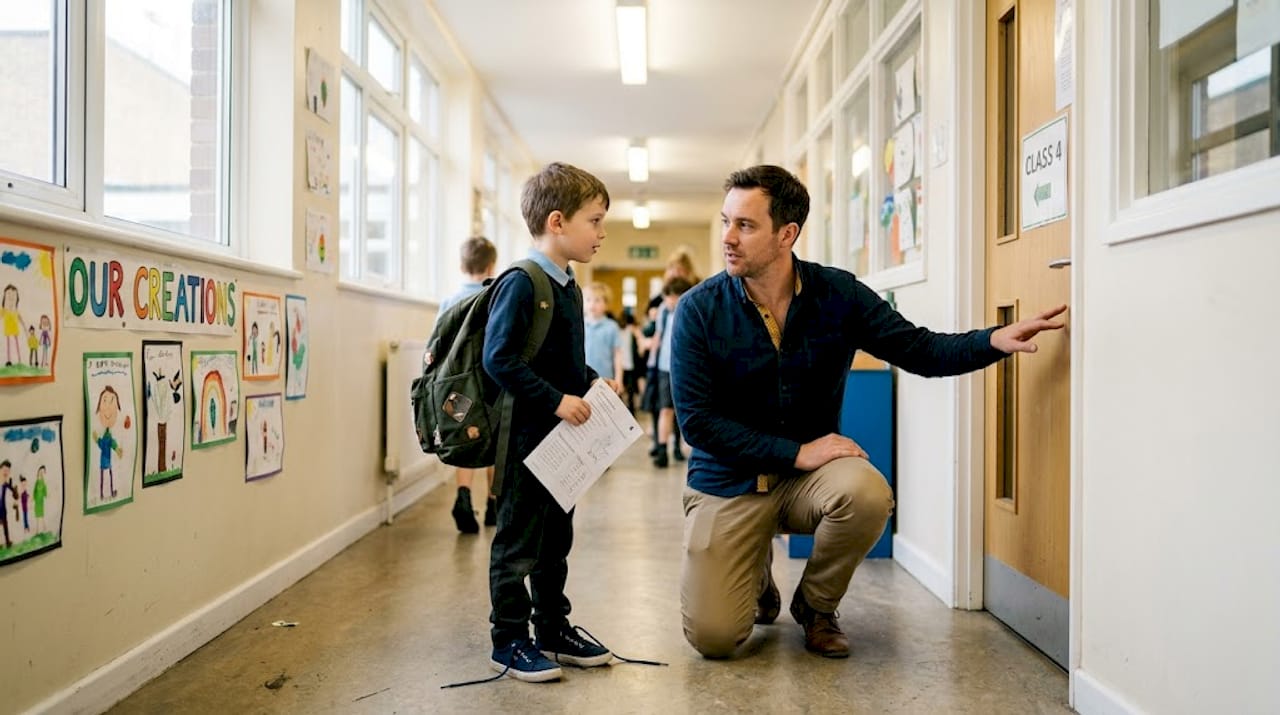
- At school pick-up: Instead of “Was it fun?”, try “What made you laugh today?” or “What question popped into your head during class that you didn’t get to ask?”
- At meal times: Share something you yourself wondered about during the day. When children see adults asking questions genuinely, they understand that curiosity is a lifelong trait, not just something for school.
- During bedtime stories: Pause and ask “What do you think will happen next?” or “Why do you think the character did that?”. These moments train the habit of anticipating and questioning narratives.
- While travelling: Whether on the bus or a long car journey, point out something unusual and say “I wonder why that is” rather than immediately explaining. Let your child sit with the question.
“Curiosity doesn’t need a classroom. It grows in kitchens, car parks, and garden corners.”
Pro Tip: Use “I wonder” statements regularly throughout your day. Saying “I wonder why those clouds are that shape” or “I wonder what that bird is eating” is a powerful modelling technique. Children learn to question the world around them by watching the adults they trust do exactly that.
When children feel their questions are welcomed rather than dismissed with a quick answer or a distracted “not now”, they build the habit of noticing and wondering. And that habit, once formed, tends to stick. Exploring natural curiosity in children is something that can be supported by even the smallest daily changes in how you communicate.
Nature and creative activities as curiosity engines
Conversations lay the ground, but activities outdoors or with hands-on creativity truly supercharge questioning. There is something about being in nature or creating with your hands that consistently prompts children to ask questions that would never come up in a living room.
The reason is simple: new environments and unfamiliar materials produce genuine surprise. And surprise is the gateway to a real question. A child who picks up a piece of bark and finds woodlice underneath is not going to stay quiet. They are going to ask where the woodlice go in winter, why they curl up, and whether they feel pain. These are not trivial questions. They are the start of scientific thinking.
Teachers’ self-efficacy beliefs in their own inquiry practices positively correlate with children’s gains in inquiry skills, which means the more confidently adults guide curiosity-driven activities, the more children benefit. As a parent, you don’t need to be a scientist. You just need to believe that the exploration matters.
| Activity | Questions it naturally prompts | Age range |
|---|---|---|
| Nature walk with magnifying glass | What is this insect? Why do leaves have patterns? | 3 to 10 years |
| Garden planting experiment | Why does one plant grow faster? What does a root do? | 4 to 10 years |
| Creative craft with natural materials | How did this stone get this shape? What is bark made of? | 3 to 8 years |
| Puddle and rain observation | Where does rain come from? Why are puddles different sizes? | 2 to 7 years |
| Bird watching with binoculars | What is that bird called? Why do birds sing? | 5 to 12 years |
Try this step-by-step curiosity walk to get started:
- Choose a local green space, even a small park or garden, and visit at the same time each week.
- Give your child a small notebook and pencil. Ask them to draw or write one thing they notice that surprises them.
- When they point something out, resist the urge to explain immediately. Ask “What do you think?” first.
- After the walk, spend five minutes looking up one of their questions together, either in a book or online.
- On the next visit, remind them of last week’s discovery and ask if they’ve seen anything similar since.
Pro Tip: Let your child lead the exploration entirely. Follow their pace, follow their gaze, and follow their questions. When the adult stops directing and starts responding, the quality and quantity of children’s questions goes up noticeably.
For more structured ideas, check out these outdoor science activities or browse a broader set of nature play ideas that are specifically designed to spark questioning and wonder in children.
Overcoming common barriers and building confidence
Even with the best intentions, obstacles can arise. Here’s how to move beyond them without feeling like you’re failing as a parent.
The most common barrier parents name is this: “I’m afraid of not knowing the answer.” There’s a belief that admitting ignorance in front of your child somehow undermines your authority or damages their trust. In reality, the opposite is true. When you say “I don’t know, let’s find out together”, you show your child that not-knowing is safe, that learning is ongoing, and that no one has all the answers. That is one of the most valuable lessons a parent can pass on.
Another common myth is that question-asking takes too much time. But encouraging children to ask questions increases their valuation of new information, and even brief moments of genuine inquiry during the day can create lasting cognitive benefits. It isn’t about carving out an extra hour. It’s about making the existing moments richer.
A third barrier is the child’s own hesitation. Some children, particularly those who have been corrected harshly or made to feel foolish for asking, become reluctant questioners. Building a safe environment for questions is essential. Try these confidence-building routines:
- Celebrate questions openly: When your child asks something, respond with genuine enthusiasm. “Oh, what a great thing to wonder about!” signals that questions are welcome.
- Create a ‘wonder jar’: Place a jar on the kitchen table where family members drop in written questions during the week. Explore one together each Friday evening.
- Model being wrong: Share times when your own assumptions were proved incorrect. “I used to think butterflies only lived for a day, but I was wrong about that.”
- Avoid rushing to answer: Count silently to five before responding to a question. This pause signals that you’re taking the question seriously and gives your child space to develop their own thinking.
- Acknowledge partial answers: If your child offers a half-right guess, build on it rather than correcting it outright. “You’re close, what else might be going on?”
Exploring nature challenges for curiosity can also help children who feel hesitant, because structured activities give them a natural prompt to ask within a low-pressure context.
| Common barrier | Myth | Practical reframe |
|---|---|---|
| Not knowing the answer | Adults must know everything | “I don’t know” is a great start to learning together |
| Not enough time | Curiosity needs long sessions | Short, genuine moments beat long unfocused ones |
| Child won’t ask questions | Some children aren’t curious | All children are curious; safety and invitation matter most |
| Questions derail learning | Questions are a distraction | Questions ARE the learning, not a detour from it |
Why nurturing children’s questions matters more than ever
Stepping back, why does this matter so much in our modern world? At The Zoofamily, we think about this constantly.
Children today are growing up in an environment that quietly discourages deep questioning. Schedules are packed, screens offer instant answers before a question can fully form, and the pressure to perform academically often rewards children who give right answers rather than children who ask bold questions. The result is a slow erosion of something precious.
We believe that keeping a child’s questions alive is a genuinely radical act of parenting. It runs counter to the pace and logic of much of modern life. And it pays off in ways that are hard to measure but impossible to miss: a child who notices things, who wonders aloud, who isn’t afraid to say “I don’t understand” is a child who is building the inner resources to navigate an uncertain world.
Exploring nature connections and curiosity has taught us that the best moments of learning rarely start with an adult’s plan. They start with a child pointing at something on the ground and asking a question nobody expected. Your job is not to have the answer. Your job is to make sure that question gets asked in the first place.
Discover more ways to nurture curiosity
At The Zoofamily, we believe every child is born with a powerful instinct to wonder, and our mission is to keep that instinct alive and growing. Whether it’s through our animal-inspired kids’ cameras that help children document their discoveries, our binoculars perfect for spotting birds and insects, or our nature-focused guides and activity ideas, everything we create is designed to make curiosity feel like an adventure.
If you’re ready to bring more wonder into your child’s world, visit The Zoofamily to explore our full range of resources, activity guides, and nature-inspired tools designed specifically for curious young minds. Every camera sold helps us plant a tree, because the natural world your child is learning to question is worth protecting.
Frequently asked questions
What type of questions best encourage curiosity in children?
Open-ended questions such as “What surprised you today?” or “Why do you think that happened?” stimulate deeper thinking and invite children to explore rather than simply recall facts.
How should I respond if my child asks something I can’t answer?
Admit you don’t know and suggest finding the answer together. This models lifelong learning and shows your child that curiosity doesn’t stop just because you’re a grown-up.
Do children with less background knowledge benefit from asking questions?
Research shows that question-asking especially boosts children with less prior knowledge, helping to close early learning gaps and counter the assumption that only well-prepared children benefit.
Can nature activities really make a difference in getting kids to ask questions?
Yes. Outdoor activities expose children to new sights, textures, and behaviours that prompt genuine surprise, and genuine surprise is what produces the most authentic and enthusiastic questions.