

Short, hands-on games using found materials like sticks, stones and leaves teach counting, shape recognition and measurement more reliably than worksheets ever will. The strongest outdoor sessions cover number sense, pattern spotting and simple comparison, and most need nothing more than a 10 to 20 minute slot and whatever the garden or park already offers.
TL;DR:
- Outdoor math activities rely on simple natural materials like stones, leaves, and pinecones that support counting, patterning, and comparison without extra equipment.
- Short sessions of 10 to 20 minutes using found objects can effectively reinforce math concepts across different age groups, with repetition and variation aiding retention.
- Facilitators should focus on child-led play with minimal prompts, emphasizing vocabulary building and natural recording methods like photos and tally sheets.
- Adding basic tools like a camera or binoculars can enrich activities by supporting observation, estimation, and data collection, often with eco-friendly platforms.
- Seasonal changes influence available materials and session length, but core activities remain consistent, promoting ongoing outdoor engagement and learning.
Table of Contents
- Early years maths activities outdoors that work in any garden or yard
- Materials and simple tools: what to gather and keep low-cost
- What to say: adult prompts that deepen the learning
- Recording, extending and involving families
- Nature-focused tools that can enrich a session
- Using stories to make the maths stick
- How the seasons change what’s on offer
- Practitioner perspective: why outdoor maths sticks
- Want to add a few nature-themed tools? Here’s an honest look
- Practitioner resources worth bookmarking
- Sources
- FAQ
Early years maths activities outdoors that work in any garden or yard
Every activity below fits a short session and needs almost nothing beyond loose parts already lying around outside. Run them in order of complexity, or dip in wherever suits the group’s age and confidence.
- Number hunts and loose-parts counting. Give each child a numeral card or a small tray divided into sections, then send them off to collect that many stones, leaves or twigs. For four-year-olds, keep the target number below five and count together out loud; for older fours and fives, ask them to find a matching set for two different numbers and compare which pile has more. Outdoor maths activities built around natural materials like these consistently reinforce one-to-one correspondence better than counting plastic counters indoors.
- Keep sessions short for younger children; older five-year-olds can sustain a longer session if the activity has a clear goal.
- Rotate activity type daily so counting, measuring and pattern work all get covered across a week.
- Let children repeat a favourite activity. Repetition with small variation is where the maths concept actually settles.
Pro Tip: Keep one activity “unfinished” at the end of the session, such as a half-sorted pile of stones. Children often return to it unprompted the next day, which gives you a natural way to check what they remembered.
Materials and simple tools: what to gather and keep low-cost
You don’t need a shopping list, just a box. Sticks and stones support one-to-one counting and simple addition; leaves and pinecones work well for sorting by size or texture; pebbles are ideal for pattern-making because they hold their arrangement without rolling away. Practical outdoor maths tools such as buckets, scales and measuring cups turn a mud kitchen into a genuine capacity and comparison station.
- Found materials: sticks, stones, leaves, pinecones, acorns, seed pods.
- Low-cost tools: chalk, buckets, measuring spoons, yoghurt pots, a simple balance scale.
- Storage: labelled trays or loose-parts baskets, sorted by type, stored somewhere that drains easily after rain.
- Safety and inclusion: waterproof clothing or spare wellies, hand-washing after mud kitchen play, sun cream and shade in warmer months, and insect checks if children are handling leaf litter or log piles.
Pro Tip: A muffin tray or old ice cube tray makes a free sorting tool. Each cup becomes a “category,” which is a simple way to introduce data collection to three-year-olds without ever using that word.
What to say: adult prompts that deepen the learning
Outdoor maths works best as child-led play with light adult scaffolding rather than a taught lesson. Practitioner guidance from Stanford’s DREME Family Math project recommends prompting and modelling vocabulary instead of directing the activity outright.
- “How many more do we need to make five?”
- “How could we share these stones equally between the two of you?”
- “Which stick is longer? How do you know?”
- Model recording out loud: “I’m going to draw a tally mark for every leaf we find.”
- Watch for a child-led idea worth extending. If a child starts stacking pinecones by size unprompted, that’s the moment to introduce “biggest” and “smallest” rather than redirecting them.
- Build vocabulary naturally: more/less, heavier/lighter, longer/shorter, full/empty.
Minimal, well-labelled prompts, such as a five-frame drawn on a clipboard, let children record independently once they know the routine, rather than needing an adult to prompt every single time.
Recording, extending and involving families
A photo with a caption (“6 conkers found near the oak tree”) or a simple tally sheet gives enough evidence without interrupting play, and a quoted comment from the child adds context for later assessment.
- Record with: photographs plus captions, tally marks, short child quotes.
- Extend with: a pattern collection built over a week, measuring plant growth with sticks over a month, or a mini class survey (“How many of us found a snail today?”).
- Mixed-ability groups: give younger children a lower counting target within the same activity rather than a separate task, so everyone works from the same materials.
- At home: suggest families count steps to the shop, sort recycling by size, or measure garden plants with a stick, all of which mirror everyday domestic routines that make maths feel ordinary rather than extra.
Nature-focused tools that can enrich a session
None of the activities above need equipment beyond what’s already outside, but a few simple tools can add a layer of observation and record-keeping for children who enjoy that extra step.
- A child-friendly camera lets a group build a photo tally of collected leaves or shapes spotted on a walk, turning the count into something they can revisit later.
- Binoculars support distance counting, such as “how many birds landed on the fence in a minute,” which introduces estimation without any pressure to be exact.
- Walkie-talkies work well for team-scored games, where one group calls out a running total to another across the garden, adding a communication layer to a scoring activity.
Certain products are designed with animal references to draw children’s attention to the natural world, and some companies plant a tree for every camera sold.
Using stories to make the maths stick
A story gives a maths concept a reason to exist, which is often what’s missing from a straight counting drill. “The Three Little Pigs” becomes a comparison exercise once you ask which house needed more sticks. A story about a hungry fox travelling between three ponds becomes a distance and estimation task once children act it out with stick-lengths marking the route between “ponds” drawn in chalk.
Seasonal or nature-themed tales work particularly well outdoors because the setting is already in front of the child. Read a short passage about a squirrel collecting acorns for winter, then send the group off to collect and count their own “acorn store,” comparing who gathered the most. A tale about a snail’s slow journey across the garden turns into a measurement task: how many stick-lengths does the snail travel in the story, and how does that compare with a child’s own stride?
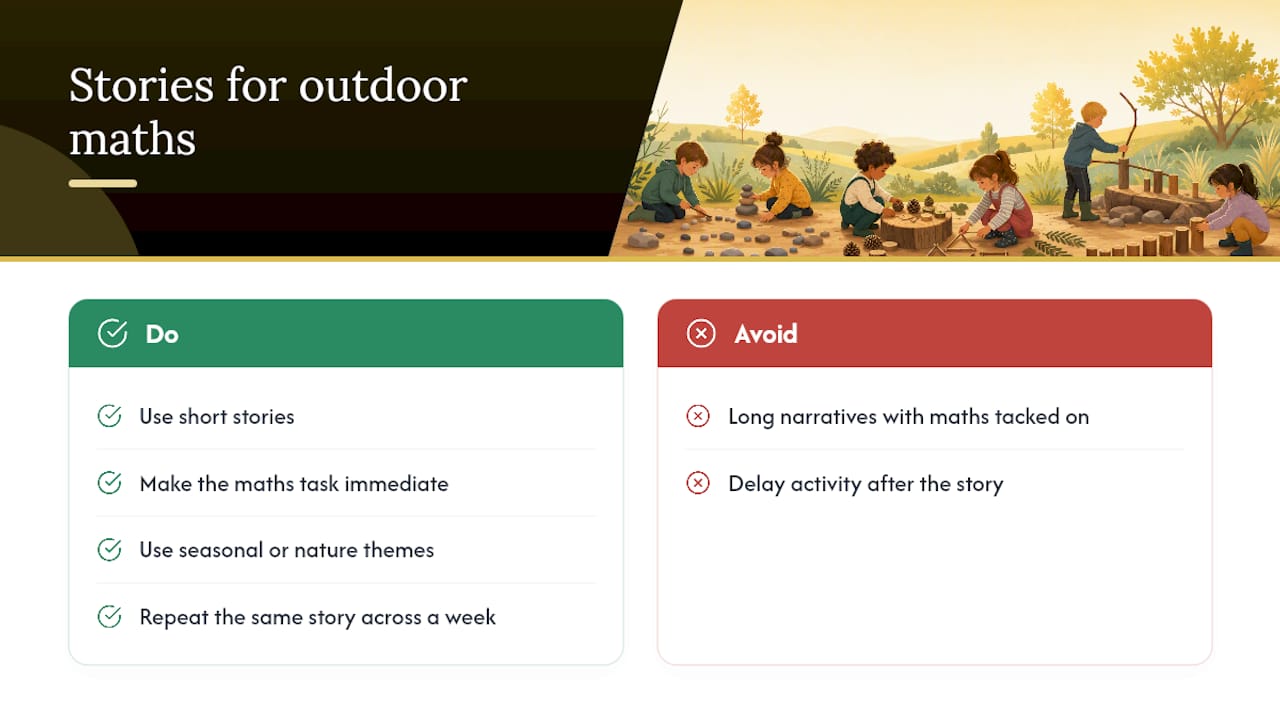
The trick is keeping the story short and the maths task immediate. A five-minute tale followed by a ten-minute activity holds attention far better than a long narrative with a maths task tacked on at the end. Repeating the same story across a week, with a slightly different maths challenge each time, also helps children build confidence with a concept before it’s dropped for something new.
How the seasons change what’s on offer
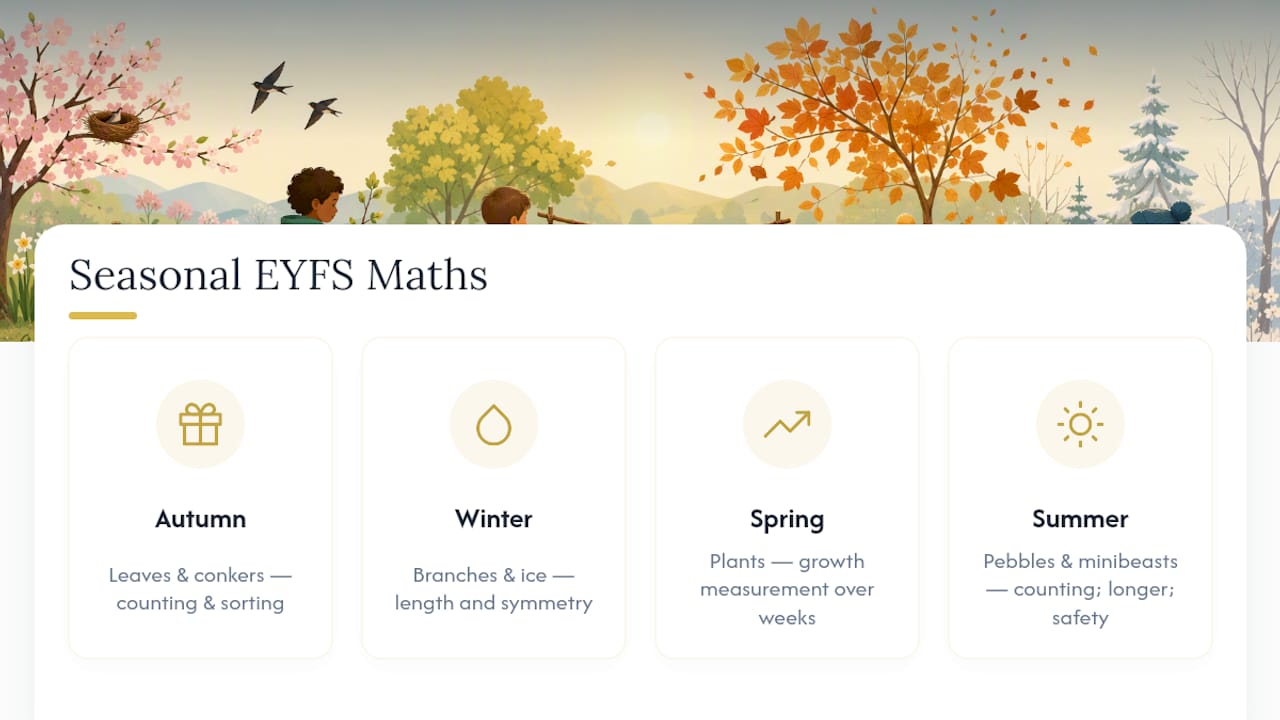
Autumn is arguably the richest season for this kind of maths. Fallen leaves, conkers, acorns and pinecones arrive in enormous, freely available quantities, which makes counting, sorting and pattern activities almost effortless to set up.
Winter narrows the material pool but doesn’t close it down. Bare branches are excellent for length comparison and stick-based measurement, and if you get a frost, ice patterns on puddles offer a genuine, if brief, lesson in symmetry and pattern. Cold weather does mean shorter sessions and warmer layers, so plan for a tighter time slot.
Spring brings growth measurement into play. Tracking a planted seed or a patch of daffodils with a stick-length ruler over several weeks turns a single activity into an ongoing project, and children get to see their own measurements change over time. Blossom and early insects also add fresh material for counting and sorting tasks.
Summer offers the longest outdoor sessions and the widest range of loose parts, from pebbles on a beach to garden minibeasts, but it also demands the most safety planning, including shade, hydration and sun cream, since sessions often run longer simply because the weather allows it.
Whatever the season, the core activities barely change. What changes is the material on offer and the length of time you can comfortably keep a group outside.
Practitioner perspective: why outdoor maths sticks
Children pay attention to maths outdoors precisely because nobody’s told them it’s a maths lesson. That mix of movement, curiosity and low stakes builds a far more positive attitude to numbers than a table-top task ever manages. Pick one activity from this list, run it this week, and simply note what the children noticed. That’s the whole method.
— ALAIN
Want to add a few nature-themed tools? Here’s an honest look
Every activity in this article works with nothing more than sticks, stones and a bit of chalk. None of it requires buying anything, and that’s worth saying plainly before any product gets a mention. But if a family or setting wants to add a bit of branded, nature-themed kit to the mix, that’s where Thezoofamily fits in, not as a replacement for loose-parts play, but as an optional extra that leans further into the same idea: getting children curious about the world outside.
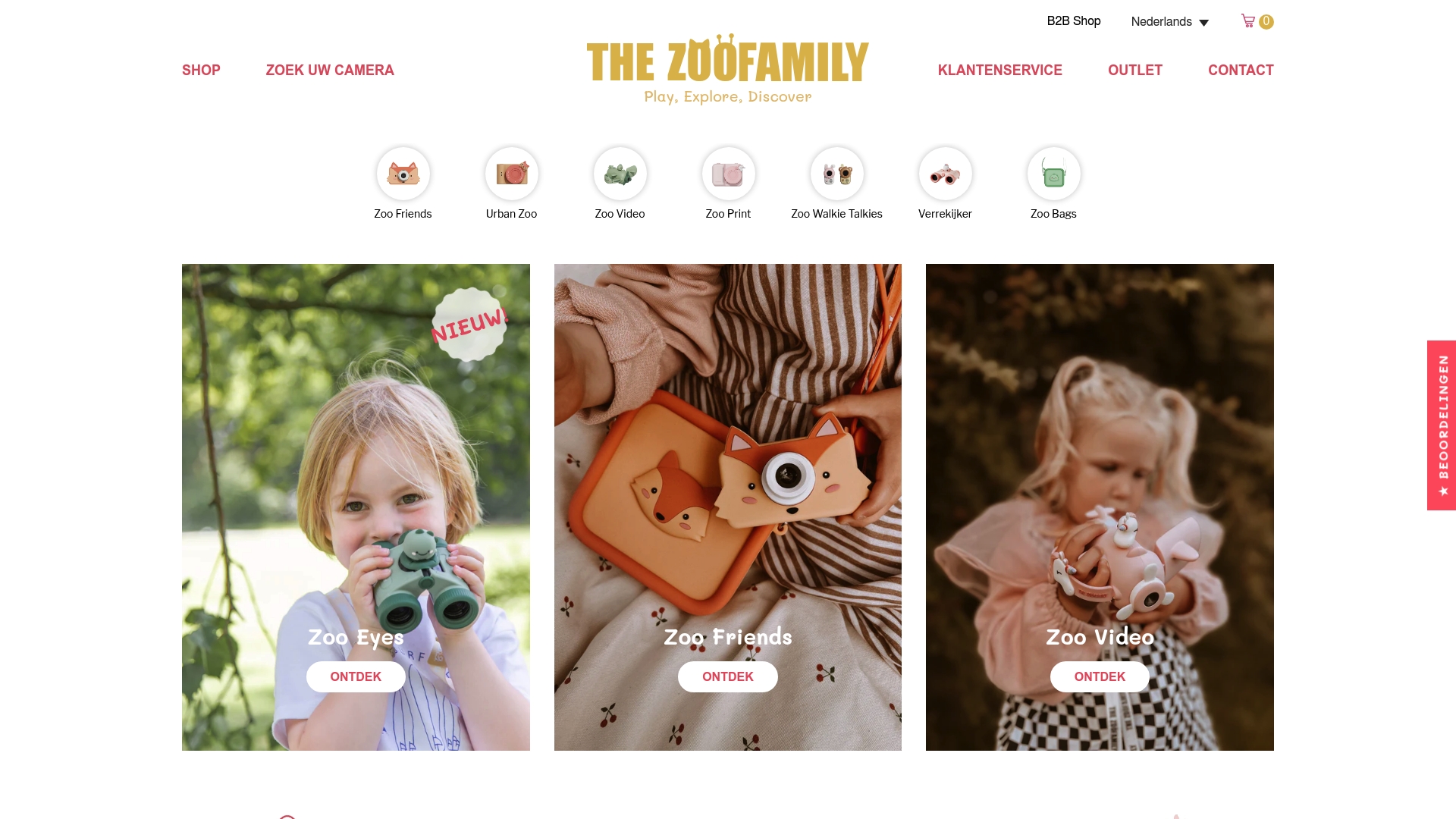
A child-friendly camera, for instance, can turn a number hunt into a photo tally, letting a child snap each stone or leaf they collect and count the pictures back at the table. A pair of binoculars can add distance and estimation to a bird count in the park. Some companies plant a tree for every camera sold, which connects purchases to the natural world the activities are exploring. For readers curious about the wider range, including Zoo Friends, Urban Zoo and the Zoo Walkie-Talkie, the full shop is worth a browse at Thezoofamily.
For more ready-made activity ideas that pair well with these tools, Thezoofamily has also put together a scavenger hunt guide and a set of outdoor maths activity examples worth checking before your next session.
Practitioner resources worth bookmarking
For deeper activity banks and research summaries, Twinkl’s outdoor maths ideas offer ready-made lesson cards, while Demme Learning’s piece on maths in nature covers pattern and measurement in more depth.
Sources
- Outdoor maths activities for ages 4–6 — Educate Outside
- Nature and math in preschool — Edutopia
- Taking math learning outdoors into nature — DREME Family Math (Stanford)
- Three easy kids activities for fun outdoor math — PBS KIDS for Parents
FAQ
What age group are these outdoor maths activities suitable for?
Most activities work from age three upwards, with simple adjustments to target numbers and session length for younger or more confident children.
Do I need special equipment to run outdoor maths activities?
No. Sticks, stones, leaves, chalk and basic mud kitchen items like buckets and cups cover nearly every activity described here.
How long should an outdoor maths session last?
Ten to twenty minutes works well for three and four year olds, while confident fives can often sustain longer sessions on a single activity.
Does Thezoofamily sell anything specifically for outdoor maths?
Thezoofamily doesn’t sell maths-specific kits, but its cameras, binoculars and walkie-talkies can add photo tallies, distance counts and team scoring to activities you’ve already set up, with current prices listed at Thezoofamily.
How do I record learning without interrupting play?
A quick photograph with a caption, a tally mark on a clipboard, or jotting down a child’s own comment all capture evidence without pulling a child out of the activity.