

Go outside after dark, find the Big Dipper (or the Plough, as it’s known across the UK and Ireland) if you’re in the Northern Hemisphere, or Orion if you’re further south, and use that one pattern as your anchor for everything else. That’s how to spot constellations without getting overwhelmed by the whole sky at once.
- Northern Hemisphere: start with the Big Dipper (part of Ursa Major) or Orion in winter months.
- Southern Hemisphere: Orion still works brilliantly, appearing higher and inverted compared to northern views.
- Seasons shift which constellations sit above your horizon, so a star chart or app confirms what you’re seeing on any given night.
TL;DR:
- Learning the Big Dipper or Orion first provides a reliable anchor for star-hopping and understanding the night sky across different seasons.
- Using the pointer method, such as tracing from Merak and Dubhe to find Polaris, simplifies navigating to key stars like Arcturus and Spica.
- Seasonal shifts significantly affect constellation visibility, making an app or star chart essential for confirming what is overhead on any given night.
- Waiting 20 to 30 minutes in darkness enhances star visibility through dark adaptation, and using averted vision reveals faint stars missed by direct sight.
- Relying on shape recognition without equipment, combined with dark adaptation, offers the most effective and affordable way for beginners and families to explore the night sky.
Table of Contents
- Five easy constellations and asterisms to learn first
- How do you star-hop from an anchor pattern to find other stars?
- Which constellations can I see this season?
- Star charts, apps and binoculars: what actually helps
- What are dark adaptation and averted vision, and why do they matter?
- Family stargazing and photography tips from Thezoofamily
- Key Takeaways
- Why the beginner’s path matters more than the gear
- Sources
Five easy constellations and asterisms to learn first
Learning the sky works best as a short, ordered list rather than a random scatter of star names. Practise each pattern for five to ten minutes across a few clear nights, and the rest of the sky starts falling into place around them.
- Big Dipper / Plough (Ursa Major) – Northern Hemisphere, visible year-round. Look north; seven bright stars form a saucepan shape with a bowl and handle.
- Orion – Best October to March. Look for three stars in a tight, straight line: that’s Orion’s Belt, flanked by two bright shoulder stars and two knee stars.
- Cassiopeia – Northern Hemisphere, year-round. Find a wide, wonky “W” or “M” shape opposite the Big Dipper across Polaris.
- Summer Triangle (Vega, Deneb, Altair) – April to October. Three of the brightest stars overhead form a large, unmistakable triangle.
- Southern Cross (Crux) – Southern Hemisphere, year-round. A compact cross shape low in the southern sky, brilliant for orientation south of the equator.
Each of these is an asterism or well-known pattern rather than a strict scientific boundary, which is exactly why beginners lean on them. The 88 official constellations recognised by astronomers are useful later, but these five patterns get you oriented fastest.
How do you star-hop from an anchor pattern to find other stars?
An anchor pattern is simply one bright, recognisable shape you can find on any clear night, then use as a signpost to everything nearby. The Big Dipper and Orion earn anchor status because they’re large, unmistakable, and visible for much of the year in their respective hemispheres, making them ideal starting points for star-hopping.
The classic technique is the pointer method. Find the two outer stars of the Big Dipper’s bowl, Dubhe and Merak, and trace a straight line off the open end of the bowl. Extend that line roughly five times the distance between the two pointer stars and you’ll land on Polaris, the North Star.
From there, other star-hops open up:
- Arc to Arcturus: follow the curve of the Big Dipper’s handle outward and you’ll arrive at Arcturus, the bright orange star anchoring Boötes.
- Sprint to Spica: continue that same arc a bit further and you’ll hit Spica, the brightest star in Virgo.
Face north for Polaris and the Dipper, or south for Orion, and check the date and time against a chart if the pattern isn’t where you expect. The sky rotates through the night and shifts seasonally, so a pattern’s exact position changes even though the shape stays constant.
Pro Tip: If you’re not sure you’re looking at the right pattern, open a sky app and hold your phone up to the same patch of sky. If the on-screen stars don’t line up with what you see, rotate slowly until they match, then trust your eyes for the rest of the session.
Which constellations can I see this season?
Some patterns never leave the sky, at least from mid to high latitudes. Circumpolar constellations like Ursa Major and Cassiopeia (Northern Hemisphere) or Crux and Carina (Southern Hemisphere) circle the celestial pole and stay above the horizon all year, which makes them dependable reference points when everything else shifts with the seasons.
Everything else follows a seasonal rhythm because Earth’s orbit changes which part of the celestial sphere faces our night side. Here’s the general Northern Hemisphere pattern, with Southern Hemisphere readers seeing many of the same constellations upside down and at different times:
- Winter: Orion, Taurus, and the blazing star Sirius dominate evening skies.
- Spring: Leo’s backwards question mark, Boötes with Arcturus, and Virgo climb into view.
- Summer: the Summer Triangle sits high overhead, with Scorpius and Sagittarius low on the southern horizon.
- Autumn: Pegasus’s great square, Andromeda, and Perseus take over as the summer stars set.
Orion is a firmly winter constellation in the Northern Hemisphere, while the Summer Triangle stays prominent from roughly April through October, which makes it one of the most reliable seasonal signposts going.
Latitude matters more than most beginners expect. A constellation comfortably overhead in Scotland might barely clear the horizon in southern Spain, and stars that circle the pole in Norway will rise and set entirely for someone near the equator. If you’re unsure what’s actually visible tonight from your exact location, an app or planetarium tool that uses your GPS coordinates will show you the live sky rather than a generic seasonal list.
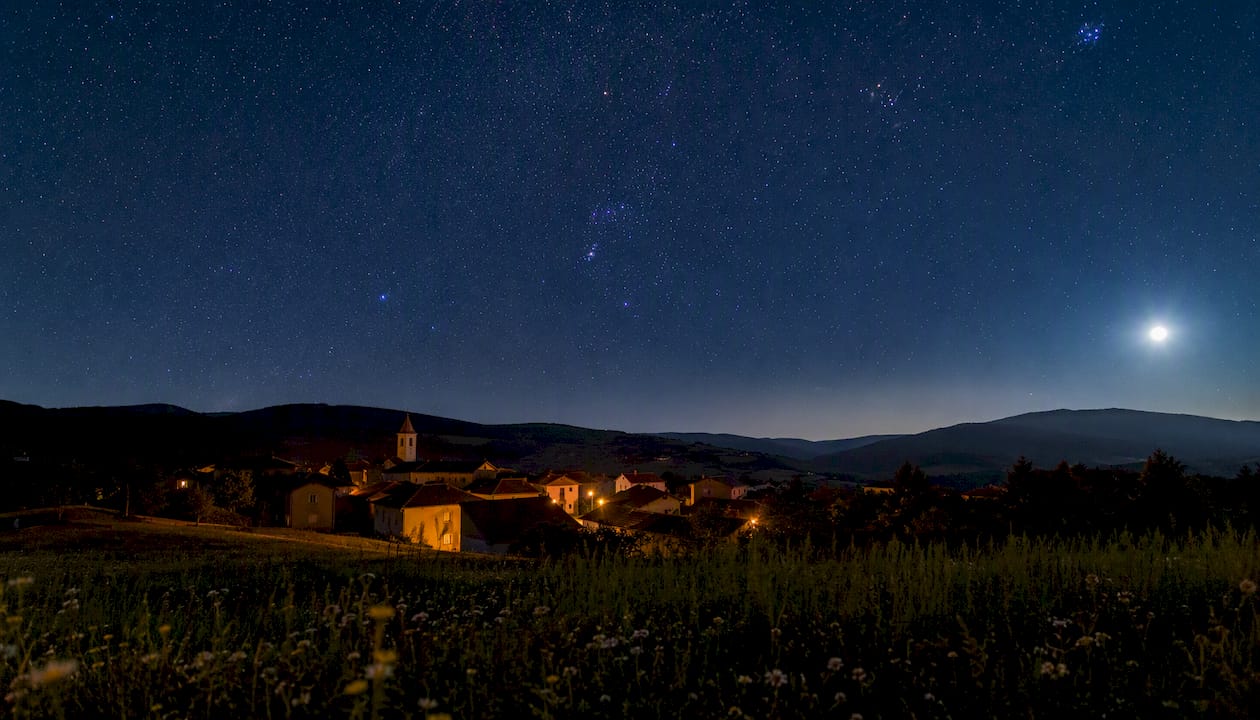
Star charts, apps and binoculars: what actually helps
Paper star charts force you to slow down and genuinely learn the shapes, but they don’t move with the sky and can be awkward to read in the dark. Apps and interactive maps solve both problems, updating in real time as you turn, and they’re best treated as confirmation tools rather than the main event.
- Learn a pattern with your eyes first, then check the app to confirm you’ve got it right.
- If your app’s display drifts out of alignment with the real sky, rotate slowly until a known bright pattern like Orion or the Big Dipper matches up.
- Drop your screen brightness right down, or switch to a red-light or night mode, before you look up again.
- Save binoculars for once you’ve found a pattern naked-eye; 7x to 10x magnification reveals star clusters and colour that the unaided eye misses.
- Skip the telescope at this stage. Its narrow field of view shows you one star at a time, which makes learning a whole constellation shape almost impossible.
What are dark adaptation and averted vision, and why do they matter?
Give your eyes 20 to 30 minutes in darkness before you judge how much of the sky you can actually see. That single wait does more for a first stargazing session than any app or gadget, because full dark adaptation reveals faint stars that were invisible minutes earlier.
Once adapted, use averted vision for faint stars: look slightly to one side of a dim point rather than straight at it. Your peripheral vision is more sensitive in low light, and this trick alone often reveals stars that vanish the moment you look directly at them.
A quick checklist before heading out:
- Check the moon phase; a full moon washes out fainter stars, so a new moon or crescent gives you the best contrast.
- Check the weather forecast for cloud cover, not just rain.
- Drive or walk somewhere with less light pollution if your usual spot is badly lit.
- Dress warmer than you think you need to. Standing still outdoors for half an hour gets cold fast.
Pro Tip: Give children a specific job, like “count how many stars you can see in the Big Dipper,” rather than a vague instruction to look up. It keeps them engaged during the dark adaptation wait, which is usually the hardest part for younger stargazers.
Family stargazing and photography tips from Thezoofamily
Once your family can spot Orion or the Big Dipper confidently, a camera turns the hobby into something to look back on. Our guide to photographing the night sky covers simple settings that work with basic equipment, no astrophotography kit required.
- Start an observation log where each child records what they spotted and when.
- Try constellation bingo: print a few shapes and tick them off as you find them.
- Pair stargazing with other outdoor family activities to build a regular nature routine.
A camera with a nature story behind it makes a night outside feel like more than a school assignment. It becomes something the whole family owns.
At Thezoofamily, we plant one tree for every camera sold, a small link between the outdoor curiosity constellation-spotting builds and the wider natural world it depends on.
Key Takeaways
Spotting constellations comes down to learning one bright anchor pattern first, then using star-hopping, seasonal awareness, and dark adaptation to build outward from it.
| Point | Details |
|---|---|
| Start with one anchor | Learn the Big Dipper or Orion first, then use it to locate everything else. |
| Use the pointer method | Trace Dubhe and Merak roughly five times their distance apart to find Polaris. |
| Match the season | Check what’s actually overhead this month rather than relying on a generic list. |
| Wait for dark adaptation | Give your eyes 20 to 30 minutes before judging how much sky you can see. |
| Confirm, don’t rely on apps | Learn shapes naked-eye first, then use a sky app to check you’ve got it right. |
Why the beginner’s path matters more than the gear
Most stargazing advice front-loads equipment: telescopes, tripods, star-tracking mounts. That’s backwards for anyone starting out, and it’s one of the main reasons families give up after one frustrating night fumbling with a telescope that shows a single star and nothing else.
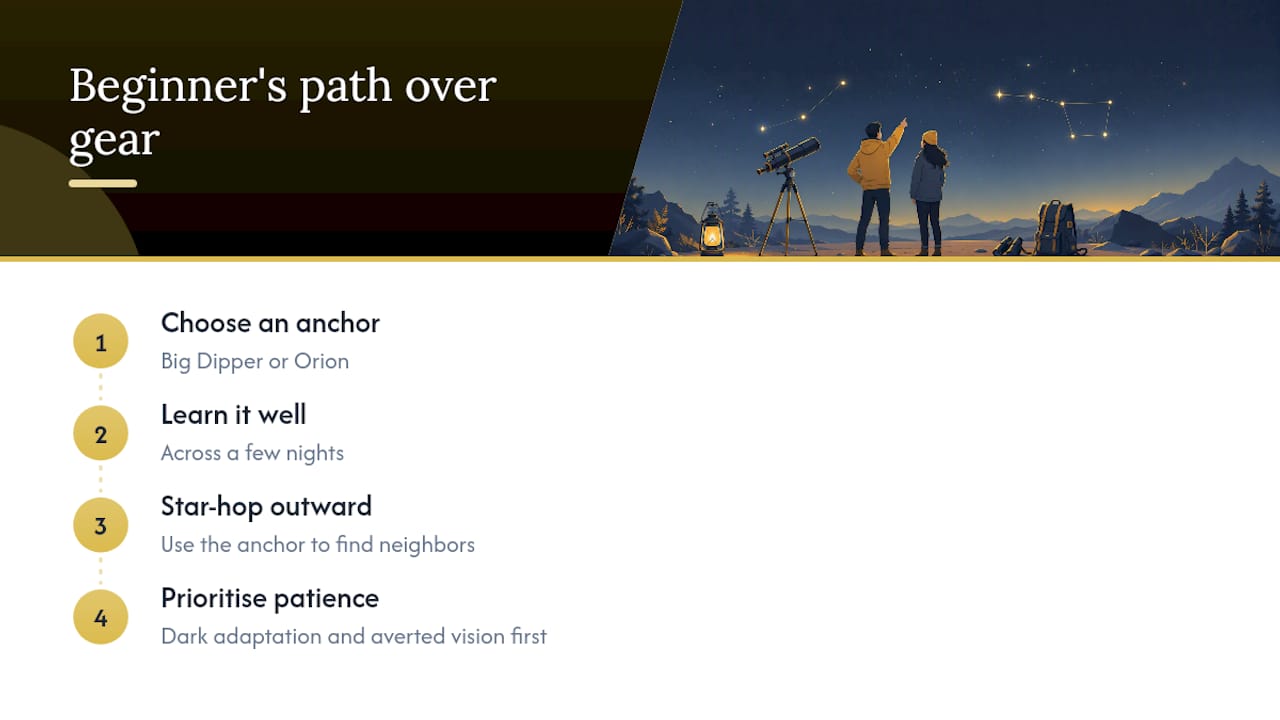
What actually works is almost embarrassingly simple: pick one anchor pattern, learn it properly across a few nights, then star-hop outward. The Big Dipper and Orion aren’t beginner consolation prizes. They’re genuinely the most efficient route into the whole sky, because their brightness and size make them nearly impossible to misidentify.
If there’s one thing conventional guides underplay, it’s patience. Dark adaptation and averted vision cost nothing and require no equipment, yet they matter more to what you’ll actually see than any app or gadget. Prioritise the wait in darkness before you prioritise the download.
— ALAIN
Sources
- Constellations: How to spot them all
- StarWalk: Averted vision and app usage
- How to find constellations in the night sky (HowToGeek)
- What are constellations? (NASA Space Place)