

TL;DR:
- Managed outdoor risk fosters children’s confidence, resilience, and problem-solving skills.
- Preparation, supervision, and teaching safety routines are essential for outdoor adventures.
- Cultural differences influence outdoor play approaches, with Nordic models emphasizing mastery and independence.
Every parent feels that instinctive pull to wrap their child in cotton wool the moment a tree looks climbable or a puddle looks deep. But what if that protective urge, taken too far, actually works against your child? The research is clear: managed risk outdoors builds confidence, resilience, and sharper problem-solving skills in ways that a sterile play environment simply cannot. This article walks you through the real principles behind outdoor safety, practical checklists for every outing, how European cultures handle risk differently, and what actually matters most when the wild throws a curveball at your family.
Table of Contents
- Why outdoor safety matters: Beyond blanket protection
- The essentials of outdoor safety: Kits, supervision and golden rules
- European approaches to outdoor play: Comparing Nordic, UK and southern norms
- Practical strategies: Nature, wildlife, and the wild card of unpredictable moments
- A fresh perspective: The uncomfortable truth about letting kids explore outdoors
- Explore safely with The Zoofamily
- Frequently asked questions
Key Takeaways
| Point | Details |
|---|---|
| Balanced risk builds confidence | Allowing children to explore with sensible boundaries supports resilience and skill development. |
| Preparation is essential | A simple safety kit and planning are the bedrock of stress-free outdoor adventures. |
| Learn from Europe’s best | Nordic and UK models show practical ways to balance protection and freedom outdoors. |
| Nature requires ongoing checks | Don’t skip post-outing checks for ticks or lost items, and reinforce lessons every time. |
Why outdoor safety matters: Beyond blanket protection
There is a meaningful difference between protecting your child and preventing them from ever feeling uncertain. Outdoor safety, done well, is not about eliminating every possible hazard. It is about understanding which risks are worth taking and which are genuinely dangerous.
Child development outdoors shows us that children who engage in physical, unpredictable play develop stronger neural pathways for decision-making and emotional regulation. They learn to read environments, recover from small setbacks, and trust their own bodies. These are not minor perks. They are foundational life skills.
The problem with overprotection is subtle. A child who is never allowed to stumble does not simply stay safe. They miss the feedback loop that teaches them how to handle failure. Overprotection reduces risky play benefits such as resilience and confidence, while Nordic models consistently show that minor injuries are far outweighed by the developmental gains. That is a significant finding, not a cultural quirk.
Research also confirms that parental risk tolerance is positively associated with the number of hours children spend in adventurous play each week. In other words, your own comfort level with uncertainty shapes how freely your child explores.
Key skills children build through outdoor risk-taking:
- Resilience: Bouncing back from minor falls or failed attempts
- Confidence: Trusting their own physical capabilities
- Problem-solving: Navigating unpredictable terrain or situations
- Risk assessment: Learning to judge what is genuinely dangerous versus simply new
- Social cooperation: Negotiating play rules and helping peers outdoors
“Children need the opportunity to experience risk and challenge in play so they can learn how to manage it. Removing all risk removes the learning.” — Nordic early childhood education principle
The goal, then, is not maximum safety. It is calibrated safety. That mindset shift changes everything about how you prepare for outdoor time.
The essentials of outdoor safety: Kits, supervision and golden rules
Good preparation makes the difference between an outing that builds confidence and one that ends in unnecessary stress. The practical steps are straightforward, and once they become routine, they take very little effort.
The five essentials for every outdoor adventure:
- Sun protection: Use broad-spectrum sunscreen SPF 30+, reapplying every two hours and after water exposure
- Hydration: Carry more water than you think you need, especially in warm months
- Shelter and clothing: A packable rain layer and a sun hat cover most European weather surprises
- Food and energy: Snacks prevent tired, irrational decision-making in children and adults alike
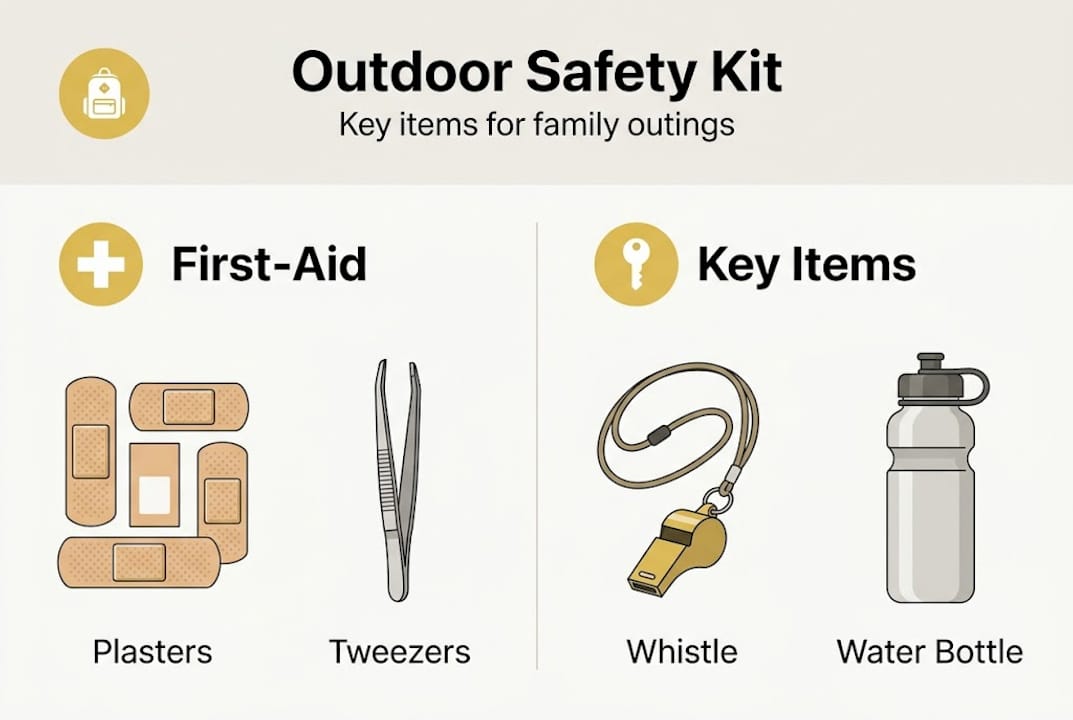
- Communication: A whistle or a charged phone ensures you can signal or call for help
Pro Tip: Teach your child the “hug a tree” rule before any outing in woodland or open country. If they get separated from you, they should stop, hug a tree, and stay put. Moving around when lost makes finding a child far harder. Pair this with a bright whistle clipped to their bag.
Supervision is non-negotiable in specific situations. The NHS guidance is clear: never leave children under three alone outdoors, check gardens for poisonous plants, and always supervise near water, as drowning risk exists in as little as 5 centimetres of depth. Use insect repellent suitable for children and check for ticks after every outing in long grass or woodland.
A solid family first-aid kit for outdoor use should include: adhesive plasters in various sizes, antiseptic wipes, tweezers for splinters and ticks, a small bandage roll, antihistamine cream, and any child-specific medication.
Quick-reference supervision guide by age:
| Age group | Supervision level | Key considerations |
|---|---|---|
| Under 3 | Constant, direct | Never alone outdoors; water risk is critical |
| 3 to 5 | Close, within sight | Assist with terrain; check for hazards first |
| 6 to 8 | Nearby, checking in | Can explore short distances; needs boundaries |
| 9 to 12 | Periodic, agreed rules | Growing independence; safety routines in place |
| 12 and over | Context-dependent | Maturity, environment, and local norms apply |
These are guidelines, not rigid rules. Your child’s maturity and the specific setting always take precedence.
European approaches to outdoor play: Comparing Nordic, UK and southern norms
Europe is not a single culture when it comes to children and outdoor risk. The contrasts are genuinely fascinating, and each approach carries lessons worth borrowing.
Outdoor play philosophies across Europe:
| Approach | Nordic (Norway, Sweden, Finland) | United Kingdom | Southern Europe (Italy, Spain, Portugal) |
|---|---|---|---|
| Risk philosophy | Embrace managed risk from age 5 to 8 | Cautious but improving; safety-led | Generally more protective; family-supervised |
| Playground standards | EN 1176 with room for challenge | EN 1176; adventure playgrounds growing | EN 1176; urban settings more common |
| Healthcare support | Covers under-16 injuries publicly | NHS covers all children | Variable; private insurance common |
| Nature connection | Central; friluftsliv is cultural norm | Growing nature-school movement | Seasonal; beach and rural traditions |
The Nordic concept of friluftsliv (literally “open-air life”) is not simply about being outside. It is a philosophy that treats nature as a classroom and a companion. Norwegian kindergartens actively teach children to assess and master risk, rather than avoid it. The outcomes speak for themselves in terms of child confidence and independence.
“In Norway, children as young as five regularly navigate woodland, climb trees unsupervised, and learn to respect fire. The goal is not recklessness. It is mastery.” — Nordic early education framework
UK parents have access to a growing adventure playground movement, and nature schools are expanding rapidly. Southern European families often keep children closer, but the rich tradition of outdoor family meals, coastal play, and rural summers provides its own form of nature connection.
What you can adapt from each approach:
- From Nordic culture: allow more physical challenge and trust your child’s body awareness
- From UK practice: use structured nature school visits or forest school sessions
- From southern European tradition: make outdoor time a social, family-centred ritual
Exploring balancing protection and discovery helps parents find their own comfortable point on this spectrum.
Practical strategies: Nature, wildlife, and the wild card of unpredictable moments
No matter how well you prepare, nature has its own agenda. Knowing how to handle the unexpected moments is what separates a confident outdoor parent from an anxious one.
Before, during, and after your outing:
- Before: Research the area for poisonous plants, water hazards, and local wildlife. Brief your child on the rules.
- During: Stay aware of tick habitats (long grass, woodland edges), weather changes, and your child’s energy and hydration levels.
- After: Always conduct a tick and insect check. Remove clothing and inspect skin carefully, particularly around hairlines, behind knees, and underarms.
Wildlife encounters are one of the most exciting parts of being outdoors with children. The key principle is observe, do not disturb. Teach children to watch from a distance, never to touch nests, eggs, or young animals, and to move calmly rather than run. A pair of children’s binoculars makes wildlife observation magical without requiring close contact.
When it comes to tools and fire, supervision is firm. Children can learn to use small tools like penknives or fire starters from around age eight to ten, but only under direct adult guidance, with clear rules established beforehand.
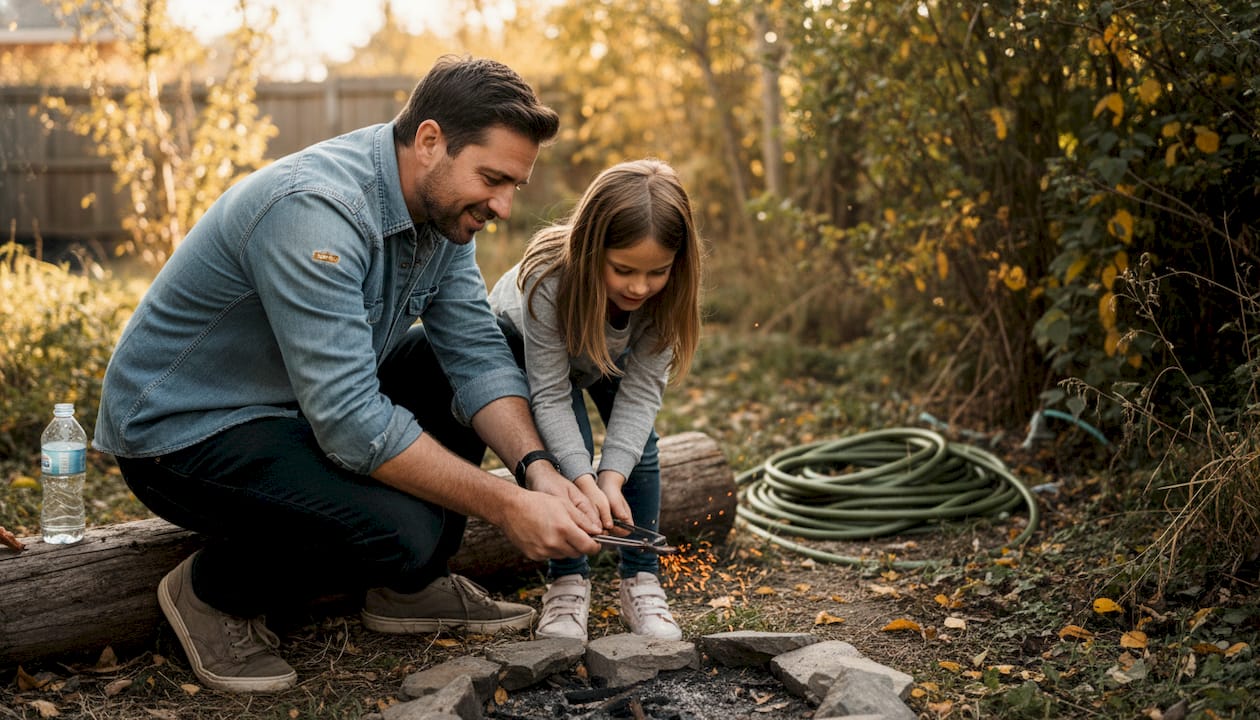
Pro Tip: The post-outing tick check is the safety step most parents skip because they are tired and ready to be home. Make it a non-negotiable part of your return routine. Tick-borne illnesses, including Lyme disease, are preventable if a tick is removed promptly and correctly using tweezers.
Repetition is how children internalise safety rules. Practise the whistle signal, repeat the “hug a tree” rule before every woodland walk, and review what went well after each outing. Routines give children a sense of agency and competence, which is the foundation of real outdoor confidence.
A fresh perspective: The uncomfortable truth about letting kids explore outdoors
Here is something most safety guides will not say plainly: the greatest risk to your child’s long-term wellbeing outdoors is often your own anxiety, not the terrain.
We have spent years connecting families with nature, and the pattern is consistent. Parents who are visibly tense about every stumble raise children who hesitate at every new challenge. Parents who model calm confidence and say “that looks tricky, give it a go” raise children who try, fail, adjust, and try again. That is not recklessness. That is development.
Minor scrapes are not failures of parenting. They are successful learning events. A grazed knee from a tree climb teaches more about body awareness than any safety briefing could. The discomfort you feel watching your child wobble on a log is valid. Act on it by staying close, not by pulling them down.
The mind-shift we encourage: see yourself as a confident support for urban nature play and calculated exploration, not simply a barrier between your child and harm. Your job is to widen their world safely, not to shrink it.
Explore safely with The Zoofamily
At The Zoofamily, we believe every outdoor adventure is a chance to deepen your child’s connection with the natural world. Our cameras, walkie-talkies, and binoculars are designed with animal-themed references that spark genuine curiosity, because a child who loves nature is a child who wants to protect it. For every camera sold, we plant one tree.
Beyond our products, The Zoofamily resources offer a growing library of articles, safety guides, and play inspiration. If you are looking for hands-on ideas to bring this all to life in your own garden, our DIY backyard play ideas are a brilliant starting point for building confidence through creative, nature-connected play.
Frequently asked questions
What is the most important item to pack for outdoor child safety?
Beyond supervision, always pack water, sun protection SPF 30+, and a whistle your child knows how to use in an emergency.
How can parents balance safety and risk outdoors?
Allow controlled challenges that build confidence and problem-solving, while setting clear boundaries. Nordic models show that minor injuries are consistently outweighed by the developmental benefits of adventurous play.
What are quick checks after a day out in nature?
Conduct a full tick and insect check, looking carefully at skin folds and the hairline. The NHS recommends using insect repellent and checking thoroughly after any time in long grass or woodland.
At what age should children be allowed to play outdoors unsupervised?
Children under three must never be left alone outdoors. For older children, independence should grow gradually based on maturity, the specific environment, and established safety routines.