

Most parents instinctively want to protect their children from every scrape and stumble. Yet research increasingly shows that shielding children from all risk may actually work against them. Risky play is defined as thrilling, exciting activity involving uncertainty and a perceived chance of injury, and it plays a genuine role in building resilience, confidence, and emotional strength. This article walks you through the science, the practical tools, and the real-world examples that can help you raise an adventurous, capable child without unnecessary worry.
Table of Contents
- Why risk-taking is fundamental for child development
- Understanding healthy versus harmful risk
- Practical ways to encourage healthy risk-taking
- European models: What we can learn from Norway and the UK
- Debates and concerns: Striking the right balance
- Connect with nature and adventure in your family’s journey
- Frequently asked questions
Key Takeaways
| Point | Details |
|---|---|
| Healthy risks boost growth | Allowing children to take supervised risks builds resilience, confidence, and core life skills. |
| Parental attitude is key | Children play more adventurously when parents support and model a balanced approach to risk. |
| Nature encourages self-led risk | Natural environments like forests or parks are ideal spaces for safe, incremental risk-taking. |
| Injuries are usually minor | Research shows that most risky play injuries are minor and serious harm is rare. |
| European models offer inspiration | Learning from Nordic and UK approaches can help families embrace healthy risk as part of daily life. |
Why risk-taking is fundamental for child development
Healthy risk-taking is not about recklessness. Researcher Ellen Sandseter identified six types of risky play: play at heights, play with speed, play with dangerous tools, play near dangerous elements like water or fire, rough-and-tumble play, and play where children can get lost. Each type stretches a child’s physical and mental limits in ways that structured, supervised activities simply cannot replicate.
The benefits are well documented. Two hours per week of risky play shows measurable improvements in physical skills, mental health, social skills, and risk assessment abilities. A UK preschool study found children averaged 22.4 hours per week of adventurous play, and outcomes were strongly positive. Understanding child development outdoors helps parents see why unstructured, challenging play is so valuable.
“Adventurous play correlates with lower child anxiety and higher confidence, with parental attitudes playing a direct role in shaping how much of it children actually get.”
Parental risk tolerance is positively associated with greater hours of adventurous play. In other words, when you feel comfortable allowing your child to take on challenges, they do more of it and reap more of the rewards.
Here is a quick overview of the core benefits:
| Benefit | What it means for your child |
|---|---|
| Resilience | Learns to recover from setbacks and try again |
| Reduced anxiety | Exposure to manageable fear builds emotional regulation |
| Social skills | Negotiating rules and risks with peers builds communication |
| Physical confidence | Mastering physical challenges improves body awareness |
| Risk assessment | Practising judgement in low-stakes situations builds lifelong skills |
These are not abstract outcomes. They show up in how your child handles a difficult friendship, a new school, or an unexpected challenge years down the line.
Understanding healthy versus harmful risk
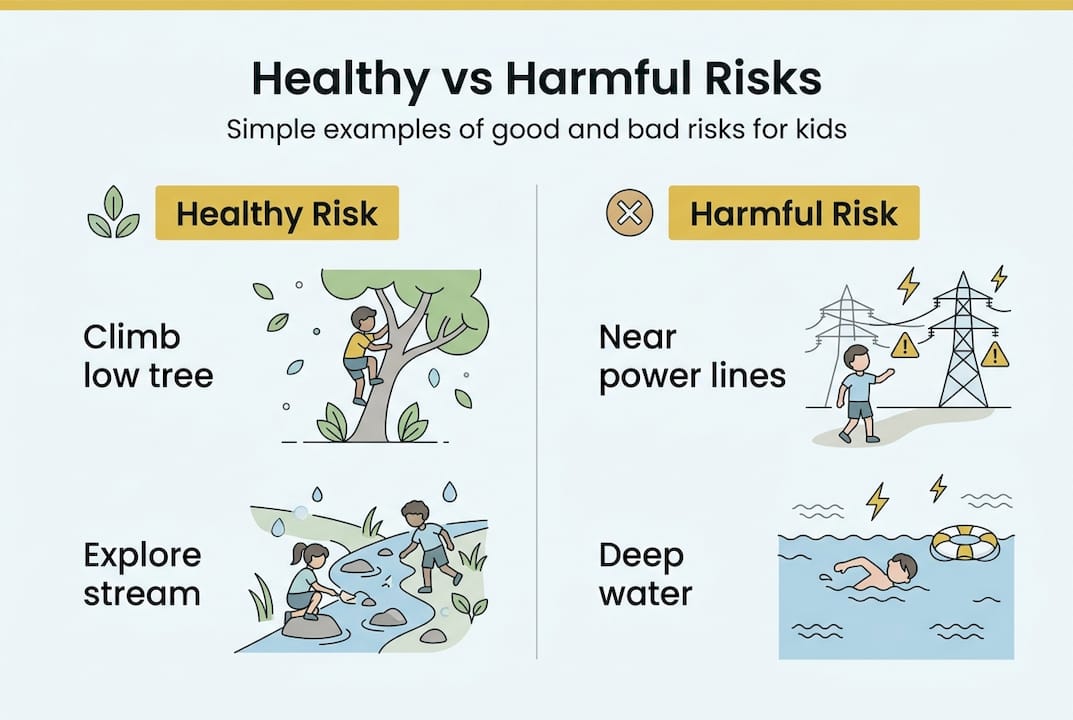
Not every risk is worth taking, and that distinction matters. The key difference between healthy and harmful risk is whether the potential harm is proportionate to the developmental gain. A child climbing a tree faces a possible scraped knee. A child near an unguarded road faces a very different level of danger.
Most injuries from risky play are minor, with little evidence that adventurous outdoor play leads to serious harm. That is reassuring, but it does not mean anything goes. Tools like REPS (Review, Evaluate, Prepare, Supervise) and TRiPS (Task, Risk, Individual, Protective factors, Supervision) give parents a simple framework for assessing activities before saying yes or no.
Here is a practical four-step process you can use:
- Review the activity and environment for obvious hazards.
- Prepare your child with any skills or knowledge they need beforehand.
- Supervise at an appropriate distance, close enough to help but far enough to allow independence.
- Evaluate afterwards, asking your child what they learned and how they felt.
This nature-based play guide offers further ideas for structuring outdoor adventures safely. Research on balancing risk and safety confirms that a thoughtful, benefit-led approach is far more effective than blanket restriction.
| Healthy risk | Harmful risk |
|---|---|
| Climbing a low tree | Climbing near power lines |
| Exploring a stream with supervision | Swimming alone in deep water |
| Using child-safe tools for crafts | Handling sharp adult tools unsupervised |
| Running on uneven ground | Running near fast-moving traffic |
Pro Tip: Watch your child’s body language and verbal cues. If they are excited and engaged, they are likely within their comfort zone. If they look frozen or distressed, that is a signal to step in gently rather than push.
Practical ways to encourage healthy risk-taking
Knowing the theory is one thing. Putting it into practice on a rainy Tuesday afternoon is another. The good news is that encouraging healthy risk does not require special equipment or elaborate planning. It mostly requires stepping back.
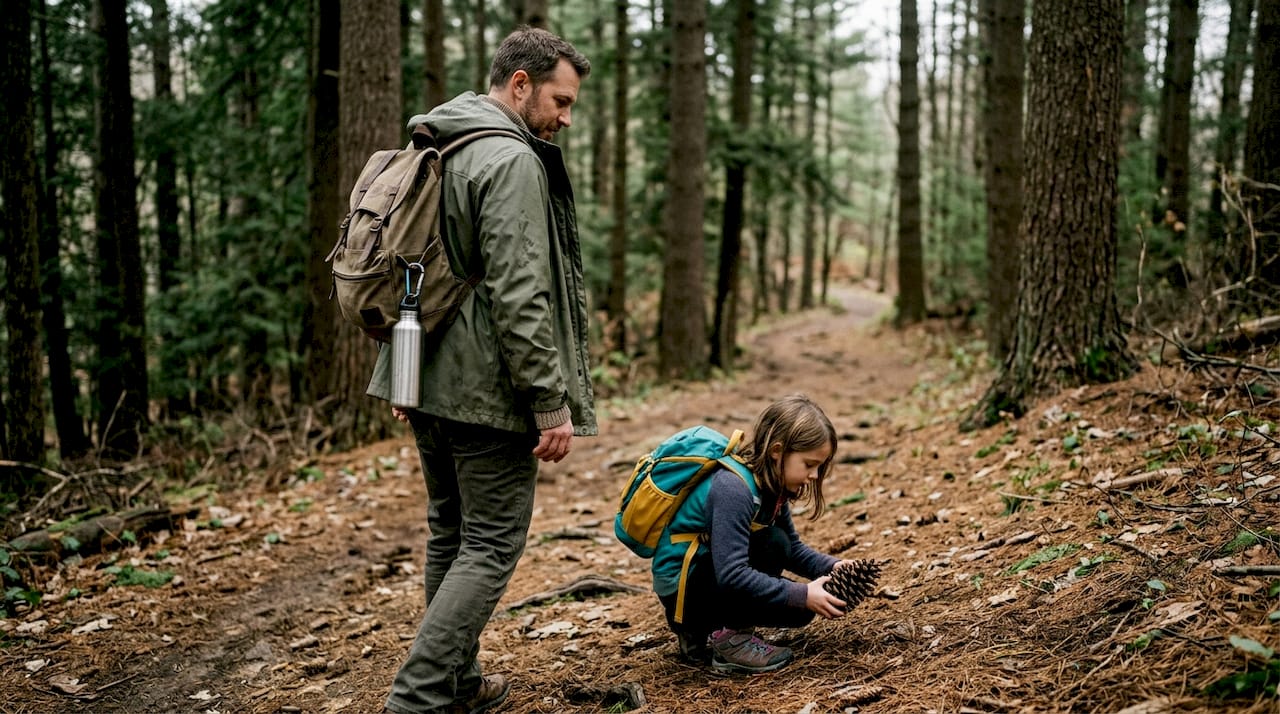
Natural environments like uneven terrain, trees, and streams support self-led, incremental risk-taking in ways that flat, manicured playgrounds simply cannot. Forest schools across Europe actively encourage risky, nature-based activities including tool use, shelter building, and fire-making under supervision, because these experiences build genuine competence.
Here are practical ways to bring more healthy risk into your child’s week:
- Offer open-ended outdoor spaces. Parks with varied terrain, woodland edges, and streams are ideal. Let your child lead the exploration.
- Allow tree climbing. Start low and let them judge their own limits. Resist the urge to lift them down unless they ask.
- Introduce simple tools. Child-safe knives for whittling, small trowels for digging, or magnifying glasses for investigating insects all build confidence and fine motor skills.
- Step back physically. Position yourself where you can see but your child cannot constantly check your reaction. This encourages independent problem-solving.
- Encourage group play. Social risk-taking, such as joining a new group or negotiating a game, is just as important as physical risk.
Exploring forest walks with children is a wonderful starting point, and building eco-awareness in children through nature observation adds an extra layer of curiosity and connection.
Pro Tip: Keep a simple weekly play diary. Jot down one adventurous activity your child tried each week. Over a month, you will see genuine progress in their confidence and willingness to try new things.
European models: What we can learn from Norway and the UK
Some countries have moved well beyond debate and embedded healthy risk into national education policy. Norway is the clearest example. The concept of friluftsliv, meaning open-air life, is woven into Norwegian culture and schooling from an early age. Norwegian kindergartens are mandated to facilitate risky play, and forest schools across Scandinavia treat risk as developmentally essential rather than something to be minimised.
The results speak for themselves. Norwegian children consistently score well on measures of independence, resilience, and emotional regulation. The approach is not about ignoring safety. It is about trusting children to develop their own judgement within a supportive framework.
In the UK, a preschool study found children averaging 22.4 hours per week of adventurous play, with positive outcomes across physical and emotional development. Educational forest walks are increasingly common in British primary schools, reflecting a growing recognition that outdoor challenge supports academic and social development too.
Key takeaways from Norwegian and UK practice that your family can use today:
- Prioritise outdoor time daily, not just at weekends. Even 30 minutes in a local park counts.
- Resist the urge to over-schedule. Unstructured time is where the most valuable risk-taking happens.
- Talk to your child’s school about outdoor learning opportunities and forest school programmes.
- Connect with other families who share your values around adventurous play. Shared norms reduce social pressure.
- Celebrate small acts of bravery, whether that is jumping into a puddle or trying a new climbing frame.
Debates and concerns: Striking the right balance
Despite compelling evidence, many parents still feel caught between wanting to allow adventure and fearing judgement from other adults. That tension is real and worth addressing honestly.
Experts acknowledge that overprotection can create a risk deficit, leading to higher anxiety and reduced coping skills in children. At the same time, some caution regarding genuine hazards is entirely warranted. The goal is not to eliminate all supervision but to calibrate it thoughtfully.
“The question is not whether children should face risk, but whether adults can tolerate the discomfort of watching them do so.”
Social pressure is one of the biggest barriers. A parent who allows their child to climb a tree in a public park may face disapproving looks or comments. Having a clear, evidence-based rationale helps. Sharing what you know about ecological photography for children and nature-based learning can open conversations with other parents and educators who may be curious but uncertain.
A positive approach with children also means framing risk conversations constructively rather than as warnings. Instead of “be careful,” try “what do you think you need to do to stay safe?”
Simple ways to advocate for balanced risk in your community:
- Share research with your child’s school or nursery when discussing outdoor play policies.
- Model calm, confident behaviour when your child faces a physical challenge.
- Acknowledge your own discomfort openly rather than projecting it onto your child.
- Build alliances with other parents who value adventurous play.
Connect with nature and adventure in your family’s journey
Encouraging healthy risk-taking is one of the most meaningful gifts you can give your child. It builds the kind of inner strength that no classroom lesson can fully replicate. As you bring more adventure into your family’s daily life, having the right tools and inspiration makes the journey easier and more enjoyable.
At The Zoofamily, we design kids’ cameras, walkie-talkies, and binoculars with animal-inspired details that spark genuine curiosity about the natural world. Every product is built to support the kind of outdoor exploration and nature connection that research shows children truly need. And for every camera sold, we plant one tree, because we believe the wild places your child explores today deserve to be there for their children too. Explore our full range of nature play resources and find the tools that will help your family’s adventures grow.
Frequently asked questions
What counts as healthy risk for young children?
Healthy risk includes activities like climbing trees, exploring uneven ground, using simple tools, and creative peer play that stretch children’s abilities without undue danger. Sandseter’s six types of risky play offer a useful framework for identifying these opportunities in everyday settings.
How much adventurous play should children have each week?
Aiming for 20 or more hours per week is a reasonable target, as 22.4 hours weekly of adventurous play in UK preschoolers was linked to better confidence and lower anxiety. Even small increases in outdoor challenge time make a measurable difference.
Aren’t injuries a big risk with adventurous play?
Serious injuries are rare. Only 3.5% of emergency department visits are related to outdoor play, and most injuries children sustain during adventurous activities are minor bumps and scrapes.
How can I support a cautious child in taking healthy risks?
Observe their comfort level, offer encouragement without pressure, and allow small steps that gradually increase in challenge. Incremental exposure to risk with minimal adult intervention, unless necessary, is the most effective approach for cautious children.