

The best Earth Day activities for children aged 3 and up are short, playful, and built around one simple nature-focused task rather than a packed schedule. A ten-minute bug hotel build or a photo scavenger hunt teaches more about stewardship than a full afternoon of forced fun. This guide gives you ten ready-to-run activities, safety and timing guidance, indoor backups for wet days, and the research behind why they work.
TL;DR:
- Keeping activities short and focused, such as a bug hotel or leaf rubbing, maximizes engagement and teaches conservation without overwhelming young children.
- Indoor alternatives like seed sprouting jars or virtual wildlife cams allow continued learning during bad weather while maintaining the same developmental benefits.
- Using a single tool, such as a camera or binoculars, helps children concentrate and develop observation skills more effectively than a cluttered kit.
- Tracking participation and impact through simple numbers, like waste bags collected or trees planted, boosts accountability and demonstrates tangible progress.
- Incorporating ongoing habits and repeat activities throughout the year reinforces nature connection far more than a one-off event.
Table of Contents
- 10 corporate earth day ideas for families with young children
- How to organise safe, short Earth Day sessions for little ones
- Bad-weather and indoor alternatives that keep the same learning outcomes
- Why these activities work
- Corporate earth day ideas for team-building and employee engagement
- Linking corporate social responsibility to Earth Day
- Building sustainability habits that outlast the event
- Measuring the impact of a corporate Earth Day event
- Low-cost corporate earth day ideas for any company size
- Repeat small rituals beat one-off events
- Give children a reason to look closer, all year round
- Useful resources for families and teams
- Sources
- FAQ
10 corporate earth day ideas for families with young children
These aren’t office-based corporate Earth Day ideas. They’re the family equivalent: simple, low-prep activities you can run in your garden, local park, or living room without buying anything new. Each one suits children from age 3, with adjustments noted for younger or older preschoolers.
-
Nature photo scavenger hunt. Give your child a simple camera and a list of five things to find (something round, something rough, something green, something small, something that moves). Steps: hand over the camera, read out the first item, let them search, photograph, repeat. Materials: a kids’ camera, a printed or verbal list, comfortable shoes. Learning tie-in: it sharpens observation skills and slows children down to actually look. Safety: stay within sight on uneven ground.
-
Bug hotel build. Stack twigs, bark, pinecones, and dry leaves into a small pile against a fence or wall. Steps: collect materials on a short walk, layer them loosely, leave a gap for insects, check back in a week. Materials: sticks, bark, leaves, a container or crate. Learning tie-in: shows children that “messy” habitats support wildlife. Safety: avoid handling anything with visible stings or unfamiliar insects.
-
Backyard mini-bioblitz. Set a five-minute timer and count how many different plants, bugs, or birds you can spot in one small patch of garden. Materials: a notebook, crayons, a timer. Learning tie-in: introduces the idea that biodiversity exists even in a tiny space.
-
Seed planting and sensory garden. Plant fast-growing seeds like sunflowers or peas in a pot. Materials: seeds, soil, a pot, a watering can. Learning tie-in: patience and responsibility, since the reward comes days later, not instantly. Safety: check for allergies to specific plants first.
-
Recycled-material nature crafts. Turn cardboard, bottle caps, and egg boxes into leaf collages or insect models. Materials: scissors, glue, collected recyclables, natural materials like leaves or twigs. Learning tie-in: connects the idea of reuse directly to reducing waste.
-
Birdwatching with a simple sound map. Sit still for five minutes and draw where each different bird sound comes from on a blank page. Materials: paper, crayons, binoculars if you have them. Learning tie-in: trains listening skills most children never use outdoors.
-
Pollinator planting for small spaces. Plant a single pot of lavender, marigold, or wildflower mix on a balcony or windowsill. Materials: a pot, compost, pollinator-friendly seeds. Learning tie-in: shows that even flats and small gardens can support bees.
-
Leaf rubbings and nature prints. Place a leaf under paper and rub a crayon over the top to reveal its veins. Materials: crayons, paper, collected leaves. Learning tie-in: a hands-on lesson in how leaves are built.
-
Cloud and weather experiments. Lie on a blanket and name shapes in the clouds, then guess what weather is coming. Materials: a blanket, nothing else required. Learning tie-in: connects daily weather to the wider water cycle.
-
A simple tree-planting pledge. Choose a small local planting scheme, or mark the day by donating toward one tree, and let your child pick where an imaginary forest might grow on a map. Materials: paper, crayons, a chosen charity or scheme. Learning tie-in: turns one day’s activity into an ongoing act of giving back.
For a citizen science option, try a live camera-trap classification event, where families help sort real wildlife images with no prior training needed. It works well as an add-on to activity six or seven.
Pro Tip: Pick two activities, not ten. A child who finishes a bug hotel and a leaf rubbing feels accomplished. A child dragged through a checklist of ten tasks just feels rushed.
How to organise safe, short Earth Day sessions for little ones
Keep sessions short. Twenty to 40 minutes suits children aged 3 to 4; older preschoolers can usually manage 30 to 60 minutes before attention drops. Watch for restlessness rather than the clock.
One adult can comfortably supervise two or three young children outdoors, especially near water, thorny plants, or anything unfamiliar and green. Check the area first for standing water, brambles, or plants you can’t identify.
Teach a child-friendly leave-no-trace rule early: “take a photo, not a souvenir.” It keeps nature intact and gives children a habit that lasts well beyond one day. Never approach nesting birds or feeding animals, and always keep a respectful distance, a principle drawn from official leave-no-trace photography guidance.
For inclusion, offer a quiet fallback such as a texture bag of leaves and bark for children who find open outdoor space overstimulating.
Pack light:
- Water bottle and a snack
- Sun hat or waterproof coat, depending on season
- Hand wipes
- The chosen tool (camera, binoculars, or notebook)
Pro Tip: Give your child one job and one tool. A single camera or pair of binoculars focuses attention far better than a bag full of options they’ll never use.
Bad-weather and indoor alternatives that keep the same learning outcomes
Rain doesn’t have to cancel Earth Day. These indoor swaps keep the same sensory and curiosity-building outcomes:
- Cloud-in-a-bottle experiment. Warm water, a spray of hairspray, ice on top of a jar lid. Takes five minutes and mimics real cloud formation.
- Seed-sprouting jars. A damp cotton pad, a bean seed, and a clear jar on a windowsill. Watch roots appear within days.
- Scent or sound maps. Blindfold-free version: sit by a window and draw what you hear or smell.
- Recycled-material crafts. Same as the outdoor version, just at the kitchen table.
- Virtual citizen science. Classify camera-trap animal photos from home, using the same live events available outdoors.
- Nature webcams. National park webcams and virtual experiences let children watch real wildlife in real time, a solid substitute noted by the National Park Service’s virtual Earth Day resources.
Bring outside textures in with a tray of soil, pinecones, and shells, or hang a simple bird feeder outside a window for indoor birdwatching.
Why these activities work
A yearlong ethnographic study of an outdoor preschool found that regular outdoor time strengthens children’s physical, cognitive, and emotional connection to nature. Broader research on nature play links it to stronger curiosity, creative thinking, and executive function in early childhood.
A pilot programme found that giving parents an age-appropriate toy alongside simple information made outdoor play noticeably easier to start, with most parents rating the guidance useful.
The rule “take only pictures, leave only footprints” isn’t just a slogan. It teaches children that observation, not collection, is how respectful nature engagement works.
Corporate earth day ideas for team-building and employee engagement
Some parents reading this also plan events at work, so it’s worth a brief detour into corporate Earth Day ideas for company teams, distinct from the family activities above.
A local park clean-up split into small teams builds camaraderie while producing a visible result by lunchtime. Pair it with a lunchtime seed-planting station where colleagues take home a small pot, extending the day’s theme past the office.
Office scavenger hunts work surprisingly well as team-building Earth Day events: teams photograph examples of waste, water use, or energy inefficiency around the building, then present quick fixes to management. It doubles as an informal sustainability audit.
A “commute swap” challenge, where employees log a week of walking, cycling, or carpooling instead of driving solo, turns individual behaviour into a shared team score. Combine it with a short lunch-and-learn from a local conservation group, and the day moves from novelty event to genuine environmental awareness programme.
For remote or hybrid teams, a virtual bioblitz works: everyone photographs one plant or insect near their home within a set hour, then shares results on a shared board. It costs nothing beyond staff time and still delivers the shared-experience payoff of an in-person event.
Linking corporate social responsibility to Earth Day
Earth Day works best as a visible entry point into a company’s wider corporate social responsibility programme, not a standalone gesture that disappears by 6 p.m.
A straightforward approach: tie the day’s activity directly to an existing CSR commitment. If a company already funds local reforestation, use Earth Day to invite staff to plant those specific trees rather than a generic symbolic gesture. If the company has a waste-reduction target, use the day to publish progress against it alongside the event.
Volunteer days pair naturally with Earth Day. A river clean-up, a community garden build, or a local school greening project gives corporate volunteer opportunities a concrete outcome employees can point to later, rather than a photo opportunity with no follow-through.
Matching employee donations on the day, rather than running a separate campaign later, tends to lift participation because the ask and the action happen at the same moment. Even a modest per-head match to a verified environmental charity signals that the company is spending, not just talking.
The strongest CSR integration treats Earth Day as a single loud moment inside a programme that runs all year, with clear links back to whatever sustainability commitments the company has already made publicly.

Building sustainability habits that outlast the event
A single Earth Day event changes very little on its own. What sticks is what happens in the weeks after, when the novelty has worn off and habits either form or don’t.
Simple structural changes carry further than any one-day event: swapping single-use cups for a reusable stock, adding clearly labelled recycling stations, or defaulting printers to double-sided. None of these require a budget line, just a decision.
A monthly “green tip” shared in a team meeting, rotated between departments, keeps the topic visible without becoming a lecture. Some companies pair this with a simple sustainability challenge board, tracking things like reduced paper use or bike-to-work days, updated weekly rather than quarterly.
Employee-led green teams tend to outperform management-mandated ones. A small group with genuine interest, given a modest budget and permission to experiment, usually finds more workable ideas than a top-down directive ever will.
The goal isn’t perfection. It’s making the sustainable choice the easy choice, so employees don’t have to think about it every time.
Measuring the impact of a corporate Earth Day event
Impact only counts if someone tracks it, and tracking doesn’t need to be complicated.
For a clean-up event, count bags of waste collected, kilograms if you have a scale, and the number of participating employees. For a donation-matching day, report the total raised and how many people gave. For a commute challenge, log the number of car journeys avoided over the week.

Simple numbers communicate better than vague summaries. “Forty-three employees collected 62 kilograms of litter from the riverside path” tells a sharper story than “the team had a great time cleaning up.” Share results in the same internal channel used for other company updates, not a separate sustainability newsletter nobody opens.
Photos help too, but pair them with the actual figures. A picture of a clean beach means little without the count of what was removed. If the event links to a planting scheme, note the number of trees committed or planted rather than a general reference to “supporting reforestation.”
Year-on-year comparison matters more than any single figure. Tracking whether commute-swap participation grew from one Earth Day to the next tells you whether the underlying habit is spreading, or whether the event is just a one-off spike in enthusiasm that fades by May.
Low-cost corporate earth day ideas for any company size
Budget shouldn’t decide whether a company marks Earth Day at all, since some of the strongest ideas above cost nothing beyond staff time.
For very small teams or start-ups, a lunchtime seed-swap where everyone brings one packet of seeds to trade costs almost nothing and still gets people talking. A single shared spreadsheet logging everyone’s commute for a week works just as well without hiring anyone.
Mid-sized companies with a small events budget can fund a local park clean-up kit (gloves, bags, litter pickers) for under the cost of a team lunch, and still get the same team-building value as a costlier off-site.
Larger organisations with more resources can scale the same ideas rather than replacing them: multiple clean-up sites across office locations, a company-wide donation match with a higher ceiling, or a paid half-day for a structured volunteer opportunity. The mechanics stay identical; only the reach changes.
Whatever the size, avoid one common trap: spending the entire budget on branded merchandise for the day rather than on the actual activity or the cause it supports. A tree planted costs less than a printed tote bag and does considerably more.
Repeat small rituals beat one-off events
The families who get the most out of Earth Day aren’t the ones who plan the most elaborate day. They’re the ones who repeat two or three simple activities across the year, not just in April.
A bug hotel checked weekly teaches more than a bioblitz done once and forgotten. A camera handed over on every walk becomes a habit rather than a novelty. Treat the tool, whether it’s a camera, binoculars, or a simple notebook, as a prompt for attention, not a substitute for sitting down with your child and actually looking at what they’ve found.
— ALAIN
Give children a reason to look closer, all year round
A camera, a pair of binoculars, or a walkie-talkie doesn’t teach a child to love nature on its own. What it does is give them a focused task: something to point, something to spot, something to report back. That’s often the missing piece between “go play outside” and a child who actually stops to notice a beetle on a leaf.
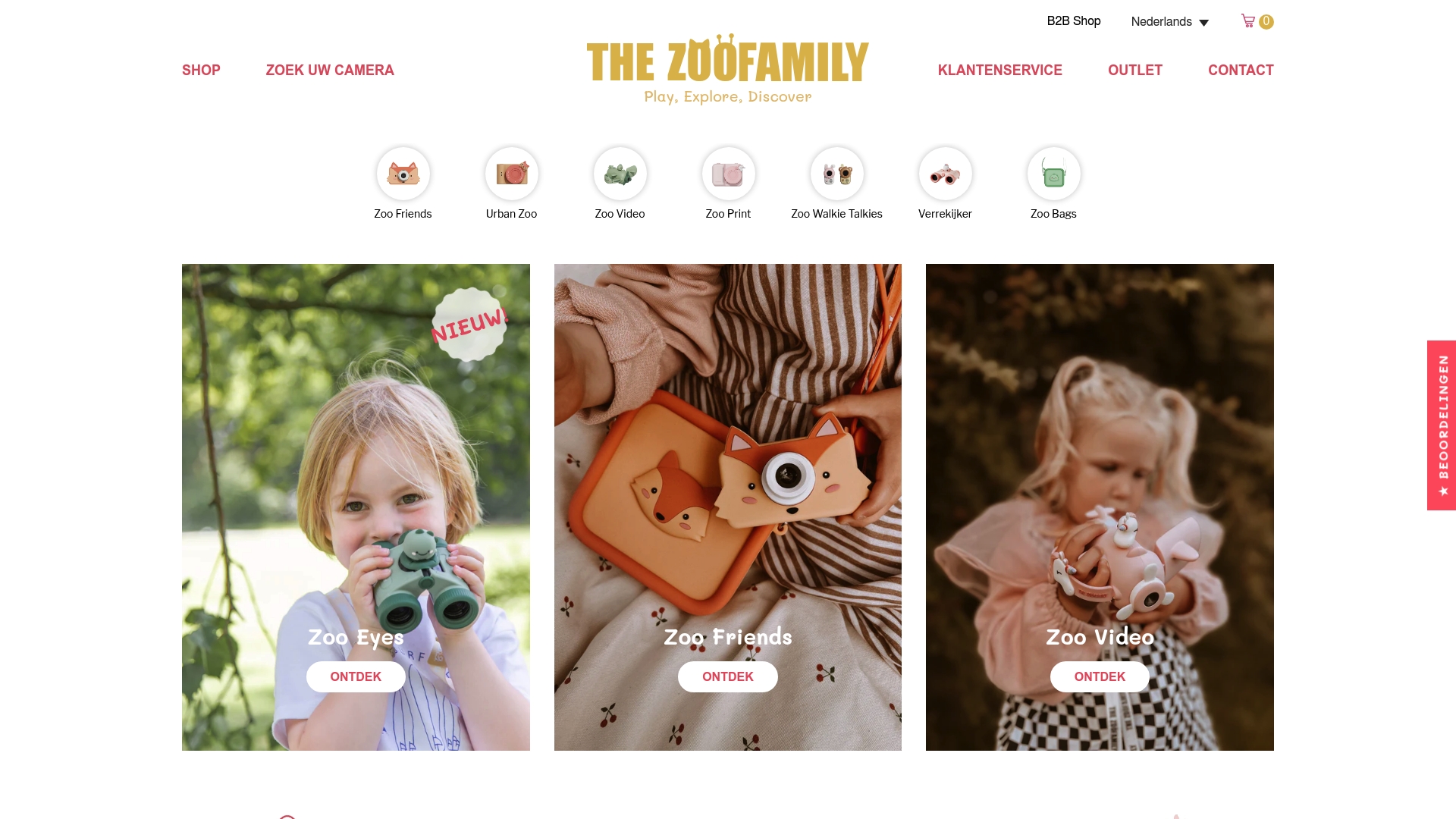
Thezoofamily makes animal-themed kids’ cameras, binoculars, and walkie-talkies designed for children aged 3 and up, each one built to turn an ordinary walk into a small mission. For each camera sold, one tree is planted, so a birthday gift or an Earth Day present connects to real reforestation rather than being a one-off gesture. If you’re planning this year’s activities, browse the current range and pick the tool that matches whatever task you’re setting: a camera for the scavenger hunt, binoculars for the bird sound map.
Useful resources for families and teams
- Earth Day Teach-In Toolkit, for age-banded activities and downloadable lesson plans.
- National Park Service virtual Earth Day experiences, including live webcams.
- SciStarter’s Animal Spot-A-Thon, a live citizen science classification event.
- Sustainability guide for food operators, useful for low-waste picnic snack ideas.
- More Earth Day activity ideas from Thezoofamily.
Sources
- With Nature: An Ethnographic Study of Child-Nature Connectedness in an Outdoor Preschool
- Project Nature pilot study on a primary care-based intervention to promote active outdoor play
- Young children’s contributions to sustainability: the influence of nature play
- Teach-In Toolkit | Earth Day
- Acts of Science: Earth Day Animal Spot-A-Thon - SciStarter
FAQ
What age is right for Earth Day nature activities?
Most activities in this guide suit children from age 3, with shorter sessions and simpler tasks for younger preschoolers. Older preschoolers, aged 5 to 6, can handle longer sessions and slightly more complex steps like sound mapping or seed planting.
How long should an Earth Day activity last?
Twenty to 40 minutes works well for children aged 3 to 4, while older preschoolers can often manage 30 to 60 minutes. Watching for restlessness matters more than sticking to a fixed time.
What should I buy for outdoor Earth Day activities?
A simple, durable tool like a kids’ camera or binoculars works better than a full kit of gadgets, since it gives children one clear focus. There are kid-friendly cameras and binoculars designed specifically for children aged 3 and up, with current prices listed on the site.
What if the weather ruins our plans?
Indoor swaps like seed-sprouting jars, cloud-in-a-bottle experiments, and virtual citizen science classification keep the same learning value without needing dry ground. National park webcams also offer a genuine substitute for live outdoor observation.
Where can children record what they find?
A simple notebook works, or families can log real observations through citizen science platforms such as the live camera-trap classification events run around Earth Day. These let children contribute genuine data without needing any prior experience.