

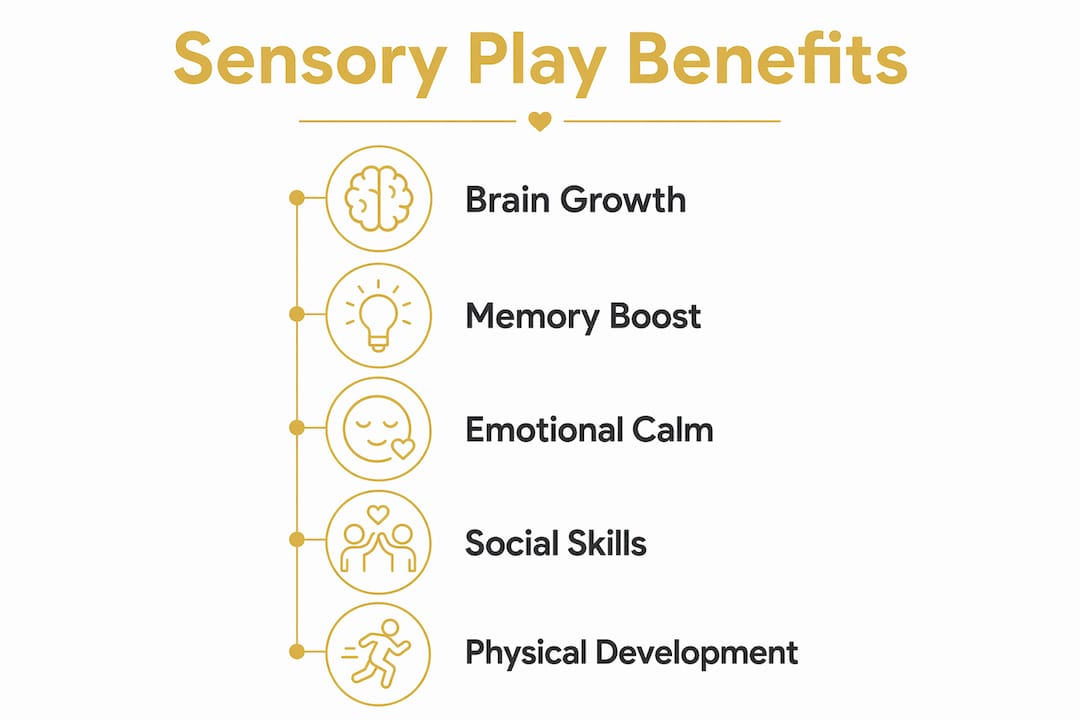
Sensory play is defined as any activity that stimulates a child’s senses — touch, sight, hearing, smell, and taste — and is essential for healthy brain development from infancy onwards. Understanding why is sensory play important means looking at the science behind how young brains are built. A 2024 study in Frontiers in Education confirmed that multi-sensory materials are significantly superior to traditional toys for children aged 3–6. That finding matters because it shifts sensory play from a “nice extra” into a core part of early childhood education. Thezoofamily builds its products around exactly this principle: connecting children to the natural world through their senses, from the texture of a camera body to the sounds of the outdoors.
Why is sensory play important for brain development?
Sensory play builds the brain’s infrastructure during the critical early years by promoting synapse firing and myelination of neurons, both of which are essential for learning and self-regulation. Myelination is the process by which nerve fibres develop a protective coating that speeds up signals between brain cells. The more a child engages with varied sensory experiences, the faster and more efficiently those signals travel. This is not abstract neuroscience. It is the biological reason why a child who regularly plays with sand, water, and clay learns to concentrate, remember, and adapt more readily than one who does not.
Erin O’Connor, a developmental expert cited in K-12 Dive research, describes sensory play as laying the “language infrastructure” of the brain. Children who handle natural materials gain vocabulary to describe textures, temperatures, and sensations they could not otherwise name. Clemson University research from 2023 confirms that tactile experiences with materials like sand and clay directly expand a child’s vocabulary and give them tools to express complex emotions. That dual benefit, language and emotional literacy together, is rare in any single type of activity.
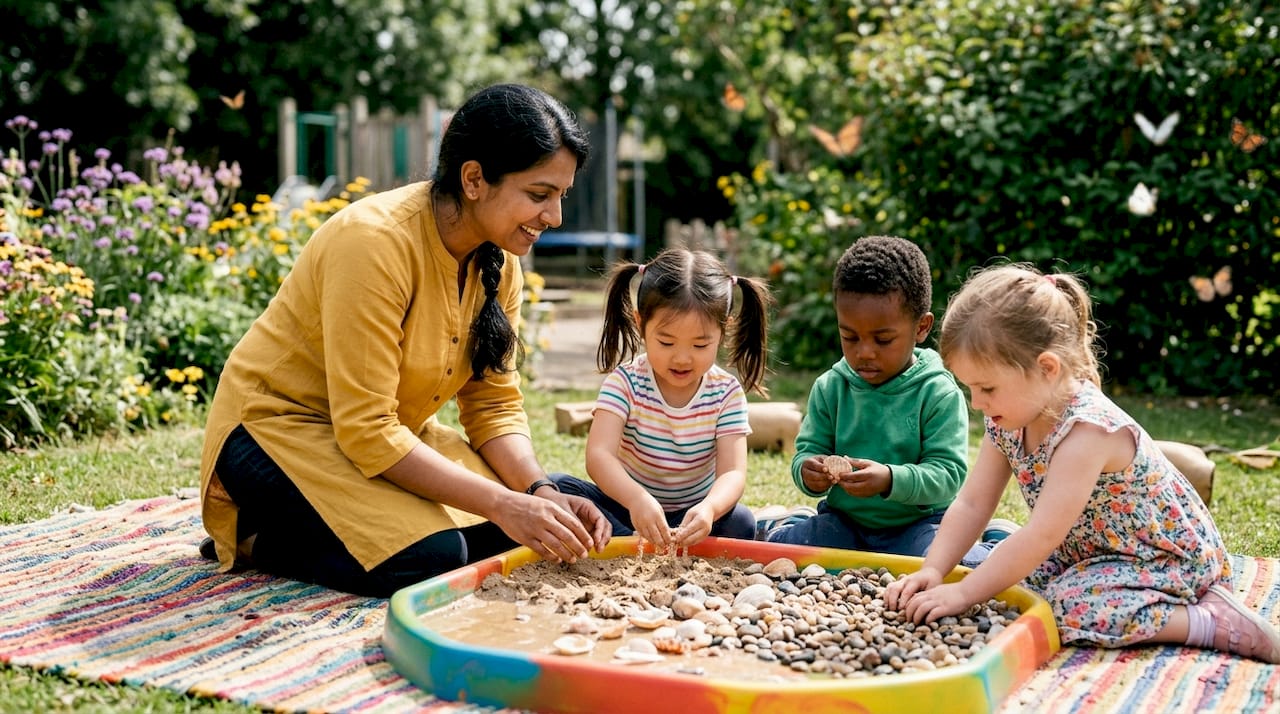
How sensory play builds memory and critical thinking
Engaging multiple senses simultaneously creates more memory links to words and concepts, which significantly boosts a child’s ability to retain and recall information. Think of it this way: a child who only hears the word “rough” stores one memory trace. A child who hears it while running fingers over bark stores a visual, tactile, and auditory trace simultaneously. That layered memory is far harder to forget.
- Sensory play with open-ended materials like ice and clay forces children to problem-solve without a fixed answer.
- Repeated sensory experiences train the brain to notice patterns, which underpins early mathematical thinking.
- Describing sensory experiences out loud, such as “this feels cold and slippery,” builds sentence structure and expressive language.
Pro Tip: Set up a simple “texture tray” with three or four contrasting materials, such as rice, wet sand, and smooth pebbles, and ask children to describe each one using at least two words. This single activity builds vocabulary, memory, and critical thinking at once.
How does sensory play support emotional regulation and social skills?
Sensory play reduces cortisol levels in children, producing a measurable calming effect that supports emotional regulation and kindergarten readiness. Cortisol is the body’s primary stress hormone. When it drops, children become more receptive to learning, more patient with peers, and better able to manage frustration. This is why many early years settings use water play or sand tables at the start of a session rather than at the end.
The physical act of squeezing, moulding, or pouring provides external sensory input that calms the nervous system from the outside in. Stress balls, kinetic sand, and water play all work on this principle. A child who cannot yet name their anxiety can still release it through the repetitive motion of kneading dough. That is self-regulation without requiring the child to have the vocabulary for it.
Sensory play also creates natural opportunities for social interaction. When two children share a water tray, they negotiate, take turns, and communicate about what they are doing. These are not incidental benefits. They are the direct result of placing children in a shared sensory environment.
- Shared sensory activities, such as building with wet sand, require children to communicate and cooperate.
- Tactile play helps children with heightened emotional responses find a physical outlet before they reach a tipping point.
- Group sensory activities build empathy, as children observe and respond to each other’s reactions.
Pro Tip: Introduce a shared “calm corner” in your classroom or home with a small tray of kinetic sand or a bowl of water beads. Children can visit it independently when they feel overwhelmed, building self-regulation as a habit rather than a reaction.
What physical benefits does sensory play offer children?
Sensory play builds physical skills through repetition. Repeated sensory activities develop muscle memory, balance, and coordination by engaging the body in natural, purposeful movements. Each time a child pours water between containers, they are refining hand-eye coordination. Each time they mould clay, they are strengthening the small muscles in their fingers that will later hold a pencil.
These physical gains are not trivial. Fine motor control underpins writing, drawing, and self-care tasks like fastening buttons. Gross motor skills, developed through larger sensory activities like digging in soil or splashing in puddles, support balance and spatial awareness. Children who develop these skills early show greater physical independence in everyday tasks.
- Pouring and scooping with sand or water refines hand-eye coordination and wrist control.
- Moulding and squeezing clay or dough strengthens finger muscles needed for writing.
- Digging and carrying in outdoor sensory environments builds arm strength and gross motor balance.
- Threading and sorting small natural objects, such as pebbles or shells, develops precision grip and concentration.
- Balancing on uneven natural surfaces during outdoor sensory play improves proprioception, the body’s sense of its own position in space.
The physical and neurological benefits of sensory play are inseparable. Every movement a child makes during sensory activity sends signals to the brain that reinforce neural pathways. The body and brain develop together through the same experience.
Which sensory materials and environments best support children’s learning?
The most effective sensory play uses open-ended natural materials, which allow children to assign their own purpose and thereby stimulate imagination and critical thinking. A plastic toy with one function teaches one skill. A tray of wet sand teaches physics, language, social negotiation, and fine motor control simultaneously. The difference is the absence of a fixed answer.
The Reggio Emilia philosophy describes the environment as a “third teacher”, placing it alongside the child and the adult as a key driver of learning. This approach advocates for materials that invite exploration rather than instruction. A well-designed sensory environment does not tell a child what to do. It creates conditions in which the child cannot help but investigate. Thezoofamily’s nature-inspired products follow this same logic, placing children in dialogue with the natural world rather than directing their attention.
Outdoor sensory play extends these benefits further. Sensory play in nature connects children to textures, sounds, and smells that no indoor tray can replicate. The unpredictability of natural environments, a rough stone, a cold stream, a patch of mud, forces children to adapt and respond in real time.
| Sensory material | Primary sense engaged | Key developmental benefit |
|---|---|---|
| Wet sand | Touch, sight | Fine motor control, creative expression |
| Water | Touch, hearing | Emotional regulation, cause-and-effect thinking |
| Clay or dough | Touch | Finger strength, vocabulary for texture and form |
| Ice | Touch, sight | Scientific curiosity, understanding of change |
| Natural objects (leaves, stones, shells) | Touch, sight, smell | Cognitive flexibility, language development |
- Rotate materials regularly to maintain novelty and challenge children’s thinking.
- Combine materials, such as adding water to sand or mixing clay with natural pigments, to increase complexity.
- Allow children to lead the activity without directing the outcome.
For parents looking to extend creative sensory experiences, paint-by-numbers kits offer a tactile, visually rich activity that builds concentration and fine motor skills alongside creative expression.
Key takeaways
Sensory play is the single most efficient way to build cognitive, emotional, physical, and social skills in young children simultaneously, because it engages the whole brain and body at once.
| Point | Details |
|---|---|
| Brain development | Sensory play promotes synapse firing and myelination, building the neural foundations for learning and self-regulation. |
| Language and memory | Engaging multiple senses at once creates layered memory traces, expanding vocabulary and recall significantly. |
| Emotional regulation | Sensory activities reduce cortisol levels, calming the nervous system and improving a child’s capacity to focus and self-regulate. |
| Physical skills | Repetitive sensory movements build muscle memory, fine motor control, and gross motor coordination. |
| Best materials | Open-ended natural materials like sand, clay, water, and ice produce the broadest developmental benefits across all domains. |
What I have learned from watching children play with sand
After years of observing children in early years settings, the benefit that surprises most parents is not the language development or the motor skills. It is the self-regulation. A child who arrives at nursery wound tight, unable to sit still or listen, will often spend ten minutes at a water tray and emerge visibly different. Calmer. More present. Ready to engage. That is not magic. It is the nervous system doing exactly what it is designed to do when given the right input.
The second thing I have noticed is how rarely adults need to intervene. The best sensory play is child-led. When a parent or educator steps back and resists the urge to direct, children go further, stay longer, and learn more. The instinct to guide is understandable, but it often cuts the experience short. A child left alone with a tray of ice and clay will eventually ask questions that no adult would have thought to pose.
The benefits that get overlooked most often are cognitive flexibility and the capacity for open-ended thinking. Children who regularly engage with imaginative, open-ended play develop a tolerance for ambiguity that serves them throughout their education. They become children who try things, fail, adjust, and try again. That disposition is worth more than any single skill.
My honest advice: do not wait for the perfect setup. A bowl of water, a handful of dried pasta, and fifteen minutes of uninterrupted time is enough to make a difference. Consistency matters far more than complexity.
— ALAIN
Thezoofamily and the world of sensory exploration
Thezoofamily was built on the belief that children learn best when they are genuinely connected to the natural world around them.
Every product Thezoofamily creates, from kids’ cameras to binoculars and walkie-talkies, is designed to put a child’s senses at the centre of their play. The animal-inspired designs are not decoration. They are an invitation to look closer, listen harder, and engage more deeply with the environment. For every camera sold, Thezoofamily plants one tree, because the natural world that makes sensory play so powerful is worth protecting. Parents and educators who want to go further with natural sensory play will find a growing library of ideas, research, and activities at Thezoofamily.
FAQ
What is sensory play, exactly?
Sensory play is any activity that engages one or more of a child’s five senses through direct, hands-on experience. Common examples include water play, sand play, clay moulding, and outdoor exploration with natural materials.
At what age should children start sensory play?
Sensory play is appropriate from birth. Babies engage through touch, taste, and sound, while toddlers and pre-schoolers benefit most from structured sensory activities with materials like sand, water, and clay.
How does sensory play help children with sensory processing differences?
Sensory activities provide a controlled environment where children with sensory processing differences can explore at their own pace, building confidence and reducing anxiety without pressure or overstimulation.
How often should children engage in sensory play?
Daily sensory play produces the strongest developmental outcomes. Even short sessions of 10–15 minutes with open-ended materials support neural pathway development, language growth, and emotional regulation consistently over time.
Is sensory play only beneficial for young children?
Sensory play delivers the greatest neurological benefit during the early years, when the brain is most plastic. However, sensory-rich activities continue to support focus, creativity, and emotional regulation well into primary school age.