

Light pollution has quietly transformed our night skies into glowing blankets of artificial light. Across the world, over 80 percent of people now live under skies polluted by excessive brightness, unable to see the true darkness once celebrated by generations past. Yet what catches most off guard is that this widespread glow does not just spoil stargazing. Its real danger lies in disrupting the delicate rhythms of both nature and our own bodies in ways few ever imagine.
Table of Contents
- What Is Light Pollution And Why Should We Care?
- The Science Behind Light Pollution: How It Affects Our Environment
- The Impact Of Light Pollution On Health And Wildlife
- Practical Solutions To Reduce Light Pollution In Your Community
Quick Summary
| Takeaway | Explanation |
|---|---|
| Light pollution disrupts natural ecosystems. | Excessive artificial lighting interferes with nocturnal species’ behaviors, affecting their survival and reproduction patterns. |
| Human health is impacted by artificial lighting. | Prolonged exposure to light at night can lead to sleep disorders and increased risks of anxiety and metabolic issues. |
| Implement directional lighting to reduce pollution. | Using fixtures that direct light downward can minimise unnecessary brightness and enhance safety without disrupting darkness. |
| Advocate for dark sky policies in communities. | Support initiatives that promote reduced outdoor lighting and the creation of designated dark sky areas for ecological preservation. |
| Choose lower intensity and warmer lighting options. | Opting for less intense lights can reduce glare and light trespass while still providing necessary illumination. |
What is Light Pollution and Why Should We Care?
Light pollution represents a significant environmental challenge that transforms our natural nightscape into an artificially illuminated environment. Dark Sky International defines this phenomenon as the excessive, misdirected, or inappropriate use of outdoor lighting that disrupts the natural darkness of our planet.
Understanding Light Pollution
At its core, light pollution occurs when human-made lighting extends beyond its intended purpose, creating unnatural brightness in areas that should remain dark. This includes street lamps casting light into residential windows, commercial signs glowing throughout the night, and industrial facilities using excessively powerful illumination that spreads far beyond their operational boundaries.
Below is a table summarising the four main types of light pollution and their effects, helping readers clearly distinguish each concept and its impact.
| Type of Light Pollution | Description | Typical Effects on Environment and Humans |
|---|---|---|
| Skyglow | Brightening of the night sky over inhabited areas | Obscures stars and constellations, diminishes natural darkness for humans and wildlife |
| Glare | Excessive brightness causing visual discomfort | Reduces visibility and safety, contributes to eye strain |
| Light Trespass | Unwanted light spilling into unintended areas | Disrupts sleep, invades private property, affects residents and nearby ecosystems |
| Clutter | Confusing grouping of bright light sources | Distracts and overwhelms the senses, creates unsafe urban or roadside conditions |
Key characteristics of light pollution include:
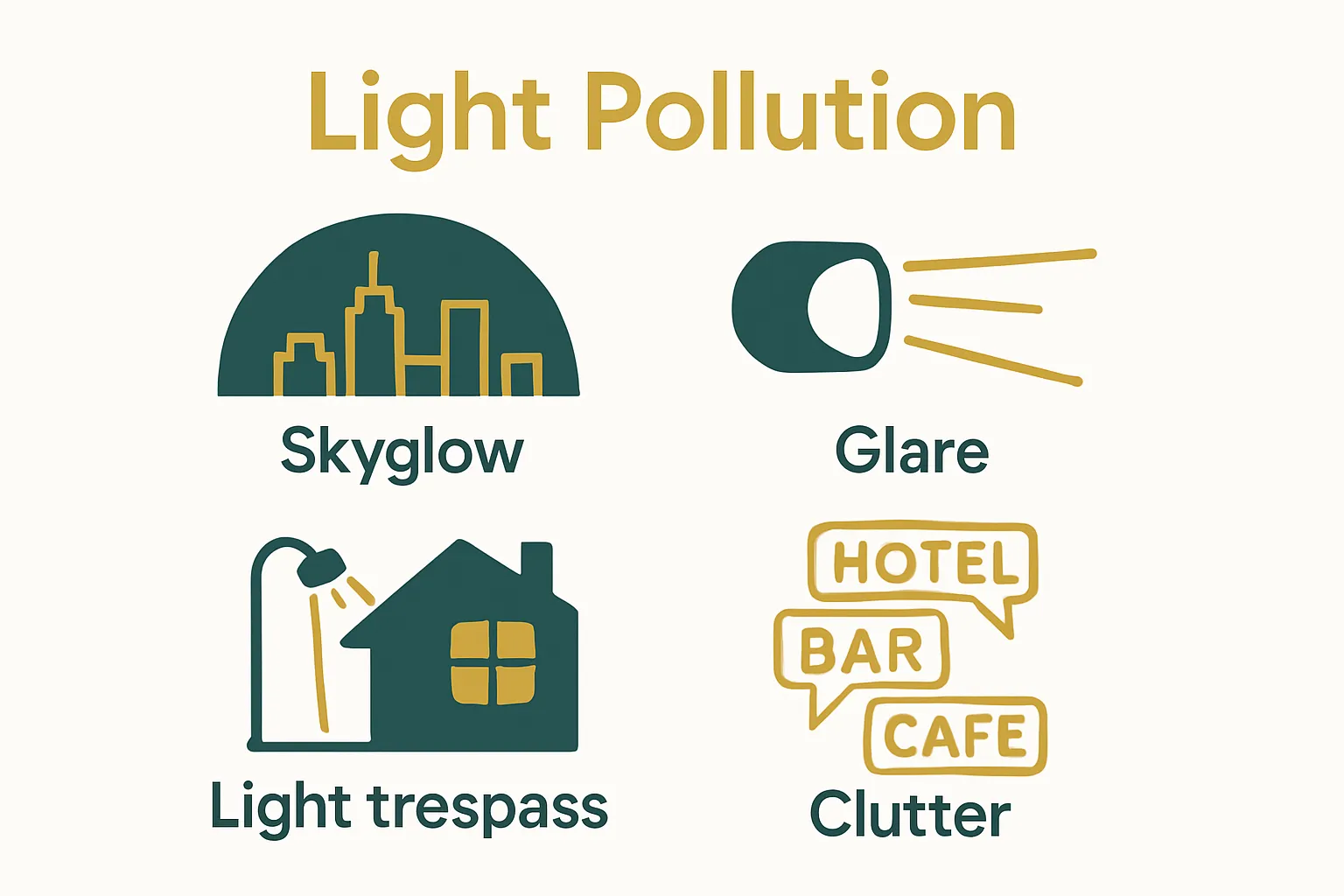
- Skyglow: The brightening of the night sky over inhabited areas
- Glare: Excessive brightness causing visual discomfort
- Light trespass: Unwanted light falling outside intended areas
- Clutter: Bright, confusing clustering of light sources
Environmental and Health Consequences
Light pollution is not merely an aesthetic problem but a profound ecological and human health concern. Artificial night lighting disrupts natural biological rhythms for both humans and wildlife. Nocturnal animals like bats, owls, and insects rely on darkness for navigation, hunting, and reproduction. National Geographic reports that excessive artificial light can disorient migratory birds, interfere with marine ecosystems, and potentially contribute to declining biodiversity.
For humans, prolonged exposure to artificial light during nighttime can disrupt circadian rhythms, potentially leading to sleep disorders, increased stress levels, and even higher risks of certain health conditions.
The table below outlines the major health and ecological impacts of light pollution on humans and wildlife, providing a concise comparison for better understanding.
| Impact Area | Specific Effects on Humans | Specific Effects on Wildlife |
|---|---|---|
| Circadian Rhythm Disruption | Sleep disorders, reduced melatonin, increased stress | Disorientation, altered migration, disrupted reproductive cycles |
| Physical Health | Higher risk of metabolic issues and anxiety | Hormonal imbalances, navigation problems, decreased survival rates |
| Reproduction | Potential sleep-related reproductive disruption | Sea turtle disorientation, firefly mating decline, impaired breeding |
| Behaviour | Mood disturbances, reduced wellbeing | Altered hunting strategies, changes in feeding and predator-prey dynamics |
| Biodiversity | Indirectly contributes to urban ecosystem imbalance | Biodiversity loss, population declines in light-sensitive species |
By understanding light pollution, we can take meaningful steps to mitigate its widespread environmental and personal health impacts, preserving the natural beauty of our nocturnal world and supporting ecological balance.
The Science Behind Light Pollution: How It Affects Our Environment
Light pollution is far more than a simple visual nuisance. It represents a complex environmental phenomenon with intricate scientific implications that transform our natural ecosystems and biological systems. NASA Earth Observatory highlights how artificial lighting fundamentally alters our planet’s natural rhythms.
Ecological Disruption Mechanisms
The scientific understanding of light pollution reveals profound interconnections between artificial illumination and ecological systems. Organisms evolved over millions of years with predictable light-dark cycles, and sudden changes to these patterns trigger significant biological responses. Nocturnal and diurnal species rely on specific light wavelengths to regulate critical life processes such as migration, reproduction, and metabolic functions.
Key ecological disruption mechanisms include:
- Circadian Rhythm Interference: Artificial light disrupts natural day-night biological cycles
- Predator-Prey Dynamics: Changed light conditions alter hunting and survival strategies
- Reproductive Cycle Modifications: Light pollution can interrupt mating and breeding patterns
Physiological Impact on Wildlife
Wildlife experiences dramatic physiological transformations under persistent artificial lighting. Current Biology Research00222-2) demonstrates that nocturnal creatures experience significant hormonal and neurological changes when exposed to artificial light. Migratory birds become disoriented, insects alter their navigation patterns, and marine organisms experience profound reproductive challenges.
For example, sea turtle hatchlings naturally navigate towards moonlight reflected on ocean waters. Artificial coastal lighting frequently misdirects these young creatures, leading them away from their marine habitat and towards potentially fatal terrestrial environments. Similarly, nocturnal pollinators like moths experience substantial navigation difficulties, potentially compromising entire ecosystem food chains.
Understanding these scientific mechanisms helps us recognize light pollution as a critical environmental challenge requiring comprehensive, scientifically informed mitigation strategies.
The Impact of Light Pollution on Health and Wildlife
Light pollution extends far beyond environmental aesthetics, presenting profound implications for both human wellness and wildlife survival. World Health Organization recognizes artificial night lighting as a significant emerging health concern with complex biological consequences.
Human Health Disruptions
Prolonged exposure to artificial night lighting dramatically influences human physiological and psychological functioning. Our biological systems operate on intricate circadian rhythms calibrated through centuries of natural light-dark cycles. When these cycles are disrupted, multiple health challenges emerge, impacting everything from hormonal balance to neurological functioning.
Key human health disruptions include:
- Melatonin Suppression: Reduced natural sleep hormone production
- Metabolic Disorders: Increased risks of obesity and diabetes
- Psychological Stress: Higher likelihood of anxiety and depression
Wildlife Survival Challenges
For wildlife, artificial night illumination represents an existential threat. Many species rely on precise light patterns for navigation, reproduction, and survival strategies. National Wildlife Federation reports that excessive artificial lighting fundamentally alters ecological interactions, creating cascading environmental challenges.
Ecosystem impacts manifest through complex mechanisms. Nocturnal predators struggle to hunt effectively, migratory birds become disoriented during long-distance travels, and marine organisms experience significant reproductive disruptions. Insects, critical for pollination and food chains, become particularly vulnerable when natural darkness is compromised.
Particularly striking are the reproductive challenges faced by numerous species. Sea turtle hatchlings, normally guided by moonlight’s natural reflection, become fatally misdirected by artificial coastal lighting. Fireflies, whose intricate mating communications depend on precise light signaling, experience substantial population decline in brightly illuminated environments.
Understanding these nuanced health and ecological impacts underscores the urgent need for responsible, scientifically informed lighting practices that respect both human and wildlife biological requirements.
Practical Solutions to Reduce Light Pollution in Your Community
Addressing light pollution requires collective action and strategic implementation of environmentally conscious lighting practices. International Dark-Sky Association provides comprehensive guidance for individuals and communities seeking meaningful change.
Community and Residential Lighting Strategies
Reducing light pollution begins with thoughtful lighting design and conscious illumination choices. Homeowners and community planners can implement several practical approaches to minimise unnecessary artificial lighting while maintaining safety and functionality.
Key residential and community strategies include:
- Directional Lighting: Use fixtures that point downward and limit light spread
- Motion Sensor Installations: Activate lights only when necessary
- Lower Intensity Alternatives: Choose warmer, lower-lumen lighting options
Technological and Policy Interventions
Effective light pollution reduction requires both technological innovation and supportive municipal policies. Zoofamily’s environmental guide emphasises the importance of educating communities about sustainable lighting practices.
Municipalities can lead transformative efforts by:
- Implementing dark sky ordinances
- Retrofitting public infrastructure with adaptive lighting technologies
- Creating designated dark sky preservation zones
Technological solutions like intelligent LED systems with adjustable brightness and colour temperatures offer promising avenues for reducing unnecessary illumination. These smart lighting technologies can automatically adjust based on environmental conditions, significantly minimising light pollution while maintaining essential visibility.
Individuals can contribute by advocating for responsible lighting policies, conducting neighbourhood awareness campaigns, and making conscious choices about outdoor and indoor lighting installations.
Here is a table outlining practical solutions for reducing light pollution at both community and policy levels, offering a clear overview of strategies and their primary benefits.
| Solution Type | Example Actions | Key Benefits |
|---|---|---|
| Directional Lighting | Downward-facing fixtures, shielded lamps | Reduces skyglow and light trespass |
| Motion Sensors | Lights activated only when movement is detected | Minimises unnecessary illumination |
| Lower Intensity Lighting | Use of warm, low-lumen bulbs | Lowers glare and energy waste |
| Dark Sky Ordinances | Municipal bans on excessive or misdirected lighting | Preserves natural dark areas |
| Smart Lighting Technology | Adaptive LED systems and automatic adjustments | Maintains safety and reduces pollution |
| Community Initiatives | Neighbourhood awareness campaigns | Promotes local engagement |
Give Your Children Brighter Nights and a Healthier Planet
Are you concerned about the growing impact of light pollution discussed in this article? The loss of natural darkness affects not only wildlife but also the well-being and sleep patterns of families everywhere. If you want your children to connect with the wonders of nature while learning the value of protecting our environment, your everyday choices matter.

Explore the unique selection of kids’ cameras, binoculars, and walkie-talkies at The Zoofamily. Each product features animal-inspired designs to engage children’s curiosity and build a love for nature, helping them understand issues like light pollution in a personal way. For every camera you buy, we plant a tree. Help us restore natural beauty and empower future generations to protect our world. Visit The Zoofamily nature-inspired shop now and take part in creating a healthier planet—every action taken today brightens tomorrow.
Frequently Asked Questions
What is light pollution?
Light pollution refers to the excessive, misdirected, or inappropriate use of outdoor lighting that disrupts the natural darkness of our environment, resulting in an artificial brightness in areas that should remain dark.
What are the main types of light pollution?
The main types of light pollution include skyglow, glare, light trespass, and clutter, each affecting visibility and the natural environment in different ways.
How does light pollution affect wildlife?
Light pollution disrupts the natural behaviours and circadian rhythms of wildlife, leading to issues such as disorientation in migratory birds, altered hunting and breeding patterns in nocturnal animals, and significant reproductive challenges in various marine organisms.
What can individuals do to reduce light pollution in their communities?
Individuals can help reduce light pollution by using directional lighting, installing motion sensors, opting for warmer and lower-intensity lighting options, and advocating for responsible lighting policies within their community.