

Eco friendly carpet cleaning is the practice of using non-toxic, biodegradable products and methods to remove dirt, allergens, and stains from carpets without releasing harmful chemicals into your home or the wider environment. For households with young children, pets, or anyone sensitive to indoor air quality, this approach is not a luxury. It is the standard that certified bodies like Green Seal and the EPA Safer Choice programme have spent years defining. The two most common professional methods are hot water extraction and low-moisture encapsulation, and each carries distinct advantages depending on your schedule, carpet type, and sustainability priorities.
What do Green Seal certifications actually mean for carpet cleaning products?
Green Seal certification is the most credible independent standard for evaluating whether a carpet cleaning product or service genuinely meets environmental and health criteria. The organisation publishes specific standards: GS-37 covers commercial cleaning services, while GS-52 and GS-53 address cleaning products and systems. These are not marketing labels. They require third-party verification and ongoing compliance audits.
One of the most significant criteria is the prohibition of PFAS chemicals. No intentionally added PFAS appear in Green Seal certified products, which matters because PFAS compounds accumulate in the body and persist in the environment for decades. Choosing a certified product is a direct way to remove that exposure from your home.
The certification also connects to broader sustainability goals. Green Seal certified products can contribute to up to 5% of LEED certification points for sustainable building operation. That figure signals that these standards carry weight beyond individual households and are recognised at an institutional level.
The practical lesson for homeowners is straightforward:
- Look for the Green Seal or EPA Safer Choice logo on any product label before purchasing.
- Ask professional cleaners to name the specific certification standard their products meet, not just claim they are “green” or “natural.”
- Avoid products that use vague language like “eco-conscious formula” without a verifiable third-party certification.
- Check that the certification is current. Green Seal publishes its certified product list online, so verification takes under two minutes.
“Greenwashing is rampant in the cleaning industry. A product labelled ‘natural’ can still contain petrochemicals and synthetic fragrances. Certification is the only reliable filter.”
The distinction between certified products and vague green claims protects your family and prevents you from paying a premium for something that delivers no real benefit.
Hot water extraction vs low-moisture encapsulation: which is better?
The two dominant methods in professional green carpet cleaning differ primarily in water use, drying time, and the type of soiling they handle best.
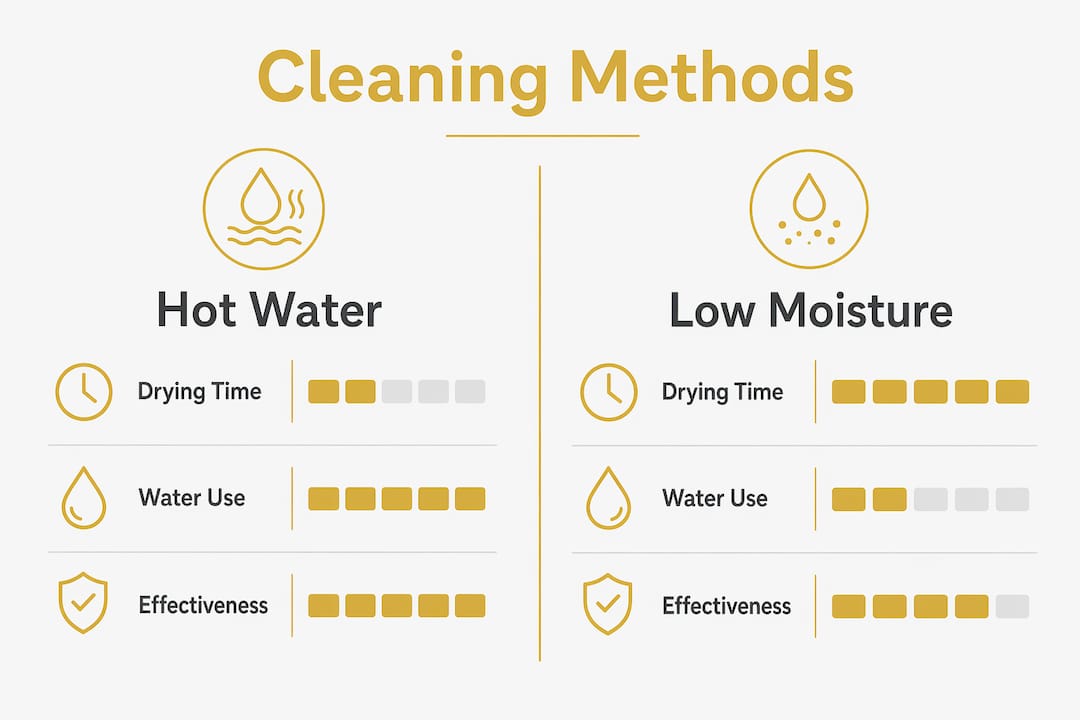
Hot water extraction injects hot water into carpet fibres at pressure and immediately recovers it along with loosened soil. This method sanitises through heat and extraction rather than chemical action, which reduces the volume of cleaning agents needed. It is the preferred choice for deep cleaning heavily soiled carpets, pet accidents, and allergen removal.
Low-moisture encapsulation uses a polymer-based solution that surrounds soil particles and crystallises them as it dries. The crystallised residue is then vacuumed away. It uses significantly less water and is better suited to maintenance cleaning between deep cleans.
| Feature | Hot water extraction | Low-moisture encapsulation |
|---|---|---|
| Drying time | 6 to 12 hours | Under 2 hours |
| Best for | Heavy soiling, allergens, pet stains | Maintenance cleaning, high-traffic areas |
| Water usage | Higher | Significantly lower |
| Chemical reliance | Low (heat does the work) | Moderate (polymer solution required) |
| Suitable for wool | With care | Generally safer |
Drying time is the key practical constraint when choosing between these methods. A family with young children who crawl on the floor cannot wait 12 hours before re-occupying a room. In that case, encapsulation is the more practical choice for routine maintenance, with hot water extraction reserved for annual deep cleans.
Pro Tip: Open windows and run a dehumidifier or HVAC fan during and after hot water extraction. Prolonged dampness in thick-pile carpets risks mould growth and fibre damage, which undermines the entire point of a careful clean.
For families with pets, hot water extraction remains the gold standard for removing embedded dander and odour. The heat penetrates the carpet backing in a way that encapsulation cannot match.
Are eco-friendly carpet cleaning products actually effective?
The short answer is yes, provided you choose products with verified formulations rather than marketing claims. Plant-based carpet shampoos that exclude sulfates, phosphates, and petrochemicals are safe for grey water and septic systems and perform comparably to conventional products on everyday soiling. Puracy, for example, produces a concentrated formula at four times standard strength, which reduces packaging waste and transport emissions alongside the cleaning benefit.
DIY options like white vinegar and lemon juice have genuine utility for light stains and odour neutralisation, but they carry limits. Vinegar is acidic and can affect certain dye lots in wool or natural fibre carpets. Always spot-test on a hidden area before applying any solution to a visible section.
Baking soda is widely recommended as a deodoriser, and it works. However, baking soda should be used sparingly and vacuumed thoroughly, particularly on dense or wool carpets. Residue that accumulates in the pile over repeated applications can make professional deep cleaning harder and may damage fibres over time.
Here are the ingredients to avoid in any carpet cleaning product you bring into your home:
- Optical brighteners (synthetic chemicals that remain in fibres and can irritate skin)
- Synthetic fragrances (often contain undisclosed phthalates)
- Chlorine bleach (toxic fumes, harmful to aquatic life when disposed of)
- Phosphates (contribute to water body eutrophication)
- Petrochemical solvents (volatile organic compounds that off-gas into indoor air)
Pro Tip: Dilution matters as much as ingredients. A concentrated plant-based formula used at the correct dilution ratio is both more effective and less wasteful than a pre-diluted conventional product used at full strength.
For a broader view of sustainable floor care beyond carpets, the eco-friendly floor cleaning guide from Thezoofamily covers hard surfaces alongside soft furnishings.
How to prepare for and maintain eco-friendly carpet cleaning at home
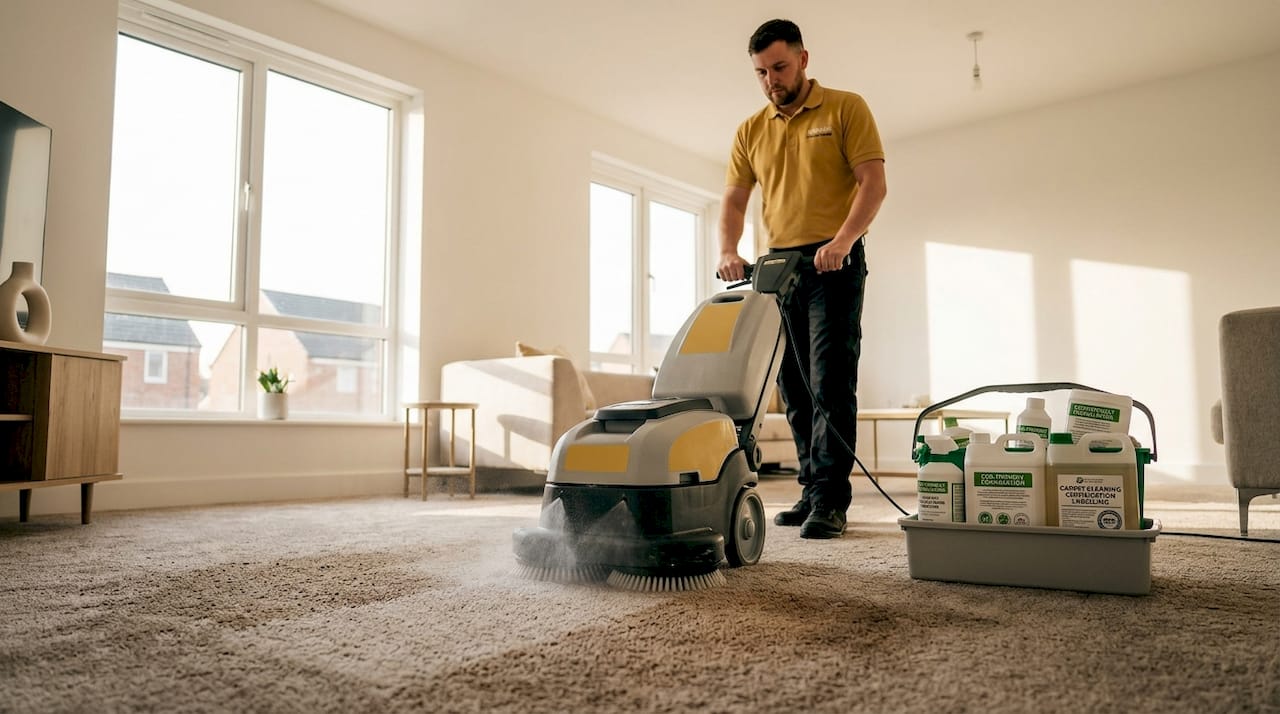
Preparation determines how effective any carpet cleaning visit will be, and it also affects drying time. A professional cleaning visit typically lasts one to two hours onsite, but the scheduling window you need to plan around is the drying period that follows.
Follow these steps to get the most from a professional eco-friendly clean:
- Vacuum thoroughly the day before. Removing loose debris before the professional arrives allows the cleaning method to focus on embedded soil rather than surface dust.
- Move lightweight furniture off the carpet. Chairs, side tables, and lamps should be relocated. Leave heavy items like sofas in place and ask the cleaner to work around them.
- Identify problem areas in advance. Note pet stains, high-traffic paths, and any spots where previous cleaning products were applied. This helps the cleaner choose the right pre-treatment.
- Plan for ventilation. Open windows in the rooms being cleaned and set ceiling fans to run on low. If you have a dehumidifier, position it in the room before the cleaner arrives.
- Keep children and pets out of the area during and after cleaning. Certified products eliminate toxic fumes associated with conventional cleaning, but wet carpets still present a slip hazard and should be avoided until fully dry.
- After drying, vacuum again. This lifts the carpet pile and removes any crystallised residue from encapsulation methods, restoring texture and appearance.
For ongoing maintenance between professional visits, vacuum at least twice a week in high-traffic areas and treat fresh spills immediately with a diluted plant-based solution. Periodic spot treatments extend the life of a professional clean by months. For practical tips tailored to busy households, the eco cleaning tips resource from Thezoofamily offers a useful framework.
When speaking with a professional cleaner, ask directly which certification standard their products meet and request the product name so you can verify it independently. A cleaner committed to genuine sustainable carpet care will answer without hesitation.
Key takeaways
Eco friendly carpet cleaning works when you combine certified products, the right method for your carpet type, and proper preparation before and after each clean.
| Point | Details |
|---|---|
| Certification is non-negotiable | Green Seal (GS-37, GS-52/53) and EPA Safer Choice are the only reliable markers of a genuinely safe product. |
| Method choice depends on drying time | Hot water extraction takes 6 to 12 hours; encapsulation dries in under 2 hours. Match the method to your schedule. |
| DIY options have real limits | Baking soda and vinegar work for light maintenance but can damage wool fibres or leave residue if overused. |
| Preparation multiplies results | Vacuuming before, managing ventilation during, and vacuuming again after significantly improves cleaning outcomes. |
| Greenwashing is common | Vague claims like “natural” or “eco-conscious” mean nothing without a named, verifiable third-party certification. |
Why I stopped trusting “green” labels and started checking certification numbers
I spent years assuming that if a product was sold in a health food shop or carried a leaf logo, it was safe. That assumption was wrong. The first time I asked a carpet cleaning company to name the specific Green Seal standard their products met, they could not answer. They used the word “eco” four times in their response and named none of their products. That conversation changed how I approach every cleaning decision in my home.
The families I speak with most often underestimate how much indoor air quality is affected by carpet cleaning products. Conventional formulas off-gas volatile organic compounds for hours after application. Children who play on the floor are the most exposed. Switching to certified non-toxic cleaning is not a lifestyle statement. It is a direct health intervention.
I have also found that hot water extraction, done correctly with proper ventilation, outperforms every DIY method I have tried for deep cleaning. The drying time concern is real, but manageable. Scheduling a clean on a warm, low-humidity day and running a dehumidifier overnight solves the problem in most homes. The families who tell me eco cleaning “doesn’t really work” are usually comparing a certified product used at the wrong dilution against a conventional product used at full strength. The comparison is not fair.
My advice: ask for the certification number, not the brand story. Verify it on the Green Seal website before the cleaner arrives. That single step separates genuine sustainable carpet care from expensive marketing.
— ALAIN
How Thezoofamily supports safer, greener homes
Thezoofamily was built on the belief that protecting the natural world starts at home, and that means the products you use on your floors matter as much as the ones you use outdoors.
The Thezoofamily approach to eco-friendly home cleaning centres on non-toxic, biodegradable formulas that are tested for safety around children and pets. Every product recommendation is grounded in the same certification standards covered in this guide: Green Seal, EPA Safer Choice, and verified PFAS-free formulations. Whether you are looking for professional-grade guidance or practical home care advice, Thezoofamily provides resources designed for families who refuse to compromise between a clean home and a healthy one. For professional floor cleaning services that meet verified eco standards, ACT Cleaning by Demand offers credentialled options worth exploring.
FAQ
What is eco friendly carpet cleaning?
Eco friendly carpet cleaning uses non-toxic, biodegradable products and methods such as hot water extraction or low-moisture encapsulation to clean carpets without releasing harmful chemicals. Certified standards like Green Seal and EPA Safer Choice define what qualifies as genuinely safe.
How long does eco-friendly carpet cleaning take to dry?
Hot water extraction takes between 6 and 12 hours to dry fully, depending on pile thickness and humidity. Low-moisture encapsulation methods dry in under 2 hours, making them the better choice when you need the room back quickly.
Is baking soda safe to use on carpets?
Baking soda deodorises effectively but should be used sparingly and vacuumed out thoroughly. Repeated use on dense or wool carpets causes residue build-up that can damage fibres and complicate future professional cleaning.
How do I know if a carpet cleaning product is genuinely eco-friendly?
Look for a named, verifiable certification such as Green Seal or EPA Safer Choice on the label. Vague terms like “natural” or “plant-based” carry no regulatory weight without a third-party certification number you can check independently.
Can eco-friendly carpet cleaning remove pet stains and odours?
Yes. Hot water extraction using certified non-toxic products penetrates carpet backing and removes embedded pet dander, urine, and odour effectively. The heat does the heavy work, reducing the need for chemical agents.