

Story stones are painted or decorated pebbles used to inspire children’s storytelling, imaginative play, and language development. They are one of the most accessible creative storytelling stones available to parents today, requiring nothing more than smooth rocks, a few art supplies, and a child’s curiosity. According to Little Pioneers, story stones need only 10–20 pebbles and basic materials like paint markers or decoupage glue to get started. What makes them remarkable is their open-ended nature. A single stone painted with a fox can become a hero, a villain, or a bystander depending entirely on the child holding it.
1. What makes story stones for creativity so effective?
Story stones work because they place creative control entirely in the child’s hands. Unlike picture books or structured games, they carry no fixed narrative. A child who picks up three stones showing a castle, a dragon, and a rainstorm must invent the connections herself. That act of invention is where the real developmental work happens.
The open-ended nature of these storytelling tools for kids supports several areas of growth at once:
- Language development: Children practise vocabulary, sentence structure, and narrative flow as they describe what is happening on each stone.
- Sequencing: Arranging stones in order teaches beginning, middle, and end thinking, a foundation for literacy.
- Problem-solving: When a story reaches a dead end, children must think laterally to resolve it.
- Associative thinking: Diverse images push children to make unexpected connections between unrelated ideas.
Random selection boosts flexible thinking in younger children, while intentional selection aids sequencing and narrative planning in children aged five and above. This means the same set of stones can serve a three-year-old and a seven-year-old in meaningfully different ways. The activity scales with the child rather than becoming obsolete.
Children who use story stones transition from passive readers to active story authors, building confidence and narrative skills that carry into formal literacy. That shift from consumer to creator is the core of what makes this activity so valuable.
2. Animal and nature themes
Animal-themed stones are the most popular starting point for good reason. Children connect instinctively with creatures, and a set featuring a hedgehog, an owl, a fox, and a badger gives immediate storytelling material rooted in the natural world. Paint each animal in its natural habitat on the reverse side to add a second layer of prompting.
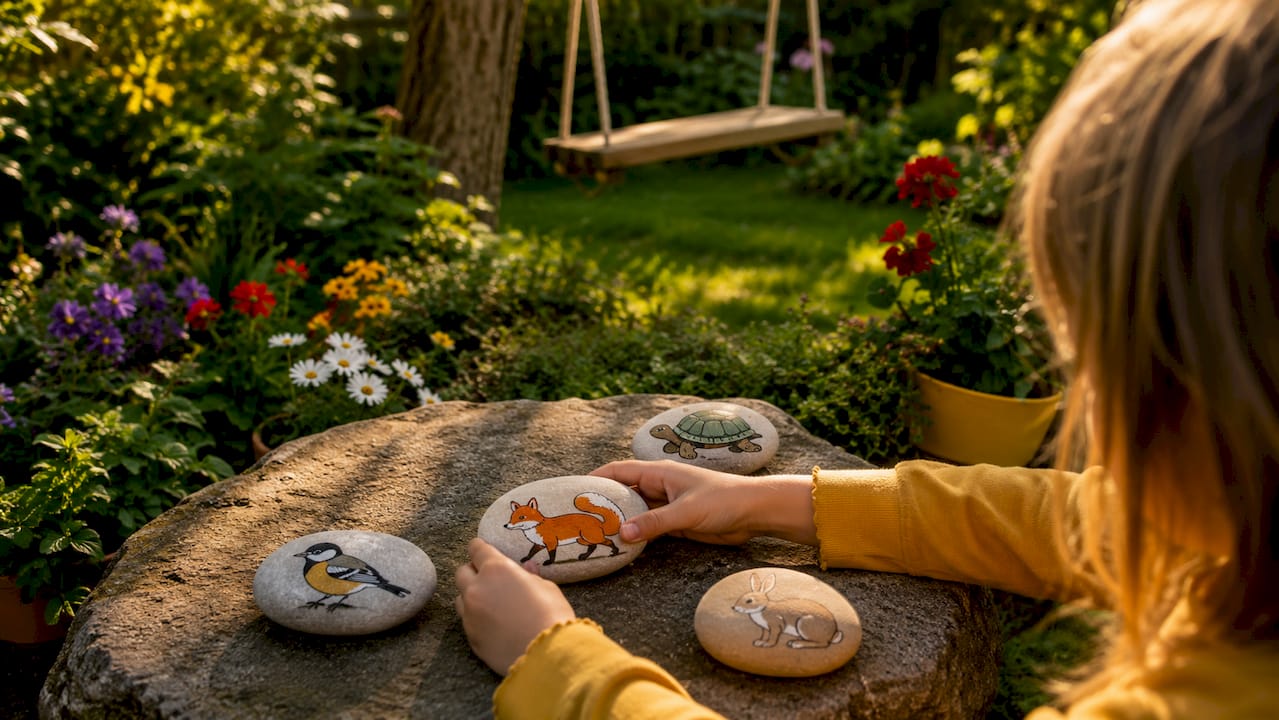
Nature themes extend beyond animals. Stones painted with a sun, a cloud, a raindrop, and a snowflake let children build weather-driven narratives or seasonal stories. This works especially well alongside outdoor play. Thezoofamily’s approach to connecting children with nature makes animal-themed stones a natural fit for families who already use wildlife-inspired toys and activities.
Pro Tip: Collect stones with your child on a walk before painting them. Gathering stones together adds a sensory, nature-based dimension that builds ownership and excitement before the craft even begins.
3. Fantasy and adventure motifs
Dragons, wizards, treasure chests, and enchanted forests give children the raw material for epic narratives. Fantasy stones are particularly effective for children who find everyday topics uninspiring. A stone painted with a sword and another with a locked door can generate twenty minutes of uninterrupted storytelling from a reluctant talker.
Adventure motifs work well in combination with animal stones. A brave mouse, a mysterious cave, and a golden key create a complete story arc from just three pieces. Keep the images bold and simple so the child’s imagination fills in the detail rather than the stone doing it for them.
4. Everyday objects and emotions
Stones painted with familiar objects, a bicycle, a lunchbox, a telephone, ground storytelling in the child’s real world. These are ideal for younger children or those who find abstract themes overwhelming. Emotion stones showing faces expressing happiness, sadness, surprise, and anger are particularly useful for children who are developing emotional vocabulary.
Emotion stones serve a dual purpose. They support storytelling and they open conversations about feelings in a low-pressure way. A child who struggles to say “I felt left out today” may find it easier to pick up the sad-face stone and build a story around it. This makes them one of the most versatile artistic stone storytelling tools available to caregivers.
5. Comic-style story stones
Comic panel stones are a structured variation that bridges verbal play and early writing skills. Each stone represents a single panel in a sequence: an establishing scene, a problem, a turning point, and a resolution. Structured storytelling tools like comic panel templates help children move from spoken narrative to written literacy with confidence.
To make comic-style stones, paint a simple border on each one to suggest a panel frame. Inside, add a single image or character. Children arrange the panels in sequence, narrate the story aloud, and can then write or dictate the words for each panel. This is an excellent activity for children aged six and above who are beginning to write independently.
6. Transportation and journey themes
Trains, boats, aeroplanes, and cars painted on stones inspire journey narratives. Where are we going? Who is on board? What happens along the way? Journey stories have a natural structure, departure, travel, arrival, which makes them ideal for teaching sequencing to younger children.
Pair transportation stones with destination stones showing a mountain, a beach, a city, or a forest. The child draws a destination stone at random and must plan the journey to get there. This random selection approach boosts flexible thinking and keeps the activity fresh across multiple play sessions.
7. Seasonal and celebration stones
A set of seasonal stones gives children a storytelling activity that evolves throughout the year. Autumn leaves, winter snowflakes, spring flowers, and summer suns each carry a distinct mood and vocabulary. Celebration stones, featuring birthday cakes, fireworks, or lanterns, connect storytelling to family events and cultural traditions.
Seasonal stones are also a practical way to refresh a collection without starting from scratch. Adding four or five new stones each season keeps the activity feeling new. Children who helped paint the original set will take particular pride in contributing to the seasonal additions.
8. DIY story stones: a step-by-step guide
Making your own stones is straightforward. DIY creation requires minimal materials: smooth pebbles, paint markers, acrylic paint, and a coat of decoupage glue or clear varnish to seal the finished design. The process takes anywhere from 30 minutes to several hours depending on the complexity of the images.
- Collect and clean your stones. Choose smooth, flat pebbles with an even surface. Wash them thoroughly and allow them to dry completely before painting.
- Apply a white base coat. A single coat of white acrylic paint makes colours appear brighter and more vivid on dark stone surfaces.
- Draw or paint your images. Paint markers work well for detailed line work. Acrylic paint with a fine brush suits bolder designs. All artistic styles are equally valid, from detailed illustrations to simple symbols.
- Involve your child at every stage. Younger children can colour in shapes while you handle the finer details. The creation process itself develops fine motor skills and concentration.
- Seal with varnish or decoupage glue. Two coats of clear sealant protect the design and make the stones safe for handling by small hands.
- Store in a canvas bag. A compact bag keeps the set together and makes it a portable, screen-free activity for travel and waiting times.
Pro Tip: If your child is under four, skip the fine paintbrush and use chunky paint markers or stickers instead. Speed and simplicity keep young children engaged through the whole process.
For more craft inspiration, Thezoofamily’s guide to recycled art projects for children pairs beautifully with a stone-making session.
9. How to use story stones to nurture storytelling skills
The way you introduce story stones matters as much as the stones themselves. Allowing free verbal storytelling first leads to stronger engagement before moving to written or more complex tasks. Start by spreading the stones face-up and inviting your child to pick three at random. Ask only one question: “What happens next?”
Practical activities that work well with a story stones activity include:
- Storytelling circles: Each person in a group picks one stone and adds a sentence to a shared story. This works for siblings, classrooms, or family game nights.
- Retelling familiar stories: Ask your child to retell a known story, such as The Gruffalo or Goldilocks, using only the stones available. The constraint sparks creative problem-solving.
- Story mapping: Lay stones in a line to map out a plot. This visual approach supports children who think spatially rather than verbally.
Placing stones in an accessible, low-pressure area invites spontaneous play throughout the day. A small basket on a low shelf is all it takes. Children who encounter the stones casually are more likely to pick them up independently than those who only see them during structured activity time.
| Approach | Best for |
|---|---|
| Random selection | Children aged 3–5, building flexible thinking |
| Intentional sequencing | Children aged 5+, developing narrative structure |
| Comic panel layout | Children aged 6+, bridging verbal and written skills |
| Group storytelling circle | Mixed ages, building collaborative language |
For ideas on taking the activity outdoors, Thezoofamily’s guide to outdoor group storytelling for kids offers practical frameworks for group play.
10. Ready-made versus DIY: which is right for you?
Ready-made story stones are available from independent makers on platforms like Etsy and from educational suppliers. They are a good choice when time is short or when you want a polished set for a gift. The trade-off is that children have no ownership over the images, which reduces the personal connection that makes DIY sets so engaging.
DIY sets win on almost every other measure. They cost less, they reflect your child’s specific interests, and the making process is itself a creative and developmental activity. A child who painted the dragon stone will always reach for it first. That ownership translates directly into richer, more confident storytelling. For families who enjoy pairing physical play with animal-themed toys, animal plush toys can complement a nature-themed stone set beautifully during imaginative play sessions.
Key takeaways
Story stones for creativity work best when children help make them, use them freely, and are never rushed from verbal play into written tasks.
| Point | Details |
|---|---|
| Open-ended design is the key | Stones with simple images give children full creative control over the narrative. |
| DIY beats ready-made for engagement | Children who make their own stones show stronger ownership and richer storytelling. |
| Start verbal, not written | Free spoken storytelling before written tasks builds confidence and creativity. |
| Low-pressure access drives spontaneous play | A basket of stones on a low shelf invites independent use throughout the day. |
| Portable storage extends the activity | A canvas bag turns story stones into a screen-free activity for travel and waiting. |
Why I think story stones are underrated by most parents
Most parents I speak to have heard of story stones but treat them as a one-afternoon craft project. They make a set, use it twice, and then the stones end up in a drawer. That is a missed opportunity of the first order.
The real value of a story stones activity is not the craft session. It is the cumulative effect of a child returning to the same set of stones over months and telling completely different stories each time. I have watched a five-year-old use the same fox stone as a villain in October and a misunderstood hero in February. That shift in perspective is genuine creative and emotional growth, and it happened because the stone was sitting on a low shelf where she could reach it without asking permission.
The other thing most guides get wrong is the emphasis on artistic quality. I have seen beautifully painted professional sets that children ignore and scruffy, lopsided stones painted by a four-year-old that get used every single day. The narrative process matters far more than artistic perfection. A wobbly circle with two dots for eyes is a character if the child says it is.
My honest recommendation: make a small set of ten stones with your child, put them somewhere accessible, and then step back. Resist the urge to prompt or structure. The stories that emerge when children feel no pressure are the ones worth hearing.
— ALAIN
Discover more creative play ideas at Thezoofamily
Thezoofamily believes that the best childhood activities connect creativity, nature, and genuine play. Story stones are a perfect example of that philosophy in action. If you are looking for more ways to spark your child’s imagination beyond the craft table, Thezoofamily offers a range of creative play resources designed to get children exploring, storytelling, and engaging with the natural world. From wildlife-inspired cameras to outdoor adventure tools, every product is built to deepen the connection between children and their environment. Browse the full collection and find your next favourite family activity.
FAQ
What are story stones?
Story stones are smooth pebbles painted or decorated with images, characters, or symbols used to inspire children’s storytelling and imaginative play. They are a low-cost, open-ended creative tool suitable for children from age two upwards.
How many story stones do you need to start?
A set of 10–20 stones is enough to begin. That number provides enough variety to generate different story combinations without overwhelming younger children.
What age are story stones suitable for?
Story stones suit children from around age two, with younger children using them for simple naming and older children building complex narratives. The activity scales naturally with developmental stage.
Can story stones support literacy development?
Story stones support early literacy by building vocabulary, sequencing skills, and narrative structure through play. Comic-style stone sets in particular help bridge verbal storytelling and written composition for children aged six and above.
How do you seal DIY story stones safely?
Apply two coats of clear acrylic varnish or decoupage glue over the finished design. This protects the paint, makes the surface smooth for small hands, and ensures the stones are durable enough for regular play.