

Most parents assume empathy grows through conversation, sharing, and social play. Yet handing a child a camera and sending them into the garden may be one of the most powerful empathy-building moves you can make. Photography teaches empathy by encouraging perspective-taking, sharpening observation, and forging emotional connections with the world around us. In this article, we explore why that matters, what the research actually shows, and how you can weave photography into everyday family life to raise a child who genuinely cares.
Table of Contents
- Why empathy matters for children
- How photos can nurture empathy in young children
- Evidence: What research says about photo activities and empathy
- Simple ways to use photography to foster empathy at home
- Common pitfalls and expert tips for maximising empathy benefits
- Support empathy and creativity with the right tools
- Frequently asked questions
Key Takeaways
| Point | Details |
|---|---|
| Photography builds empathy | Taking photos helps children understand others’ feelings and viewpoints in real life. |
| Nature focus deepens care | Photographing animals and plants boosts empathy for all living things and supports eco-friendly attitudes. |
| Everyday activities work | Simple family photo projects or nature walks can meaningfully nurture empathy at home. |
| Freedom maximises benefits | Letting children choose what they photograph fosters genuine interest and emotional growth. |
| Expert guidance helps | Parental support and regular practice ensure empathy-building through photography is effective and positive. |
Why empathy matters for children
Empathy is the ability to understand and share the feelings of another. For children, that “another” does not have to be a person. It can be a hedgehog snuffling through autumn leaves, a bee working a flower, or a friend who has scraped their knee. When children learn to feel with others, including animals and the natural world, the benefits ripple outward in every direction.
Research shows that empathy with nature promotes pro-environmental behaviours even in children as young as four to six. That is a remarkable finding. It means the compassion a child develops for a ladybird today can shape the environmental choices they make for decades to come.
Here is a quick look at what early empathy development offers:
- Stronger friendships built on genuine understanding rather than surface-level interaction
- Reduced bullying because children who feel with others are less likely to cause harm
- Pro-environmental attitudes that translate into real caring behaviours towards nature
- Creative problem-solving rooted in the ability to see situations from multiple viewpoints
- Emotional resilience as children learn to name and process feelings in themselves and others
There is also a compelling link between time in nature and emotional wellbeing. The reasons kids need nature go far beyond fresh air and exercise. Nature exposure builds patience, wonder, and a sense of belonging to something larger than oneself. Combine that with a camera, and you have a genuinely powerful tool.
“Empathy is not a soft skill. It is the foundation of every meaningful relationship a child will ever have, including their relationship with the planet.”
Understanding the benefits of kids cameras goes hand in hand with understanding empathy. A camera is not just a toy. It is a lens through which a child learns to see.
How photos can nurture empathy in young children
So how does pointing a camera at a snail actually build empathy? The mechanics are more interesting than you might expect.
When a child looks through a viewfinder, they must slow down. They must choose a subject, consider its position, and decide what matters. That act of deliberate attention is the first step in perspective-taking. Visual arts including photography enhance cognitive empathy precisely through this process of observation and reflection.
Nature photography is particularly effective. A study found that nature photography projects with children aged eight to ten increased their ability to notice details in nature, strengthened their connection to living things, and measurably boosted empathy for creatures. That is not a minor effect. It is a shift in how children relate to the world.
| Skill developed | How photography builds it |
|---|---|
| Perspective-taking | Choosing a subject and framing it from its own level |
| Observation | Slowing down to notice colour, texture, and movement |
| Emotional connection | Revisiting photos and discussing feelings about subjects |
| Communication | Sharing stories behind each image with family or friends |
| Environmental care | Feeling responsible for the creatures and places photographed |
After the photo is taken, the conversation that follows is just as important as the click of the shutter. Asking “What do you think that butterfly was doing?” or “How do you think the frog felt when you got close?” turns a simple image into a rich emotional dialogue.
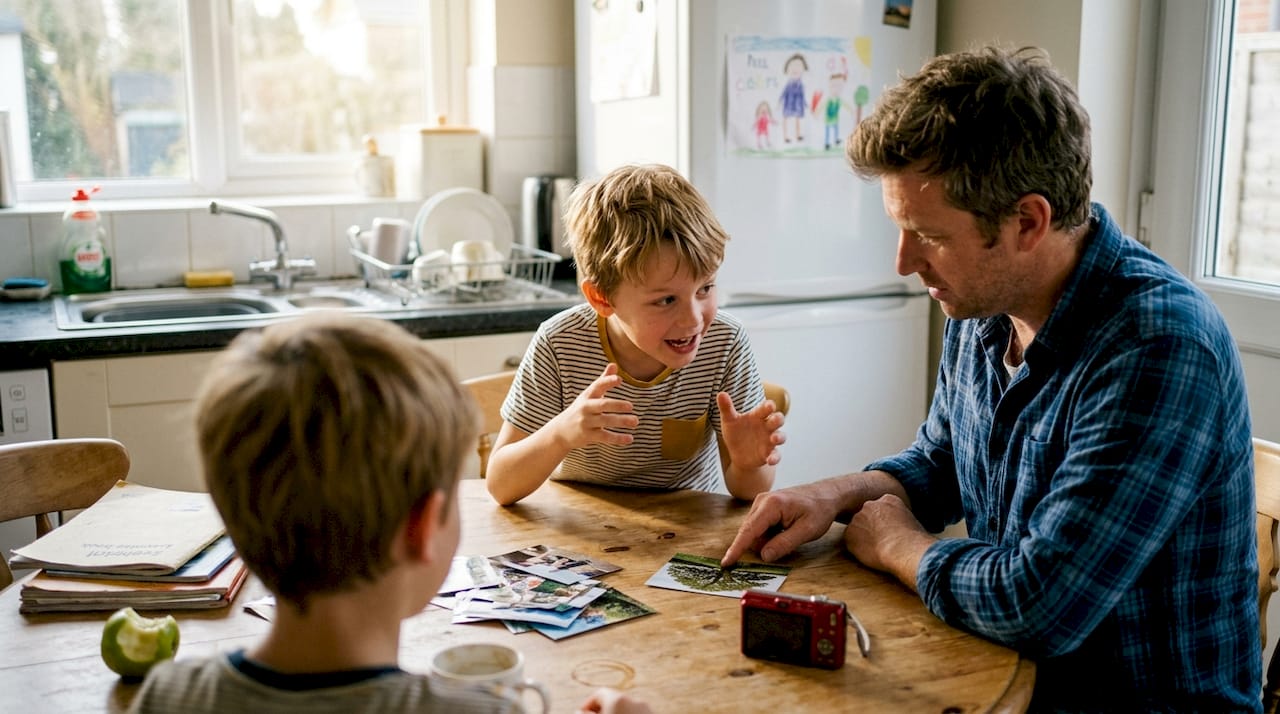
Pro Tip: Get down to your child’s level when they are photographing small creatures. When you crouch beside them and look at the same subject, you model the curiosity and care you want them to develop.
Exploring photographic activities for kids and educational photo tips can give you a ready-made starting point for these conversations at home.
Evidence: What research says about photo activities and empathy
The evidence base here is genuinely encouraging. Let us look at what the studies actually found.
In one landmark project, child-led photography in nature with preschoolers acted as an inquiry and reflection tool. Children communicated their interests more clearly, developed social and emotional skills, and showed greater curiosity about the living world around them. Crucially, the children chose their own subjects. That freedom mattered enormously.
| Study | Age group | Key finding |
|---|---|---|
| The Nature Photography Project | 8 to 10 years | 29 of 30 children felt more connected to nature |
| Child-led photography in nature | Preschool | Boosted emotional skills and communication |
| Visual arts and empathy review | Mixed ages | Reliable increase in self-reported empathy |
| Empathy induction via visuals | 4 to 6 years | Increased pro-environmental choices and donations |
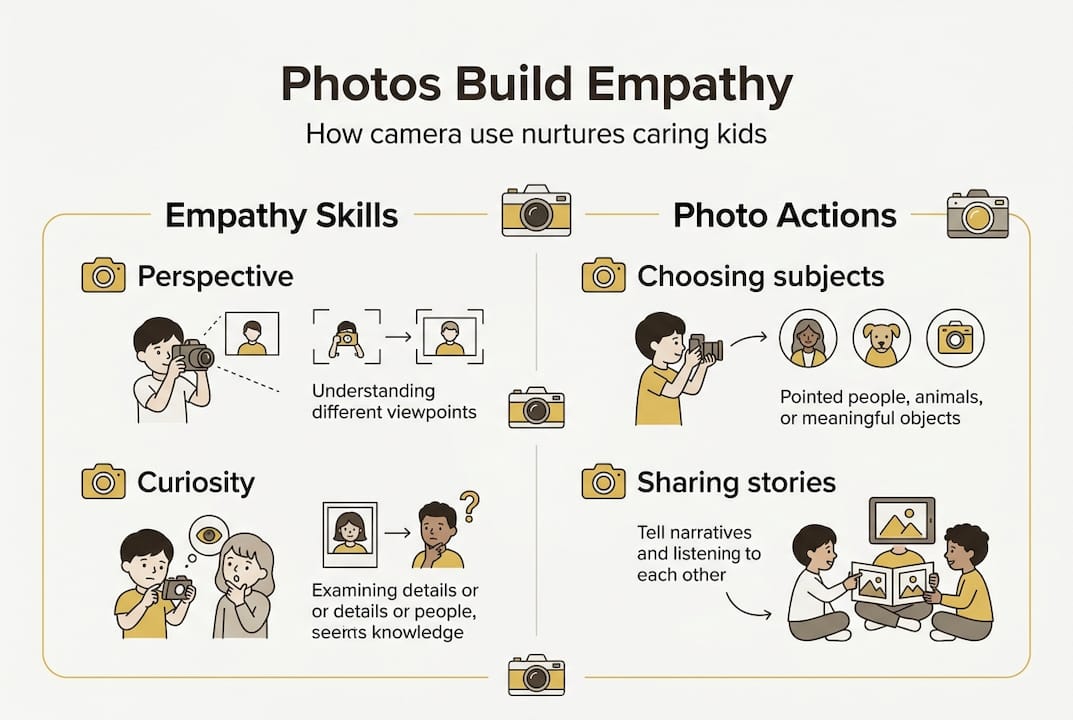
One statistic stands out above the rest. In the Nature Photography Project, 29 out of 30 children reported feeling more connected to nature after the programme. That is a 97% positive response rate. For a simple, low-cost activity that any family can try, that is a remarkable result.
Research also shows that empathy induced via visuals promotes real-world pro-environmental actions, including donations and conservation choices. This is not abstract. Children who feel connected to nature through photography are more likely to act in ways that protect it.
The children’s camera benefits extend well beyond fun, and the evidence on self-esteem through photography shows that the confidence children gain from creating images they are proud of feeds directly into their emotional development.
Simple ways to use photography to foster empathy at home
You do not need a professional camera or a structured curriculum. Here is how to get started in a way that feels natural and enjoyable for your child.
- Give your child their own camera. Even a simple, robust children’s camera is enough. The act of ownership creates responsibility and investment.
- Go on a themed photo walk. Choose a theme such as “tiny creatures,” “things that are resting,” or “colours of autumn.” Themes focus attention without limiting creativity.
- Ask story questions after each walk. “Who lives here?” or “What was this creature doing before you arrived?” These questions build narrative empathy.
- Create a family photo album about small lives. Document a garden snail over several weeks, or photograph the same tree through the seasons. Continuity deepens connection.
- Discuss respect during the process. Talk about not disturbing nests, not picking flowers just for a photo, and leaving places as you found them. This embeds ethical care naturally.
- Share the photos with others. Showing grandparents or friends the images your child took encourages them to explain and articulate their feelings, reinforcing the empathy loop.
Photography as an inquiry tool works best when children feel free to explore without pressure. Your role is to be curious alongside them, not to direct the outcome.
Pro Tip: Print a small selection of your child’s favourite nature photos and let them arrange a mini exhibition at home. Explaining their choices to family members builds both confidence and empathy.
For more inspiration, our guides on ecological photography for kids and animal photo tips for kids are full of practical ideas you can try this weekend.
Common pitfalls and expert tips for maximising empathy benefits
Even the best intentions can go sideways. Here are the most common mistakes parents make, and how to avoid them.
- Focusing on technical quality. A blurry photo of a beetle that your child is proud of is worth infinitely more than a sharp image they were told to retake. Value the intention, not the result.
- Directing every shot. When adults control what gets photographed, children disengage. Art and photography reliably boost empathy and perspective-taking, especially when children have genuine creative agency.
- Treating it as a one-off activity. A single photo walk is lovely. A weekly habit is transformative. Regularity builds the emotional muscle.
- Skipping the conversation. The photo is the starting point, not the destination. The discussion afterwards is where the empathy actually grows.
- Ignoring ethics. Teach children from the start that photography ethics in nature matter. Do not chase animals, do not damage habitats, and always ask before photographing people.
“The best nature photographers are not the ones with the best equipment. They are the ones who care most about what they are photographing.”
Building a regular rhythm, perhaps a Sunday morning walk with cameras, creates a family ritual that children look forward to. Over time, that ritual becomes a shared language of curiosity and care. Exploring how cameras inspire young minds can help you understand just how much is happening beneath the surface of what looks like simple play.
Support empathy and creativity with the right tools
Knowing that photography builds empathy is one thing. Having the right tools to make it easy, durable, and genuinely fun for young children is another. At The Zoofamily, we designed our children’s cameras with exactly this in mind: robust enough for small hands, inspiring enough to spark real curiosity, and connected to a love of the natural world through animal-themed designs that children adore.
Every camera we sell also plants a tree, so your child’s creative journey contributes directly to the natural world they are learning to care for. If you are looking for a gift that does more than entertain, visit The Zoofamily shop to find cameras, binoculars, and activity tools that turn everyday moments into genuine opportunities for empathy, creativity, and connection with our planet.
Frequently asked questions
Why is photography effective for teaching empathy to children?
Photography promotes perspective-taking by encouraging children to slow down, observe carefully, and consider the experience of their subject. This process builds emotional connection, particularly when the subject is a living creature or natural environment.
What age is best to start using photography for empathy-building?
Children as young as four can benefit meaningfully from photo activities. Research shows that empathy with nature via visuals promotes pro-environmental behaviours in children aged four to six, making early childhood an ideal time to begin.
Does photography only help empathy towards people?
Not at all. Nature photography projects show that photographing animals and plants increases children’s connection to living things broadly and encourages pro-environmental attitudes that extend well beyond the classroom.
Should parents direct what their child photographs?
Freely chosen subjects yield the best results. Child-led photography in nature enhances emotional skills and engagement far more effectively than directed activities, so follow your child’s curiosity rather than setting a fixed agenda.