

Motor skills development is the process by which children gain control over their body movements, progressing from broad physical actions to precise, coordinated tasks. It covers both gross motor skills, such as walking and jumping, and fine motor skills, such as gripping a pencil or fastening a button. The American Academy of Pediatrics and MedlinePlus both identify clear developmental milestones that help parents track progress and spot concerns early. Understanding these stages gives you the tools to support your child through play, routine, and well-timed encouragement.
What are gross motor skills and how do they develop in toddlers?
Gross motor skills are the large-movement abilities that use the major muscle groups of the arms, legs, and torso. They form the foundation for balance, coordination, and physical confidence. Without them, children struggle with everything from climbing stairs to playing in the park.
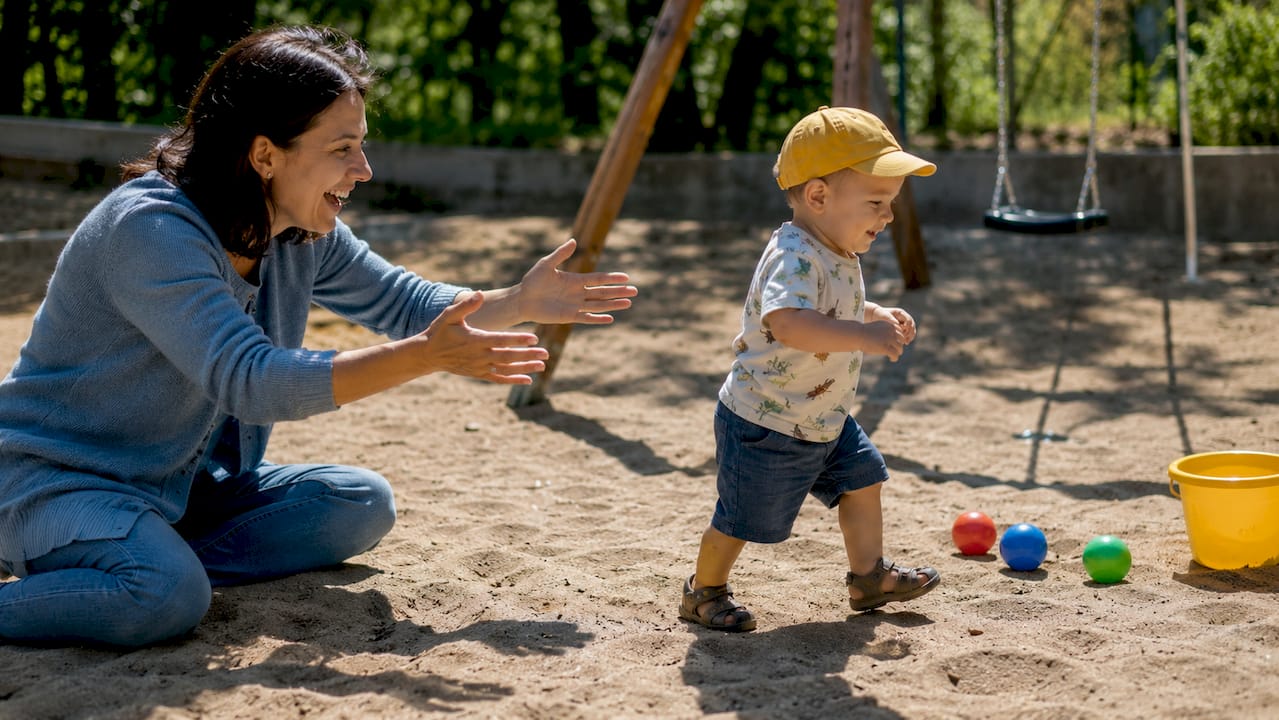
MedlinePlus outlines a clear progression: most children stand alone by 12 months, walk well by 12–15 months, and can jump in place by 24 months. By 36 months, many children ride a tricycle. Parents should consult a health provider if a child is not walking by 18 months. These benchmarks are useful guides, not rigid deadlines.
Typical gross motor milestones at a glance
| Age | Milestone |
|---|---|
| 12 months | Stands alone without support |
| 12–15 months | Walks well independently |
| 18 months | Consultation advised if not yet walking |
| 24 months | Jumps in place |
| 36 months | Rides a tricycle |
Large muscle development supports more than movement. Strong core and leg muscles give children the stability they need to sit at a desk, carry a school bag, and participate in group activities. Physical confidence built in the toddler years carries directly into school readiness.
The best way to build gross motor skills is through active, varied play. Walking on uneven ground, climbing low frames, running, and kicking a ball all challenge the body in different ways. Outdoor play in natural spaces, such as parks or woodland paths, provides the kind of unpredictable terrain that indoor environments simply cannot replicate. Active travel, like walking to the shops or the park rather than being pushed in a buggy, adds meaningful movement to the daily routine.
- Let children walk on grass, gravel, and slopes rather than always on flat pavements.
- Encourage climbing on low, safe structures at the playground.
- Play chasing games, rolling, and tumbling on soft ground.
- Use action songs like “Head, Shoulders, Knees and Toes” to combine movement with learning.
Pro Tip: Swap the buggy for a short walk at least once a day. Even ten minutes of independent walking on varied surfaces builds balance and leg strength faster than passive travel.
How do fine motor skills develop and why are they critical for independence?
Fine motor skills involve the small muscles of the hands, fingers, and wrists, working together with visual input in a process called visual-motor integration. These skills are foundational for school readiness and independence, yet they often go unnoticed until a child struggles to dress themselves or hold a pencil.
Fine motor development follows a proximal-to-distal pattern. This means control begins at the shoulder and gradually moves outward to the fingertips. A six-month-old uses a whole-hand raking grasp because precise finger control is biologically not yet available. The pincer grip, where the thumb and index finger pick up small objects, typically emerges between 9 and 12 months. Stacking blocks with some accuracy usually appears around 24 months.
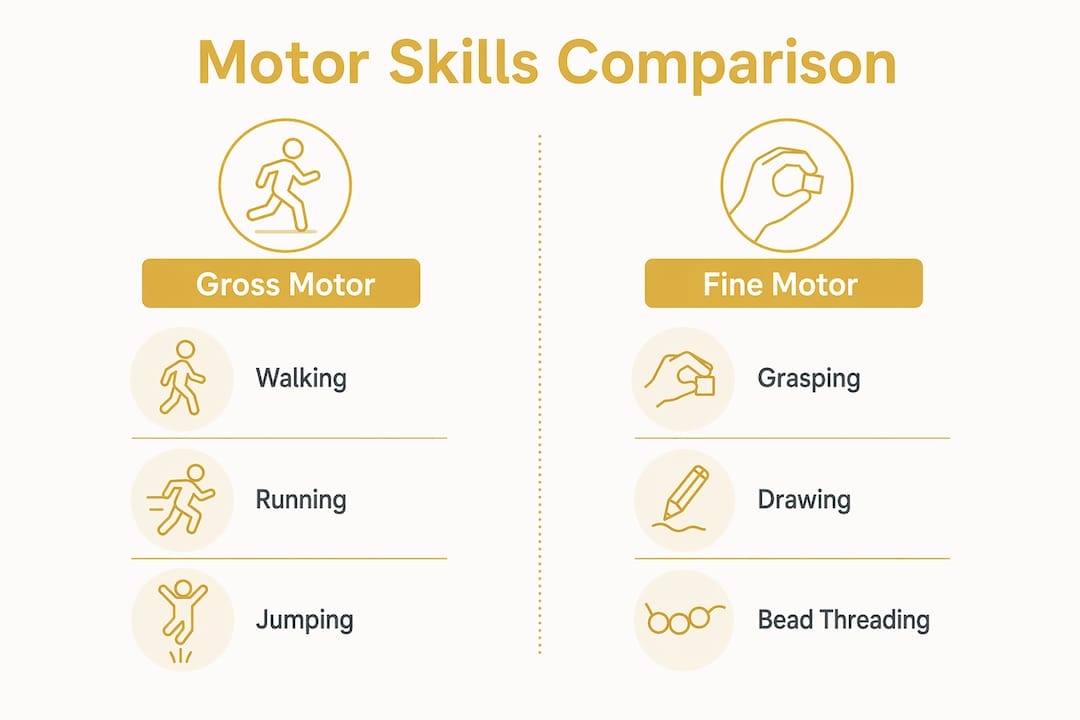
Fine motor vs gross motor skills: key differences
| Feature | Fine motor skills | Gross motor skills |
|---|---|---|
| Muscles involved | Small hand and finger muscles | Large arm, leg, and core muscles |
| Examples | Writing, threading, buttoning | Walking, jumping, climbing |
| Develops from | Shoulder outward to fingertips | Head downward to feet |
| School relevance | Writing, cutting, self-care | PE, sitting posture, coordination |
Fine and gross motor skills develop on partially independent tracks. A child can show typical gross motor progress while having fine motor delays, and vice versa. This is worth knowing because parents sometimes assume that a physically active child must be developing well across the board.
Practical activities that build fine motor control include:
- Rolling and squeezing playdough to strengthen hand muscles.
- Threading large beads or pasta shapes onto a lace.
- Picking up small finger foods like peas or raisins at mealtimes.
- Drawing, colouring, and cutting with child-safe scissors.
- Building with Duplo or wooden blocks.
Pro Tip: Offer playdough before structured drawing activities. Five minutes of squeezing and rolling warms up the hand muscles and makes pencil tasks noticeably easier for young children.
What role does play and daily routine have in motor skill enhancement?
Play is the primary vehicle for motor skill enhancement in young children. Manipulative play, including building blocks, playdough, and threading beads, directly improves fine motor control. Moderate-to-vigorous physical activity is equally important for gross motor stability and coordination. Neither happens by accident. Parents who build both types of play into the daily routine see the most consistent progress.
Screen time works against this. Increased screen time is linked to negative impacts on motor development. Replacing sedentary screen time with active or tactile play benefits both fine and gross motor skills. The shift does not need to be dramatic. Swapping thirty minutes of screen time for outdoor play or a craft activity makes a measurable difference over weeks.
Action-based songs are a particularly underused tool. BBC Tiny Happy People notes that action songs build both physical and cognitive skills simultaneously. Songs like “The Wheels on the Bus” or “If You’re Happy and You Know It” combine rhythm, memory, and movement in a way that children find genuinely engaging.
A practical daily routine for motor skill support might look like this:
- Morning: Encourage self-dressing, including buttons and zips, to build fine motor control through real tasks.
- Mid-morning: Outdoor play on varied terrain for gross motor development.
- After lunch: A craft or manipulative activity such as playdough, drawing, or threading.
- Afternoon: Active play with a ball, climbing, or dancing to music.
- Evening: Bath time offers natural fine motor practice through pouring, squeezing, and washing.
- Use mealtimes as fine motor practice by offering foods that require pinching and scooping.
- Avoid always completing tasks for your child. Let them struggle briefly with zips and lids.
- Rotate toys regularly so children encounter new physical challenges.
Pro Tip: Nature-based play, such as collecting leaves, digging in soil, or examining insects with children’s binoculars, combines sensory exploration with the kind of precise hand movements that build fine motor skills naturally.
How to recognise and respond to delays in physical development in children
A spread of 2–3 months variation around published milestones is normal. Consistent progress over time matters more than hitting a single benchmark on a specific date. A child who walks at 16 months rather than 12 months is not necessarily delayed. A child who shows no progress across several months warrants closer attention.
Gross and fine motor delays do not always appear together. A child can have strong gross motor skills and still struggle with fine motor tasks. Parents who notice uneven development should track both areas separately rather than assuming one reflects the other.
Key signs that merit a conversation with your GP or health visitor include:
- Not walking independently by 18 months.
- Unable to stack two blocks by 18 months.
- Not using a pincer grip by 12–14 months.
- Significant regression in skills already achieved.
- Marked difference between the two hands in terms of control or strength.
The American Academy of Pediatrics recommends developmental screenings at 9, 18, and 30 months, with autism-specific screenings at 18 and 24 months. These screenings catch concerns early, when intervention has the greatest effect. Attending them is one of the most practical things a parent can do.
If a delay is suspected, early intervention through play-based therapy or occupational therapy produces strong outcomes. Adaptive play, where activities are modified to match a child’s current ability, keeps children engaged and progressing without frustration. A guide on healthy screen time habits can also help parents reclaim time for the active play that supports development.
Pro Tip: Keep a simple photo or video diary of your child’s physical milestones. It gives your health visitor concrete evidence to work with and helps you spot gradual progress that is easy to miss day to day.
Key takeaways
Motor skills development in young children depends on consistent, varied play and daily physical activity across both fine and gross motor domains.
| Point | Details |
|---|---|
| Gross motor milestones | Children typically walk well by 12–15 months; consult a provider if not walking by 18 months. |
| Fine motor progression | Development moves from shoulder to fingertips; expect a pincer grip between 9 and 12 months. |
| Play drives progress | Manipulative play and active physical play are the most effective tools for motor skill enhancement. |
| Screen time reduces gains | Replacing screen time with tactile or active play directly improves both fine and gross motor outcomes. |
| Variation is normal | A 2–3 month spread around milestones is typical; track consistent progress rather than single benchmarks. |
What I have learnt from watching children grow through movement
Parents put enormous pressure on themselves to hit every milestone on schedule. I understand the instinct. When you see another child at the park running confidently while yours is still cautious on their feet, it is hard not to worry. But the research is clear, and experience confirms it: consistent progress across weeks and months matters far more than any single date on a chart.
What I have found genuinely useful is reframing daily life as a motor skills programme. Not in a clinical sense, but in the sense that mealtimes, bath time, dressing, and outdoor play are all opportunities. Parents who see these moments as practice rather than chores tend to be more relaxed, and their children tend to be more willing to try. Pressure produces avoidance. Playfulness produces effort.
The other thing I would push back on is the assumption that structured activities are always better. A child digging in the garden, carrying a watering can, or picking up stones is doing serious fine and gross motor work. The developing fine motor skills resource from Thezoofamily makes this point well: the best activities are often the ones that feel least like activities. Nature play, in particular, offers a richness of texture, weight, and unpredictability that no toy can fully replicate.
Celebrate small wins. The first time a child does up a button, pours their own drink, or balances on one foot for three seconds is worth acknowledging. These moments build the confidence that keeps children willing to keep trying.
— ALAIN
Tools and resources to support your child’s development
Thezoofamily builds products that put children in direct contact with the natural world, and that contact is exactly what motor skill development needs.
Kids’ cameras, binoculars, and walkie-talkies from Thezoofamily are designed to get children moving, looking closely, and handling objects with care. Using a camera to photograph a butterfly requires steady hands and focused attention. Adjusting binoculars to spot a bird involves precise finger movements and hand-eye coordination. These are not incidental benefits. They are built into the design. For every camera sold, Thezoofamily plants one tree, connecting physical development with a wider purpose. Visit Thezoofamily to find tools that turn outdoor play into genuine motor skill practice.
FAQ
What is motor skills development in young children?
Motor skills development is the process by which children gain control over their movements, covering both gross motor skills such as walking and fine motor skills such as gripping and writing. It progresses through predictable stages from birth through early childhood.
When should I be concerned about my child’s gross motor development?
Consult your GP or health visitor if your child is not walking independently by 18 months. The American Academy of Pediatrics also recommends developmental screenings at 9, 18, and 30 months to catch concerns early.
What activities best support fine motor skills in toddlers?
Playdough, bead threading, finger foods, drawing, and building with blocks are among the most effective activities. These build hand strength, pincer grip, and visual-motor integration through natural, engaging play.
Does screen time affect motor skills development?
Screen time is linked to poorer motor outcomes in young children. Replacing sedentary screen time with active or tactile play directly supports both fine and gross motor skill development.
Is it normal for fine and gross motor skills to develop at different rates?
Fine and gross motor skills develop on partially independent tracks. A child can show strong gross motor progress while having fine motor delays, or vice versa, and this does not indicate a global developmental problem.