

TL;DR:
- Consistent routines enhance children’s emotional regulation, behavior, and sleep quality.
- Routines reduce parental stress and strengthen family bonds through shared activities.
- Flexibility and involving children in routine planning are key for sustainable family rituals.
A regular bedtime does far more than help your child sleep. Consistent bedtime routines improve emotion regulation in young children, meaning something as simple as a nightly wind-down ritual can shape how your child handles frustration, disappointment, and change. For many parents, that is genuinely surprising. We tend to think of routines as practical tools for keeping the household running, yet the research tells a richer story. Routines build security, strengthen family bonds, and reduce stress for everyone involved. In this article, we will walk you through why routines matter so deeply, what the evidence says, and how to build ones that actually last.
Table of Contents
- Why family routines matter for children’s development
- Real benefits of family routines: Evidence from European families
- Navigating challenges: What gets in the way of good routines?
- Setting up sustainable routines: Practical steps for your family
- Perspective: The case for flexible, connected routines
- Discover more: Grow together with expert family resources
- Frequently asked questions
Key Takeaways
| Point | Details |
|---|---|
| Routines build wellbeing | Daily family routines foster emotional regulation, better behaviour, and parent-child connection. |
| Consistency reduces stress | Predictable routines help children cooperate and reduce parents’ stress, especially in busy households. |
| Balance is key | The most effective routines are flexible and prioritise positive family engagement, not rigid structure. |
| Small steps matter | Parents should start simple, adjust gradually, and involve everyone for lasting routines that work. |
Why family routines matter for children’s development
A family routine is any repeated, predictable sequence of activities shared by household members. Think bedtime rituals, morning school preparation, or sitting down together for meals. These are not just habits of convenience. They are the invisible scaffolding that supports a child’s growing sense of self and safety.
From a developmental perspective, predictability is everything for young children. When a child knows what comes next, their nervous system can relax. That calm creates space for learning, emotional growth, and positive behaviour. Consistent routines support emotion regulation and positive behaviours, and the effects compound over time. A toddler who experiences reliable bedtime routines is better equipped to manage big feelings at age five than one who does not.
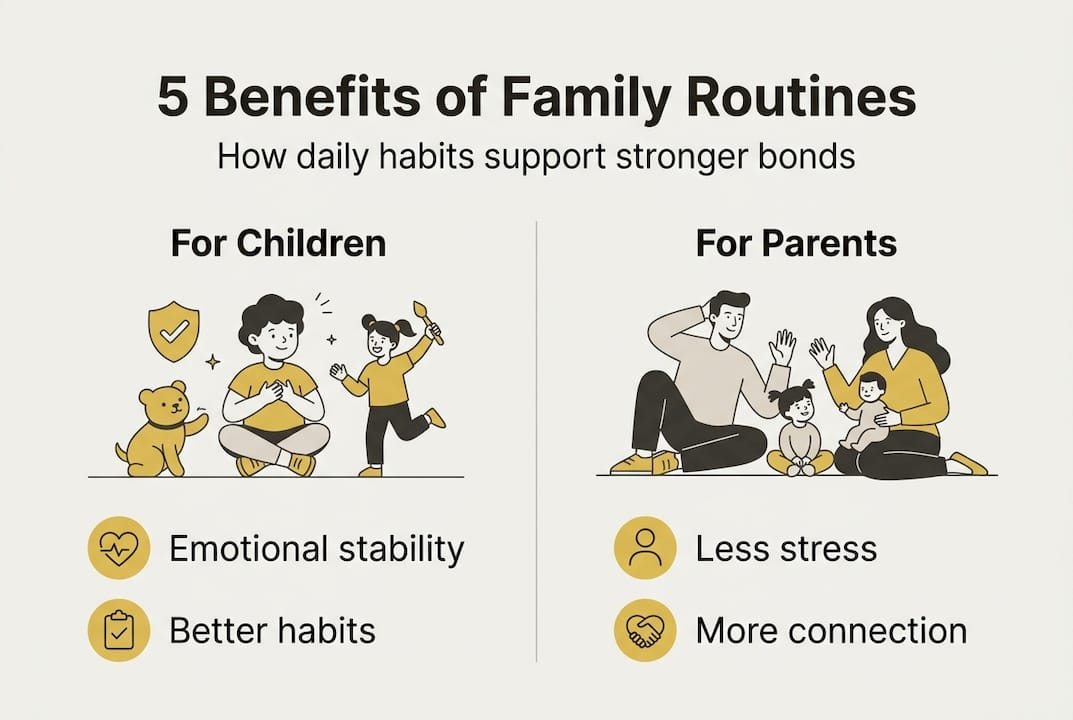
The behavioural benefits extend beyond the child. Child routines at age 3 predict decreased noncompliance at age five, and reduced parental stress follows naturally. When children cooperate more readily, parents feel less overwhelmed. That dynamic makes the whole family system healthier.
Routines also create natural opportunities for connection. A mealtime routine is not just about eating. It is a daily moment to check in, laugh, and feel like a unit. You can explore how understanding eco-friendly routines can add another layer of meaning to these shared moments, weaving values into everyday life.
“Routines give children the gift of knowing what to expect, and in that predictability, they find the confidence to explore the world.”
Here are the top areas where routines make the greatest difference:
- Emotional regulation: Children learn to manage transitions and frustration more effectively.
- Behavioural compliance: Predictable structures reduce power struggles and tantrums.
- Sleep quality: Consistent bedtime cues signal the brain to wind down.
- Academic readiness: Morning routines support focus and reduce school-day anxiety.
- Family cohesion: Shared rituals strengthen the sense of belonging.
- Parental wellbeing: Predictable days lower parental stress and improve mental health.
The impact is especially pronounced in younger children, whose brains are developing rapidly and who rely most heavily on external structure to feel secure. Think of routines as building family resilience from the ground up, one repeated moment at a time.
Real benefits of family routines: Evidence from European families
Moving from theory to lived experience, the evidence from European families is compelling. Researchers across Spain and Sweden have examined what happens when families are supported in building strong routines, and the results are consistent.
A study on family-centred early intervention in Spain found that when professionals helped families embed learning and development into everyday routines, children showed improved participation, stronger family bonds, and better developmental outcomes. The approach treated daily life, mealtimes, bath time, outdoor play, as the primary context for growth rather than separate therapy sessions.
In Sweden, researchers found that early establishment of routines in the first years of life reduced parental stress and depression. Strikingly, 24% of Swedish parents reported benefiting from professional support specifically focused on establishing new routines. That is a significant proportion, and it tells us that many families want this guidance but are not always sure where to start.
| Family outcome | With consistent routines | Without consistent routines |
|---|---|---|
| Child emotional regulation | Significantly improved | Often delayed or inconsistent |
| Parental stress levels | Noticeably reduced | Frequently elevated |
| Family cohesion | Stronger sense of belonging | More fragmented interactions |
| Child compliance | Higher cooperation | More frequent conflict |
| Developmental participation | Active and confident | Passive or withdrawn |
Parents in these studies reported several concrete benefits:
- Reduced daily stress because children knew what to expect and resisted less.
- Greater family cohesion as shared rituals created a sense of identity and togetherness.
- Improved child participation in learning and social activities.
- Better parental mental health, particularly for mothers managing multiple responsibilities.
- Stronger parent-child relationships built through consistent, repeated moments of connection.
Exploring eco-friendly family routines is one practical way to combine these relational benefits with a shared sense of purpose, giving your family something meaningful to build together.
Navigating challenges: What gets in the way of good routines?
Knowing the benefits is one thing. Actually building routines in a busy, modern family is another matter entirely. Several real-world barriers make consistency genuinely difficult, and it helps to name them honestly.
Nonstandard work schedules are one of the biggest obstacles. When a parent works shifts, evenings, or irregular hours, a fixed bedtime routine becomes logistically complicated. Single-parent households face an even steeper challenge, managing every aspect of the day without a partner to share the load. Economic pressures add another layer, as financial stress makes it harder to maintain calm, predictable environments.
Research shows the benefits of routines are strongest for families facing the most adversity, including low-income households, younger mothers, and those with lower levels of formal education. This is not a coincidence. Routines act as a stabilising force precisely when life feels most unpredictable.
However, there is an important caveat. Harsh parenting can undermine routine benefits, even when routines are technically in place. A rigid, punitive approach to structure strips routines of their warmth and safety. The routine becomes a source of anxiety rather than comfort. The Gottman Institute notes that everyday connection is what transforms a routine into a ritual, and it is the emotional quality of these moments that matters most.
Common pitfalls to avoid:
- Trying to overhaul every part of the day at once.
- Enforcing routines rigidly without room for flexibility.
- Ignoring children’s input, making routines feel imposed rather than shared.
- Abandoning routines entirely after one disrupted week.
- Confusing busyness with structure; a packed schedule is not the same as a meaningful routine.
Pro Tip: If you are struggling with consistency, focus on building resilience naturally by anchoring just one routine firmly before adding others. One reliable bedtime ritual is worth more than five half-hearted ones.
“Structure without warmth is just a timetable. What children need is structure that feels like love.”
Setting up sustainable routines: Practical steps for your family
With the challenges in mind, here is how to build routines that genuinely stick. The key is to start with intention rather than perfection.
- Choose one anchor routine. Pick the time of day that feels most chaotic and focus there first. Bedtime and morning are the highest-impact choices for most families.
- Involve your children. Ask them what they want the routine to include. Children who help design their routines are far more likely to follow them. Even a four-year-old can choose between two options for the order of activities.
- Keep it simple. A three-step bedtime routine (bath, story, lights out) is more sustainable than a ten-step programme. Complexity is the enemy of consistency.
- Use visual cues. For younger children, a simple picture chart of the routine steps removes the need for repeated verbal reminders and reduces friction.
- Repeat for at least three weeks. Habits take time to form. Expect resistance in the first week, improvement in the second, and genuine ease by the third.
- Review and adapt. Every few months, check whether the routine still fits your family’s needs. Children grow, schedules change, and routines should evolve too.
Pro Tip: Integrating reading and shared activities into your routines does not just build literacy. It creates a reliable moment of closeness that children remember well into adulthood.
Creative ideas to weave into your routines:
- Mealtime conversation starters: Take turns sharing one good thing and one hard thing from the day.
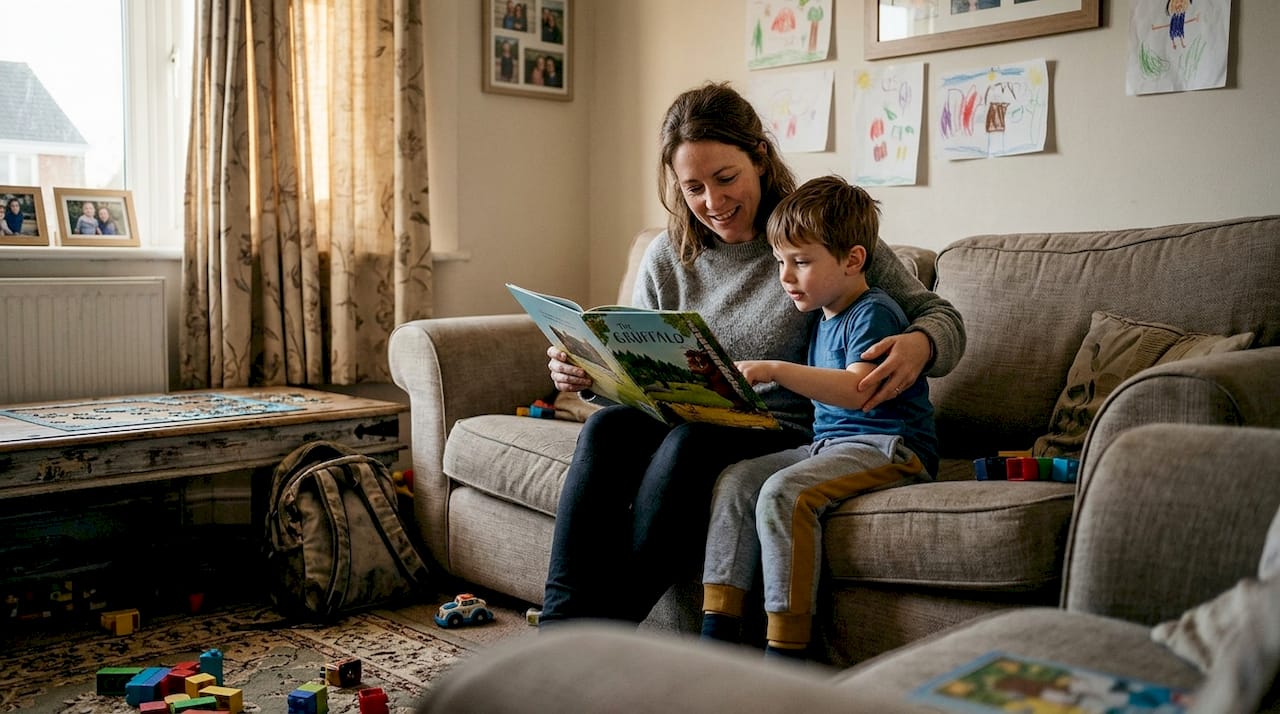
- Evening reading: Even ten minutes of shared reading before bed builds connection and calm.
- Outdoor rituals: A weekend walk or nature activity, perhaps with outdoor family rituals as inspiration, gives children a sense of rhythm connected to the natural world.
- Morning affirmations: A simple, cheerful send-off phrase said at the door each morning can become a powerful anchor.
These small, repeated moments are what understanding eco-friendly routines is all about: making daily life intentional and connected.
Perspective: The case for flexible, connected routines
Here is something the research does not always say loudly enough: more structure is not always better. There is a persistent assumption among parents that if routines are good, stricter routines must be even better. The evidence does not support this.
Overly rigid routines can be counterproductive; what matters is a balance between predictability and cognitive flexibility. A family that falls apart when the routine is disrupted by a holiday or illness has built rigidity, not resilience.
At The Zoofamily, we see this clearly. The families who thrive are not the ones with the most detailed schedules. They are the ones who have built routines around connection rather than control. A bedtime routine that ends with a genuine conversation beats a perfectly timed lights-out every single time.
Europe’s cultural diversity also matters here. What works for a family in Stockholm may not suit a family in Seville. Routines need to be culturally meaningful, not imported wholesale from research conducted in one context. The principle is universal. The practice must be personal. Explore eco-friendly routines that reflect your own family’s values and rhythms, and you will find the structure that actually fits.
Discover more: Grow together with expert family resources
Building routines that genuinely work for your family takes time, patience, and a little inspiration. At The Zoofamily, we believe that the best routines are the ones that bring families closer together and spark a love of the natural world in children.
Whether you are just starting out or looking to refresh what you already have, our blog is full of practical, research-backed ideas to support you. From understanding eco-friendly routines to finding creative ways to connect outdoors, we are here to help you build a family life that feels intentional, joyful, and genuinely yours. Come and explore what is possible.
Frequently asked questions
What are the most important family routines to establish?
Bedtime, mealtime, and school preparation routines have the biggest positive effect on child development. Consistent bedtime routines improve emotion regulation and behaviour, making them the single highest-impact place to start.
How do routines reduce parental stress?
Routines lower daily uncertainty and improve child compliance, which directly reduces the mental load on parents. Child routines at age 3 predict decreased noncompliance at age five, and early establishment of routines in Sweden was linked to lower parental stress and depression.
What should families do if routines get disrupted?
Be flexible, restart with one small step, and involve all family members in rebuilding together. Overly rigid routines can be counterproductive, so treat disruptions as a normal part of family life rather than a failure.
Are routines still helpful for older children?
Absolutely. Routines evolve with age, shifting towards homework schedules, shared meals, and family activities, but the stabilising effect remains. Family routines benefit children across age groups by supporting participation, connection, and a sense of belonging.