

Most parents assume that if a product has leaves on the label and smells of lemon, it must be safe and effective. The reality is more nuanced. Choosing a genuine eco friendly disinfectant means understanding the difference between a product that cleans and one that actually kills pathogens. Many so-called natural surface cleaners reduce visible dirt without meeting any regulated antimicrobial standard. This guide cuts through the confusion, explaining what certifications actually mean, why contact time determines whether disinfection works at all, and how to pick environmentally friendly cleaners that protect your family without harming the planet.
Key takeaways
| Point | Details |
|---|---|
| Certification is non-negotiable | Look for EPA Safer Choice or Design for the Environment labels to confirm a product genuinely disinfects. |
| Contact time decides efficacy | A surface must stay visibly wet for the full dwell time or the kill claim is invalid. |
| Cleaning and disinfecting differ | Cleaning removes dirt; disinfecting kills pathogens. Only certified products should be trusted for the latter. |
| Short dwell times suit families | Products with 30-second to 2-minute contact times are far easier to use correctly around children. |
| Greenwashing is widespread | Vague words like “natural” and “plant-based” carry no regulatory weight without a matching EPA registration number. |
What makes an eco friendly disinfectant genuinely effective
The industry term for what most people call an “eco friendly disinfectant” is a certified antimicrobial product. Understanding that distinction matters, because not every green-labelled spray earns that status.
Cleaning versus disinfecting
These are not interchangeable. Cleaning physically removes grease, dirt, and some microorganisms. Disinfecting uses regulated active ingredients to kill a defined percentage of specific pathogens on a surface. Only certified products should be trusted when your goal is actual disinfection rather than surface tidying. A product can be both a cleaner and a disinfectant, but it must say so on the label explicitly.
Certifications that carry real weight
The US EPA runs two searchable databases you can use to verify products: Safer Choice and Design for the Environment (DfE). The EPA recommends both labels as the most reliable way to identify trustworthy environmentally friendly cleaners, and warns explicitly against vague marketing language that implies green credentials without certification.
Key labels and what they mean:
- EPA Safer Choice: Confirms that ingredients meet health and environmental standards without sacrificing function.
- EPA DfE (Design for the Environment): Applied to antimicrobial products that meet specific safety and environmental criteria.
- EPA Registration number: Any product making a disinfection claim in the US must carry this. It is a legal approval, not a marketing badge.
The EPA Registration and Master Label define exactly which pathogens the product kills, under what surface conditions, and with what contact time. These are legal instructions, not suggestions.
Common active ingredients in eco disinfectants
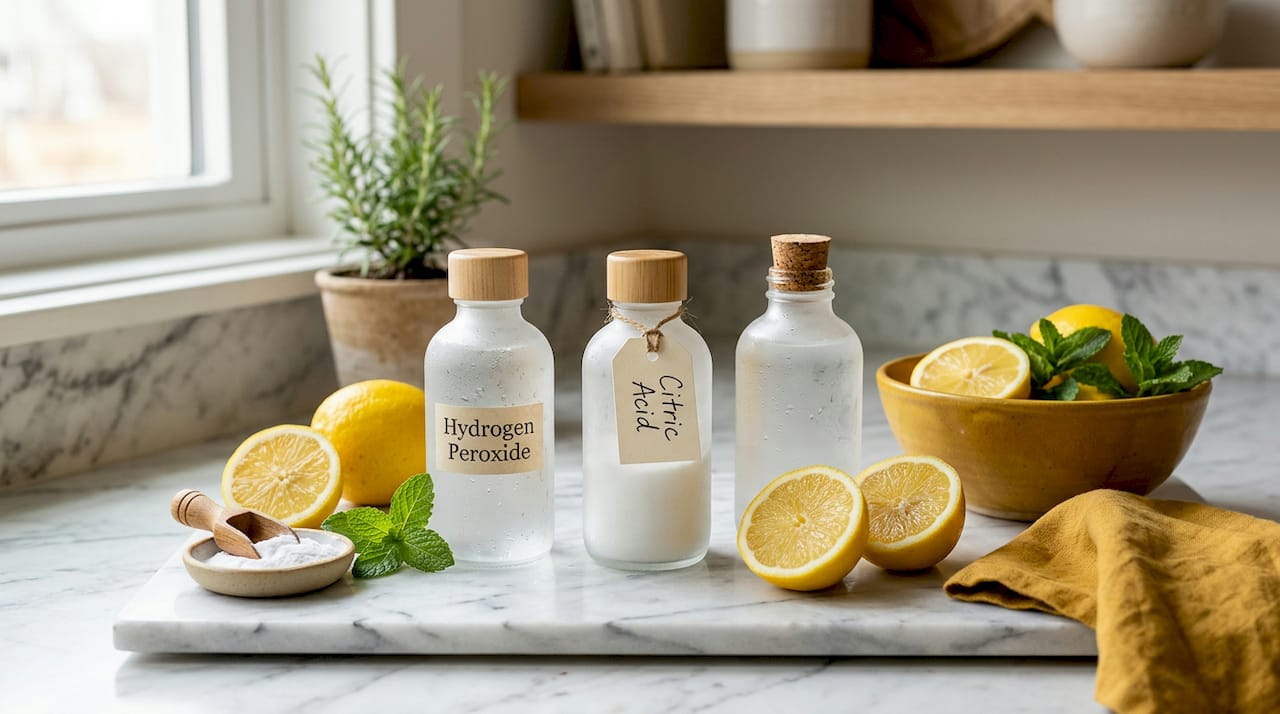
Hydrogen peroxide degrades into water and oxygen, making it one of the cleaner options environmentally. Citric acid at sufficient concentration can kill certain bacteria, viruses, and fungi. Bleach, hydrogen peroxide, and quaternary ammonium compounds each have different kill spectra, and organic matter on surfaces reduces their effectiveness. No single ingredient does everything, which is why reading the approved pathogen list on the label matters so much.
Pro Tip: Search the EPA’s Safer Choice product finder before buying. If a product is not listed, its green claims are unverified marketing.
Contact time: the variable most families get wrong
Contact time, also called dwell time, is the length of time a surface must remain visibly wet with disinfectant for the kill claim to be valid. It is the single most misunderstood concept in home disinfection.
Here is why it matters so much. When EPA testing validates a disinfectant, those tests are run with surfaces kept wet for the full contact time. Dwell time must be fully adhered to for any kill claim to hold. The moment you wipe a surface dry before the clock runs out, you have cleaned it, not disinfected it.
How to apply disinfectant correctly at home
- Pre-clean the surface. Remove visible dirt and grease first. Organic matter reduces disinfectant effectiveness significantly.
- Apply generously. Use enough product that the surface remains visibly wet throughout the entire contact time. A quick spritz that dries in 20 seconds is insufficient.
- Set a timer. Particularly for products requiring 3 to 10 minutes of dwell time, a timer removes the guesswork.
- Do not wipe early. Wet time failure is the most common reason green disinfectants underperform in homes. Wait until the full time has elapsed.
- Allow to air dry or wipe after. Once the contact time is complete, air drying is ideal. Wiping is acceptable if the full time has passed.
Contact time varies considerably. Hydrogen peroxide products typically require 30 seconds to 5 minutes. Some citric acid-based options on the EPA List N claim a 5 to 10 minute contact time for viruses, bacteria, and fungi. For families managing busy routines with young children, this is a practical consideration worth factoring into your purchase.
Pro Tip: If you have children who touch surfaces frequently, prioritise products with a contact time of 30 seconds to 2 minutes. Short contact time wipes offer hospital-grade efficacy that families can realistically achieve.
Comparing eco disinfectant types for family homes
Not all biodegradable disinfecting sprays perform equally across surfaces, pathogens, or safety profiles. The table below compares the most common options families encounter.
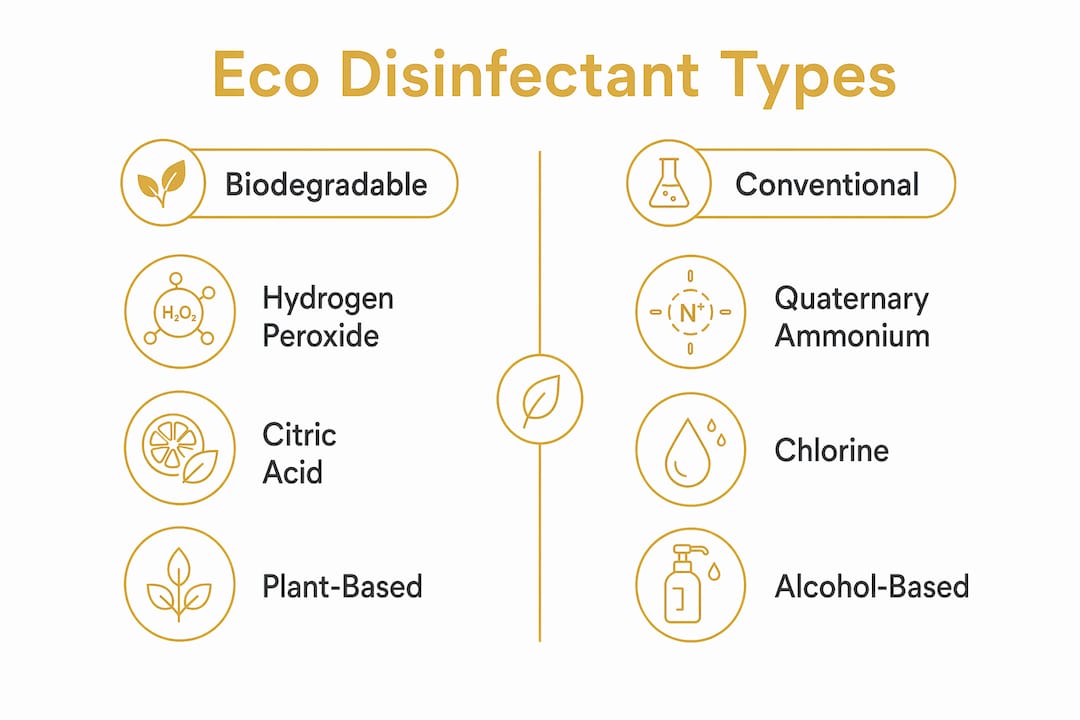
| Type | Kill spectrum | Typical contact time | Child/pet safety | Environmental profile |
|---|---|---|---|---|
| Hydrogen peroxide (3%) | Bacteria, viruses, some fungi | 30 sec to 5 min | Good after drying | Degrades to water and oxygen |
| Citric acid-based | Bacteria, viruses, TB, fungi | 5 to 10 minutes | Good; food-contact safe variants exist | Biodegradable, plant-derived |
| Quaternary ammonium (quat) | Bacteria, enveloped viruses | 2 to 5 minutes | Use with caution near children | Persistent in environment |
| Bleach-based | Broad including norovirus, C. diff | 1 to 10 minutes | Requires ventilation, rinsing | Not biodegradable; toxic fumes |
| Botanical/essential oil blends | Limited (bacteria only, unregistered) | Variable or unverified | Generally safe | Variable |
A few points worth highlighting from this comparison:
- Hydrogen peroxide is the most family-friendly option for general surfaces. It is effective, breaks down safely, and products with short contact times exist.
- Citric acid-based products cover a broad kill spectrum and are genuinely plant-based. They work well as an eco friendly multi purpose cleaner on kitchen and bathroom surfaces.
- Quaternary ammonium compounds appear in many “green” branded products but are less effective for non-enveloped viruses and persist in the environment longer than alternatives.
- Essential oil blends and botanical sprays often fall into the cleaning category rather than the disinfecting category. Without EPA registration, treat them as pleasant cleaners, not pathogen killers.
For families interested in reducing indoor chemical exposure more broadly, eco bathroom cleaners can cut indoor pollutants significantly when used consistently across the home.
Spotting greenwashing before you buy
Greenwashing is rife in the cleaning product market. These are the specific signals to watch for.
- Vague language without certification: Words like “natural,” “eco,” “plant-derived,” or “green formula” mean nothing without a corresponding EPA registration number or Safer Choice listing.
- No EPA registration number: Any product claiming to disinfect must carry one. Find it on the label, then verify it in the EPA registration database.
- Missing contact time: A product that does not state a specific dwell time for specific pathogens has not been through the registration process for those claims.
- Ingredient opacity: Genuine non-toxic cleaning products list every active and inactive ingredient. Proprietary blend claims with no disclosure are a red flag.
- Overreaching pathogen claims: If a product claims to kill everything without citing specific organisms and contact times, the claim is not backed by registered testing.
Safe use of eco disinfectants in homes with children
Disinfection is not something most surfaces need every day. Routine cleaning with a good natural surface cleaner handles most situations. Reserve disinfection for high-touch surfaces during illness season, after a family member has been unwell, or in bathrooms and kitchens where pathogen risk is genuinely elevated.
Follow these steps to keep children safe during and after disinfection:
- Store all disinfectants in a locked cupboard, regardless of how “natural” the label claims.
- Apply products when children are out of the room and allow full contact time plus dry time before they return.
- Choose fragrance-free or low-VOC formulations. Even plant-based sanitisers can irritate airways in enclosed spaces.
- Select products with child-resistant caps. Packaging safety matters as much as ingredient safety.
- Keep a family cleaning routine that separates daily surface wiping from targeted disinfection sessions, so you are not over-applying products unnecessarily.
For floor surfaces where children spend most of their time, checking child-safe floor cleaner options certified for family use is a practical next step.
My honest take on eco disinfectants for family homes
I’ve spent a long time looking at the gap between what families think they are buying and what a product actually does. The frustration is real. You want to protect your children and the planet at the same time, and the market is full of products designed to make you feel good without necessarily delivering on either promise.
What I’ve found is that the families who get this right are not the ones who spend the most or buy the most expensive botanical spray. They are the ones who check the EPA registration number, read the contact time, and actually follow it. That sounds tedious. In practice, it takes about 30 seconds of label reading before you add something to your trolley.
The other thing I want to push back on is the idea that “natural” automatically means safer for children. Some plant-based compounds are potent irritants. Certification, not origin, is the measure of safety here. A product that has been through the EPA Safer Choice process has been scrutinised in ways that a charming label with a leaf on it simply has not.
The good news is that the technology is improving. More genuinely effective, short-contact-time, biodegradable products are reaching shelves each year. Consumer pressure is working. But right now, the most powerful thing you can do is verify before you buy, and apply correctly when you do.
— ALAIN
How Thezoofamily supports eco-conscious families
At Thezoofamily, the commitment to protecting children and the planet runs through everything we do. We know that health-conscious families are not just looking for greener gadgets; they want a home environment that is genuinely safe and genuinely clean. That is why we curate information and products aligned with certified, non-toxic cleaning products that meet the standards described in this guide. Whether you are building a safer cleaning routine or looking for family products that reflect your values, explore our full range to find options tested against real safety and environmental benchmarks. Every choice you make for your home is a choice for the world your children will inherit.
FAQ
What does “eco friendly disinfectant” actually mean?
It refers to a disinfectant that kills pathogens while using ingredients and packaging that minimise environmental harm. Only products with EPA registration and certifications like Safer Choice or DfE can back that claim with verified data.
How do I know if a natural spray actually disinfects?
Check for an EPA registration number on the label. If it is absent, the product has not been approved as a disinfectant, regardless of its ingredient list or marketing language.
What is contact time and why does it matter?
Contact time is how long a surface must stay visibly wet with disinfectant for the kill claim to be valid. Disinfectant efficacy depends entirely on adhering to this time. Wiping early means the surface has been cleaned, not disinfected.
Can I make a homemade eco disinfectant?
Homemade mixtures such as vinegar and water can reduce bacteria on some surfaces but have no EPA registration and cannot make verified kill claims. For reliable disinfection, particularly during illness, use a registered product.
Are plant-based sanitisers safe around children and pets?
Many are, but “plant-based” is not a safety guarantee on its own. Choose products with EPA Safer Choice certification, low VOC ratings, and clearly listed ingredients. Always apply when children are not present and allow surfaces to dry fully before contact.