

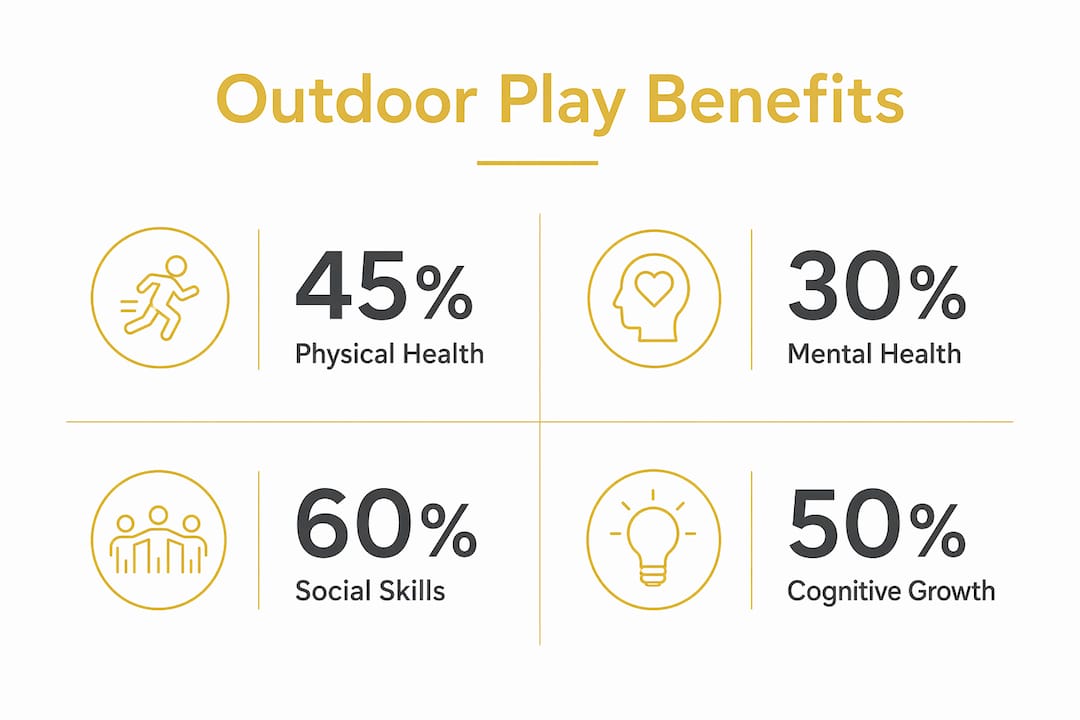
Children who play outdoors regularly develop stronger bodies, better emotional regulation, sharper social skills, and more capable minds than those who spend most of their time inside. The evidence is clear and consistent across dozens of studies. Outdoor play is not a supplement to development. It is central to it.
Here is a quick summary of what outdoor play delivers:
- Physical health: more moderate-to-vigorous activity, stronger muscles and bones, lower obesity risk
- Mental and emotional well-being: reduced stress, better mood, fewer ADHD symptoms
- Social skills: cooperation, friendship-building, communication with peers
- Cognitive growth: creativity, problem-solving, planning, and executive function
- Physiological benefits: vitamin D synthesis, improved sleep quality
- Resilience: confidence built through managed risk-taking and self-directed play
The sections below cover each of these in detail, with practical guidance on how to support outdoor play at every stage of childhood.
Table of Contents
- 1. Physical health benefits of outdoor play for children
- 2. How outdoor play supports your child’s mental and emotional health
- 3. Social skills and cognitive development fostered by outdoor play
- 4. Vitamin D and the role of sunlight during outdoor play
- 5. How to encourage and support outdoor play
- 6. Safety considerations when children play outdoors
- 7. Playing outdoors across all seasons
- 8. Environmental awareness and connection to nature
- 9. Long-term developmental outcomes of regular outdoor play
- Key takeaways
1. Physical health benefits of outdoor play for children
Getting children outside is one of the most direct ways to meet daily activity targets. The World Health Organisation recommends that children aged 5–17 get at least 60 minutes of moderate-to-vigorous physical activity every day. Children who spend at least two hours daily outside have 27% more moderate-to-vigorous activity than those who do not.
Key physical benefits include:
- Gross motor skills: running, jumping, climbing, and balancing all develop coordination and muscle control
- Cardiovascular health: sustained active play strengthens the heart and improves circulation
- Bone and muscle strength: weight-bearing outdoor activities support healthy skeletal development
- Lower obesity risk: unstructured physical activity reduces the likelihood of weight-related health concerns
- Reduced sedentary behaviour: time outdoors naturally replaces screen time and passive indoor activity
- Motor development across ages: toddlers, school-age children, and adolescents all gain physical benefits from outdoor activity
Children play harder outdoors than indoors. A ball, a climbing frame, or simply a patch of grass encourages movement that structured indoor activities rarely match.
2. How outdoor play supports your child’s mental and emotional health
Outdoor play acts as a natural mood regulator. Research shows that children who spend time in natural settings have less anger and aggression, better impulse control, and lower stress levels. The effect is consistent across age groups and settings.
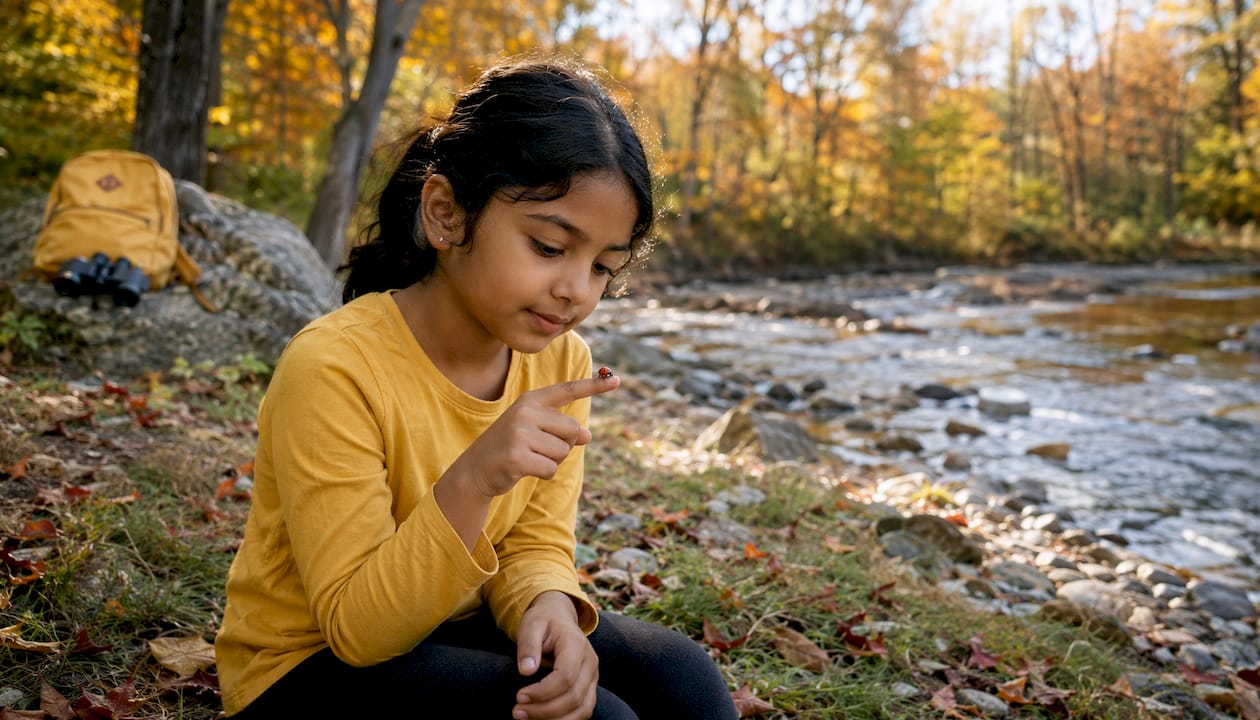
A Norwegian study found that preschoolers who spent more time outdoors each day were less likely to show ADHD symptoms. Even a 20-minute walk in a park improved concentration in children with ADHD more than a walk in an urban neighbourhood. Green space appears to have a specific calming effect that built environments do not replicate.
Sleep quality also improves with outdoor play. Children who play outdoors sleep better at night, likely because of the combination of physical activity, stress reduction, and natural light exposure during the day. Better sleep then feeds back into concentration and mood the following day.
3. Social skills and cognitive development fostered by outdoor play
Outdoor play builds the social and cognitive skills that structured settings cannot fully teach. When children are free to organise their own games, negotiate rules, and resolve disagreements without adult intervention, they practise the exact skills they will need throughout life.
Executive functions such as planning, prioritising, troubleshooting, and multitasking develop best when children have unstructured time outdoors. These are skills that must be practised, and outdoor play provides the context for that practice.
Skills developed through outdoor play include:
- Cooperation and sharing: children learn to work together without adult direction
- Communication: negotiating games and activities builds vocabulary and listening skills
- Creative thinking: open-ended environments encourage imaginative play
- Problem-solving: natural settings present real challenges with no fixed answers
- Resilience: managing setbacks during play builds emotional adaptability
- Empathy: supporting peers who fall or struggle develops consideration for others
Children in green outdoor areas also interact more cooperatively and use more language and creativity than children in artificial play areas. Natural environments appear to bring out collaborative behaviour in ways that concrete playgrounds do not.
Pro Tip: Let children lead their own outdoor play without suggesting what to do. Boredom is often the starting point for the most creative games.
4. Vitamin D and the role of sunlight during outdoor play
Sunlight exposure during outdoor play is how children produce vitamin D, and the body cannot function well without it. Vitamin D plays a role in bone development, immune system function, mood regulation, and healthy sleep patterns. Children who spend little time outdoors are at greater risk of deficiency, particularly in the UK where sunlight is limited for much of the year.
Key points on sunlight and vitamin D:
- Bone health: vitamin D is required for calcium absorption and skeletal development
- Immune function: adequate vitamin D supports the body’s ability to fight infection
- Mood and sleep: sunlight exposure helps regulate circadian rhythms and serotonin levels
- Safe exposure: short periods of unprotected sun exposure (outside peak UV hours) are beneficial; sunscreen should be applied for longer sessions
- UK context: between October and March, sunlight in the UK is insufficient for vitamin D synthesis, so diet and supplements become more relevant during those months
The goal is not to avoid the sun but to manage exposure sensibly. Brief daily outdoor time during spring and summer months goes a long way.
5. How to encourage and support outdoor play
Getting children outside regularly does not require a large garden or expensive equipment. Small, consistent changes to daily routines make a real difference.
- Set a daily outdoor time: aim for at least 60 minutes for school-age children, split across the day if needed
- Reduce screen time: scheduling outdoor play sets a natural limit on device use and replaces sedentary screen time with active engagement
- Use what you have: a balcony with plants, a local park, or a walk through a wooded route to school all count
- Go with them: children are more likely to play outdoors when adults join in, at least initially
- Limit structured activities: free, child-led play outdoors produces better cognitive and social outcomes than organised activities alone
- Explore urban green spaces: even small green areas in cities provide meaningful developmental benefits
Pro Tip: Equip children with tools that make outdoor exploration feel purposeful. Binoculars for spotting birds, a camera for recording what they find, or walkie-talkies for games across a park all extend the time children want to spend outside. Thezoofamily designs exactly these kinds of tools with nature connection in mind.
For more ideas on creating engaging outdoor spaces, the DIY outdoor play area guide from Thezoofamily covers practical setups that work in small gardens and urban settings alike.
6. Safety considerations when children play outdoors
Safety and outdoor freedom are not opposites. The goal is to manage risk sensibly, not eliminate it. Managed risk-taking through activities like climbing and balancing builds resilience, bravery, and decision-making skills that children cannot develop in a fully controlled environment.
Common safety measures to keep in mind:
- Supervision by age: younger children need closer supervision; older children benefit from increasing independence within safe boundaries
- Traffic awareness: choose play areas away from roads, or teach road safety before allowing independent outdoor time
- Sun protection: apply sunscreen for extended outdoor sessions, especially between 11AM and 3PM in summer
- Environmental hazards: check play areas for broken glass, unstable structures, or standing water
- Weather readiness: dress children appropriately for cold, wet, or hot conditions rather than avoiding outdoor play altogether
Overprotection limits learning. Minor scrapes from climbing or falling are a normal part of childhood and carry far less cost than the developmental opportunities lost through excessive restriction. A child who never takes a physical risk outdoors misses out on building the confidence to take measured risks later in life.
7. Playing outdoors across all seasons
Outdoor play does not stop when the weather changes. Each season offers different experiences and different developmental opportunities, and children who play outside year-round develop greater adaptability and physical resilience.
Autumn brings fallen leaves, conkers, and mud. Collecting and sorting natural materials supports early science thinking and sensory development. Winter outdoor play, even in cold or wet conditions, builds tolerance for discomfort and keeps children physically active during the months when indoor sedentary time tends to increase. Appropriate clothing makes almost any weather manageable. Spring and summer offer the longest windows for outdoor exploration, wildlife observation, and physical activity, along with the vitamin D benefits that UK winters cannot provide.
The key message for parents is simple: there is no bad weather for outdoor play, only unsuitable clothing. Children in Scandinavian countries play outside in temperatures well below freezing as a matter of routine, and the developmental benefits follow regardless of the season.
8. Environmental awareness and connection to nature
Children who spend regular time outdoors develop a genuine understanding of the natural world. This is not incidental. Harvard Health notes that children who grow up without contact with nature may never fully grasp what is at stake environmentally. Walking in woods, digging in soil, watching insects, and observing animals in their habitat builds the kind of connection that shapes long-term environmental values.
Research supports this directly: the more time a child spends in nature, the more likely they are to grow up caring about it. Thezoofamily builds this principle into its products, designing animal-themed tools that prompt children to look more closely at the natural world around them. For families in cities, outdoor play in urban areas can still deliver meaningful nature connection through parks, community gardens, and wildlife observation.
Even a birdfeeder on a balcony or a pot of plants on a patio gives children something living to observe and care for. The scale of the green space matters far less than the regularity of the contact.
9. Long-term developmental outcomes of regular outdoor play
The benefits of outdoor play compound over time. Children who play outside regularly throughout childhood arrive at adolescence with stronger physical fitness, better emotional regulation, and more developed social skills than peers who spent those years predominantly indoors.
School readiness is one measurable outcome. Outdoor play has been linked to better school readiness in preschoolers, partly because of the executive function and social skills it builds. Children who develop these skills through self-directed outdoor play are better equipped to plan, focus, and work with others in classroom settings.
Longer term, regular outdoor activity in childhood is associated with lower rates of obesity, better cardiovascular health, and stronger mental health into adulthood. The habits formed early tend to persist. A child who grows up playing outside is more likely to remain physically active as a teenager and adult. The child development guide from Thezoofamily covers how these milestones connect across different stages of growth.
Key takeaways
Regular outdoor play is the single most accessible intervention available to support children’s physical health, emotional resilience, social skills, and cognitive development across every stage of childhood.
| Point | Details |
|---|---|
| Physical activity target | Children spending at least two hours outside daily have 27% more moderate-to-vigorous activity than those who do not. |
| Mental health benefits | Outdoor play reduces anger, aggression, and ADHD symptoms while improving concentration and sleep quality. |
| Unstructured play matters | Child-led outdoor play builds executive functions such as planning, negotiation, and creative problem-solving. |
| Vitamin D in the UK | Between October and March, UK sunlight is insufficient for vitamin D synthesis; outdoor time in spring and summer is especially valuable. |
| All seasons count | There is no season in which outdoor play stops being beneficial; appropriate clothing removes most weather barriers. |