

Mindful parenting might sound like just another wellness trend but its impact runs far deeper than most realise. Studies show that families who adopt mindful parenting practices report substantially lower parental stress and a marked reduction in child behavioural challenges. Now here is the surprise. The true magic is not in adopting special techniques or rules but in the shift that happens within everyday moments when parents choose presence over reaction. This simple difference is quietly reshaping homes everywhere.
Table of Contents
- Defining Mindful Parenting: Key Principles And Concepts
- The Importance Of Mindful Parenting In Modern Families
- How Mindful Parenting Enhances Parent-Child Relationships
- Core Practices For Incorporating Mindfulness In Parenting
- Real-World Benefits Of Embracing Mindful Parenting
Quick Summary
| Takeaway | Explanation |
|---|---|
| Mindful parenting enhances emotional connections. | This approach fosters deeper understanding between parents and children, promoting empathy and compassion in interactions. |
| Practice active listening and empathy. | Engaging fully with your child’s feelings leads to improved communication and a sense of emotional safety. |
| Respond with intentionality, not reactivity. | Taking a moment to pause before reacting can prevent misunderstandings and conflicts in parenting. |
| Model emotional regulation for your children. | By managing your emotions, you teach children valuable skills in handling their own feelings effectively. |
| Create nurturing environments through compassion. | Encouraging an emotionally supportive atmosphere helps children develop resilience and healthy social skills. |
Defining Mindful Parenting: Key Principles and Concepts
Mindful parenting represents a transformative approach to raising children that moves beyond traditional parenting techniques. At its core, this method focuses on cultivating deep awareness, intentional presence, and compassionate interaction within the parent-child relationship.
The Essence of Mindful Awareness
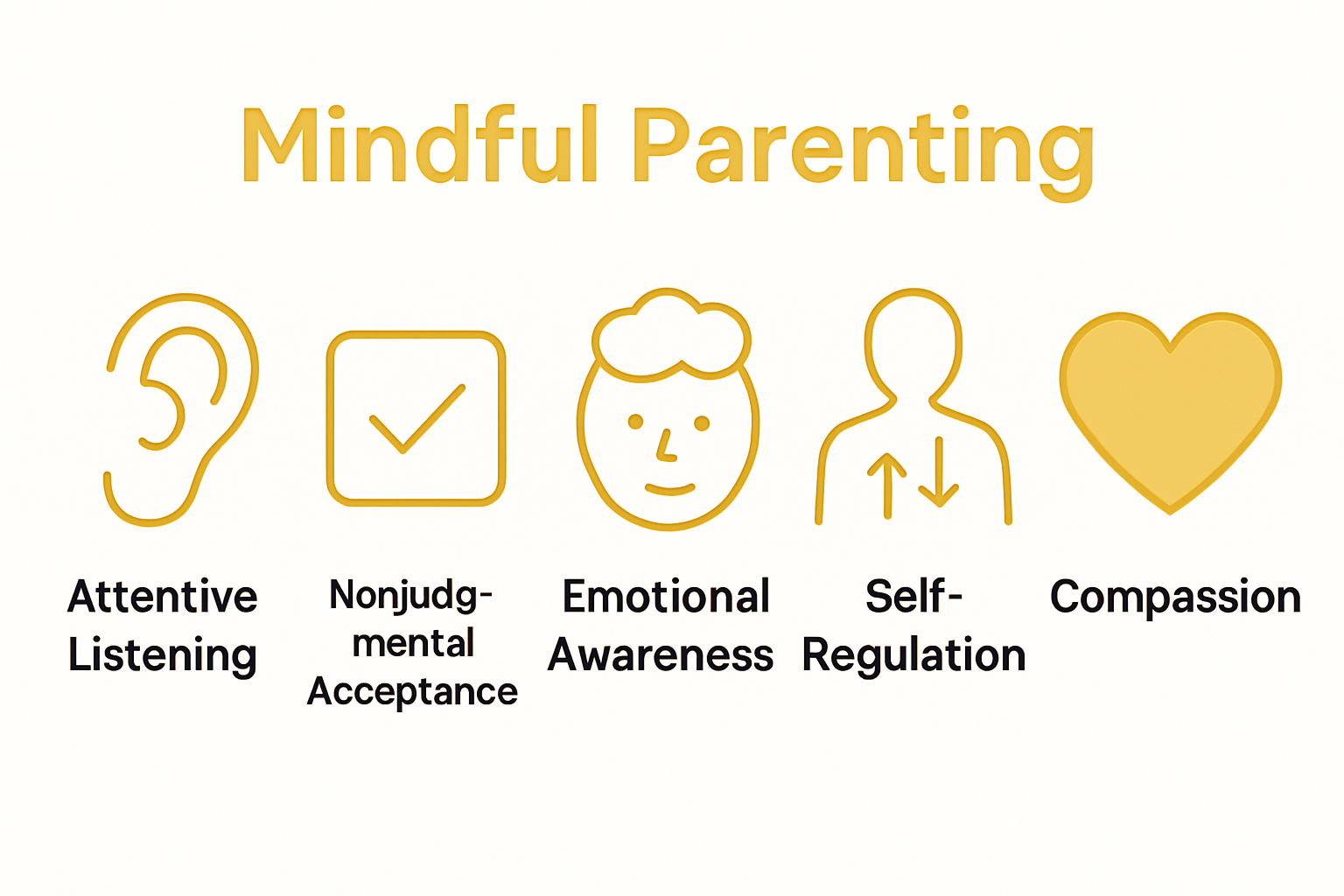
Understanding mindful parenting starts with recognising how parents can create meaningful connections through conscious engagement. Research from the University of California reveals that mindful parenting involves five critical dimensions:
- Listening with full attention
- Nonjudgmental acceptance of both parent and child
- Emotional awareness of self and child
- Self-regulation during challenging interactions
- Developing compassion for oneself and the child
This approach isn’t about achieving parenting perfection but about being present and responsive rather than reactive. Parents practising mindfulness learn to observe their emotions and their child’s experiences without immediate judgment, creating space for understanding and empathy.
The table below summarises the five critical dimensions of mindful parenting, providing concise definitions to support understanding of each principle.
| Dimension | Definition |
|---|---|
| Listening with full attention | Giving undivided focus to the child, setting aside distractions to truly hear what is said. |
| Nonjudgmental acceptance | Accepting both parent and child as they are, without imposing critical or negative judgement. |
| Emotional awareness of self/child | Recognising and understanding both the parent’s and the child’s emotions in a given moment. |
| Self-regulation during challenges | Managing one’s emotions to respond calmly rather than react impulsively during difficulties. |
| Compassion for self and child | Approaching oneself and the child with kindness and understanding, especially when stressed. |
Practical Application of Mindful Principles
Mindful parenting transcends theoretical concepts by providing practical strategies for daily interactions. By staying attuned to the present moment, parents can respond to their children’s needs with greater emotional intelligence. This means pausing before reacting, recognising emotional triggers, and approaching challenging situations with curiosity and openness.
Parents who embrace this approach often discover improved communication, deeper emotional connections, and more positive family dynamics. Understanding childhood development becomes easier when parents remain emotionally regulated and compassionate.
By integrating mindfulness into parenting, families can create nurturing environments where children feel genuinely heard, understood, and supported in their emotional growth.
The Importance of Mindful Parenting in Modern Families
In an increasingly complex and fast-paced world, mindful parenting emerges as a critical approach to nurturing healthy family relationships and supporting children’s emotional development. The significance of this approach extends far beyond traditional parenting methods, addressing the unique challenges faced by contemporary families.
Emotional Resilience and Family Dynamics
Research from the Journal of Youth and Adolescence demonstrates that mindful parenting significantly impacts family interactions and children’s psychological well-being. Key benefits include:
- Reduced negative emotional responses during family conflicts
- Enhanced communication and understanding between parents and children
- Improved emotional regulation for both parents and children
- Greater capacity to navigate complex social and emotional landscapes
Modern families face unprecedented challenges, including digital distractions, academic pressures, and rapid social changes. Mindful parenting provides a robust framework for creating emotional stability and deep connection amidst these complexities.
Long-Term Developmental Impacts
Beyond immediate family interactions, mindful parenting has profound long-term implications for children’s development. When parents practise consistent emotional awareness and compassionate engagement, children learn critical life skills such as emotional intelligence, self-reflection, and empathetic communication.
The approach supports children in developing healthy emotional frameworks, enabling them to better manage stress, build meaningful relationships, and navigate life’s challenges with greater resilience. Understanding eco-friendly routines can complement this holistic approach to family well-being, emphasising the interconnectedness of emotional and environmental consciousness.
Ultimately, mindful parenting represents more than a parenting technique. It is a transformative philosophy that recognises children as unique individuals deserving of respect, understanding, and compassionate guidance.
This comparative table outlines the distinctions between traditional parenting approaches and mindful parenting, highlighting key differences in approach and outcomes as discussed in the article.
| Aspect | Traditional Parenting | Mindful Parenting |
|---|---|---|
| Communication | Often directive or corrective | Focused on active listening and empathy |
| Emotional Responses | Frequently reactive or automatic | Intentional, responsive, and emotionally aware |
| Conflict Navigation | May escalate with frustration | Managed with pauses, reflection, and understanding |
| View of Child | Sees child behaviour as needing control | Views child as unique, deserving respect |
| Emotional Regulation | Less emphasis on self-regulation | Strong focus on modelling emotional self-regulation |
How Mindful Parenting Enhances Parent-Child Relationships
Mindful parenting represents a transformative approach to building deeper, more meaningful connections between parents and children. By cultivating genuine presence and emotional understanding, this method transcends traditional communication patterns and creates more authentic family interactions.
Communication and Emotional Intelligence
Research from the U.S. National Institutes of Health reveals that mindful parenting significantly improves parent-child relationship quality through enhanced communication and emotional attunement. The approach emphasises several critical relational skills:
- Active and empathetic listening
- Nonreactive emotional responses
- Genuine curiosity about the child’s inner experiences
- Compassionate understanding instead of immediate judgment
- Creating safe emotional spaces for vulnerability
These skills enable parents to move beyond surface-level interactions, developing deeper emotional connections that support children’s psychological development and sense of security.

Transforming Conflict and Building Trust
Mindful parenting fundamentally reshapes how families navigate challenges and disagreements. Instead of approaching conflicts with frustration or automatic reactivity, parents learn to pause, reflect, and respond with emotional intelligence. This approach helps children feel genuinely heard and understood, even during difficult moments.
By modelling emotional regulation and compassionate communication, parents teach children invaluable life skills. Making learning fun through engaging activities can further complement this approach, creating positive learning environments that strengthen familial bonds.
Ultimately, mindful parenting is about creating a relationship characterised by mutual respect, emotional safety, and genuine connection. It transforms parenting from a role of control to a journey of mutual growth and understanding.
Core Practices for Incorporating Mindfulness in Parenting
Incorporating mindfulness into parenting requires intentional practices that transform everyday interactions into opportunities for deeper connection and emotional growth. By developing specific skills and approaches, parents can cultivate a more present, compassionate approach to raising children.
Foundational Mindfulness Techniques
Research from the National Institutes of Health highlights several core practices essential for mindful parenting. These techniques focus on developing emotional awareness and conscious responses:
- Practicing deliberate breathing during stressful moments
- Observing personal emotional reactions without immediate judgment
- Creating intentional pauses before responding to challenging behaviours
- Developing non-reactive awareness of children’s emotional states
- Cultivating self-compassion during difficult parenting experiences
These foundational techniques help parents shift from automatic, reactive responses to thoughtful, compassionate interactions that support children’s emotional development.
Mindful Communication Strategies
Effective mindful parenting requires developing communication skills that prioritise genuine connection and understanding. This involves actively listening without interrupting, acknowledging children’s feelings, and expressing empathy through both verbal and non-verbal communication.
Parents learn to create emotional safety by validating their children’s experiences, even when they disagree with their behaviours. Explore engaging learning activities that can complement these communication strategies, fostering interactive and supportive family environments.
By consistently practicing these mindful approaches, parents can transform their relationships, creating nurturing spaces where children feel genuinely seen, heard, and understood. Mindfulness becomes not just a technique, but a profound way of being present with one another.
Real-World Benefits of Embracing Mindful Parenting
Mindful parenting transcends theoretical concepts, offering tangible, measurable benefits that transform family dynamics and individual well-being. By integrating mindfulness into daily interactions, parents and children experience profound positive changes across emotional, psychological, and relational domains.
Psychological and Emotional Wellness
Research from the International Journal of Environmental Research and Public Health reveals significant psychological benefits of mindful parenting. The approach demonstrates remarkable outcomes in reducing stress and improving family relationships:
- Substantial reduction in parental stress levels
- Decreased frequency of child behavioural challenges
- Enhanced emotional regulation for both parents and children
- Improved psychological resilience within family units
- Lower instances of anxiety and depressive symptoms
These benefits stem from a fundamental shift in how parents perceive and respond to challenging situations, creating more supportive and understanding family environments.
Long-Term Developmental Advantages
Beyond immediate emotional benefits, mindful parenting contributes to children’s long-term psychological development. Children raised with mindful approaches tend to develop stronger emotional intelligence, better communication skills, and more robust coping mechanisms.
Parents who practice mindfulness model emotional self-regulation, teaching children invaluable life skills through consistent, compassionate interactions. Understanding the benefits of imaginative play can further complement these developmental advantages, creating holistic learning environments.
Ultimately, mindful parenting is not just a technique but a transformative approach that nurtures healthier, more connected family relationships. By embracing presence, empathy, and conscious communication, parents lay the groundwork for their children’s emotional success.
Bring Mindful Parenting to Life with The Zoofamily
Many parents strive to foster mindful awareness and nurturing connections, but are challenged by daily distractions and the pressure to keep children engaged meaningfully. The article highlights the importance of being present and building genuine relationships, as well as encouraging curiosity and compassion for our world. At The Zoofamily, we understand your goal to support emotional growth and inspire curiosity, while also cultivating a love for nature in your children.
Discover how our thoughtfully designed kids’ cameras, walkie-talkies, and binoculars open new pathways for mindful family interactions. Each product encourages children to explore the outdoors, communicate attentively, and capture precious moments together – all essential aspects of mindful parenting discussed in the article. Visit The Zoofamily now and take the next step towards meaningful engagement. Every camera you choose also helps restore our planet, as we plant one tree for every purchase.
Frequently Asked Questions
What is mindful parenting?
Mindful parenting is an approach that emphasises being present and responsive in the parent-child relationship through awareness, intentional interaction, and compassion.
How can I practise mindful parenting?
You can practise mindful parenting by engaging in activities such as active listening, emotional regulation during challenging interactions, and maintaining self-compassion while parenting.
What are the benefits of mindful parenting?
Mindful parenting offers various benefits, including reduced parental stress, improved emotional regulation, enhanced communication, and the development of emotional intelligence in children.
How does mindful parenting impact children’s emotional development?
Mindful parenting supports children’s emotional development by fostering compassion, emotional awareness, and resilience, helping them navigate life’s challenges more effectively.