

Choosing the right playground activities for your preschooler can feel overwhelming when you want to nurture creativity while fostering a genuine connection to nature. Parents across Europe face the challenge of selecting outdoor experiences that go beyond simple entertainment to build essential skills and ecological awareness. This guide provides a clear criteria framework and curated activity selection with practical tips, empowering you to confidently create enriching playground experiences that align with your child’s developmental needs and your family values.
Table of Contents
- How To Choose The Right Playground Activities For Your Preschooler
- Top Creative Outdoor Playground Activities For Preschoolers
- Comparing Playground Activity Types: Benefits And Best Uses
- Safety And Practical Tips For Implementing Playground Activities
- Summary Comparison And Situational Recommendations
- Discover Creative Play Tools For Your Preschooler At The Zoofamily
- Frequently Asked Questions
Key takeaways
| Point | Details |
|---|---|
| Selection criteria | Evaluate activities based on developmental benefits, nature engagement, safety considerations, and accessibility to resources. |
| Top activity types | Nature scavenger hunts, loose parts play, binocular and camera exploration, imaginative role play, and cooperative group games deliver optimal creative and ecological outcomes. |
| Safety foundation | Active supervision reduces playground injuries significantly whilst enabling children to explore confidently within safe boundaries. |
| Practical guidance | Tailor activity choices to your family’s space constraints, budget, seasonal climate, and child’s unique interests for best results. |
How to choose the right playground activities for your preschooler
Selecting appropriate playground activities requires understanding what supports your child’s growth holistically. Age appropriateness forms the foundation, as creative outdoor activities for preschoolers enhance fine and gross motor skills by up to 25% compared to indoor play alone. Choose activities matching your child’s current abilities whilst gently challenging them to develop coordination, balance, and social interaction skills.
Prioritise outdoor settings rich in natural elements. Playgrounds with trees, rocks, sand, and water offer sensory variety impossible to replicate indoors. Look for spaces using sustainable materials rather than exclusively plastic equipment, as these align with teaching ecological responsibility early. Natural environments spark curiosity about living systems and seasonal changes, creating organic learning opportunities.
Educational themes woven into play deepen engagement. Activities incorporating observation, classification, or problem solving using nature’s materials build cognitive skills alongside physical development. When evaluating options, consider whether the activity encourages questions about the natural world and offers scope for discovery rather than predetermined outcomes.
Safety and supervision capabilities must match activity complexity. Assess your ability to monitor multiple children, the inherent risks of each activity, and how equipment or materials might pose hazards. Balance protection with allowing appropriate risk taking that builds confidence and resilience.
Finally, account for practical constraints. Evaluate costs, access to necessary resources, and compatibility with your local European climate and seasonal variations. Sustainable playground ideas demonstrate how thoughtful planning maximises existing resources whilst minimising environmental impact and expense.
Pro tip: Create a simple checklist rating potential activities on development, nature connection, safety, and practicality. This systematic approach prevents impulse choices and ensures selections genuinely serve your child’s needs.
Top creative outdoor playground activities for preschoolers
Nature scavenger hunts transform ordinary playground visits into structured exploration adventures. Design themed hunts around colours, shapes, textures, or specific natural items like different leaf types or insects. These activities boost ecological knowledge whilst delivering substantial physical activity as children search enthusiastically across varied terrain. Equipping young explorers with collecting bags and simple identification guides extends engagement and learning depth.
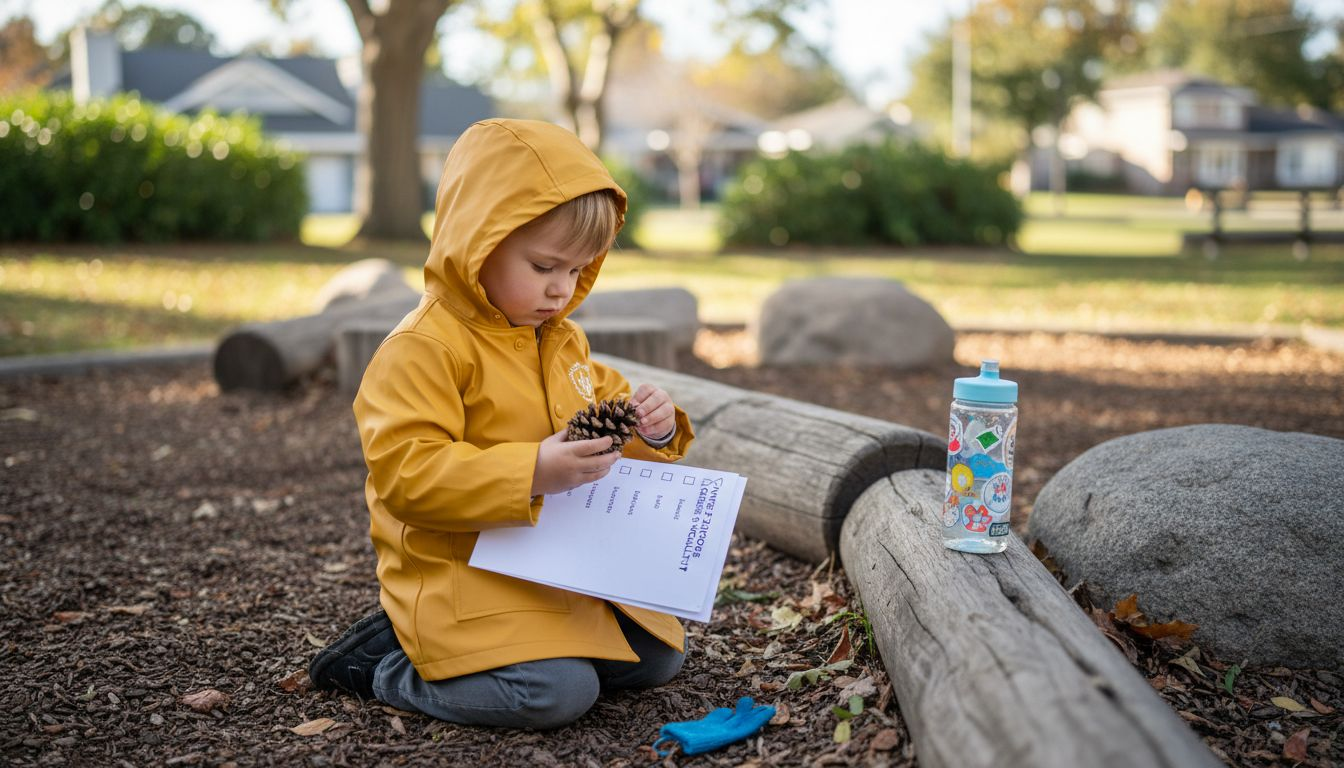
Loose parts play revolutionises creative thinking by providing open ended materials without predetermined purposes. Sticks, stones, pinecones, shells, and fallen leaves become building blocks for imaginative constructions. Research shows children engage with natural loose parts 60% longer than structured plastic toys, as the materials inspire continual reinvention. This approach fosters problem solving, spatial reasoning, and cooperative negotiation when children collaborate on shared projects.
Mini explorations using binoculars and kids’ cameras elevate simple observation into focused scientific discovery. Animal themed binocular and camera exploration increases engagement by 40% and extends focused observation time significantly. Children document discoveries photographically, creating personal nature journals whilst practising patience and attention to detail. These tools make abstract concepts like magnification and perspective tangible and thrilling.
Imaginative ecological role play invites children to embody animals, plants, or natural processes through dramatic play. Scenarios like pollination, migration, or food chains become living lessons when children act them out physically. This activity particularly promotes creativity and social cooperation, though it requires adult facilitation to maintain focus and ensure accurate ecological concepts. Creative outdoor play ideas offer numerous themed scenarios adaptable to different environments and group sizes.
Group cooperative games designed around nature themes build peer interaction skills whilst increasing physical activity. Activities like animal movement relays, collaborative nest building, or team based habitat creation encourage communication, turn taking, and shared problem solving. These work exceptionally well with multiple children and suit various skill levels through adjustable complexity.
Pro tip: Rotate activities weekly rather than daily to allow deeper exploration and skill building. Familiarity breeds confidence, enabling children to innovate within known frameworks rather than constantly adapting to new rules.
Comparing playground activity types: benefits and best uses
Understanding how different activities perform across key metrics helps match choices to your priorities and circumstances. Engagement quality varies significantly, with loose parts play and camera exploration sustaining focused attention longest due to their self directed nature. Scavenger hunts deliver intense bursts of energetic engagement but may conclude quickly without careful planning.
Developmental benefits differ substantially across activity types:
- Nature scavenger hunts excel at building observation skills, vocabulary, and classification abilities
- Loose parts play develops spatial reasoning, fine motor control, and creative problem solving
- Camera and binocular exploration strengthens patience, documentation skills, and scientific thinking
- Role play activities build empathy, cooperation, and ecological understanding through embodied learning
- Cooperative games enhance communication, teamwork, and physical coordination
Cost and accessibility considerations impact feasibility significantly. Scavenger hunts and loose parts play require virtually no financial investment, using freely available natural materials. Camera and binocular activities involve moderate equipment costs but deliver extended value through repeated use. Role play and cooperative games fall between these extremes, sometimes requiring simple props but mainly relying on imagination and facilitation.
Environment suitability determines practical implementation success. Natural playgrounds with diverse vegetation and terrain suit all activity types beautifully. Traditional equipment based playgrounds accommodate cooperative games and role play well but limit loose parts and scavenger hunt potential unless adjacent green spaces exist. Group outdoor games scored 15% higher in promoting peer cooperation than individual nature exploration activities in preschoolers, making them particularly valuable for social development priorities.
| Activity type | Engagement duration | Primary developmental benefit | Cost | Best environment |
|---|---|---|---|---|
| Nature scavenger hunts | Moderate (20-40 min) | Observation and classification | Very low | Natural settings |
| Loose parts play | High (45-90 min) | Creative problem solving | Very low | Any outdoor space |
| Camera/binocular exploration | High (30-60 min) | Scientific observation | Moderate | Diverse natural areas |
| Ecological role play | Moderate (25-45 min) | Social cooperation and empathy | Low | Open areas |
| Cooperative games | Moderate (20-35 min) | Peer cooperation | Low | Any playground |
Pro tip: Combine complementary activities in single sessions. Start with energetic scavenger hunts, transition to focused camera work, then conclude with cooperative games to balance energy levels and attention demands.
Safety and practical tips for implementing playground activities
Active adult supervision forms the foundation of safe outdoor play. Parental supervision significantly reduces outdoor play injuries in preschool playgrounds by 50%, making your presence and attention the single most effective safety measure. Position yourself where you can observe all participants whilst remaining available for questions or assistance without hovering intrusively.
Weather and seasonal factors demand proactive planning across Europe’s varied climates. Implement these seasonal adjustments:
- Spring: Inspect areas for seasonal hazards like flooding or unstable ground from winter freeze thaw cycles
- Summer: Schedule morning or evening sessions during heat waves and ensure adequate hydration and sun protection
- Autumn: Check loose parts play materials for moisture and mould, particularly in northern regions with heavy rainfall
- Winter: Adapt activities to shorter daylight hours and dress children in layers for temperature regulation
Natural materials require safety inspection before use. Examine sticks, stones, and other loose parts for sharp edges, splinters, or contamination. Establish clear boundaries about what children may handle, particularly regarding mushrooms, berries, or insects that could pose toxicity or allergy risks. Create simple visual guides showing safe versus unsafe natural items.
Local climate and playground features necessitate activity adaptation. Urban spaces with limited vegetation benefit from portable nature collections you bring. Coastal regions offer unique shells and sand for sensory play. Forest adjacent playgrounds provide abundant loose parts but require extra vigilance for trip hazards from roots and uneven terrain.
Group dynamics management ensures positive experiences for all participants. Match activity complexity to the least experienced child’s ability level, then offer extensions for advanced participants. Rotate leadership roles in cooperative games to build confidence across different personality types. Educational outdoor activities provide frameworks for inclusive participation regardless of individual differences.
Regular outdoor play in all weather conditions builds resilience and adaptability in young children, preparing them for lifelong outdoor engagement and environmental stewardship.
Pro tip: Maintain a simple outdoor play kit in your vehicle with essentials like collecting bags, basic first aid supplies, extra layers, and emergency contact information. This eliminates preparation barriers and enables spontaneous nature exploration opportunities.
Summary comparison and situational recommendations
This comprehensive comparison helps you quickly assess which activities best match your priorities and circumstances. The ratings reflect typical outcomes when activities receive appropriate facilitation and occur in suitable environments.
| Activity | Creativity boost | Nature connection | Cost | Social benefit | Space required |
|---|---|---|---|---|---|
| Nature scavenger hunts | High | Very high | Very low | Moderate | Medium to large |
| Loose parts play | Very high | High | Very low | High | Small to medium |
| Camera/binocular exploration | High | Very high | Moderate | Low to moderate | Any size |
| Ecological role play | Very high | Moderate | Low | Very high | Medium to large |
| Cooperative games | Moderate | Moderate | Low | Very high | Medium |
Urban parents with limited outdoor space should prioritise loose parts play and camera exploration. Both activities adapt brilliantly to small areas, with loose parts requiring minimal square footage whilst delivering extended engagement. Portable nature collections brought from parks or countryside visits supply materials for apartment balconies or small yards.
Parents wanting to enhance ecological awareness specifically should emphasise nature scavenger hunts and binocular exploration. These activities direct attention explicitly to natural systems, seasonal changes, and biodiversity whilst building observation skills that underpin scientific thinking. Combine them with simple field guides appropriate for preschool comprehension levels.
Families with budget constraints gain maximum value from scavenger hunts and loose parts play. Neither requires purchased equipment beyond basic collecting containers you likely own already. Natural materials cost nothing and offer infinite variety, whilst themed scavenger hunt lists download freely from numerous outdoor play resources.
Adapt your choices to your child’s demonstrated interests and temperament:
- Energetic, physical children thrive with scavenger hunts and cooperative games
- Contemplative, focused children excel at camera work and loose parts construction
- Social, collaborative children benefit most from role play and group activities
- Independent explorers appreciate binocular observation and open ended loose parts play
Environmental conditions influence success significantly. Rainy climates suit activities using waterproof cameras and embracing mud play as legitimate learning. Arid regions benefit from shade based scavenger hunts during cooler hours. Coastal families incorporate beach materials naturally, whilst forest access enables extensive loose parts collections.
Pro tip: Document your child’s playground experiences photographically to track developmental progress and identify which activity types generate the deepest engagement and learning for their unique personality and interests.
Discover creative play tools for your preschooler at The Zoofamily
Transforming outdoor play from ordinary to extraordinary often requires just the right tools that spark curiosity and extend engagement naturally. The Zoofamily specialises in educational, eco friendly cameras and binoculars designed specifically for preschool aged explorers, combining durability with child appropriate functionality that makes nature observation genuinely accessible and thrilling.
Our animal themed designs trigger immediate interest in wildlife and natural systems whilst providing robust tools that withstand enthusiastic outdoor use. Kids’ cameras document discoveries that children revisit repeatedly, building visual literacy and observation skills through repeated viewing and discussion. Complement exploration tools with our walkie talkies, which enhance cooperative play whilst providing practical safety communication during playground adventures, as detailed in our safety guide for kids’ walkie talkies.
Every camera sold plants one tree, demonstrating environmental commitment concretely to young minds whilst contributing to habitat restoration for generations ahead. Visit The Zoofamily to discover curated, sustainable play products that deepen your child’s creativity and nature connection through quality tools designed for meaningful outdoor engagement.
Frequently asked questions
What are the best playground activities to boost creativity in preschoolers?
Nature scavenger hunts, loose parts play with natural materials, and imaginative ecological role play consistently deliver the highest creativity outcomes. These activities provide open ended exploration without predetermined solutions, encouraging children to invent, experiment, and problem solve using available resources. Focus on options allowing multiple approaches and outcomes rather than single correct answers.
How can parents ensure safety during outdoor playground activities?
Active supervision represents your most powerful safety tool, as parental supervision significantly reduces outdoor play injuries by 50% in preschool settings. Adjust activities to current weather conditions and inspect natural materials for hazards before use. Establish clear boundaries about safe versus unsafe items and maintain age appropriate activity complexity that matches your child’s current capabilities.
Which playground activities best connect preschoolers to nature?
Nature scavenger hunts and binocular or camera exploration foster the deepest ecological awareness by directing sustained attention to natural systems, biodiversity, and seasonal patterns. Loose parts play using sticks, stones, leaves, and other natural elements enhances sensory connection through direct manipulation. These activities build observation skills and environmental curiosity that form foundations for lifelong ecological literacy and stewardship.
What are ideal activities for parents with limited outdoor space?
Loose parts play adapts brilliantly to confined areas like balconies or small yards, requiring minimal square footage whilst delivering extended creative engagement. Camera exploration works in any sized space, as even small gardens contain fascinating details when viewed through a preschooler’s curious lens. Bring portable nature collections from parks to enable scavenger hunt style sorting and classification activities in compact urban settings.
Recommended
- 7 Outdoor Play Ideas for Preschoolers to Boost Creativity – The Zoofamily
- 7 Sustainable Daycare Playground Ideas for Nature-Loving Kids – The Zoofamily
- Making Learning Fun: Engaging Activities for Your Kids – The Zoofamily
- Best Children’s Golf Gloves: Anti-Slip Grip & Skill Development – Aiming Fluid Golf
- Top Photo Booth Trends 2026: 45% Higher Guest Engagement