

TL;DR:
- Prioritizing quality, context, and outdoor activities over strict screen time limits supports children’s mental health and wellbeing.
- Parents can foster healthier habits by co-engaging, setting tech-free zones, and encouraging outdoor exploration and creativity.
Most parents assume that setting a strict daily screen time limit is the gold standard of responsible parenting in the digital age. It feels logical: fewer hours on screens must mean a healthier, happier child. But this approach misses something vital. Updated AAP recommendations now prioritise quality, context, and what screens displace rather than focusing solely on hours. This article walks you through a more complete picture, showing how mindful technology use, combined with outdoor creativity and nature play, can genuinely transform your child’s wellbeing.
Table of Contents
- Understanding mindful tech use: more than just screen limits
- The science: screen time, mental health, and nature’s protection
- Building healthy digital habits at home
- Balancing creativity, technology, and nature: real family strategies
- Why shifting the conversation from restriction to engagement transforms families
- Find more inspiration for your mindful parenting journey
- Frequently asked questions
Key Takeaways
| Point | Details |
|---|---|
| Quality over quantity | Prioritising meaningful engagement and content is more important than strictly limiting screen time hours. |
| Nature as a counterbalance | Regular outdoor activities significantly reduce children’s reliance on digital devices. |
| Healthy routines matter | Family agreements, tech-free zones, and co-engagement help balance technology’s role at home. |
| Creativity bridges the gap | Blending tech use with nature and creative activities rewards children in healthier, dopamine-rich ways. |
| Parental modelling is key | Children mirror their parents’ attitudes and routines towards technology use. |
Understanding mindful tech use: more than just screen limits
To set the foundation, let’s redefine what healthy technology use truly means for families.
Many parents pour energy into watching the clock, but the more meaningful question is: what is your child actually doing on that screen, and what is it replacing? A child watching a quality nature documentary with a parent for 45 minutes is having a fundamentally different experience from a child passively scrolling short videos alone for 45 minutes. Duration tells you almost nothing on its own.
The American Academy of Pediatrics introduced a useful framework known as the 5 C’s to help families think beyond hours. These are:
- Child: Consider your individual child’s temperament, age, and developmental stage.
- Content: Prioritise high-quality, educational, or creative content over passive entertainment.
- Calm: Avoid screens during wind-down routines, mealtimes, and before sleep.
- Crowding out: Ask whether screen time is replacing sleep, physical activity, homework, or face-to-face play.
- Communication: Keep the dialogue open, watch together, and discuss what your child sees.
“The goal is not to eliminate screens but to use them wisely, so that technology serves your child’s development rather than working against it.”
The healthy screen time habits your family builds now create a foundation that lasts well into the teen years. Co-engagement is particularly powerful. When you sit beside your child and ask questions about what they are watching, you turn a passive activity into an interactive learning moment. Context matters enormously, and mindful parenting is about shaping that context every single day.
The science: screen time, mental health, and nature’s protection
Now that we’ve broadened our understanding, let’s look at what the evidence reveals about mental health and the unique value of nature time.
The research picture is striking and, frankly, a little alarming if your household currently runs on screens from morning to evening. Excessive screen time of four or more hours daily is strongly linked to higher risks of anxiety, depression, and ADHD in children, according to a large-scale study published in a peer-reviewed journal.
| Mental health risk | Association with 4h+ daily screen time |
|---|---|
| Anxiety | 45% higher adjusted odds |
| Depression | 61% higher adjusted odds |
| ADHD symptoms | 21% higher adjusted odds |
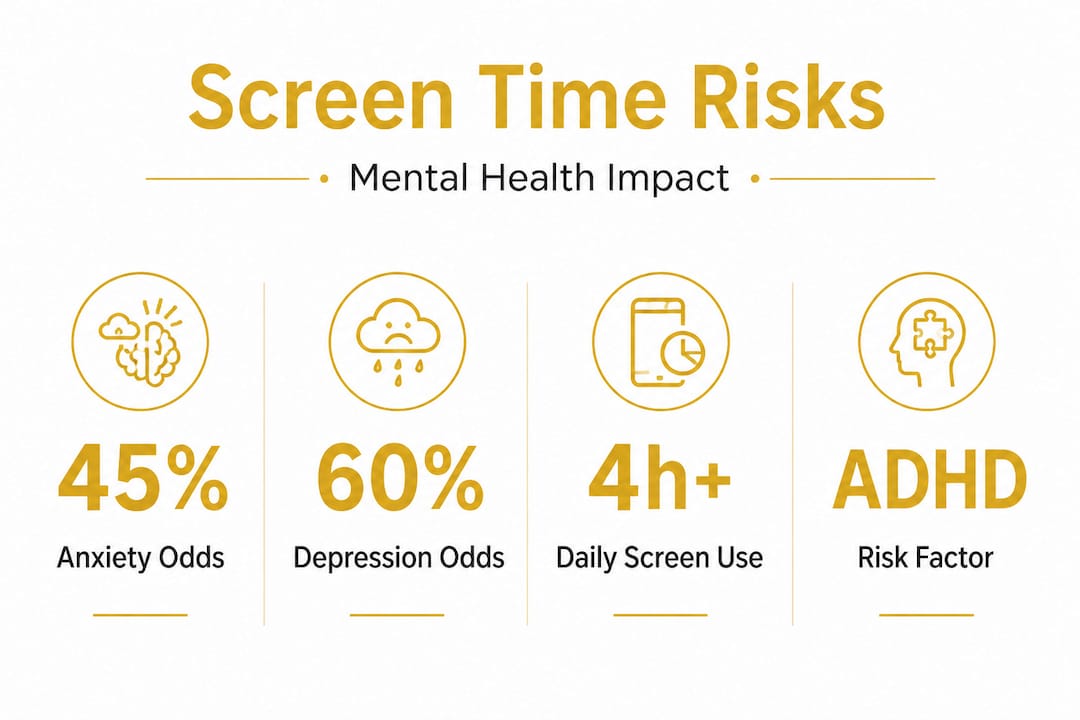
These are not trivial numbers. And here is the crucial detail: physical activity was found to mediate these risks by 30 to 39%. That means getting your child moving outdoors is not just a nice bonus. It is a direct, measurable way to offset the harm caused by too much passive screen use.
Nature does something that no app can fully replicate. It offers what psychologists call “soft fascination,” the gentle, restorative kind of attention that allows the brain to reset. Birdsong, changing light, the texture of tree bark, the unpredictability of a stream. These stimuli engage the senses without overwhelming them. In contrast, the fast-paced design of most digital content pulls hard on the brain’s arousal systems without offering recovery.
“When children play outdoors regularly, their brains get the restorative pause that screens simply cannot provide.”
Perhaps most encouraging for parents is this finding: frequent parent-child outdoor visits to gardens, parks, and nature spaces are associated with 2 to 3 fewer hours of weekly screen time in preschoolers. Simply going outside together, without a specific agenda, nudges the entire family toward healthier habits. You do not need to plan a grand adventure. A regular walk around the local park after dinner is already working in your favour.
For families curious about nature-inspired technology for families, the sweet spot lies in products that draw children outward rather than inward. A camera designed for outdoor use, for example, transforms screen time into active exploration.
Building healthy digital habits at home
With an understanding of the stakes, it is time to put practical strategies into action.
Building lasting habits requires more than willpower. It needs structure, consistency, and buy-in from the whole family. Here is a step-by-step approach that works for most households:
- Create a family media agreement together. When children help set the rules, they are far more likely to follow them. Sit down as a family, discuss everyone’s needs, and write down agreed limits.
- Establish tech-free zones. Bedrooms and mealtimes are the most impactful places to start. Screens in bedrooms disrupt sleep; screens at mealtimes interrupt conversation and connection.
- Build an activity menu. Post a visible list of screen-free activities that children can choose from when boredom strikes. Include options for both indoors and outdoors, and for different energy levels.
- Co-view purposefully. Especially for younger children, watching together and discussing what you see transforms passive viewing into a shared learning experience. Research shows that interactive co-viewing significantly reduces the negative effects of screen exposure on toddlers’ attention and prosocial behaviour.
- Model the behaviour you want. If your child sees you scrolling your phone during dinner or reaching for a device the moment you sit down, that behaviour becomes the norm. Your actions teach more than any rule you set.
Family media agreements combined with tech-free zones and consistent modelling are the most evidence-backed mechanics for creating genuine change at home.
| Strategy | Why it works | Ease for families |
|---|---|---|
| Family media agreement | Builds buy-in and ownership | Medium |
| Tech-free zones | Protects sleep and mealtime | Easy |
| Activity menu | Reduces boredom-driven screen use | Easy |
| Co-viewing | Improves content quality | Easy |
| Parental modelling | Sets the cultural norm at home | Requires effort |
Pro Tip: Rotate your activity menu seasonally. Fresh options keep children engaged and signal that screen-free time can be just as exciting as any app.
Explore tech tools to boost creativity for ideas on devices and activities that work together, and consider building screen-free family routines that your children will genuinely look forward to each week.
Balancing creativity, technology, and nature: real family strategies
Having set strong boundaries, here is how mindful parenting can bring out the best of both worlds: technology and nature.
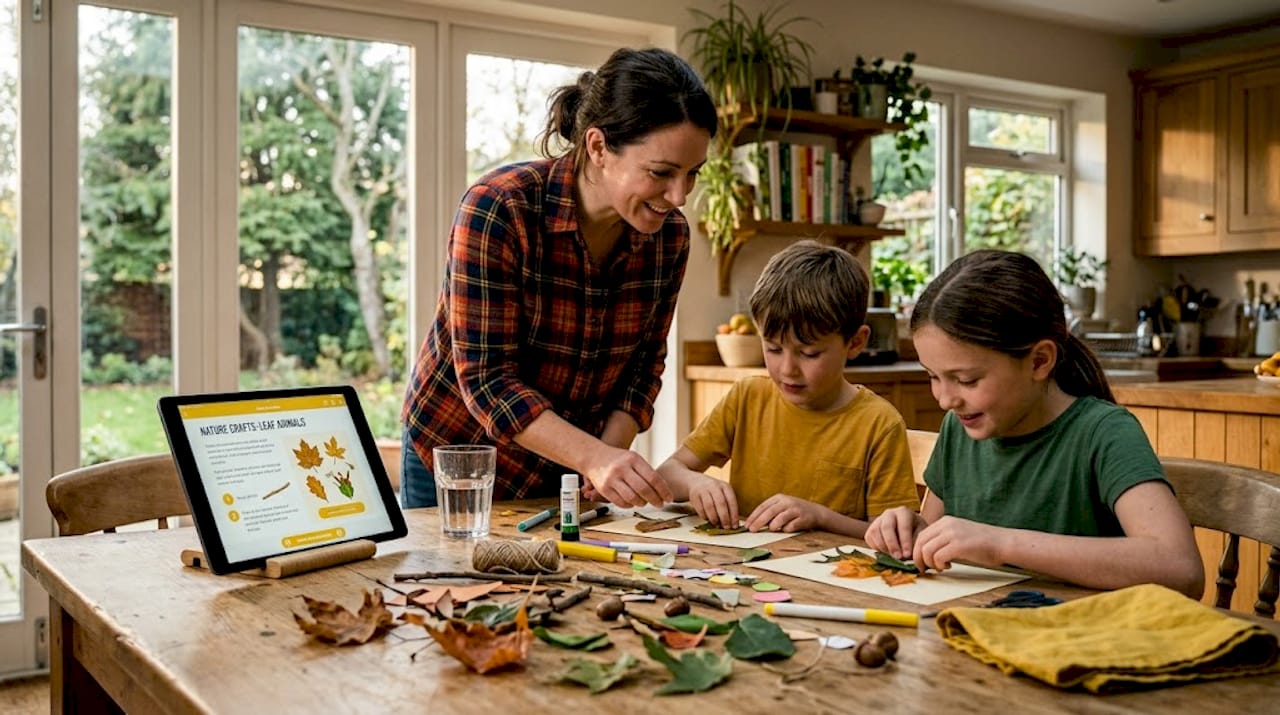
The most common mistake parents make is treating technology and nature as enemies. They are not. The question is whether technology serves as a bridge to the real world or a wall between your child and it.
Passive scrolling is particularly problematic because digital platforms are deliberately designed to be addictive. The dopamine reward cycle that keeps children swiping is fast, effortless, and endless. Nature, by contrast, offers dopamine through real rewards: finding a hidden bird, completing a trail, capturing a photograph of something beautiful. These rewards require effort, patience, and curiosity, which builds genuine resilience.
Here is a practical menu of activities that blend creativity, technology, and nature beautifully:
- Nature photography walks: Give your child a simple camera and challenge them to photograph five things they have never noticed before. The act of looking changes everything.
- Discovery journaling: Combine drawing with photos printed from a nature walk. Children aged 5 and up can create their own field guides.
- Outdoor audio projects: Use a tablet or voice recorder to capture birdsong, water sounds, or wind in the trees. Then listen back and identify what you recorded.
- Building and creating: Use sticks, stones, leaves, and clay found outdoors to build miniature worlds, then photograph them.
- Nature identification apps used outdoors: Apps like plant and bird identifiers become tools for real exploration rather than passive entertainment when used in the field.
Research confirms that nature inversely links to screen harms, meaning the more time children spend in natural environments, the more protected they are from the negative effects of screen exposure. Technology, when used as a lens through which children explore the world rather than escape it, becomes a genuine asset.
On rainy days, keep the momentum going with fun alternatives for wet weather, and when the sun returns, browse creative outdoor activities for fresh ideas. Building a library of go-to activities means you are never scrambling for alternatives when a child announces they are bored.
Pro Tip: Let your child lead a nature project from start to finish, from choosing the subject to displaying the results. Ownership is one of the most powerful motivators for stepping away from passive screens.
For ongoing inspiration, the collection of outdoor play ideas at The Zoofamily is a brilliant starting point, and revisiting screen-free routines regularly helps keep family habits fresh and intentional.
Why shifting the conversation from restriction to engagement transforms families
Here is something most parenting advice gets wrong: it places the burden entirely on rules and restrictions. Set a timer, block an app, confiscate a device. These tactics are not useless, but they treat the symptom rather than the root cause.
The real question is not how to stop your child from wanting screens. It is how to make the world outside screens so rich and rewarding that screens naturally lose some of their grip. We have seen this shift happen in families repeatedly. When parents stop policing and start participating, something changes. A parent who gets down on the floor, picks up a camera, or leads a ten-minute garden expedition sends a message that the real world is worth showing up for.
Shifting from restrictive approaches to health-positive ones, balancing screens with outdoor play, genuinely reduces problematic use. And crucially, parental self-efficacy, meaning how confident and capable you feel as a parent navigating technology, actually improves when the focus shifts to engagement rather than enforcement.
When you feel like a creative partner rather than a screen-time warden, parenting becomes more enjoyable. Your children feel the difference too. The parent who says “let’s go photograph the garden together” is far more compelling than the parent who says “put that down.” Both are loving responses. Only one builds connection.
We also know that the anxiety many parents feel about technology is partly a signal of something deeper: a longing for genuine presence with their children. That longing is healthy. Act on it by building unplugged family time into your weekly rhythm, not as a chore, but as something genuinely worth looking forward to.
Find more inspiration for your mindful parenting journey
If you are ready to move beyond screen time limits and build something richer for your family, there is a whole world of resources waiting for you.

At The Zoofamily, we believe technology and nature belong together, not in opposition. Our kids’ cameras, binoculars, and walkie-talkies are designed with animal references that spark curiosity about the natural world, turning outdoor time into genuine adventure. Every camera sold plants a tree, because we believe the world your child photographs today should still be there for their children tomorrow. Visit our healthy screen habits guide for evidence-based tips, and explore our collection of screen-free routines for families to keep your family grounded, creative, and connected to what matters most.
Frequently asked questions
What is mindful technology use for children?
Mindful technology use means prioritising quality and balance rather than focusing solely on restricting hours of screen time. It involves considering the content, context, and what technology might be displacing in your child’s day.
How much screen time is safe for young children in 2026?
For children under 18 months, only video chatting is advised; for ages 2 to 5, no more than one hour per day of high-quality, co-viewed content is recommended. For older children, quality and context matter more than a fixed hour count.
Can spending time outdoors really reduce children’s screen use?
Yes, families who regularly go outdoors together see up to 2 to 3 fewer hours of weekly screen time in preschoolers. Even simple, unstructured outdoor time makes a measurable difference.
Are there risks if my child spends too much time on screens?
Children using screens for four or more hours daily face significantly higher risks of anxiety, depression, and ADHD symptoms. Physical activity can offset these risks by 30 to 39%.
How can parents encourage creative screen use?
Focus on co-viewing and creative projects that blend technology with real-world exploration, such as nature photography or outdoor discovery apps. When screens become a tool for curiosity rather than passive escape, the whole dynamic shifts.