

Start today with five actions that take under 30 minutes each. Turn your next walk into a biodiversity mystery mission: give your child a simple list of things to find (a feather, a seed pod, something that moves). Let your child pick one short project each week. Add a basic points system where finds earn stamps or stickers. Hand them a kids’ camera or binoculars and ask them to document three things that surprise them. Set a 15-minute timer and call it a “field mission.” These five steps alone can shift how children relate to learning outdoors. The sections below cover the research behind these ideas, ready-to-run activity recipes, a UK safety checklist, and how Thezoofamily’s products fit each method.
Table of Contents
- Why does nature help children learn better?
- What strategies make everyday learning playful?
- Four ready-to-run nature activity recipes
- How do you choose the right nature-inspired toy in the UK?
- What safety steps matter for outdoor nature play?
- How Thezoofamily’s products support these methods
- Key takeaways
- Nature learning works better than it looks on paper
- Thezoofamily: nature tools for your next family mission
- Useful sources and further reading
Why does nature help children learn better?
Nature and play improve learning because they lower stress, increase curiosity, and give children direct sensory experience. Research identifies six elements that primary-age pupils associate with fun in learning: a sense of agency, challenge, diversity in experience, pleasure, a low-stress climate, and peer interaction. Nature settings deliver most of these at once. A child hunting for insects is challenged, choosing where to look, and engaged through touch and sight simultaneously.
Fun, when it is intentional and linked to a learning goal, measurably increases attention, memory encoding, and transfer. That is not an argument for turning every lesson into a game. It is an argument for designing activities where the fun and the learning goal are the same thing.
Pro Tip: Start each outdoor session with one silly rule, such as “you must whisper near the pond.” Low-stakes humour signals that mistakes are safe, which is exactly the low-stress climate the research points to.
What strategies make everyday learning playful?
Six strategies work reliably across ages and subjects: quest framing, choice and agency, mini-gamification, sensory prompts, storytelling, and short wins. Apply one or two at a time rather than all at once.
- Quest framing: Give children a specific role (“you are the habitat detective”). Playful Study Design shows that reframing a task as a proactive design challenge increases engagement without reducing rigour.
- Choice and agency: Let children decide which patch of garden to study. Agency is one of the six core fun elements identified in classroom research.
- Mini-gamification: Award a stamp for each new species spotted. Points and badges boost motivation without requiring digital tools.
- Sensory prompts: Ask “what does the bark feel like?” before “what type of tree is this?” Sensory entry points lower the barrier to abstract thinking.
- Storytelling: Reveal a new clue or fact as children complete each task. Narrative momentum keeps attention across longer sessions.
- Short wins: Break a 45-minute session into three 15-minute rounds with a small celebration between each. This matches attention spans and builds confidence.
A simple quest template you can copy:
| Element | Example |
|---|---|
| Objective | Find five living things in the garden |
| Tools | Camera, notebook, magnifying glass |
| Time | 20 minutes |
| Scoring | One stamp per find; bonus stamp for a photo |
| Celebration | Child names the mission and draws a badge |
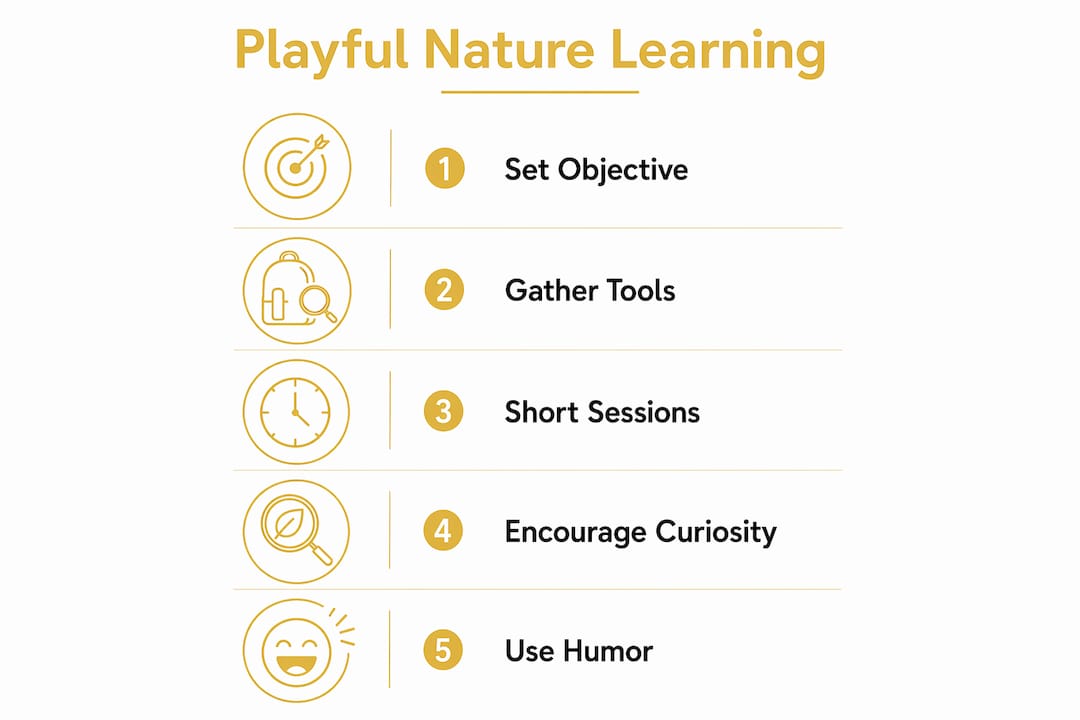
For younger children, keep the session short; as children grow older, they can handle longer sessions with breaks, adjusting duration according to their developmental stage. Connecting learning to daily life and giving movement breaks are two of the simplest ways to maintain engagement across all ages.
Four ready-to-run nature activity recipes
These four activities are short, scalable, and use low-cost materials. Each maps directly to the strategies above.
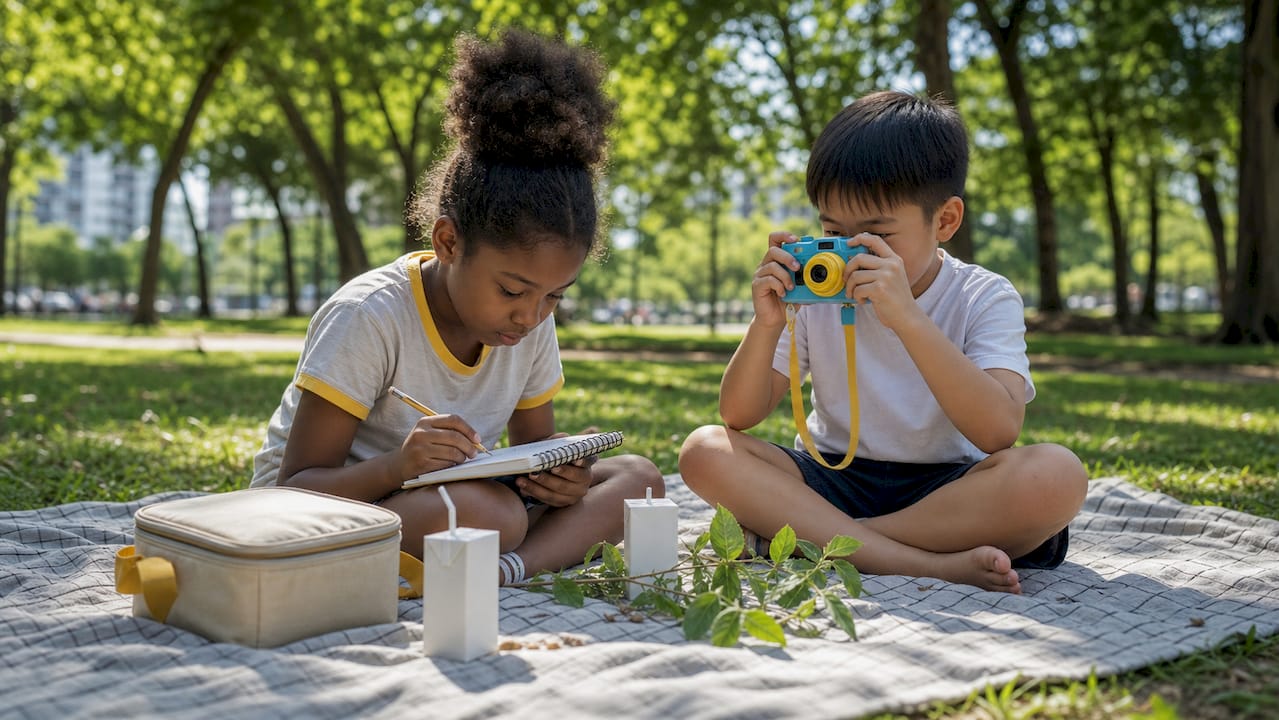
1. Mini bioblitz with a kids’ camera
Materials: Kids’ camera or phone, notebook, pencil. Steps: Set a 15-minute timer. Child photographs every living thing they can find in one patch (garden, park corner, windowsill). Count species at the end. Child names their favourite find. Learning goals: Observation, classification, counting, scientific vocabulary. Time: 15 minutes. Cost: £0 if using an existing camera.
2. Leaf lab: classify and create rubbings
Materials: Leaves, plain paper, wax crayons, a simple tree ID guide (free via Woodland Trust). Steps: Collect six leaves. Place each under paper and rub with a crayon. Sort by shape. Try to name each using the guide. Learning goals: Pattern recognition, sorting, plant biology basics. Time: 20 minutes. Cost: Under £2 for crayons.
3. Micro-habitat bottle observation
Materials: A clear 2-litre bottle, soil, small plants or moss, a few garden invertebrates (returned after 24 hours). Steps: Layer soil and moss in the bottle. Add two or three invertebrates. Observe for 24 hours, recording behaviour every few hours. Release. Learning goals: Habitat, food chains, responsible animal handling. Time: 30 minutes to set up; observation over 24 hours. Cost: £0–£3.
4. Sound safari
Materials: Notebook, pencil, optional walkie-talkies for paired play. Steps: Sit still for five minutes in an outdoor space. List every sound heard. Repeat in a different spot. Compare lists. Learning goals: Active listening, environmental awareness, data comparison. Time: 20 minutes. Cost: £0.
| Activity | Age range | Time | Typical materials | Rough cost |
|---|---|---|---|---|
| Mini bioblitz | 5+ | 15 min | Camera, notebook | £0 |
| Leaf lab | 4+ | 20 min | Leaves, crayons, paper | Under £2 |
| Micro-habitat bottle | 7+ | 30 min + 24 hr | Bottle, soil, moss | £0–£3 |
| Sound safari | 4+ | 20 min | Notebook, pencil | £0 |
You can find more ready-made prompts in Thezoofamily’s nature scavenger hunt ideas and outdoor science activities guides.
How do you choose the right nature-inspired toy in the UK?
Useful toy categories for nature learning include kids’ cameras, binoculars, magnifying glasses, sensory and nature play kits, seed-growing kits, and bug-observation sets. Hands-on tools consistently support engagement and social learning.
Buyer checklist:
- Age appropriateness: Check the manufacturer’s stated age range. Cameras and binoculars suit ages 3+; bug kits with small parts suit 6+.
- Material safety: Look for CE or UKCA marking on the packaging. Both indicate the product meets UK/EU safety standards for children’s toys.
- Durability: Outdoor toys take knocks. Prefer rubberised casing on cameras and binoculars.
- Repairability: Choose brands that offer replacement parts or clear repair guidance.
- Sustainability claims: Check whether the brand has a verifiable environmental policy (for example, a tree-planting scheme linked to sales).
- Price guidance: Kids’ cameras typically range from £20–£50; binoculars £15–£40; nature play kits £10–£30; seed kits £5–£15.
Pro Tip: Before buying, involve your child in the decision. Show them two or three options and ask which one they would use on their next mission. Agency at the selection stage increases the chance they will actually use the toy.
What safety steps matter for outdoor nature play?
The three core rules are: match supervision to age, check for choking hazards in any kit, and prepare for seasonal outdoor risks before you go out.
Children under 5 need direct, close supervision outdoors at all times. Ages 5–8 can explore a defined area independently while an adult remains nearby. Ages 9 and above can take on more independence within agreed boundaries, provided they have a way to signal for help (a whistle or walkie-talkie works well).
Before any outdoor session, check for small parts in kits (anything that fits through a 44mm circle is a choking risk for under-3s). In spring and summer, check for ticks after sessions in long grass; the NHS recommends removing ticks promptly with a tick removal tool. In winter, dress in layers and keep sessions shorter. Road awareness is relevant for any activity near paths or car parks: agree a clear boundary before the session starts.
Pro Tip: Keep a small kit in your bag: a tick remover, a plaster, and a charged phone. The NHS website has clear guidance on tick removal for UK families.
How Thezoofamily’s products support these methods
Thezoofamily produces kids’ cameras, walkie-talkies, and binoculars, each designed to connect children with the natural world. These products map directly to the activities in this guide.
- Kids’ camera → mini bioblitz: Children document finds in real time, turning observation into a tangible record they can review and share.
- Binoculars → sound safari and habitat spotting: Binoculars extend a child’s field of view without requiring them to disturb a habitat.
- Walkie-talkies → paired sound safari or quest missions: Two children in different spots can compare findings live, adding the peer interaction element the research identifies as central to fun learning.
The animal-themed design of Thezoofamily products is intended to trigger children’s interest in nature before the activity even begins. A child who picks up a camera shaped around wildlife references is already thinking about the natural world.
Key takeaways
Nature-based play works because it combines agency, sensory engagement, and low-stress challenge, the same elements research links to better memory and sustained attention.
| Point | Details |
|---|---|
| Start with five minutes | A 15-minute quest or bioblitz is enough to build the habit; length matters less than consistency. |
| Use the six fun elements | Agency, challenge, diversity, pleasure, low-stress climate, and peer interaction all appear in nature activities naturally. |
| Check safety before going out | Match supervision to age, remove small-part risks, and prepare for seasonal hazards such as ticks. |
| Involve children in toy selection | Letting children choose their own tool increases the chance they will use it and stay engaged. |
| Thezoofamily products | Cameras, binoculars, and walkie-talkies map directly to the bioblitz, safari, and quest activities in this guide. |
Nature learning works better than it looks on paper
The conventional advice on making education enjoyable tends to focus on digital tools or elaborate setups. What the research actually shows is simpler: children learn well when they have a clear role, a low-stakes environment, and something real to interact with. A 20-minute leaf-rubbing session with a wax crayon covers classification, pattern recognition, and plant biology. A sound safari with a notebook covers data collection and environmental awareness. Neither requires a screen or a lesson plan.
The part most guides underestimate is agency. Giving a child the camera and saying “you decide what to photograph” is not a soft option. It is the mechanism that activates curiosity. The research on Playful Study Design makes this explicit: reframing a task so the child is the designer, not the recipient, changes their relationship to the material. That shift is available on any walk, in any garden, with almost no equipment.
Thezoofamily: nature tools for your next family mission
Thezoofamily offers a practical starting point for families who want to put these activities into action. The range covers kids’ cameras, binoculars, and walkie-talkies, each built for outdoor use and designed with animal references that prompt children’s curiosity about the natural world.
For every camera sold, Thezoofamily plants one tree. That is a concrete, verifiable environmental commitment you can explain to your child as part of the activity itself. The products are built for the kind of hands-on, outdoor use the recipes in this guide describe, not for shelf display.
Visit Thezoofamily to see the current range and find the right tool for your child’s next mission.
Useful sources and further reading
- Fun beyond gamification (Instructional Science) — The primary research on six elements children associate with fun in learning, including agency and low-stress climate.
- Playful Study Design (Educational Psychology Review) — The evidence base for quest framing and reframing tasks as playful designs.
- Fun to be Smart — Practical summary of how intentional fun supports memory and engagement.
- Woodland Trust tree ID resources — Free, UK-specific guides for leaf and tree identification; useful for the leaf lab activity.
- NHS tick guidance — Clear UK advice on tick removal and Lyme disease prevention for families spending time outdoors.
- The Dog Gurus: enrichment services — Useful if your family involves a pet in nature activities; covers structured play and observation skills.
- Thezoofamily: making learning fun — Related activity ideas from the Thezoofamily blog.
- Thezoofamily: first nature exploration guide — A starter guide for families new to outdoor learning.
Start with the 15-minute bioblitz from this guide. It requires no preparation, no cost, and gives you an immediate sense of which activities your child responds to best.