

TL;DR:
- Creating a family nature photo album enhances children’s observation, creativity, and environmental connection through outdoor photography. It fosters shared memories, teaches patience, and promotes agency in choosing what to capture, making photography a meaningful child-led activity. Celebrating and sharing these albums inspires ongoing curiosity and deepens appreciation for the natural world.
There is something quietly powerful about handing a child a camera and pointing them towards the natural world. Research on outdoor photography projects shows that supervised nature activities genuinely improve children’s wellbeing and strengthen their connection to the environment around them. A family nature photo album takes this a step further, turning fleeting moments in parks, forests, and gardens into a creative project that builds skills, sparks curiosity, and produces something everyone can hold in their hands and treasure for years. This guide walks you through every stage, from choosing your adventures to celebrating your finished album.
Table of Contents
- Why create a family nature photo album?
- Choosing your nature photography adventures
- Fun photo prompts and shot ideas for kids
- Selecting, organising, and assembling your album
- Sharing and celebrating your family’s nature photo creations
- A fresh perspective: what family nature albums really teach children
- Ready to start your own family nature photo album?
- Frequently asked questions
Key Takeaways
| Point | Details |
|---|---|
| Nurtures creativity | Creating nature photo albums helps children observe, imagine, and express themselves outdoors. |
| Strengthens family bonds | Collaborative photography projects foster memorable moments and teamwork among family members. |
| Boosts wellbeing | Regular supervised outdoor sessions tied to photo albums measurably improve children’s health and connection to nature. |
| Accessible to all | Families of any background can start with basic equipment, nearby nature, and flexible project ideas. |
| Celebrate achievements | Sharing finished albums or entering photos in competitions motivates kids and lets them shine. |
Why create a family nature photo album?
Children are natural observers, but modern life often pulls their attention indoors and onto screens. A family nature photo album gives them a genuine reason to look closely at the world outside: a spider’s web catching the morning light, the bark of an ancient oak, the iridescent shimmer of a beetle’s wing. The act of hunting for a great shot sharpens attention in a way that few other activities can match.
The developmental benefits are real and well documented. Supervised outdoor photography improves children’s wellbeing and health whilst actively building their sense of connection to nature. These are not small gains. Children who feel connected to the natural world are more likely to care about protecting it as they grow older. That is a gift that extends far beyond any single afternoon in the park.
There is also the creative dimension. Nature photography and creativity are deeply linked; when children frame a shot, they make decisions about composition, light, and story. These are real artistic choices, and making them builds confidence.
Beyond individual development, photo albums create shared family memories that photographs alone cannot quite achieve. When you sit together to select, arrange, and annotate your favourite images, you relive the adventure. You laugh about the frog that jumped away just as the shutter clicked. You remember the hike where everyone was grumpy for the first half hour and then found a family of deer in a clearing.
Key benefits at a glance:
- Builds observation skills and a sense of wonder
- Encourages regular outdoor time and reduces screen dependency
- Improves physical and emotional wellbeing
- Develops creative and artistic thinking
- Strengthens family bonds through shared projects
- Fosters environmental values and a love of nature
“Photography gave these children a new lens through which to see and appreciate the natural world, and that shift in perspective stayed with them long after the project ended.”
Cameras and nature exploration belong together, and a photo album gives the whole experience a satisfying destination.
Choosing your nature photography adventures
One of the most common worries parents share is that their surroundings are not interesting enough for nature photography. This is almost never true. Rich photo opportunities exist in city parks, suburban gardens, coastal paths, forest trails, and even window boxes. The key is to approach any location with intention.
For families near forests or countryside, the options are obvious: woodland floors carpeted with fungi, misty morning meadows, insects on wildflowers. But urban families are not at a disadvantage. City parks contain extraordinary biodiversity if you look carefully. Pigeons, foxes, mosses growing on walls, puddles reflecting clouds, seeds drifting on autumn air: all of these make for compelling photographs when viewed through a child’s curious eye.
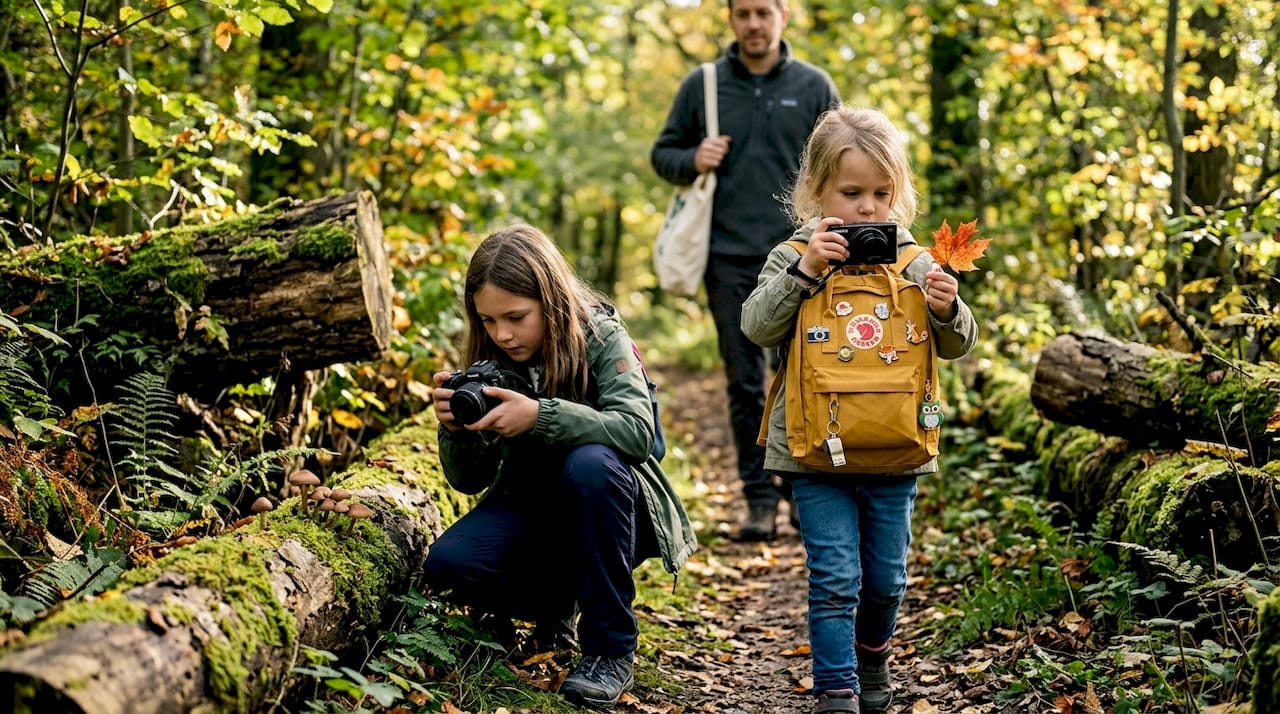
Research confirms that children with little nature exposure often gain the most from guided outdoor photography activities. This means that families who do not live near wild spaces should not hold back. Even a windowsill herb garden or a local park can become an endlessly interesting subject.
Consider these settings for your adventures:
- Local parks and nature reserves: perfect for all ages and abilities
- Gardens and allotments: excellent for close-up plant and insect photography
- Beaches and coastlines: rock pools, shells, waves, and seabirds offer huge variety
- Forests and woodland: light through leaves, animal tracks, and fungi
- Rivers and canals: reflections, waterfowl, and aquatic insects
- Urban green spaces: surprising biodiversity in unexpected places
For families where mobility is a consideration, a well-chosen park bench can become a photography base. Encourage children to photograph everything within reach from one spot, changing angle and focus rather than location.
Photography scavenger hunts are a brilliant way to give outings structure and keep children motivated. Create a list of things to photograph before you leave the house, things like “something yellow,” “a pattern made by nature,” or “an animal smaller than your thumb.”
Pro Tip: Use seasonal changes as your overarching project theme. Spring, summer, autumn, and winter each transform familiar locations dramatically. Photographing the same tree or garden corner in every season gives children a fascinating record of natural cycles and creates four distinct chapters for your album. This approach also gives you built-in nature challenges for children throughout the year without requiring any fresh planning.
Fun photo prompts and shot ideas for kids
Even enthusiastic young photographers sometimes stare blankly at a meadow and say “there’s nothing to photograph.” Creative prompts solve this instantly. The best prompts are specific enough to spark an idea but open enough to allow personal interpretation.
Here are ten prompts that consistently produce beautiful, inventive results:
- Something tiny: Find the smallest living thing you can and photograph it as large as you can make it in the frame.
- A repeating pattern: Nature is full of patterns, honeycombs, pine cones, feathers, bark. Find one and fill the whole photo.
- A creature’s home: A bird’s nest, an ant hill, a snail’s shell.
- Water: A single raindrop on a leaf, a reflection, a stream flowing over stones.
- A colour hunt: Choose one colour before you go out and photograph only things that match it.
- Light and shadow: Shadows cast by leaves, or light filtering through branches.
- A nature self-portrait: A photo taken from your own height that shows the world as you see it.
- A secret place: Somewhere small and hidden that most people would walk past.
- Before and after: Two photos of the same subject from very different distances.
- Something moving: A bee in flight, a leaf falling, water rippling.
These prompts work brilliantly with outdoor photography tips that teach children to think about light and angle before they press the shutter. Slowing down and looking carefully before shooting is a habit that improves every photograph.
For older children, close-up portrait photography of insects and small animals is both thrilling and technically demanding. Getting close enough to fill the frame with a butterfly or a ladybird requires patience, stillness, and a gentle approach. These are exactly the qualities that animal photo tips for kids help children develop over time.
Pro Tip: Share the existence of prestigious nature photography competitions with older children. The Young Wildlife Photographer of the Year competition has dedicated categories for young photographers, and knowing that their work could be seen by a real audience is enormously motivating. It also raises the bar in a positive way, encouraging children to think about what makes a photograph truly memorable rather than just technically correct.
Selecting, organising, and assembling your album
Once you have a collection of photographs from several outings, the next stage is equally rewarding: turning hundreds of images into a thoughtful, beautiful album. This process teaches children to make editorial decisions, which is a sophisticated skill with applications far beyond photography.
Follow these steps to assemble your album well:
- Review together: Gather around a screen or print contact sheets and go through every image as a family. Let each child flag their personal favourites before any discussion begins.
- Shortlist with intention: Aim for variety. Include close-ups alongside wide landscape shots, dramatic images alongside quiet, gentle ones.
- Choose your structure: Decide whether to organise your album chronologically (adventure by adventure) or thematically (all insects together, all water shots together). Thematic albums often look more impressive; chronological ones tell a clearer story.
- Design your layout: Leave breathing room around images. Do not try to fit too many photos onto a single page.
- Add captions and stories: Invite children to write a sentence or two about each image. What did they see? How did they get the shot? What surprised them?
The Young Wildlife Photographer of the Year competition demonstrates that displaying children’s nature photography in a serious context boosts confidence and inspires ongoing creative work. Your family album can do the same thing at home.
Choosing between a digital and a physical album is a genuinely interesting decision:
| Feature | Digital album | Printed album |
|---|---|---|
| Cost | Often free or low cost | Higher upfront cost |
| Shareability | Easy to send online | Requires physical sharing |
| Durability | Dependent on file backups | Lasts decades if stored well |
| Tactile experience | None | Very satisfying |
| Ease of updating | Simple | Not possible once printed |
| Environmental impact | Low if cloud-stored | Paper and ink involved |
Many families choose to do both: keep a digital master and print a single beautiful book at the end of each year. Services like Photobox, Albelli, and Cewe offer reasonably priced photo book printing across Europe.
Pro Tip: Invite children to write short captions in the voice of the subject. “I am a moss-covered stone and I have been here for 200 years” turns a simple photograph into a piece of storytelling, and it makes revisiting the album endlessly more enjoyable.
Exploring eco-photography with children can also give the album a wider purpose, helping children understand that their photographs are a record of the natural world they are helping to protect.
Sharing and celebrating your family’s nature photo creations
A finished album deserves to be celebrated, not simply filed away. Sharing your family’s work meaningfully is the final and perhaps most important stage of the whole project.
At home, print and frame individual favourites. Hang them in hallways and bedrooms so children see their own work valued and displayed every day. This is far more powerful than praise alone.
Beyond home, consider these options:
- School: Many teachers welcome nature photography projects as part of science or art units. A child arriving with a portfolio of their own work is a wonderful thing.
- Extended family: Create smaller printed copies of your album as gifts for grandparents, aunts, and uncles. Children feel genuinely proud when adults outside the family admire their photographs.
- Local libraries and community centres: These venues frequently host community exhibitions and are often delighted to display children’s nature photography.
- Online galleries: Safe, moderated platforms designed for young photographers allow children to share their work with a wider community.
“Seeing your photograph hanging on a gallery wall changes your relationship with photography forever. It stops being a hobby and becomes something real.”
For serious young photographers, competition entry is the ultimate celebration. Children under 17 can enter for free into the Young Wildlife Photographer of the Year competition, one of the most prestigious in the world.
Here is a simple overview of opportunities across Europe:
| Competition or event | Age range | Theme | Typical deadline |
|---|---|---|---|
| Young Wildlife Photographer of the Year (UK) | Under 18 | Wildlife | Autumn |
| European Wildlife Photographer of the Year | All ages | European wildlife | Spring |
| Local nature reserve photo days | All ages | Local biodiversity | Varies |
| School science fair photography category | School age | Nature and environment | Spring term |
Celebrating through creativity and sharing reminds children that their perspective on the natural world has genuine value to others, not just to the family. That realisation is transformative.
A fresh perspective: what family nature albums really teach children
Most people frame this kind of activity as being about photography. We think that misses the deeper point entirely.
A family nature photo album is fundamentally about agency. A child with a camera is not a passenger being shown the world by adults. They are the director. They decide what matters. They decide what is beautiful, interesting, or surprising. When they later choose which images go into the album, they are constructing a version of reality based on their own judgement.
This is genuinely rare in childhood. Most creative activities for children come with templates, correct answers, or adult-defined goals. Nature photography, when it is done well, has none of these constraints. The forest does not care whether you photograph the deer or the leaf on the ground. Both are valid. Both can be extraordinary.
The process also teaches something that is difficult to teach directly: patience. Animals do not appear on schedule. Interesting light lasts for minutes, not hours. Children who spend time waiting for a great shot learn that worthwhile things often require stillness and attention. These are qualities that serve them in every area of life.
We have seen this in the families who use cameras to explore and love nature through The Zoofamily community. Children who begin as reluctant walkers, preferring screens to mud, often become the ones leading the family deeper into the woods because they have developed eyes that see what others miss. The album is simply the beautiful record of that transformation.
Ready to start your own family nature photo album?
Starting is easier than you might think, and you do not need expensive equipment or a grand plan. A simple first outing to your local park with a camera in hand and a few prompts in your pocket is genuinely all it takes to begin.
At The Zoofamily, we design cameras, binoculars, and walkie-talkies specifically to draw children into the natural world, with animal-inspired designs that spark curiosity before they even step outside. For every camera sold, we plant one tree, because we believe the best nature photographs should help protect the landscapes they capture. Discover more creative nature activities on our website, from seasonal project ideas to expert tips from families across Europe. If you are looking for your next outdoor project, our guide to autumn outdoor ideas is a wonderful place to continue your family’s adventure.
Frequently asked questions
What ages are best for starting a family nature photo album?
Children as young as four can join in with simple, clear prompts, but school-age children between six and twelve typically benefit most from structured outdoor photography projects, gaining both wellbeing and learning advantages.
Do we need a special camera for children’s nature photography?
Not at all. Any smartphone or point-and-shoot camera works perfectly well for young nature photographers, and a purpose-designed kids’ camera adds extra durability and fun.
How can we safely take nature photos with young kids?
Always supervise outings, choose safe and familiar locations to start, and set clear boundaries before exploring together. Supervised outdoor activities are consistently linked to positive and safe nature experiences for children.
Are there nature photography competitions for kids?
Yes. The Young Wildlife Photographer of the Year offers free entry for under-18s and dedicated age categories, making it accessible and genuinely exciting for young photographers across Europe.
Is it better to make a digital or printed album?
Both have real advantages. Printed albums offer a tactile, lasting experience that children and grandparents tend to treasure, while digital albums are easy to update, share online, and store without physical space.